
Greenland sharks may live to be geriatrics, but they won’t need spectacles as they age
When scientists scrutinised the eyesight of Greenland sharks, they found that these long-lived, cold-adapted animals aren’t totally bumbling around in the dark; their vision is optimised for low light. And a breakthrough finding points to genes in their DNA that may prevent their retinas from degenerating over the course of a possible lifespan of nearly 400 years.
A senior citizen of the sea, bumbling through the dim, frigid waters of the Arctic, its corneas parasitised by a tiny crustacean called a copepod … it’s an image of the Greenland shark that’s hard to shake. But new research shows that these – the longest-living vertebrates on the earth – have eyes well adapted to see in low light at depth and, despite some specimens being more than a century old, their retinas showed no signs of degeneration. Using genetic analyses, we now know that many bright-light vision genes are no longer expressed in the DNA of Greenland sharks and that there are DNA repair-associated genes in the retina that might be the secret to why these aged sharks can give the ophthalmologist a miss.
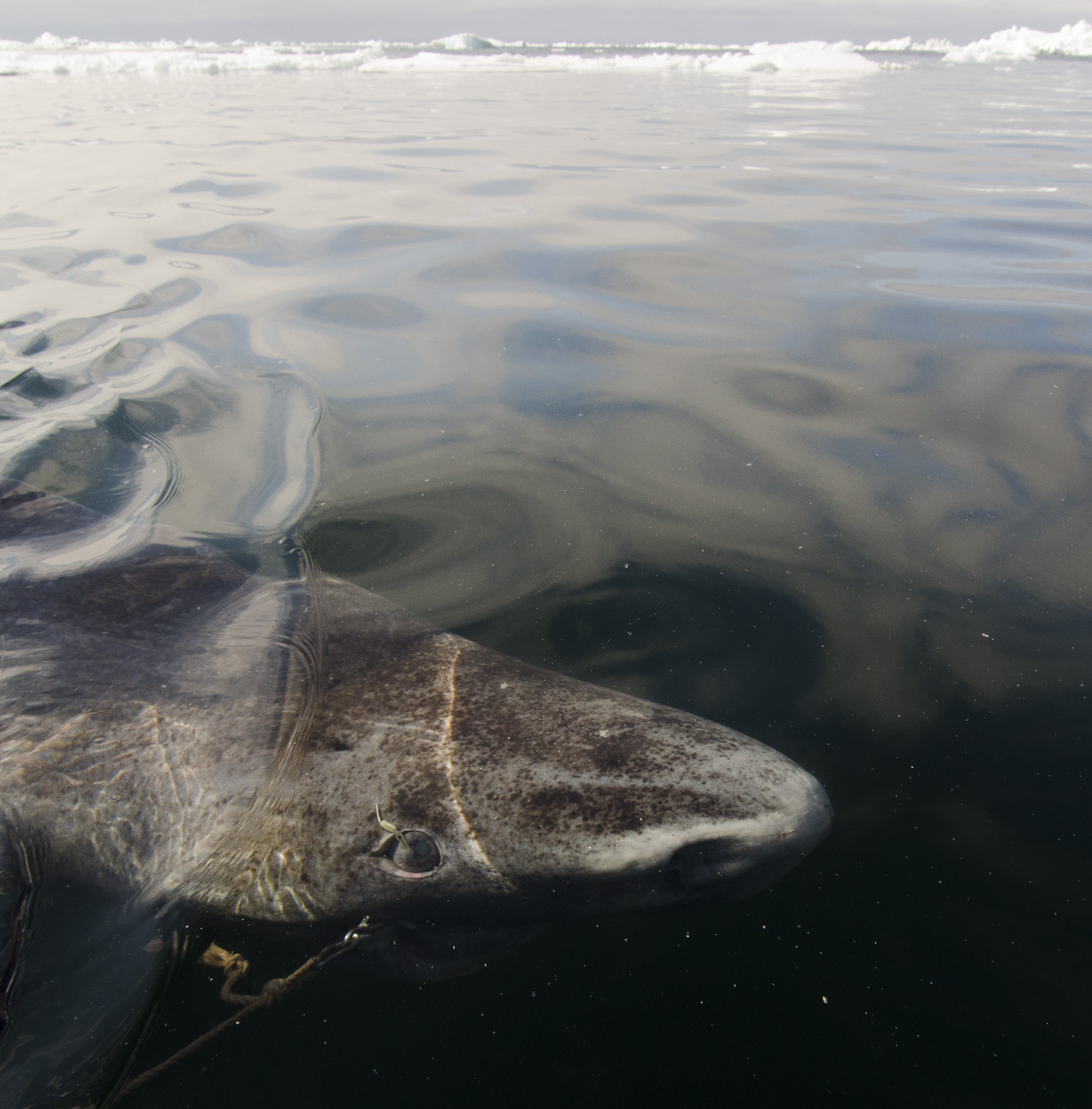
A Greenland shark in clear water. Notice the distinct parasitic copepod attached to the cornea of its eye. It has been speculated that the copepod may be beneficial to the shark as it could act as a lure, attracting prey. Photo © Julius Nielsen
Deep, dark and cold: delving into the visual system of the longest-living sharks
Until now, it’s been thought that Greenland sharks may have lost their vision entirely. That’s because they live in dim, dark waters and can inhabit depths as great as 3000 metres (10,000 feet). They also live for an incredibly long time (estimated to a potential maximum of 400 years), which would suggest that their eyesight would degenerate with advanced age and their vision would be impaired by copepods parasitising their retinas.
And yet their behaviour suggests that they still rely on sight. Their optic tectum (an area of the brain that processes visual information) is a size similar to that of other sighted sharks and they have a tapetum lucidum (a reflective layer behind the retina to support better photon capture in a low-light environment).
Researcher Dr Lily Fogg and her co-authors, including a Save Our Seas Foundation project leader of many years, Dr Peter Bushnell, have released a new paper, ‘The visual system of the longest-living vertebrate, the Greenland shark’ that details their work. Published in Nature Communications, it removes the scales from our own eyes and turns our preconceptions on their head.
What makes Greenland sharks so good at seeing in dark, cold water?
Most vertebrates have two types of photoreceptors in their retinas (the innermost, light-sensitive layer of our eyes): rods, for low-light vision; and cones, for bright-light vision. The relative proportions of these will vary depending on the environment and ecology of each species.
In extreme cases, animals can lose their vision entirely. For instance, cave fish have evolved in complete darkness and their retinas, and vision-related genes, have degenerated.
The retinas of many deep-sea fishes are dominated by rods, or even comprise entirely of rods. And the Greenland shark is no different: its retinas are what scientists call ‘pure-rod structure’. There are no cones for bright light at all. That doesn’t make their vision hawk-like by any means, but their retinas are packed with additional punch. Several features are linked to adaptation to dim light, such as the rods being densely packed and elongated, and the inner retinal layers being relatively thin.
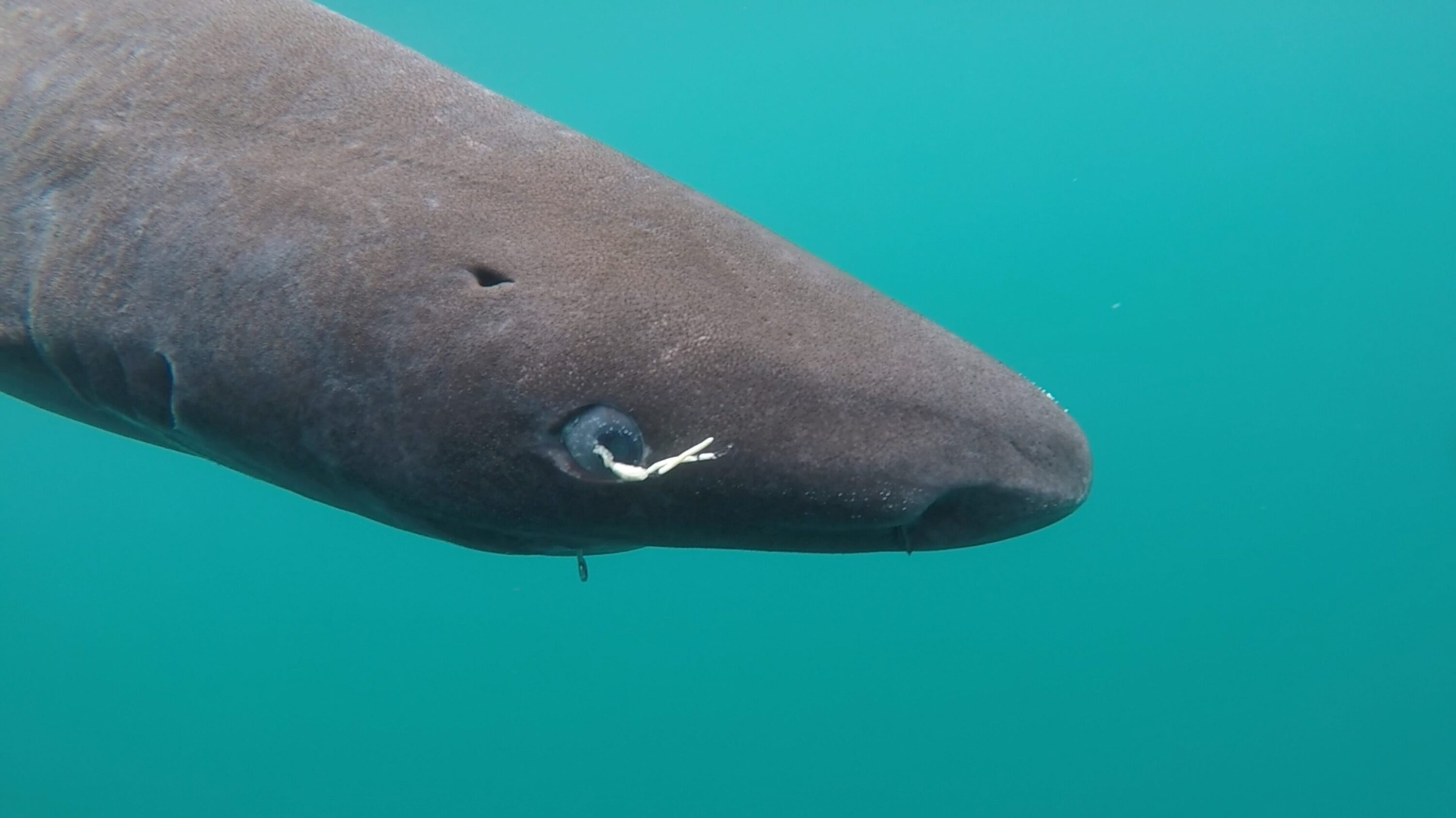
Photo © Julius Nielsen
Do Greenland sharks lose vision as they age?
It seems not! The researchers found no obvious signs of ageing on the retinas of the Greenland sharks. This is a signal of something quite remarkable, they write in their paper, because one would expect that even with healthy ageing there would be some DNA damage and loss of photoreceptors. If a human were to live as long as a Greenland shark, they could expect to lose 50–90% of their vision.
The oldest Greenland shark the scientists analysed was estimated to be more than 130 years old and all its retinal layers were still intact. Might it be the cold water that helps slow cellular decline in these sharks? It’s certainly assumed to be part of the picture, but elephants and turtles also appear to retain stable vision over the course of their relatively long lives. The lifespan of a Greenland shark, however, can be two to four times longer than that of elephants and turtles.
Its size, its lifespan, the depths it can reach, the waters it moves through, and now its vision – the Greenland shark just appears to be a species for which holding the record for the extreme is par for the course.
Reference:
Fogg LG et al. 2026. The visual system of the longest-living vertebrate, the Greenland shark. Nature Communications 17(1): 39.
You can read the study here.
Liked this topic? You should read:
World of Sharks – Greenland shark