
Shaping marine conservation in Cameroon
WORDS BY
Wenzel Pinto
Ocean Storytelling Writing Grant Winner
ILLUSTRATIONS BY
Lizzy Stewart
Imagine pursuing a Master’s dissertation about an animal you had never heard of, and one you almost never saw while you were working on that dissertation. As incredible as this sounds, that is exactly how Aristide Takoukam Kamla began his conservation journey in 2010. Today he is one of Cameroon’s – and Africa’s – foremost marine biologists and is changing the way young people in his country and around the continent are working towards preserving the natural world.
Early in February 2024 I found myself on a plane to Cameroon. I had never travelled internationally before and hadn’t expected the West African country to be my first destination. Nevertheless, I was thrilled that it was. Being a marine biologist myself, I was curious to learn about how Aristide had crafted his journey and how the conservation space he worked in differed from Lakshadweep, the archipelago in India where I work. Neither Lakshadweep nor Littoral Cameroon are cosmopolitan, buzzing, resource-rich areas of the world. The challenges of governmental control and censorship, getting access to funding and balancing conservation agendas with the needs of local communities all felt like common ground.
I was on this journey because I had received a grant from the Save Our Seas Foundation, which also funds Aristide’s work in Cameroon. The grant allowed me to spend time with him and profile his work and the conservation initiative that he founded: AMCO, or the African Marine Conservation Organisation.
Cameroon is a small country that hugs the west coast of Africa. Often called ‘Africa in miniature’, it contains a multitude of the continent’s ecosystem types, from savanna and dry scrub to lush equatorial rainforest, from montane forest and grassland to mangrove forest, and from riverine deltas and sandy beaches to unexplored shallow water reefs. Cameroon’s people are just as diverse, being made up of 240 tribes, each with its own unique language.
Aristide almost did not become a marine biologist because, although he has an affinity for wildlife, he did not see it as a career. ‘I was always fascinated by marine life, but I saw conservation as something that was done in the western world. I had no idea I could do this as a job,’ he explained. He recounted the time he first found out about manatees, back when he was studying for his Master’s degree. His professor had assigned the class a literature review, but on that day Aristide had not been present. As a result, he was left with the last of the 14 topics to choose from: Aquatic Megafauna of Cameroon. ‘What is megafauna?’, he remembers thinking. To find out more, he searched through books and learned about a large aquatic mammal found in Cameroon’s rivers. ‘Until then, I never knew that a creature like the manatee was found in Cameroon. So I wrote up my review and decided to do my dissertation on the African manatee.’
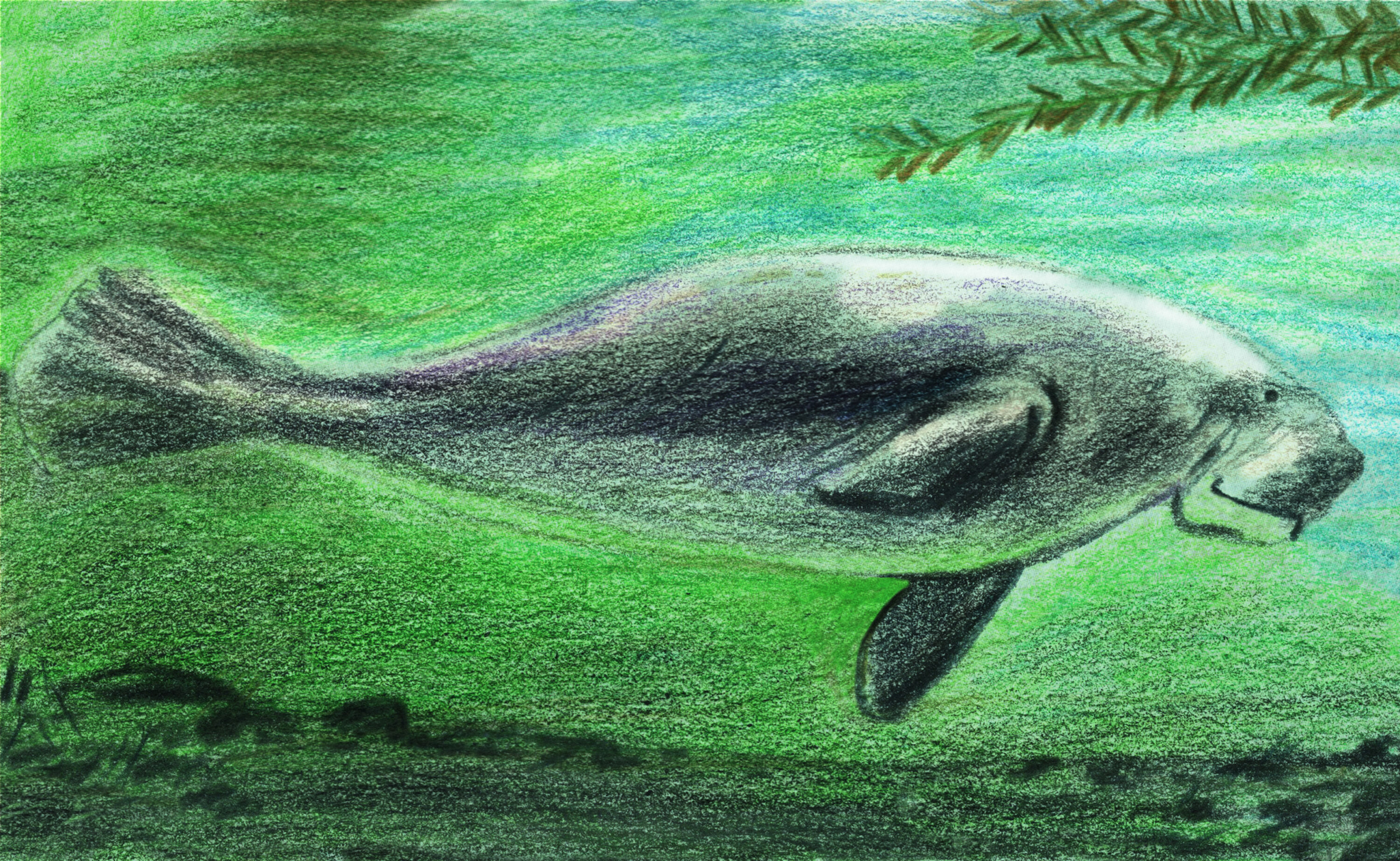
Manatees are marine mammals, as are dolphins and whales. They live in seas and estuaries. They have enormous, bulky grey bodies that can weigh up to half a ton, and a large paddle-like tail to propel themselves through the water. Aptly nicknamed ‘sea cows’, they are gentle giants, swimming slowly through rivers and bays, grazing on plants along the water’s edge and only occasionally snacking on clams and fish. Of the three manatee species found in the world, the one least known and studied is the African manatee. It has the widest distribution range of the three species, spreading down the western side of Africa from the Senegal River to Angola and spanning 21 countries. Despite its expansive range, and being so large, African manatees are exceptionally elusive, as Aristide learned at first hand.
Illustration by Lizzy Stewart | © Save Our Seas Foundation
During the six-month study for his Master’s, Aristide didn’t see a single manatee. ‘I was disappointed, almost out of the money my mother had given me, and I was ready to give up. That is when I met a fisherman in the small village of Dizangue, near the Sanaga River. He told me about bubble trails and signs of feeding, and that early morning is the best time to spot them. The next day, he took me out on a paddleboat in the middle of Lake Ossa and sure enough, I saw my first manatee! I cried real tears because I had been so close to giving up, but now I’d found them. That is what sparked my interest.’
In the decade that followed, Aristide learned of the myriad threats that the African manatee faces: poaching for meat, entanglement in fishing nets, dams that restrict its movements, and more. He completed his PhD from the University of Florida under the tutelage of Dr Lucy Keith Diagne and soon went from never knowing about the existence of manatees to being Cameroon’s leading manatee expert.
In honour of manatees
A week after landing in Cameroon, I stood at the unveiling ceremony of the Street Manatee Festival in Dizangue, which is organised by AMCO. The festival was akin to a conference: a series of planned talks, workshops and activities built around the central topic of the African manatee, its habitat and its conservation.
Holding a conference is all about getting people’s voices heard, but to bring together a wide-ranging group of individuals so that they can communicate with one another is no easy feat. The Street Manatee Festival had the most diverse set of presenters and attendees of any such event that I have been to. There were researchers from Cameroon, as well as invited speakers from the USA, France, Great Britain and Algeria. Representatives from several major wildlife conservation NGOs working in Cameroon attended. Chiefs from all the villages surrounding Lake Ossa were present. And there were people who had been displaced by dams, and government officers who worked for the departments of forests, electricity and dams. A concerted effort was made to include every group of people who had any stake in the manatee, and the voices of each group were heard at the meeting.
The only way the festival could have been any more inclusive was if a manatee had given the keynote. Well, we had the next best thing. Aristide stood alongside village chiefs and the forest conservator as the artwork was revealed…
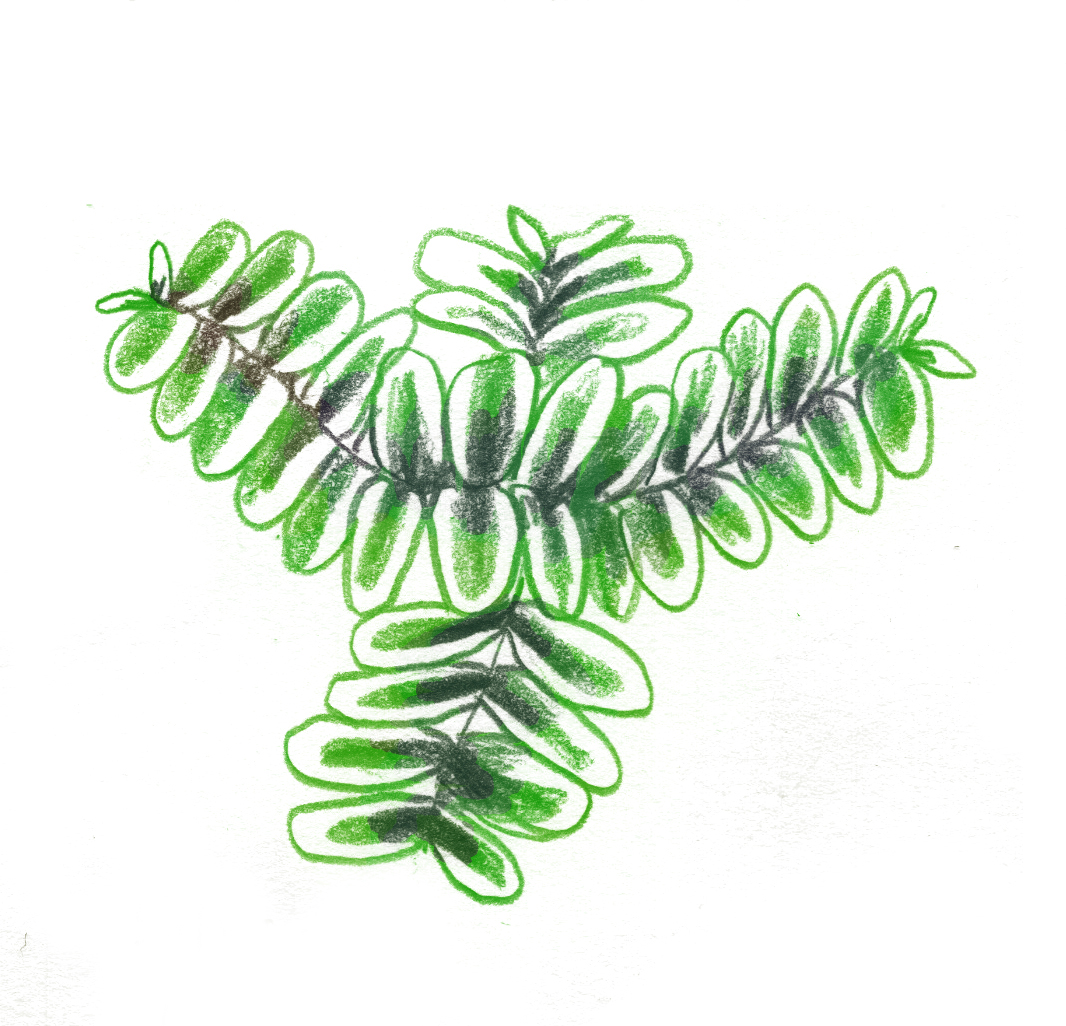
Illustration by Lizzy Stewart | © Save Our Seas Foundation
The curtain was pulled aside and out popped a large, grey blob – an artist’s rendition of an African manatee. The artwork did not paint a flattering image of the creature, but that was no fault of the artist. With its large, bulbous body and dull grey skin, the manatee can hardly be described as a good-looking animal!
Nor is it even easy to see. The streams and lakes where it occurs are thick with sediment, rendering the large mammal nearly invisible. The only manatee sighting one can hope for is the tip of a nose popping up to breathe or, on rare occasions, its snout above water, pulling riparian vegetation into its mouth. Yet this was the animal that had not only sparked Aristide’s interest, but captured the imagination of so many. Manatees have often been touted as the inspiration for the myth of the mermaid; more locally, in West Africa they are also thought to have been the origin of a water deity, the Mami Wata. In several parts, manatees are even considered to be akin to humans, and killing them is therefore a sin. It was not hard to see why more than 150 invitees had gathered for a festival to celebrate manatees and the ecosystem they inhabit.
The Street Manatee Festival ran for three days and the energy was electric. Since Cameroon is a bilingual country, there were talks in both national languages, French and English. Understanding the presentations in French was difficult for me, but I did hear some fantastic speakers in English. Dr Lucy Keith Diagne, Aristide’s former PhD adviser and now director of the African Aquatic Conservation Fund (AACF), spoke about the African manatee, its ecology and interactions between it and humans, as well as the biggest threats to its fragmented populations.
The sessions focused not only on manatees however. James Ackworth from the Central African Forest Initiative spoke about the relative importance of the forests of Central Africa in the global context. And there was a workshop about the SIREN app, led by Cedrick Fogwan from AMCO. SIREN is a simple smartphone app that helps fishermen and other citizens track fish and marine megafauna through photographs and GPS coordinates. The data from it can then be used to tackle fundamental questions about monitoring the diversity of ecosystems, understanding the geographical range of species or estimating population sizes of marine life – all questions that are now of utmost importance to Cameroon.
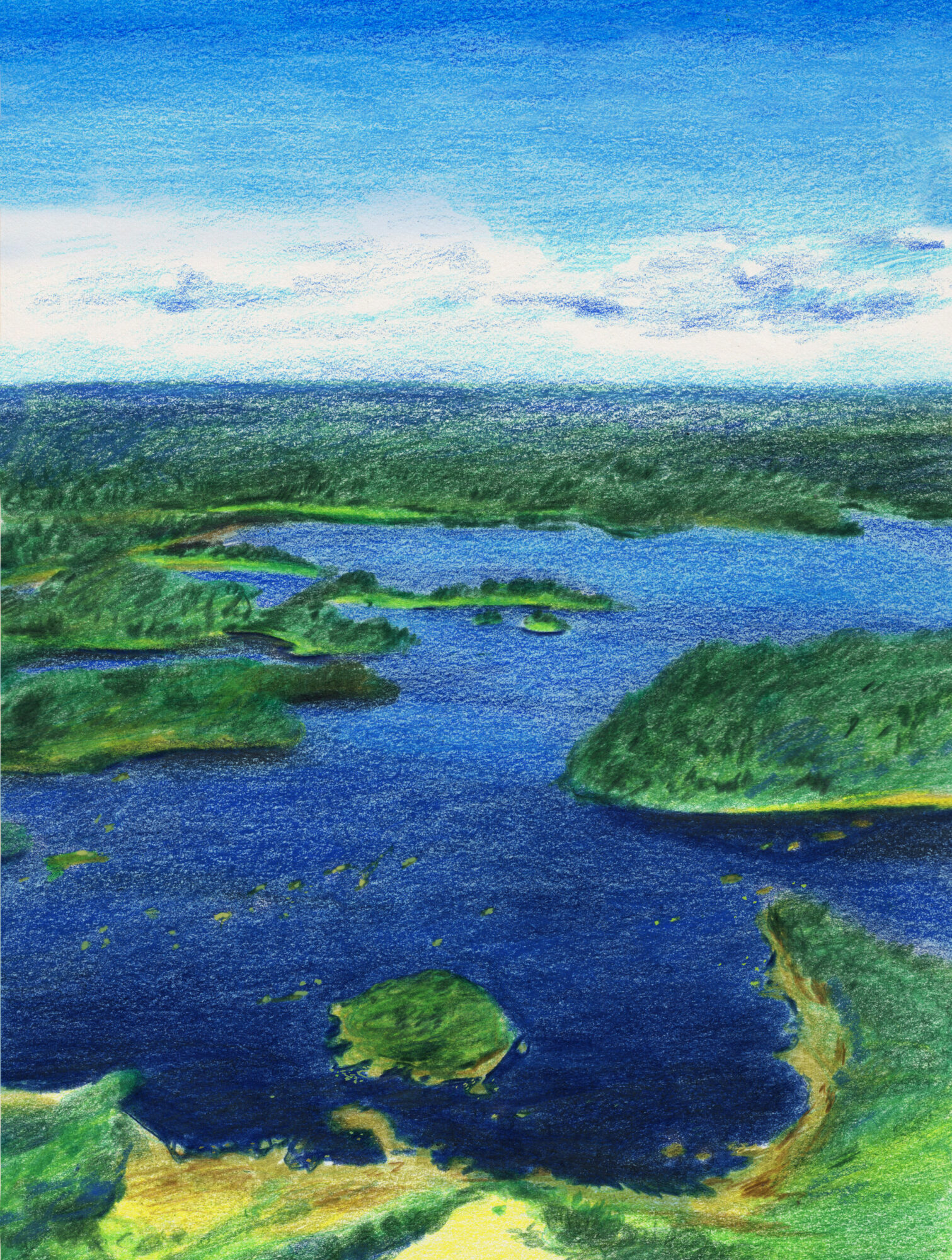
Illustration by Lizzy Stewart | © Save Our Seas Foundation
Conservation challenges in Cameroon
Cameroon’s vast resources in wood, oil and gas, and arable land were exploited by not one, not two, but three colonising powers: first the Germans, from 1884 to 1916, and then the country was divided between the French and the British. It has been independent since 1960, but the internal conflicts of a largely rural population and a high dependence on the rich natural resources have resulted in complex conservation issues. For the manatees this means facing a variety of threats, even though they have been afforded the highest level of protection in Cameroon’s wildlife legislation. In addition to being hunted for meat and getting entangled in fishing nets, manatees have had to contend with the construction of dams – the primary means of generating electricity – and the fragmentation and destruction of their habitat. This mix of conservation challenges requires nuanced solutions and it seems that AMCO is tackling the issues on many levels.
On my last day in Dizangue, I went on a boat trip on Lake Ossa, in the hope of spotting one of these animals that I had now heard so much about. Living up to their slippery reputation, manatees were nowhere to be seen. What we saw instead were abundant signs of the disruption of the lake’s ecosystem. Tattered and discarded fishing nets lay strewn along canals or washed up ashore. The edge of the lake painted an unsettling paradox of organised rows of oil palms and the tangled mess of dense tropical evergreen vegetation. Occasionally, as we moved around a bend, we would come across what had been a large tract of forest, now illegally razed to the ground to make way for more plantations. Conservation is at its most difficult when a species’ survival crosses paths with people just trying to eke out a living.
Even more prominent, though, was salvinia, a small-leaved floating fern from South America that has been taking over the surface of the lake for nearly a decade, and whose spread AMCO has been working hard to curb. In places it was forming such dense mats that tall grasses and even small trees began growing over it, making the lake’s surface resemble a floating savanna! Annick, AMCO’s site coordinator at Dizangue, has worked to repurpose salvinia into charcoal, giving people incentives to remove this invasive weed by hand. On another front, Aristide and his colleague Cyndi have been working hard to cultivate and introduce the salvinia weevil, an insect that feeds only on this weed, in the hope of reducing the area colonised by the ferns. In the four years since they began, this biocontrol agent has reduced the salvinia cover in Lake Ossa by more than half!
AMCO: past, present and future
I asked Aristide one evening what his vision for AMCO’s future was. ‘Harmony between humans and nature,’ was his reply. ‘AMCO can retire peacefully if this is achieved.’ This highlights one of the core values AMCO holds dear: working together with local people. ‘The only way we can work towards conserving nature is by heeding what the community has to say as well.’
This epiphany struck Aristide one day when a fisherman saw him travelling with acoustic equipment and complained, ‘You carry all this expensive equipment to survey manatees, but you do nothing for the people in the community. And you tell us not to hunt them. It seems like you care more about the manatees’ lives than ours.’ The fisherman’s words resonated strongly with Aristide and since then the human dimension of conservation has become a central part of AMCO’s work. Creating alternative sources of livelihood and actively engaging with the needs of the people, as well as enforcing environmental laws, have ensured the complete cessation of manatee hunting in Dizangue – a feat that is hard to overstate.
But AMCO’s work is not just localised within Cameroon. As we prepared the stage for the Street Manatee festival, I met Morgane, a Frenchwoman who has been working with the organisation for the past five years, and is currently tackling the problem of illegal, unreported and unregulated (IUU) fishing in Cameroon.
‘When it comes to fishing, the flag of Cameroon is known around the world as a flag of convenience,’ says Morgane, referring to countries that register fishing vessels not based on nationality. ‘Often the owners of boats are not Cameroonian, but they obtain licences from Cameroon.’ These vessels frequently fail to follow internationally accepted fishing regulation, which has resulted in Cameroon receiving a red card from the European Union; the bloc will no longer import its fishery products. Morgane is now leading a project to help the government curb IUU fishing by helping to draft new legislation and creating better measures to track violations.
Illustration by Lizzy Stewart | © Save Our Seas Foundation
Meanwhile, Ghofrane, who leads AMCO’s shark and ray programme, is bringing together researchers and governments from countries across the Gulf of Guinea to draft a management plan for shark and ray populations in the region. ‘We started the Gulf of Guinea network to create a strategy for managing shark and ray populations,’ he explains. The initial discussions in 2023 were so successful that the network is now expanding to cover a large part of West Africa.
Aristide’s efforts go beyond his everyday work. As well as spearheading marine conservation in Cameroon, AMCO is ushering in the next generation of conservationists. Many of the current members of the organisation began their career as Aristide’s students, working on diverse topics in the marine space under his tutelage. Clinton and Daniel are pursuing their own PhDs under his wing, while Annick, Thierry, Cyndi and Ghofrane all completed part of their dissertations with AMCO before they themselves became part of the organisation. Ceidou, a young hydrologist from Cameroon, has started his own NGO called Aquatic Environmental Management, or AQUAEMAN. When asked, he had only praise for Aristide and AMCO. ‘AMCO is like the head of a snake … paving the way for other young researchers in Cameroon [to follow].’
A few months after my trip, in May 2024, Aristide received a prestigious Whitley Award, commonly known as a Green Oscar, for his work on conserving manatee habitat in Lake Ossa. Thinking back to how this started, what strikes me is not just the work he has done, but the people he has inspired and worked with. In our very first online conversation Aristide said, ‘The story need not be about me. AMCO is much more than me.’ And indeed it is.