
A river runs through it: How rocks are reshaping the way we age river sharks
Where we live leaves its traces – in bones, in teeth and, in the case of sharks, in the blocks that build their backbones. Geochemists Hilary Lewis and Brandon Mahan and shark scientist Michael Grant combined their skills and found a new way to age rare river sharks. Using the idea that ancient elements that wash into a river from rocks and soils leave traces in the river’s living inhabitants, these three are changing what we know about speartooth sharks and how they navigate life in their unique river- and seascapes.
The Adelaide River winds for 238 kilometres (148 miles) from its source in Litchfield National Park across Australia’s Northern Territory, its course becoming more sinuous as it meanders to meet the sea in the Van Diemen Gulf. If you follow that course on a map, the topography forms faint whorls where the contours of the river’s upper catchment fade into the flattened floodplains; the river is a lifeline cut into the distinctive thumbprint of the land around it. Its entire surface catchment covers an area of roughly 7,445 square kilometres (2,875 square miles) to the east and south-east of the city of Darwin. And as it flows, the river – vein-like – takes on the earth’s own pulsing signature; the scouring, shifting and breaking down over billions of years as rocks and soils become surface reminders of our planet’s tumultuous history.
And so it is that the Adelaide River is imbued with the signals of the land around it; its history, geology and climate are alive in its course. Minerals weather from the rocks and soils, dissolving into this freshwater artery pumping along the terrestrial landscape. They become part of the Adelaide’s unique fingerprint. The headwaters are characterised by their host origins: rocks billions of years old and with an abundance of metal-rich minerals. When the river arrives at its middle reaches, the weathered plains are shaped by the Northern Territory’s intense tropical climate; heavier rocks have been weathered into alluvial deposits – shales and sandstones, siltstones and iron-rich soils.
The coast, where the river finally empties into the sea, is dominated by the tides, resulting in salty and murky water with fine-grained, muddy sediments. The nature of the Adelaide changes along its course, governed not only by the bedrock it flows over, but also by the distinct tropical seasons; more than 95% of its flow occurs in the rainy season between December and April.
River sharks: tracking Australia’s aquatic ghosts
We know little about the world’s river sharks – a cryptic group that is patchily distributed across tropical rivers and coasts in the Indo-West Pacific region. Scientists believe there are five species: the Ganges shark of the Ganges–Hooghly river system in India (and, potentially, Pakistan); the incredibly rare Irrawady River shark from Burma; the Borneo River shark from the Kinabatangan River in Sabah, Malaysian Borneo; and the northern river shark and the speartooth shark recorded in northern Australia and Papua New Guinea.
Only 60 kilometres (37 miles) south-east of the Northern Territory’s capital, Darwin, the proximity of the Adelaide River makes it popular with recreational fishers who launch their boats into the turbid current to lure barramundi and bait sharks. As one of three shark species that cruise the flushed tidal river (the bull shark and northern river shark are the others), the speartooth shark is listed as Critically Endangered on Australia’s Commonwealth Environmental Protection and Biodiversity Conservation Act 1999, and as Vulnerable by the International Union for Conservation of Nature (IUCN).
Although the species was first recorded in Australia in 1982, it was only in 2015 that researchers finally saw an adult speartooth shark. Before that, only juvenile individuals had ever been recorded across Australia since the species’ first discovery.
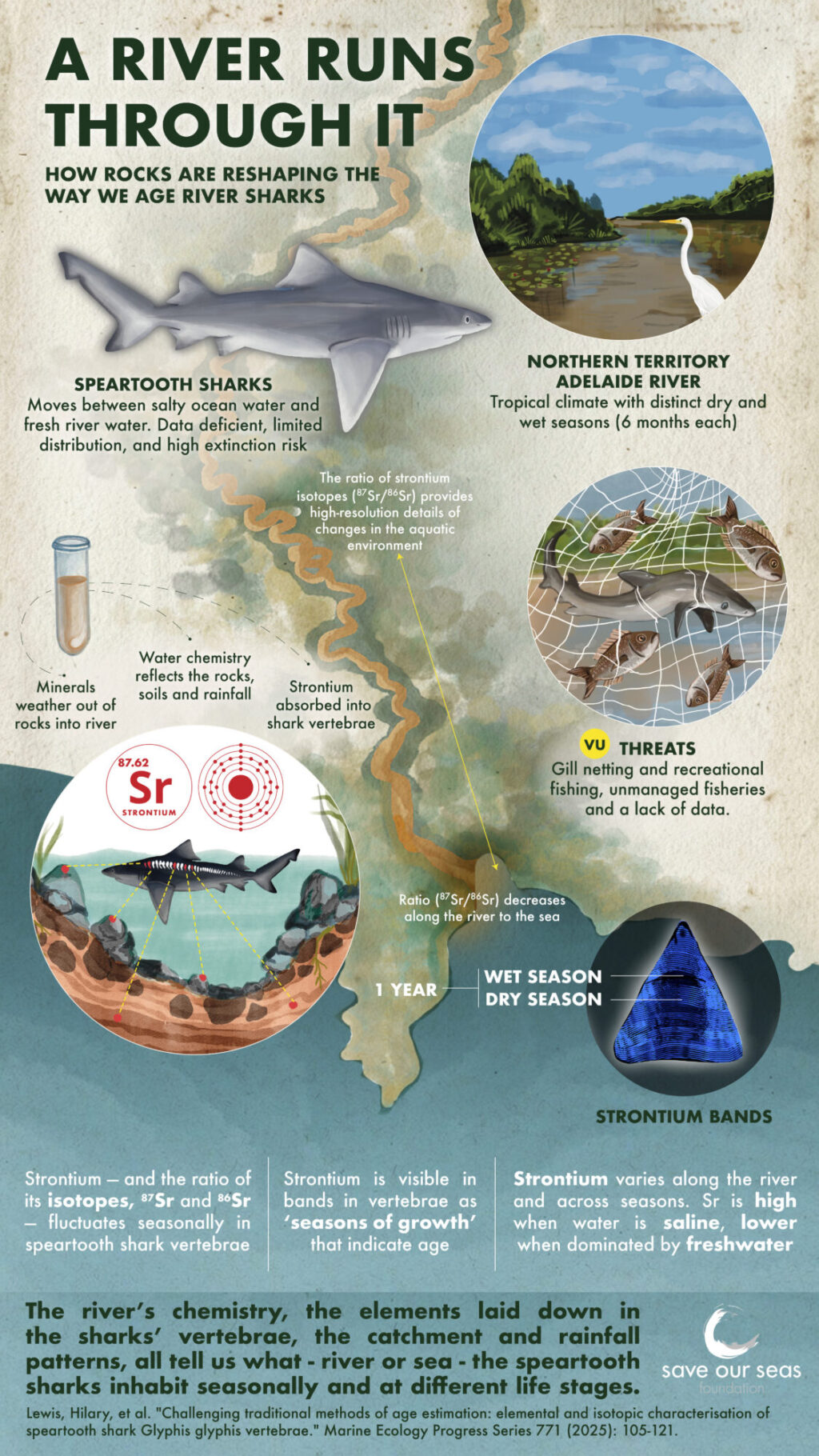
Speartooth sharks are what scientists call ‘euryhaline’: they can move between salty ocean water and fresh river water. They favour the Adelaide’s brackish nature, which is sometimes salty and sometimes fresh, depending on the season and where you are between its outlet at the coast and its upper reaches. As a result, almost everything about the life of this rare river shark is muddied in the Adelaide’s waters. What habitat does it rely on? Where does it breed, feed, grow? And how long does it live?
This lack of information, limited distribution, rarity and high extinction risk create something of a conservation conundrum for shark scientists. How do we reliably, and successfully, manage this shark’s populations if we lack critical information about its life history?
And manage them we must. River systems worldwide face growing pressure as our climate changes even more rapidly than most of the predictions, and the Adelaide system presents a challenge in the form of an active recreational fishery that is relatively unmonitored and unmanaged – and the impact of which on speartooth sharks is unknown. Commercial gill-net fisheries operate across northern Australia in its coastal inlets, estuaries and rivers. Speartooth sharks have been recorded in other river systems, like the Wenlock and Dulcie, but managing the risk they face from entanglement in gill nets means that conservation managers need to know where and when these sharks are encountering nets.
Infographic by Kelsey Manners Dickson | © Save Our Seas Foundation
Shark science meets geoscience: an academic ‘meet-cute’
We use elements and isotopes – those fundamental building blocks of all matter on earth – to understand our planet’s age and history. What if the same could be done for the living, breathing planet? Could environmental and seasonally predictable fluctuations in elements and their isotopes give us a way to age river sharks more successfully – and in doing so, retrace the aquatic habitat they live in? Even where they move along and between water systems, when we can’t easily track them in real time?
Marine biologist Dr Michael Grant has spent years rewriting what we know about sharks and the rivers they live in. From Papua New Guinea to Borneo and back to his homeland in Australia, deciphering the role that rivers play in the lives of sharks is a central theme in his research.
Trace element and isotope geochemist Dr Brandon Mahan is used to looking at the world in very different time and spatial scales. As the American Geosciences Institute puts it: ‘Geoscience investigates the past, measures the present and models the future behaviour of our planet.’ It is the study of the earth, the processes that formed it and the resources we use. Geoscientists investigate the oceans, atmosphere, rivers, lakes, glaciers and soils, right down to the planet’s metallic core. Some geoscientists study other planets, investigating the chemical composition of matter elsewhere in the universe, and some investigate the interconnection between inorganic and organic systems, where geology and biology collide.
‘In my own academic background,’ says Brandon, ‘I am quite adventurous and like to apply analytical geochemistry in new research areas using techniques and instrumentation that are typically used for answering questions in geosciences and in cosmochemistry. I see great potential for applying these techniques to biological systems.’
While Michael and Brandon share the moniker of ‘scientist’ – and once shared an academic home at James Cook University (Mahan is now at the University of Melbourne) – they still inhabit very different research worlds.
‘I happened to be in our geochemistry instrument lab one day analysing some samples on one instrument while Michael was analysing some shark vertebrae to measure element concentrations on another instrument. We got to talking and realised we had overlapping interests and a passion for forging novel approaches to answer long-standing questions. The conversation came around to the kernel of an idea that eventually led to our application to the Save Our Seas Foundation (SOSF), and to a new project (led by Mahan). The rest, as they say, is history.’
The problem in question: how do we reliably age speartooth sharks and learn more about where they live, and what they do, at different ages?
‘I think that straddling interdisciplinary lines leads us not only to ask questions differently, but to change fundamentally our collective approach to addressing the questions themselves,’ explains Brandon. ‘In practice, this means taking what today we often call a “systems approach”, which means to look at problem-solving as a framework itself wherein a specific question is interrogated not in isolation, but as part of a larger system of interconnected and co-dependent parts or systems.’
Much like scientists age trees, shark scientists slice a section of a shark’s vertebra and count the rings of growth that appear in dark and light bands under light. Here, shark vertebrae have been cut into vertebral sections. Photo © Hilary Lewis
X-ray vision: can we age river sharks in a new light?
The result of breaking these scientific silos has been to give us an entirely new way to age river sharks – and it may also have shaken up the way we’ve always done things. That’s because, in their article ‘Challenging traditional methods of age estimation: elemental and isotopic characterisation of speartooth shark Glyphis glyphis vertebrae’, lead author and PhD candidate Hilary Lewis from Australian National University, under Brandon’s supervision during Honours research at James Cook University, and together with Michael and a host of contributing co-authors, showed that the traditional way of ageing sharks was null and void for this species. It’s an astounding finding that suggests that the way we’ve always done things may not be applicable to all shark and ray species and may require additional tools to truly validate shark ages.
Scientists typically work out the age of sharks in much the same way that they age trees. By slicing a thin cross-section of a shark’s vertebra and shining a light through it, they can count the repeating pairs of light-and-dark bands that are meant to represent a year’s growth. They are, in effect, counting layers of calcium phosphate (the same basic mineral that makes your teeth) laid down in sharks’ vertebrae as they grow. It’s like counting tree rings, which also grow radially. This is done using a method called transmitted light optimal microscopy (TLOM) – and scientists do it with fish ear bones (called otoliths, made from calcium carbonate) to age fish in much the same way.
But the process is still beset with challenges. It’s tricky, and costly, to find and then recapture sharks in habitats that are difficult to access, or shark species that are highly mobile and travel long distances. And that’s a necessary part of the process to verify the ageing results. It also becomes increasingly difficult to distinguish these alternating light and dark bands as a shark gets older, because they become more compacted. This means that, for many sharks, their actual age is likely to be underestimated.
To find a new way to overcome some of these hurdles, Brandon and his colleagues reached for a familiar tool: chemistry. Rather than using visible light, they used X-rays. Micro-X-ray-fluorescence (μXRF) can chemically show concentrations of elements; they show up in the sliced vertebrae, layered in element ‘heat spots’ that are coded K, Ca, Sr and P (the letter symbols for elements, for example K = potassium). And they glow in beautiful fluorescent false-colour in images taken from the instrument.
Elements are the simplest chemical substances on earth and are represented on the periodic table by abbreviations like Ca for calcium (required for healthy bones and teeth), P for phosphorous (also good for bones and teeth, and for growing healthy crops) and K for potassium. Hilary, Michael, Brandon and their colleagues wanted to know if elements, introduced by the environment and incorporated into shark vertebrae, were distinguishable in a way that could be counted in these μXRF bands.
The element that showed up best was strontium (Sr), which is often taken up together with – or as a sort of ‘chemical imposter’ for – calcium. And so, it’s a heavy mineral element that is easily incorporated into the calcified hard vertebrae of sharks as they grow. The question was, does strontium show a visually identifiable false-colour pattern under X-ray? And more importantly, would alternating bright and dark strontium bands indicate seasonal growth and therefore age?
Concentrations of strontium differ drastically in sea water and fresh water. They are also, predictably and measurably, high in the dry season in Australia’s Northern Territory and the Adelaide River landscape, and low in the rainy season when freshwater flow dilutes strontium in the water.
It turns out that strontium does form highly identifiable μXRF bands in speartooth shark vertebrae; layers of alternating light and dark that match seasonal rainfall patterns from the Adelaide River region. Light bands indicate more concentrated strontium and dark bands show where it is more diffuse (less concentrated) in the rainy season. In this part of the world, distinct dry and wet seasons break the year into two definite periods – and confirm that a light/dark band pair can represent a year’s growth for speartooth sharks.
But, surprisingly, the patterning of these bands did not match the light/dark band pairs seen by using TLOM, the traditional method. On average, the μXRF method put shark ages at 1.3 years younger than those determined by TLOM. Over-estimating age, as the team explains, can lead to inaccurate management advice.
‘We knew that there have been long-standing debates about whether conventional light/dark band pairs are actually a signal of yearly change and can be used to accurately age sharks, and this was a key motivation for taking novel approaches,’ says Brandon. ‘So we were expecting that not all data would line up between the old way and the new way. However, given that nature is messy and science is an iterative activity that often leads to more questions than answers, we were not expecting our new approach to show such strong and unambiguous results for our river sharks.’
Under the scrutiny of micro-X-ray-fluorescence, scientists can see the composition of elements like strontium, calcium, potassium, and phosphorous, in the vertebrae of sharks.
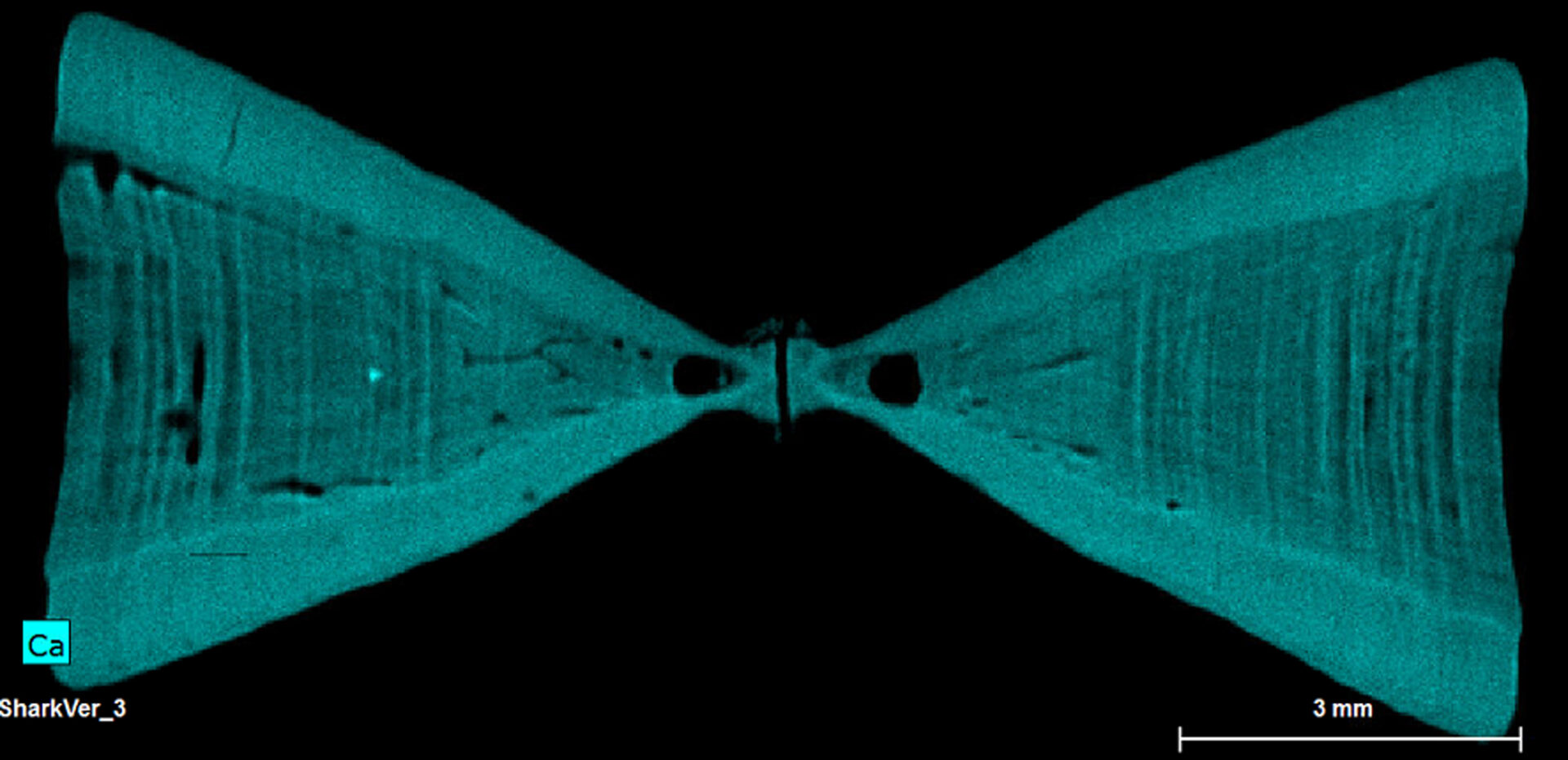
Figure © Lewis HMK, et al. (2025)
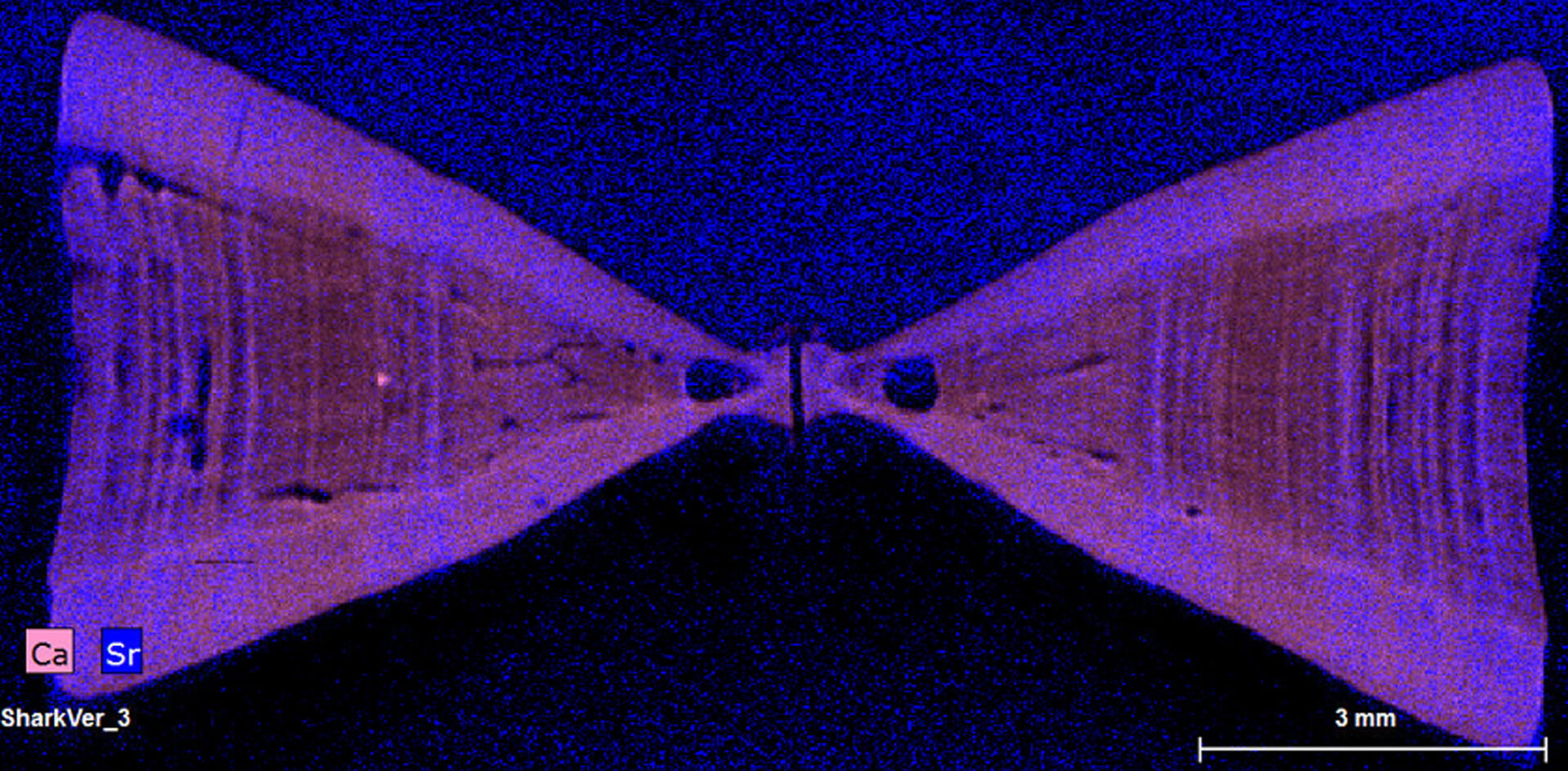
Figure © Lewis HMK, et al. (2025)
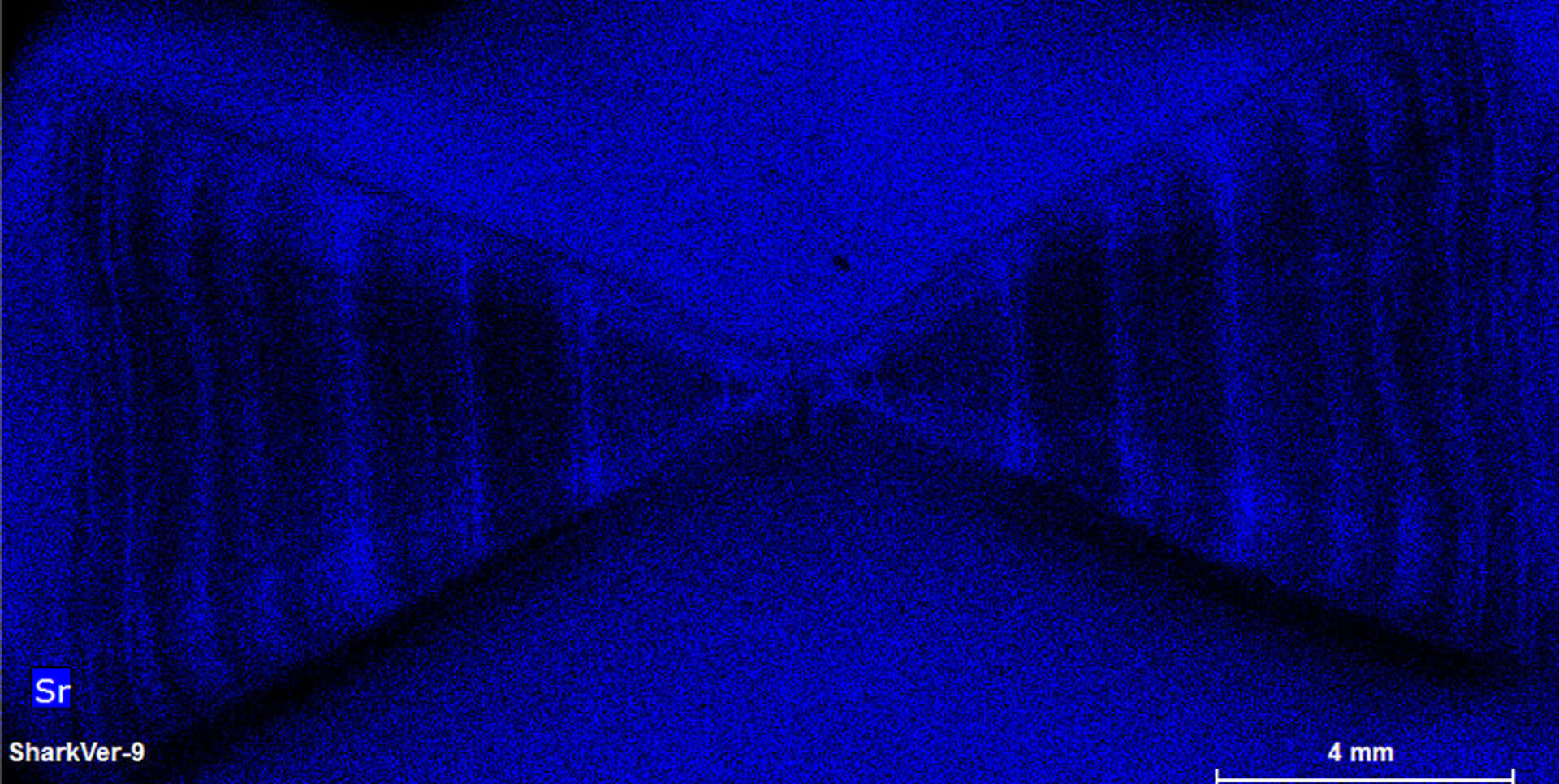
Figure © Lewis HMK, et al. (2025)
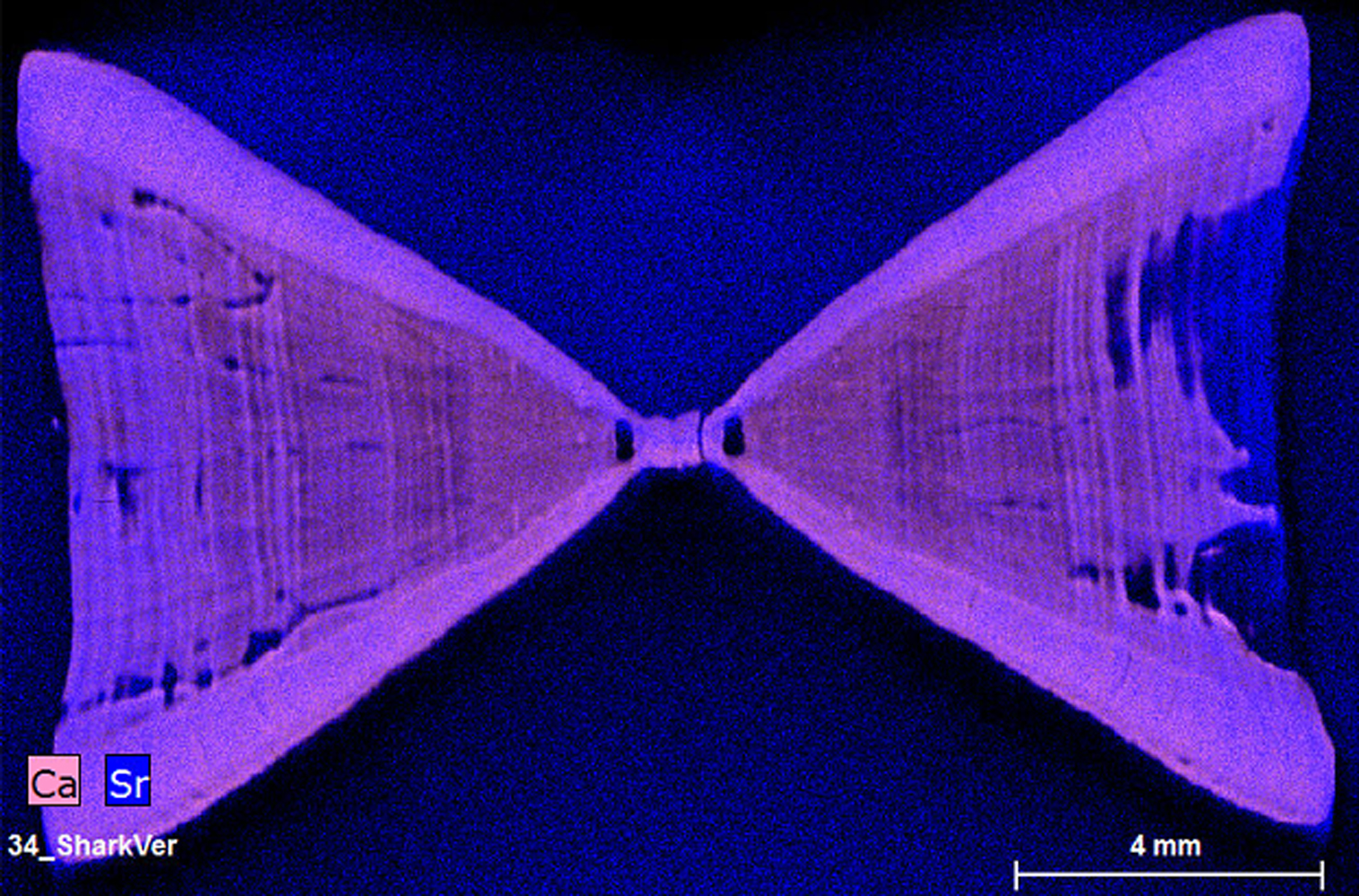
Figure © Lewis HMK, et al. (2025)
It’s elemental: how do we track where speartooth sharks move in the Adelaide River?
‘We can’t look at the chemistry of shark vertebrae without also looking at how this connects to the speartooth shark’s riverine-to-coastal habitat, and likewise how the river system connects to larger geographic and precipitation records, and how all this even further connects to deep-time geologic processes that have created the current state of this larger system,’ explains Brandon.
In an element’s family tree, isotopes are its not-totally-identical relatives, the way not all apples falling from the same tree are exactly the same size. They share a family name and they all have the same number of protons, but they have different numbers of neutrons. Elements are made up of protons, electrons and neutrons; isotopes are named for their ‘mass’. In fact, the word isotope comes from isos and topos, meaning ‘same’ and ‘place’ – as in atoms inhabiting the same place on the periodic table (atoms of the same element with different masses). For instance, carbon has six protons and a fixed place on the periodic table that describes its chemical behaviour. Its three family members – carbon 12, carbon 13 and carbon 14 – get their names from the additional neutrons they each have. Carbon 12 has six neutrons, carbon 13 has seven neutrons and carbon 14 has eight neutrons.
Strontium has four naturally occurring stable isotopes that are found in the environment. Scientists look at the ratio of one isotope relative to another to tell us certain things. Depending on the element and its isotopes that they’re focusing on, they can work out things like the age of rocks, what geological or biological processes have occurred, where individuals are moving, or even what they are eating.
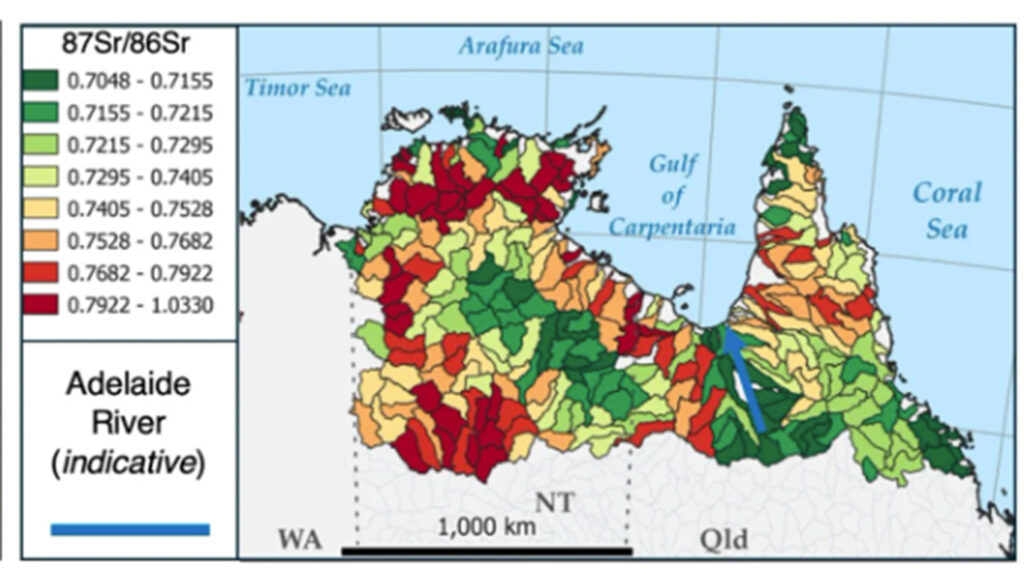
Strontium’s naturally-occurring isotopes - 87Sr and 86Sr – are found in varying ratios across the landscape and in its waterways. The resulting map of their distribution is called an isoscape. Figure © de Caritat, et al. (2023)
With strontium, the ratio of 87Sr relative to 86Sr (87Sr/86Sr expressed as a number) tells us something about place (geography and also geology). The ocean has a distinct ratio of 87Sr/86Sr that is more or less constant. Conversely, the ratio of 87Sr/86Sr in freshwater systems, like rivers and estuaries, is variable and often higher; it changes depending on the geological characteristics and age of the catchment. Simply put, 87Sr/86Sr is typically higher when it is released from rocks that are older and/or higher in Rb (an isotope of which decays radioactively to the much more stable 87Sr). In effect, for rivers this also typically means a higher value when closer to the source of strontium (upstream rocks and soils).
To understand the Adelaide’s unique strontium signature, the team collected water samples along its length, starting at the salty ocean waters at Adam Bay before moving upstream and gradually sampling the increasingly freshwater reaches of the river. 87Sr/86Sr was the expected (lower) value at the sea, and it became higher and more variable as they moved up the river towards its headwaters.
‘On the more conceptual side of things, this also allows us to look at the processes and physical aspects of one part of the system and find similarities and patterns in other parts, so that we can see and answer old questions with new eyes and thoughts. For example, conceptualising how elements and their isotopes make their way into the vertebrae (and teeth) of sharks, in terms of physics and chemistry, is in essence the exact same as understanding how rocks and minerals interact with fluids in more geological settings, or how these fundamental particles get shuffled around during the process of planetary formation. In the end it is all the same,’ explains Brandon.
If we know that there are predictable patterns in rainfall, or run-off from land, then the unique signature that shows up in the river system could be analysed in the calcified hard parts of river sharks and rays, to detect change in the ratio of 87Sr/86Sr (and Sr elemental concentrations) in their vertebrae along the axis of growth, too. To measure this, the team used laser ablation multi-collector inductively coupled plasma mass spectrometry (LA-MC-ICP-MS). That’s advanced geochemist-speak for using a high-energy laser to blast miniscule particles off the surface of a vertebra, which are sucked into a mass spectrometer to understand the abundance of (in this case) strontium’s isotopes (that is, the ratio of 87Sr relative to 86Sr), as well as strontium’s overall concentration. It’s extremely high-resolution work, and it enabled them to look at 87Sr/86Sr in the different light/dark bands in the vertebrae band pairs.
‘The day that we saw our μXRF element results stacking so beautifully next to our LA-MC-ICP-MS isotope results, and from two entirely different instruments no less, was quite a wonderful “research joy” moment!’
When all the pieces of this study are placed together, patterns of life can emerge. In the speartooth shark’s vertebrae, the concentration of strontium – and the ratio of its isotopes, 87Sr and 86Sr – fluctuates according to season, and can be visibly identified and paired as ‘seasons of growth’ to indicate age. But the concentration of strontium also varies along the profile of the river and as a function of season, with high concentrations when the water is dominated by the sea, and lower concentrations when dominated by fresh water (including rainfall). This can tell us what aquatic environment the sharks are inhabiting, where and at what age. At an even higher level of detail, the ratio of strontium isotopes provides an even more robust fingerprint of these changes in the aquatic environment. The river’s unique signature, the elements laid down in the sharks’ vertebrae with a specific isotope ratio, the land around the catchment area and the rainfall patterns all tie together to help determine the life history of speartooth sharks between these two ends of the aquatic spectrum: fresh river and the sea, in summer and winter, year-on-year, and at different life stages.
How does this change shark science?
‘Our hope,’ ventures Brandon, ‘is ultimately that our work shows that when you cross disciplinary boundaries and take strides along new frontiers in the pursuit of answering old questions, you can arrive not only at somewhere new, but enlightened with additional insights.’
And those additional insights are what can be used to help manage the uncertainty around protecting speartooth sharks and their riverine shark (and ray) kin elsewhere. Knowing where these sharks are moving, and when, can guide more effective fishing regulations, as well as complementary protection tools to ensure they are conserved at their most vulnerable life stages in the correct places: where they breed, pup, feed and grow.
‘Moreover, we hope that at the end of such a journey we have provided some very robust new ways to determine age in sharks that alleviate human biases and that are inextricably connected to the sharks’ natural environments in ways that can be tested and quantified. On the latter, and back to that idea of a systems approach, using elemental and isotopic signatures within the shark vertebrae further enables us to begin reconstructing their lived environments and life histories in ways that conventional optical light/dark band pairs simply cannot.’
A neonate speartooth shark. Photo © Julia Constance
Could we rewrite the future for sharks and their rivers?
‘We should shift away from considering conservation ecology, aqueous geochemistry and biogeochemistry (including physics and chemistry), geography, climate and weather, and so forth, in isolation, and shift back towards the integration of disciplines.’ Brandon’s conclusions echo calls across much of the conservation sector. We won’t solve the questions of our time by working alone, or by exploring answers through the lens we already know.
‘Analytical geochemistry is often seen as a field of expertise whose application extends not far beyond geological, planetary and environmental sciences,’ he adds. ‘In reality, because analytical geochemistry is essentially a means to interrogate the inherent elemental and isotopic features of just about any physical and chemical process, or material object – anything made of matter – and is intensely quantitative and good at this, this means that analytical geochemistry can be dove-tailed into many other disciplines to create extremely high-value results and a sum greater than its parts.’
A sum greater than its parts.
If there’s anything that the Adelaide River’s course teaches us, it’s this: that what we see in front of us is often made up of so much more that escapes our eye – in space, in time, and in how deeply we can look.