
Requin Provocateur (Part 2 of 2): Challenging current paradigms in shark age estimation using interdisciplinary science and state-of-the-art microchemistry
Our project’s narrative ark is simple yet complex, encompassed by its driving question: How can we harness the awesome power of cutting-edge instrumentation to complement conventional approaches to elasmobranch (shark) age estimation and life history reconstruction?
This blog is Part 2 of 2, chronicling our journey from project experimental design, through to some potentially paradigm-shifting outcomes, publication, and of course, beautiful pictures!
In Part 1 of Requin Provocateur, we detailed the experimental design and logic of our project, and outlined some key terminology and technology used both in conventional ways of ageing sharks, as well as the novel approach taken in our study. For those who want to follow this alongside the published article, the Open Access publication in Marine Ecology Progress Series (MEPS) can be found HERE, or HERE in the SOSF article covering this research, and for those who want a quick refresher, Requin Provocateur Part 1 can be found HERE.
Current conventional age estimation of sharks is done by counting vertebral bands using transmitted light microscopy optical (TLOM). In essence, normal light shines through a thin section of the shark vertebrae (cut to show its radial growth, just like a tree), revealing repeating light-dark band pairs where darker bands are more dense and therefore let less light through. This method assumes that the light-dark band pairs are a seasonal pattern and therefore one light-dark band pair equals one year of growth. Validating this method relies on methods such as mark-recapture (catching individuals and using a chemical marker such as oxytetracycline, then re-catching them later in life and matching real-time against vertebral band pairs formed since the chemical mark in the vertebrae was made). This presents a number of methodological challenges. Methodologically, re-capture is time- and cost-intensive and problematic for species with wide and/or difficult-to-access habitats and mobility. Scientifically, this technique checks the assumption that light-dark band pairs are an exact 1:1 match to seasonal changes, and relies on (ii) habitat seasonality being strong enough to drive large differences in band densities, and (iii) the ability for humans to readily and consistently differentiate these band pairs with their eyes, even in older sharks where they become much thinner and less pronounced.
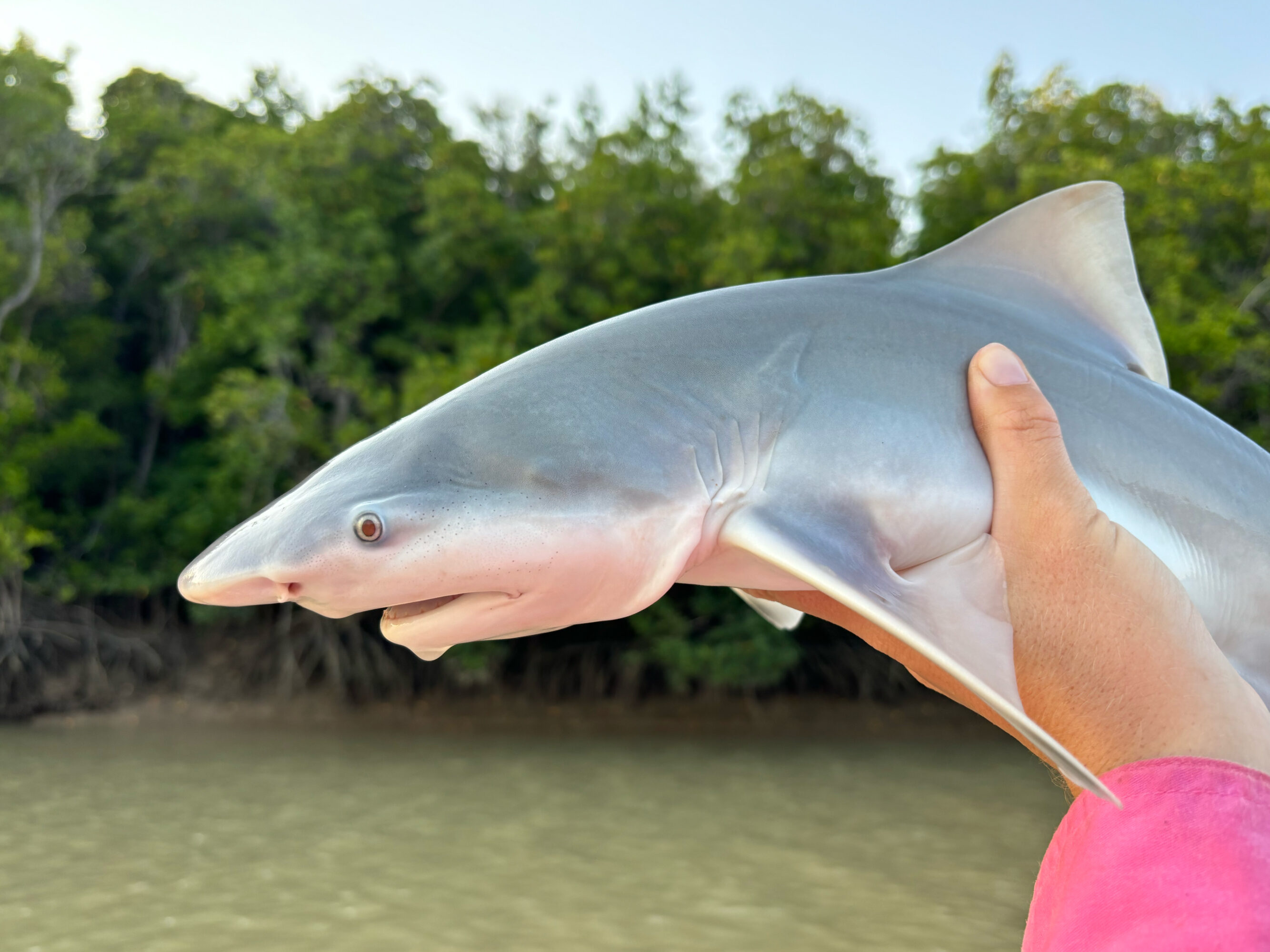
A neonate speartooth shark. Photo © Julia Constance
Enter novel geochemical approaches…
Due to these limitations and the human bias and subjectivity of these current ageing techniques, after many tea-room chats between shark folk and geochemistry folk, we decided we would take a new and exploratory approach to this conundrum, leveraging the quantitative and objective nature of geochemical instrumentation and applying this to a rare and Vulnerable species in an area allowing us develop a highly controlled natural experiment. Part 1 chronicles this journey through the scientific method, here we bite right into results and impact.
Briefly, our combined mXRF Sr concentrations and LA-MC-ICP-MS 87Sr/86Sr not only match each other exactly as they should if being controlled by marine vs terrestrial water sources, more importantly these signals are in total lockstep with precipitation records in the area as well as geochemical data for the Adelaide River and the surrounding land and groundwater which influences its 87Sr/86Sr signature (Northern Territory, Australia). This exceptional matching anchors these geochemical signatures in both space and time, for the first time showing that these new methods can indeed track age, particularly in species whose habitat fluctuates between riverine/estuarine and open sea. Due in large part to anthropogenic inputs such as fishing, habitat degradation and climate change, such species are more susceptible to becoming threatened with extinction, and furthermore their life histories are often very difficult to characterise by re-capture due to their larger habitat catchment and often low-visibility aqueous environments. Therefore, this novel approach has proven not only robust and accurate for ageing and understanding of life history, and for species that need it most. Moreover, because the broader geochemical signature of shark vertebrae provides a richness of information regarding the sharks’ ambient environment, and can even be used to help match sharks to their non-oceanic habitat(s), this is a frontier absolutely ripe with power and impact potential.
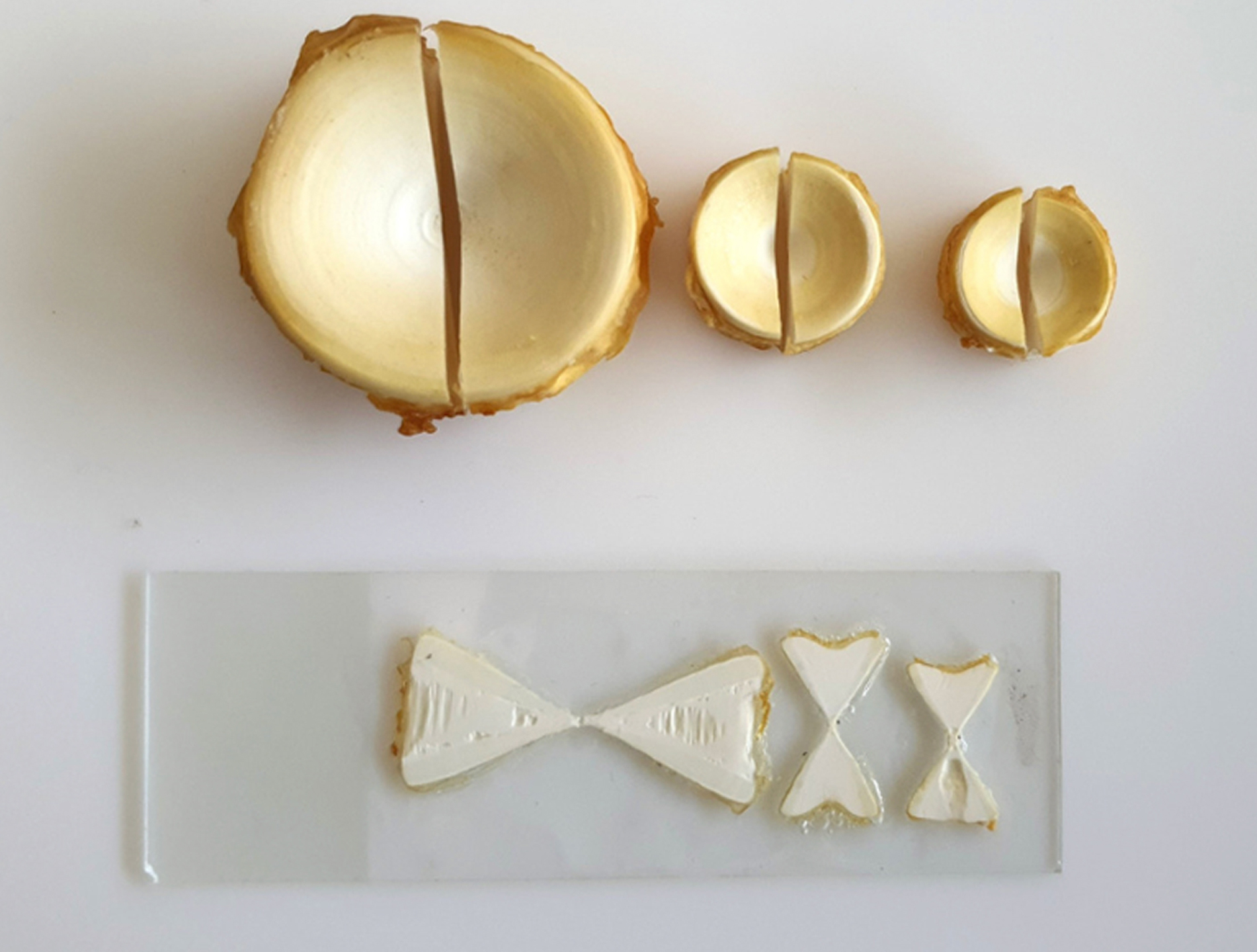
Much like scientists age trees, shark scientists slice a section of a shark’s vertebra and count the rings of growth that appear in dark and light bands under light. Here, shark vertebrae have been cut into vertebral sections. Photo © Hilary Lewis
And here is where Provocateur comes into the namesake…
Our approach using geochemical data robustly match the seasonal precipitation patterns and the fluctuating pattern that this creates in both Sr concentrations and isotope signatures, HOWEVER this does not match the light-dark band pairs seen by the conventional methods described above and previously. This finding is potentially quite profound, as in our study this has in essence invalidated the conventional technique for this species, and continues to build the evidence base that conventional counting of band pairs may only be applicable to a selection of shark and ray species.
Moreover, this mismatch is not small, nor do visible band pairs and geochemical “band pairs” line up well even when final band-pair count (age determination) is similar, and the age discrepancy increases the older the sharks are. On average, our method determined ages 1.3 years younger than those determined by conventional methods, which even for the oldest shark at 11 years old is over a 10% difference, and furthermore it trends towards an overestimation of age by conventional methods for this species. This, combined with the observation that the discrepancy increases with shark age, as important follow-on implications with respect to conservation, as over-estimating age can lead to inaccurate management advice.
Perhaps most concerning from the perspective of fundamental understanding is the fact that in our case study the geochemical signatures, which are robustly anchored down in time, do not match the visible band pairs. This rattles the base assumption that light/dark bands are annual, with implications reverberating into shark research wherever annual band pair formation is a built-in factor, as our results suggest that—at least for the species studied—visible light-dark band pairs are NOT tracking age and are a function of some other physiological process (or multiple processes) occurring.

The composition of elements like strontium, calcium, potassium, and phosphorous in the vertebrae of sharks can be seen using micro-X-ray-fluorescence. Images © Lewis HMK et al (2025)
With all the above in mind, it is our hope and goal to continue this research towards:
- Characterising a broader range of species and habitat associated chemical markers
- Incorporating a broader range of geochemistry to for more complete reconstructions of shark life history
- Drawing further comparisons to conventional methods, and
- Further explore the underlying physical and/or biological drivers of visible light-dark band pair growth and its relationship (if any) to geochemical signatures.
That’s all for Requin Provocateur! We hope you’ve enjoyed this deep dive into how geochemistry and shark ecology can work together towards groundbreaking research with real-world impact. Stay tuned for future research and developments from the Requin Provocateur research team, where further work is already well underway.