
Requin Provocateur (Part 1 of 2): Challenging current paradigms in shark age estimation using interdisciplinary science and state-of-the-art microchemistry
Our project’s narrative ark is simple yet complex, encompassed by its driving question: How can we harness the awesome power of cutting-edge analytical instrumentation and interdisciplinarity to complement conventional approaches to elasmobranch (shark) age estimation and life history reconstruction?
This blog is Part 1 of 2, chronicling our journey from project design, through to some potentially paradigm-shifting outcomes, publication, and of course, beautiful pictures!
Here in Part 1, we break down project design and logic, setting the stage for Part 2 by biting off a digestible chunk, and articulating experimental design to highlight the many other applications where this approach may be taken in the future. To accomplish this, Part 1 covers four interdisciplinary facets of our approach: Ecological, Analytical, Geochemical, and Geographic. For those who want to follow this alongside the published article, the Open Access publication in Marine Ecology Progress Series (MEPS) can be found HERE.
Ecologically, we focussed our attention on a species of high importance for ecological conservation, but for which life histories such as age and habitat movements are difficult to constrain – the Speartooth Shark (Glyphis glyphis), a rare river shark that occupies the Adelaide River, Northern Territory, Australia. Speartooth sharks inhabit riverine-to-coastal waters, whose physiology accommodates a variety salinities and turbidity. This spectrum of environs, and in particular low visibility water systems, make it difficult to build a framework of understanding for this rather elusive species. Importantly, Glyphis glyphis is listed as Vulnerable on the IUCN Red List, highlighting it as a species in need of better understanding and life history metrics for Conservation.
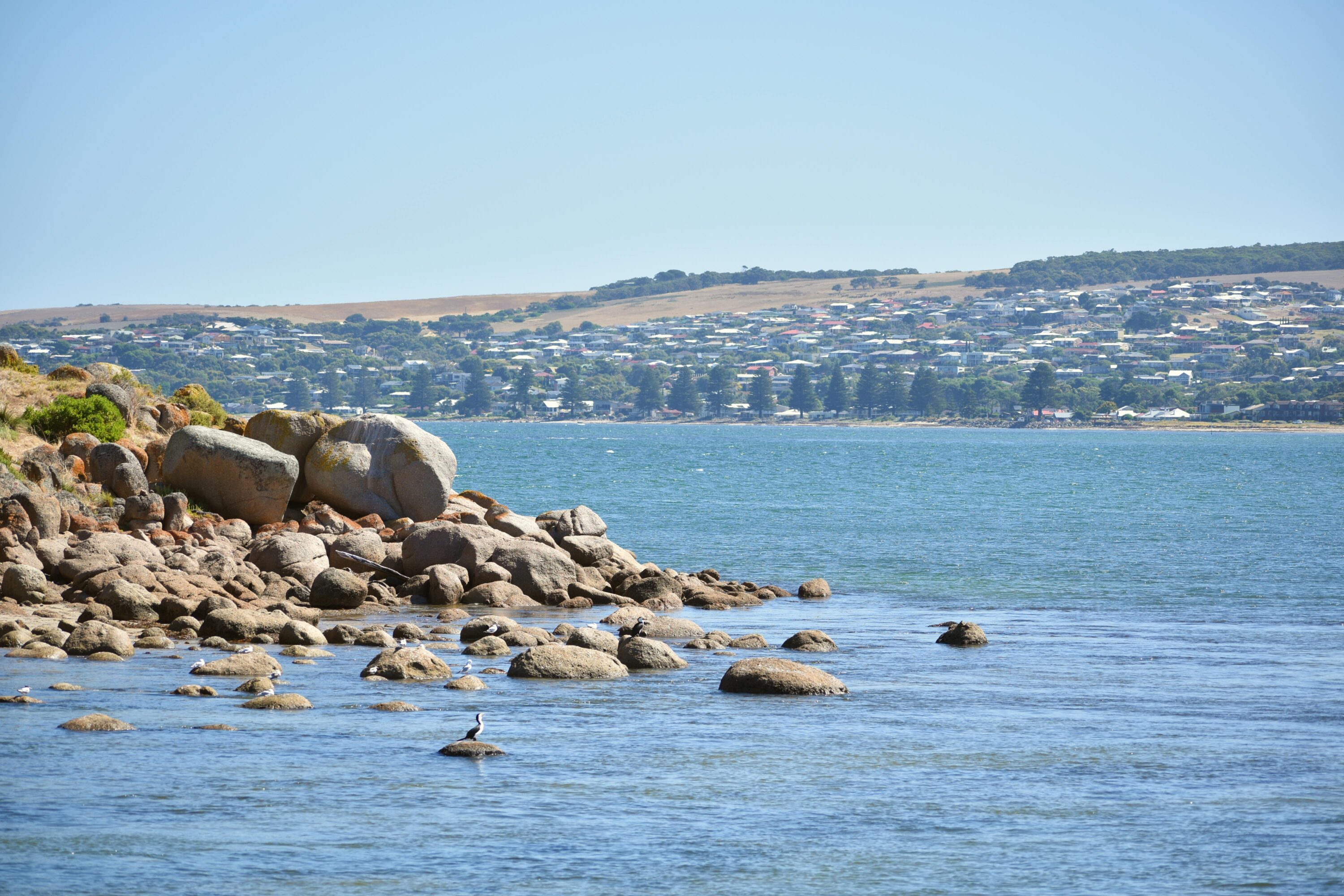
Adelaide. Photo © Ryan Vand | Pexels
Analytically, we focussed our attention on high-resolution in situmicrochemistry within shark vertebrae to provide insight into the environment(s) speartooth sharks inhabit throughout their life cycle, as while such approaches are now common in otoliths, less has been done in vertebrae which also grow radially with age, but which are markedly larger and easier to harvest than otoliths. The larger size and accessibility of vertebrae provide several advantages, especially with respect to characterising the chemistry (elements and their isotopes) at high resolution along the main growth direction, that may benefit current age estimation conducted via transmitted light optical microscopy (TLOM), which at its most basic involves shining a light through a thin slice of the otolith/vertebrae and counting light and dark bands (with the latter being more dense and letting less light through). In our work, we have coupled two novel ways of characterising these bands based not on their density (light transmission), but rather on their chemistry. These techniques are called micro X-ray fluorescence imaging (micro-XRF) and laser ablation multi-collector inductively coupled plasma mass spectrometry (LA-MC-ICP-MS; a mouthful even for a shark!). Micro-XRF basically uses a different part of the electromagnetic spectrum (X-rays instead of visible light) to chemically characterise materials, while laser ablation MC-ICP-MS uses a high-energy laser beam to blast tiny disintegrated particles off the surface of a sample and into a VERY fancy instrument which can characterise not just elements but the abundances of that element’s isotopes. Both instruments operate at very high resolution and can characterise tiny spots roughly 1/4 the diameter of human hair, then we use software to reconstruct this information into a line (or image) of the distribution of elements and their isotopes.
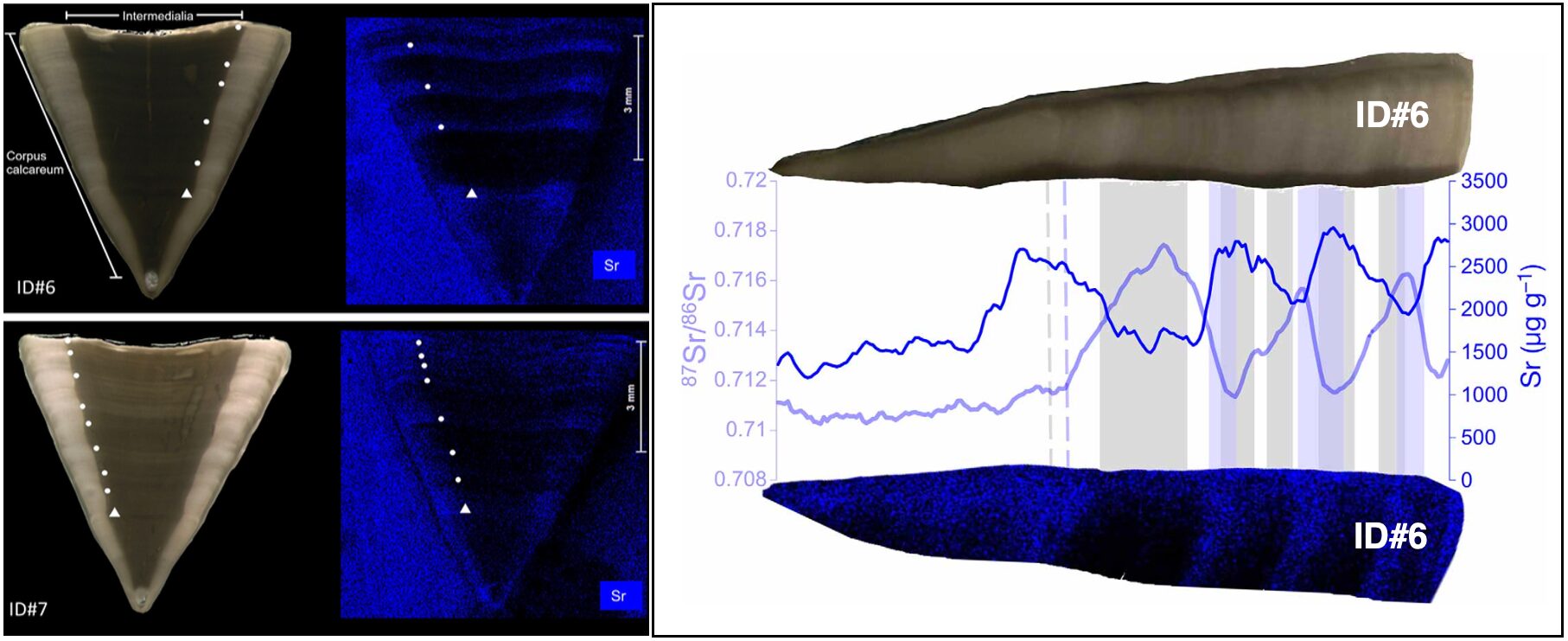
A side-by-side of shark vertebrae TLOM, mXRF Sr and LA-MC-ICP-MS. Figures © Lewis et al. (2024)
Geochemically, we focussed our attention on strontium (Sr). Strontium is a powerful tool for differentiating between marine and freshwater systems, as Sr concentrations are typically orders of magnitude higher in seawater vs freshwater. Meanwhile, the radiogenic Sr isotope ratio—the abundance of 87Sr relative to 86Sr, or 87Sr/86Sr, expressed as a number—of the global ocean is a single homogeneous value, while freshwater systems typically have higher and often individually distinct 87Sr/86Sr. Relative Sr concentrations were tracked along vertebral growth axes using two different but highly complementary ways. First, we used micro-XRF, which can rapidly image Sr concentrations as qualitative “heatmaps” of Sr intensity, allowing for robust image-based age estimation compared to TLOM. LA-MC-ICP-MS transect analyses across the growth axis complement this by providing high-resolution quantitative Sr concentrations, as well as high-precision determination of 87Sr/86Sr from the exact same location on the vertebrae. To robustly pin all this vertebrae microchemistry down to physical environs and precipitation records, we conducted elemental and isotopic characterisation of an entire transect of the Adelaide River (known habitat of our speartooth sharks), from coastal to nearly 100 km upstream freshwater.
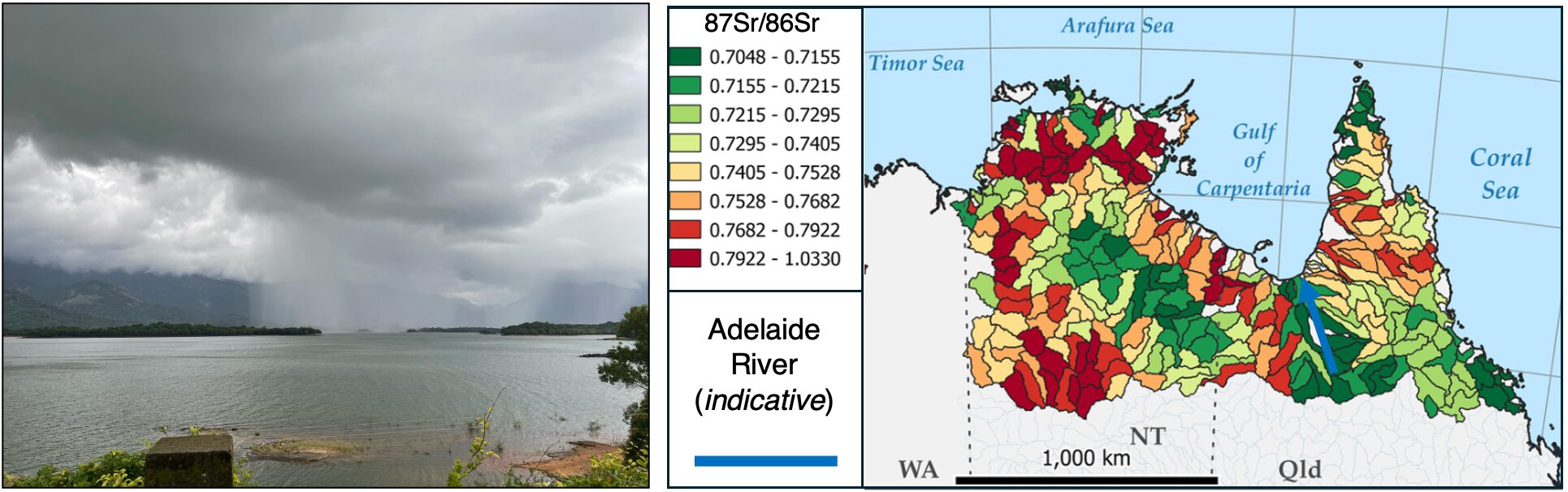
A side-by-side of Adelaide River. Photo © free commons; and isoscape. Figure © de Caritat et al. (2023)
Geographically, our emphasis on speartooth sharks was purposeful. These sharks inhabit the Adelaide River of the Northern Territory (Australia). This geographical context provides two critical components which allow us to anchor our vertebrae microchemistry data to the field area. Firstly, this region experiences monsoonal precipitation, meaning strongly bimodal wet and dry seasons, with the wet season marked by enhanced freshwater run-off carrying a freshwater Sr elemental and isotopic composition further downstream than in the dry season; thanks to proximity to Darwin International Airport, we have sub-annual precipitation records through the Bureau of Meteorology. Secondly, recent large-scale geochemical survey efforts have characterised regional 87Sr/86Sr with catchment-scale resolution, connecting strontium systematics at the water-rock interface along the Adelaide River.
That’s all for Part 1 of Requin Provocateur! Stay tuned for Part 2, where we detail our project results, which boldly challenge current paradigms in determination of shark age, offering a complementary pathway towards shark age estimation that is chemically linked to the inhabited lands and waterways, creating inextricable connection between these “-spheres” towards a unified paradigm of interpretation for speartooth sharks and other similar vulnerable species.
The author kindly acknowledges project and co-authorship credit to Hilary Lewis and Michael Grant.