
Freeing Marble
We were traveling back through Squally Channel in our research vessel when Cam and Eva Hill from Hartley Bay called us on the radio. I had to slow the boat and ask Cam to repeat his message, for fear that I heard him correctly. His message came through loud and clear: they were with a whale, and it was entangled in prawn fishing gear. We rushed back to the Fin Island Research Station to retrieve a satellite buoy while Cam reported what he was seeing to the coastguard. Within minutes, we were on the scene with Cam, Eva, and their family who had been watching this whale breach and tail lob repeatedly. We later realised this whale was “Marble” (BCX1713) – a whale that has been returning to Gitga’at Territory every year since 2015. Thankfully, by the time we approached, Marble had settled down – tired from trying to be free of the entangling gear.
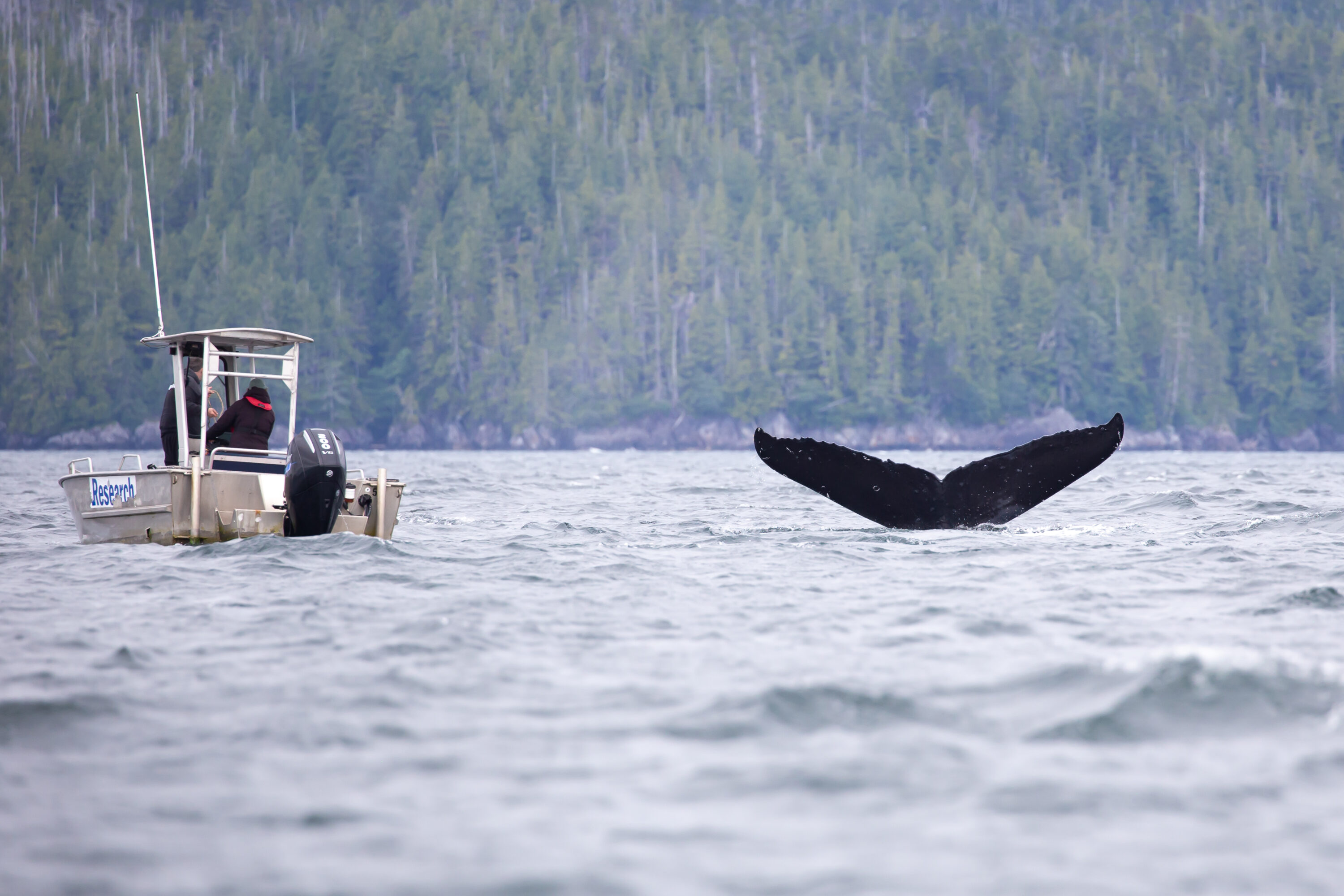
Grace Baer and Cam Hill monitoring Marble’s behaviour and making the approach with the satellite tag. Photo © North Coast Cetacean Society
We slowly came alongside Cam and Eva’s boat and made a plan for attaching the satellite buoy to the trailing line, which would send location updates and allow us to relocate Marble. We monitored Marbles behaviour carefully, knowing that we would have to approach without causing further stress to have any hope of attaching the satellite buoy. While we watched Marble from a distance, we got a radio call from Braede who was at the Fin Island Station and received word that DFO’s disentanglement team was on their way – but wouldn’t be able to be on scene until the evening of the following day due to the remoteness of the region. In that time Marble could easily disappear, and the importance of attaching the satellite buoy to have a chance to relocate her was weighing heavily on our minds.
Marble was now completely still at the surface, and two small buoys attached to the end of the entangling rope popped up behind her. This was the best-case scenario – the grapple on the satellite tag could hook on to the trailing buoys. We approached slowly, drifting closer and closer. I guided our boat, and Cam was ready to throw the grapple from the boat. On our second attempt, we hooked onto the trailing line, and Marble reacted to the extra weight and drag of the satellite buoy immediately.
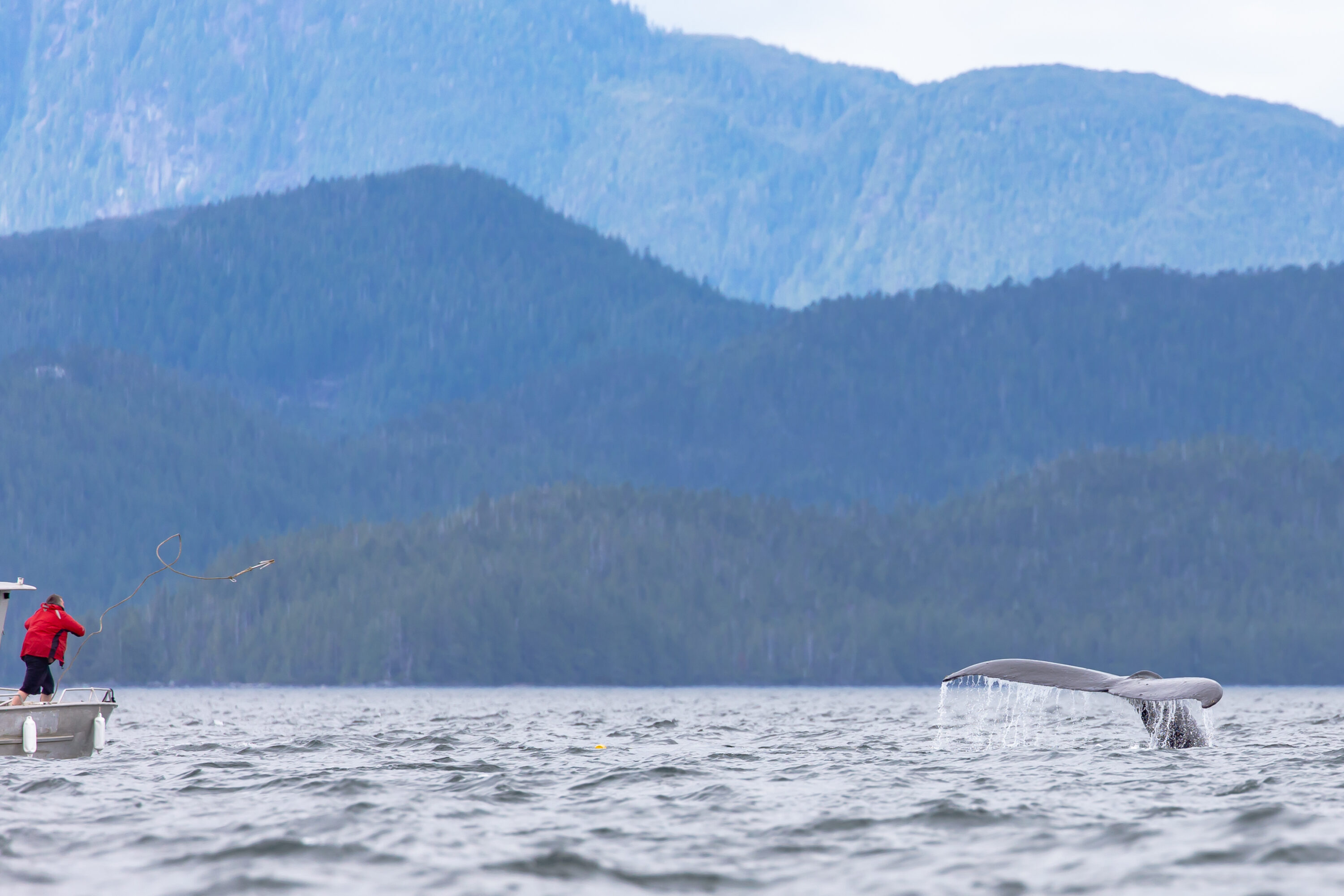
Cam Hill making the throw that would attach the grapple and satellite tag to the entangling gear. Photo © North Coast Cetacean Society
With forceful, tonal breaths at the surface, Marble took off. She was moving so fast that the buoy was being held underwater and the satellite transmitter couldn’t send its signals. We followed Marble as long as we could as she looped Squally Channel, went out into Otter Channel, and then looped back. All the while, the satellite transmitter remained submerged. Battling whitecaps and a setting sun, we knew that we would have to leave Marble soon. I couldn’t help but wish there was a way we could communicate with other species and let them know that we were there to help. I didn’t sleep much that night, and when I did, I dreamt of Marble.
The next day we were back on the water early in the morning – Marble had finally slowed enough for the satellite transmitter to break the surface and send a signal! We raced to the last known location, but by the time we got there, Marble was nowhere in sight. We searched all day, along with Marven Robinson, Hermann Meuter from the Pacific Whale Society, and Gitga’at Guardians Shelby and George Fisher. We documented over 20 unique humpbacks, but none were Marble. Eventually, the wind howled through and forced us to end the search for the day, feeling defeated.
On the third day, we were up at first light and set out to search again. We were halfway across Squally Channel when we saw the first blow. As we slowly approached, the whale dove perpendicular to us. We typically identify whales by the undersides of their flukes, and with the direction this whale was facing, we were not able to see the fluke at all. I was just about to start to position the boat so that we were behind the whale for its next surfacing when, a few seconds later, we saw the little satellite transmitter sticking out of the water and dragging behind the whale. It was Marble! The relief and hope that filled the air was palpable. Less than a minute later, Hermann called us on the radio and was soon on his way to us to help keep eyes on Marble until the disentanglement team arrived. We quickly put our drone in the air to help get a sense for where the rope was actually wrapped.
Once the drone was over the whale, my heart sank. Marbles pectoral flippers were the source of the entanglement, and were pinned underneath the body. I could not begin to fathom the pain this must be causing, how it would impact Marble’s ability to feed, or the exhaustion from the extra energy spent just to swim and dive. It was also clear this would be a difficult disentanglement. Just as I was bringing the drone back in, Hermann arrived, as did our next obstacle: thick fog.
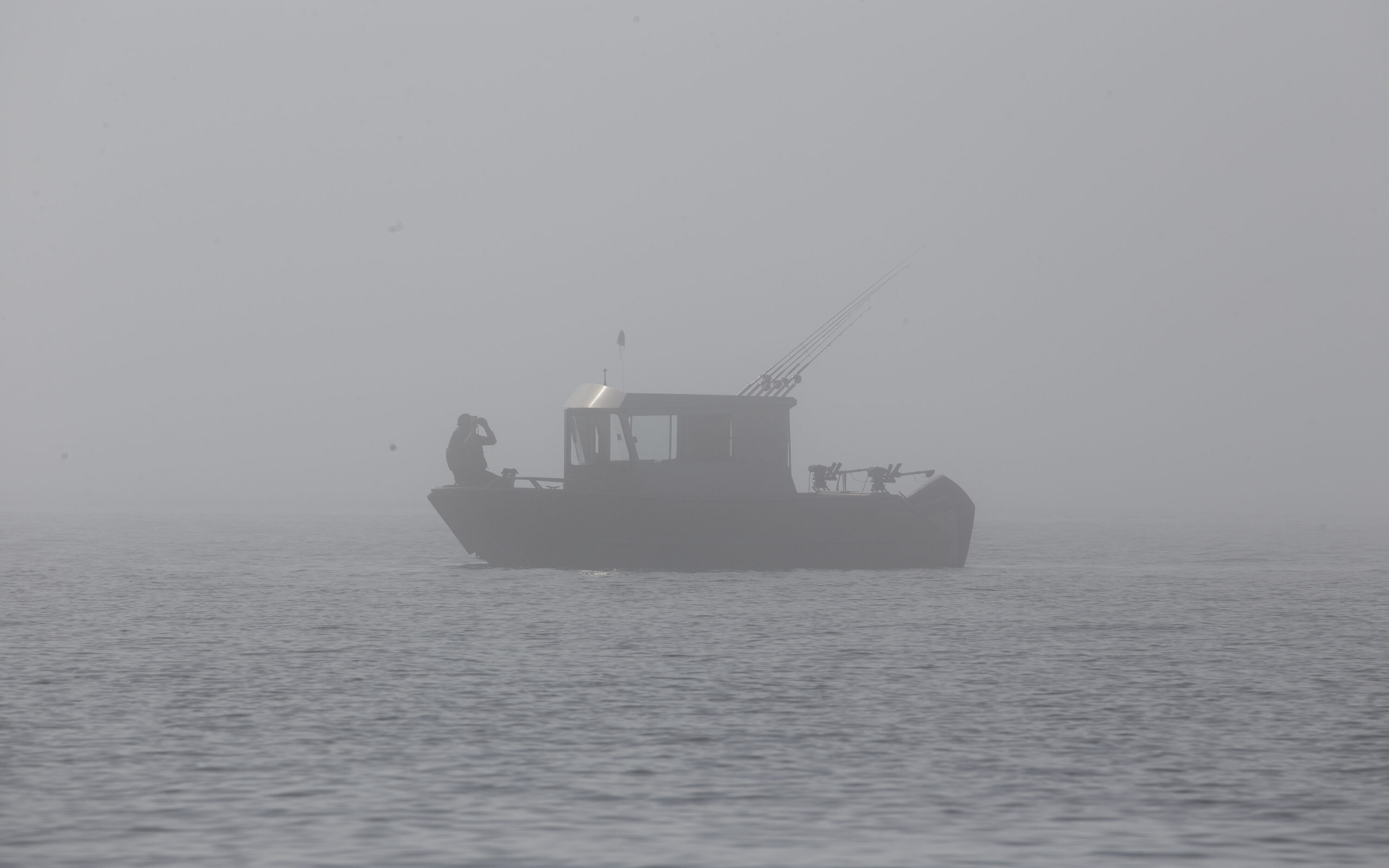
Hermann Meuter on board his research vessel the “Josephine” shrouded in fog and searching for Marble. Photo © North Coast Cetacean Society
Within minutes, we were surrounded. We could barely make out the water 100 meters in front of us, and Marble was routinely diving. Keeping up with her, even with both of our boats and expertise, seemed impossible. We separated ourselves with us staying behind Marbles last location, and Hermann to the East. Marble had been following a steady South heading, and we kept our bearing and hoped for the best.
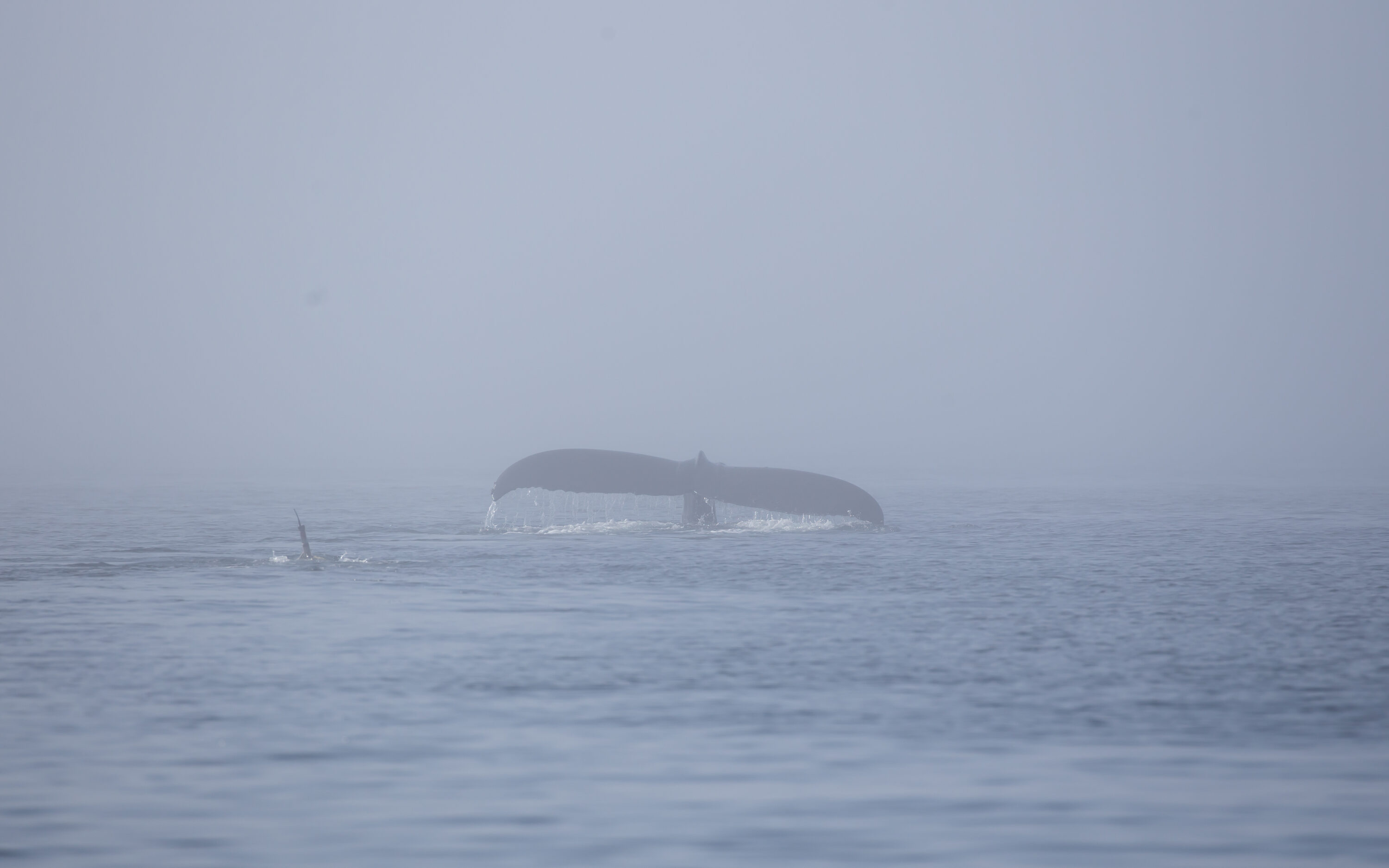
Marble surfacing in the fog, with the satellite buoy trailing behind. Photo © North Coast Cetacean Society
7 minutes passed, and before we even saw Marble, the satellite buoy popped up above the surface. Using binoculars, we were able to keep an eye on it. Finally, Marble took a breath, and then another, and then dove back down – taking the satellite buoy with her. We kept our heading, and 7 minutes later, the same pattern repeated. This continued for 2 hours and miraculously we stayed with Marble the whole time. Around 10:30am the fog started to lift, and not long after DFO’s Paul and Brendan Cottrell alongside fisheries officers arrived to begin the disentanglement effort.
Brendan hopped onto our vessel with plans to have a drone in the air the whole time to get a birds eye view of the situation and to communicate Marbles movements through a specialised headset to the crew on the fisheries vessel. We followed at a distance to act as safety support should something go wrong, as well as to keep an eye on Marble and her behaviours.
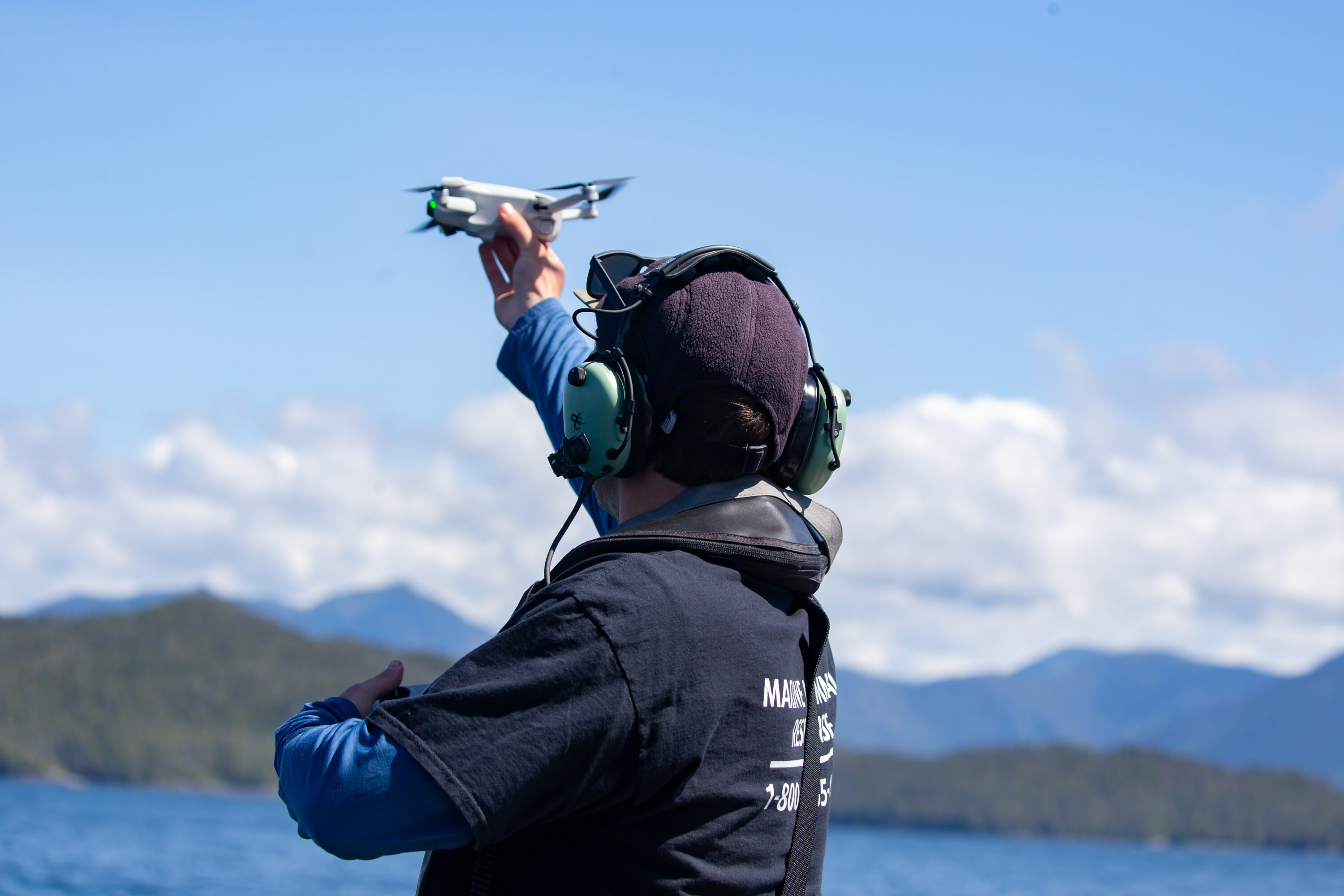
Brendan Cottrell launching a drone to relay Marbles surface movements and the position of the trailing line to the DFO response team. Photo © North Coast Cetacean Society
One thing that became clear very quickly: Marble did not like boat noise. Though we were able to follow her for hours at a very slow, consistent speed – as soon as another boat was added into the equation that had to make closer approaches, her behaviour changed dramatically. Marble was swimming faster, and taking longer dives, making it difficult to keep eyes on her. Around 4pm, we lost her.
Between ourselves, Hermann, and the DFO team we were not able to relocate her. With heads hanging, we had to call it for the day. This was an immense blow. That we were able to remain with Marble through dense fog only to lose her in clear skies was felt by all. But, we weren’t giving up. We would try again in the morning.
With heavy eyelids, I made my way to our boat on the fourth day. I really did not know what to expect, but I knew we had to keep giving it our all to find and free this whale. Hannah, Zoey, and I set off towards the top of Lewis Passage and Wright Sound – Marbles last known location. I had never seen so many whales at the same time in these places. There were easily over 40 humpback and fin whales, and among all of them – we had to find 1 specific whale. Hermann was also back on the water continuing the search in further reaches of Wright Sound and Whale Channel. Paul and the fisheries team were on their way from Kitimat and would be joining the search once they arrived. We searched for almost 4 hours before we got the call on the radio from Paul that they found Marble and it was now a waiting game for her to slow enough so that they could finally start the disentanglement.
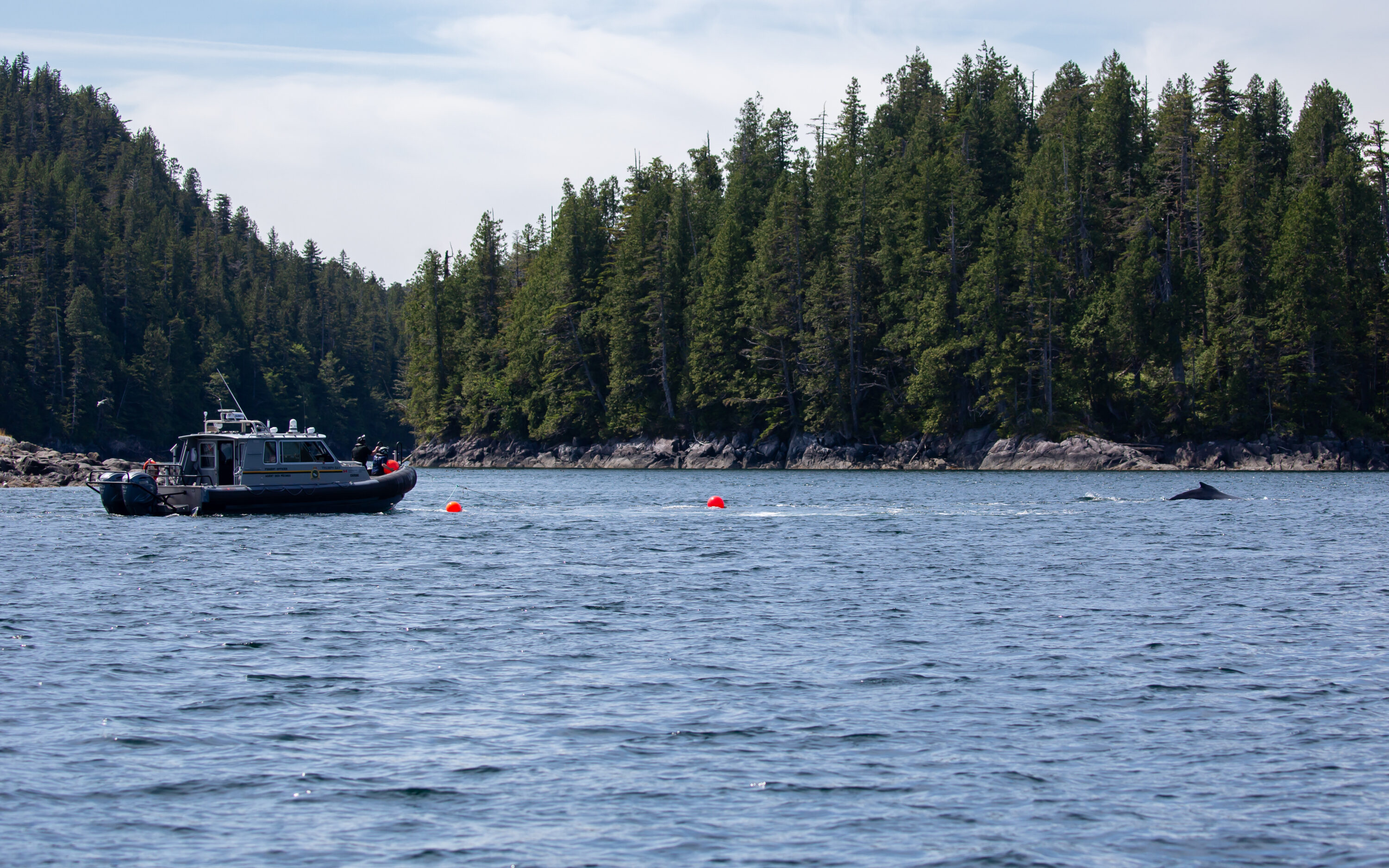
The DFO marine mammal response and disentanglement team adding additional buoys to the trailing gear behind Marble and attaching the line to their vessel to slow down her movements to allow for the rescue efforts to begin. Photo © North Coast Cetacean Society
First came the most dangerous and emotional part – the trailing line behind Marble had to be attached to the fisheries boat to allow them to begin cut the gear. This is a major reason why whale disentanglements are only done by highly trained individuals, the possibility of injury to the whale and the people working to free the whale could be high if not done correctly.
Once Marble realised she was now dragging the weight of a large vessel, she understandably began to panic. She tried to out-swim the weight, was projecting haunting tonal blows above the surface, and began dragging the fisheries boat at a clip of 7 knots. Soon after, another humpback whale “Sheen” (BCY1002) arrived at Marbles side. Sheen stayed with Marble as she towed the fisheries boat for over an hour. Watching Sheen’s response was a true testament to the social bonds of humpback whales, and how much we truly do not understand about the depths that they will go to protect and stand by each other.
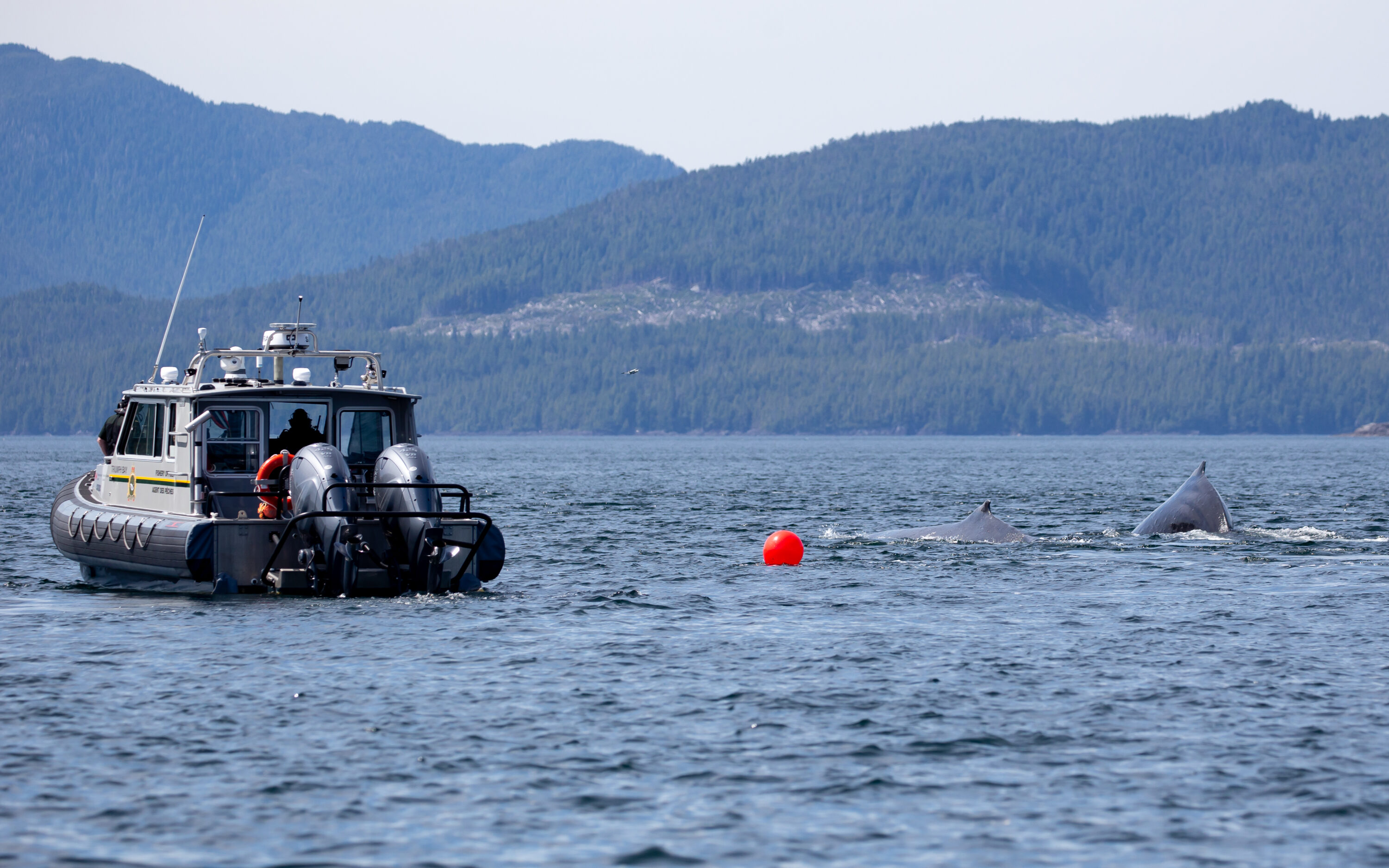
Sheen (right) joining Marble and accompanying her in this time of distress. Photo © North Coast Cetacean Society
Finally, Marble slowed down. This was bittersweet as we knew it was from exhaustion, but we knew this meant her chance at freedom had arrived. Slowly, Paul and the fisheries team were able to work their way up the entangling line and make preparations to begin cutting.
Then, everything seemed to happen all at once. Paul made the first cut, releasing one of the buoys they had attached earlier. I moved our boat to retrieve it, and just as we hauled it onto our vessel, I turned and saw Marble heading straight towards us. Thinking she was still attached to the fisheries boat, I quickly moved into reverse to get out of the way! But out of the corner of our eyes, we saw what looked like celebration on the other boat. I turned to Brendan who was listening through his headset and frantically asked “are they still attached!?” just as he looked up at us and smiled, saying “no, she’s free.”
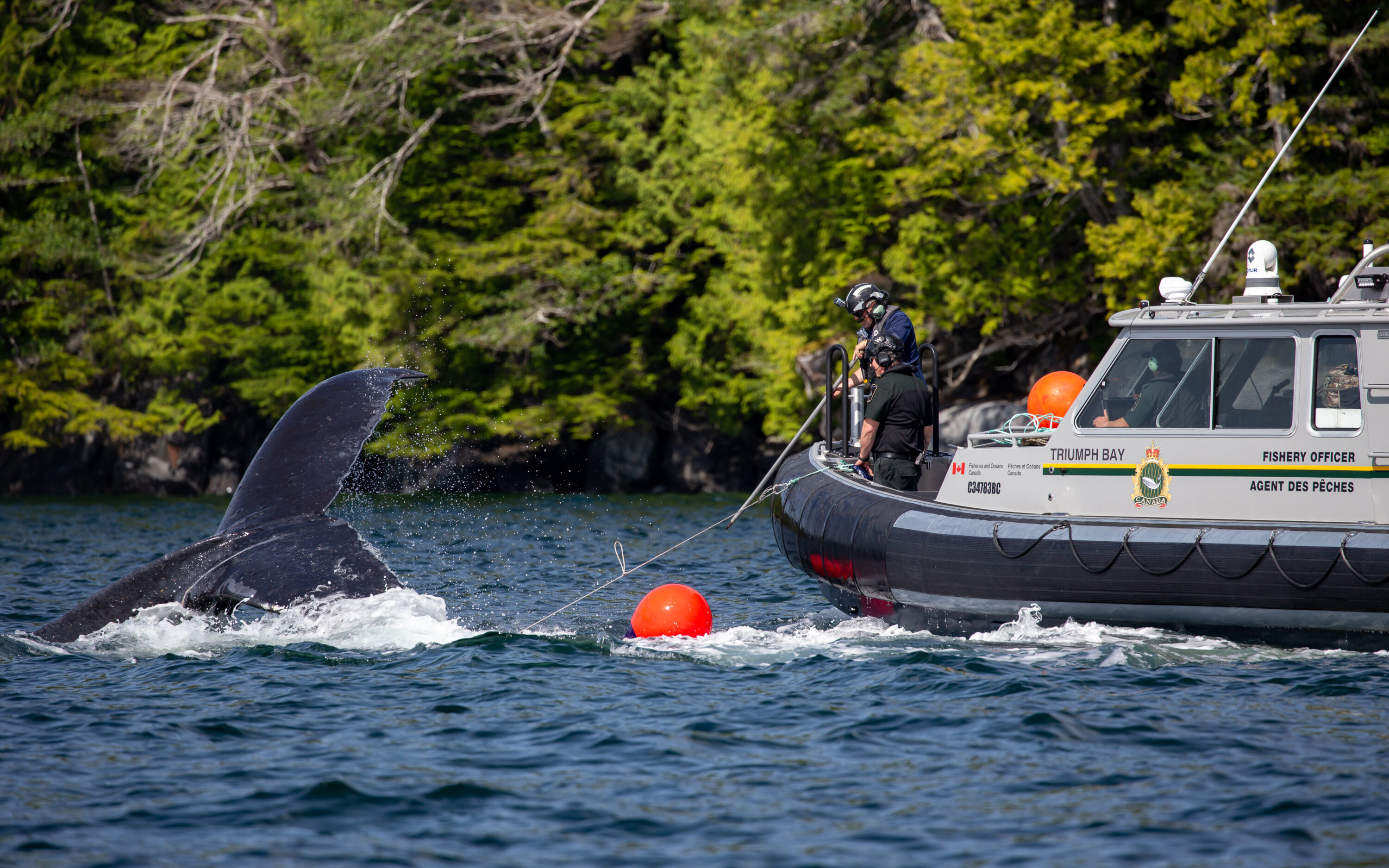
Paul Cottrell making the final cut on the entangling line. Photo © North Coast Cetacean Society
After 4 long days, and who knows how many before, Marble was finally swimming freely – her pecs no longer tied to her body, no longer dragging gear. I turned off our engine and let her pass us undisturbed. Brendan was able to get the drone over her one last time to confirm that all the gear was gone, and we all watched as she swam off with a new lease on life.
So much and so many people went into the success of freeing her, but it all started with Cam and Eva who immediately did the best possible thing: they reported the entanglement and did not try to cut any of the lines themselves. This is truly what saved Marble. Had the trailing line been cut, we would not have been able to attach the satellite buoy which allowed us to relocate her, nor would it have been possible for the disentanglement team to work to cut the wrapped lines.
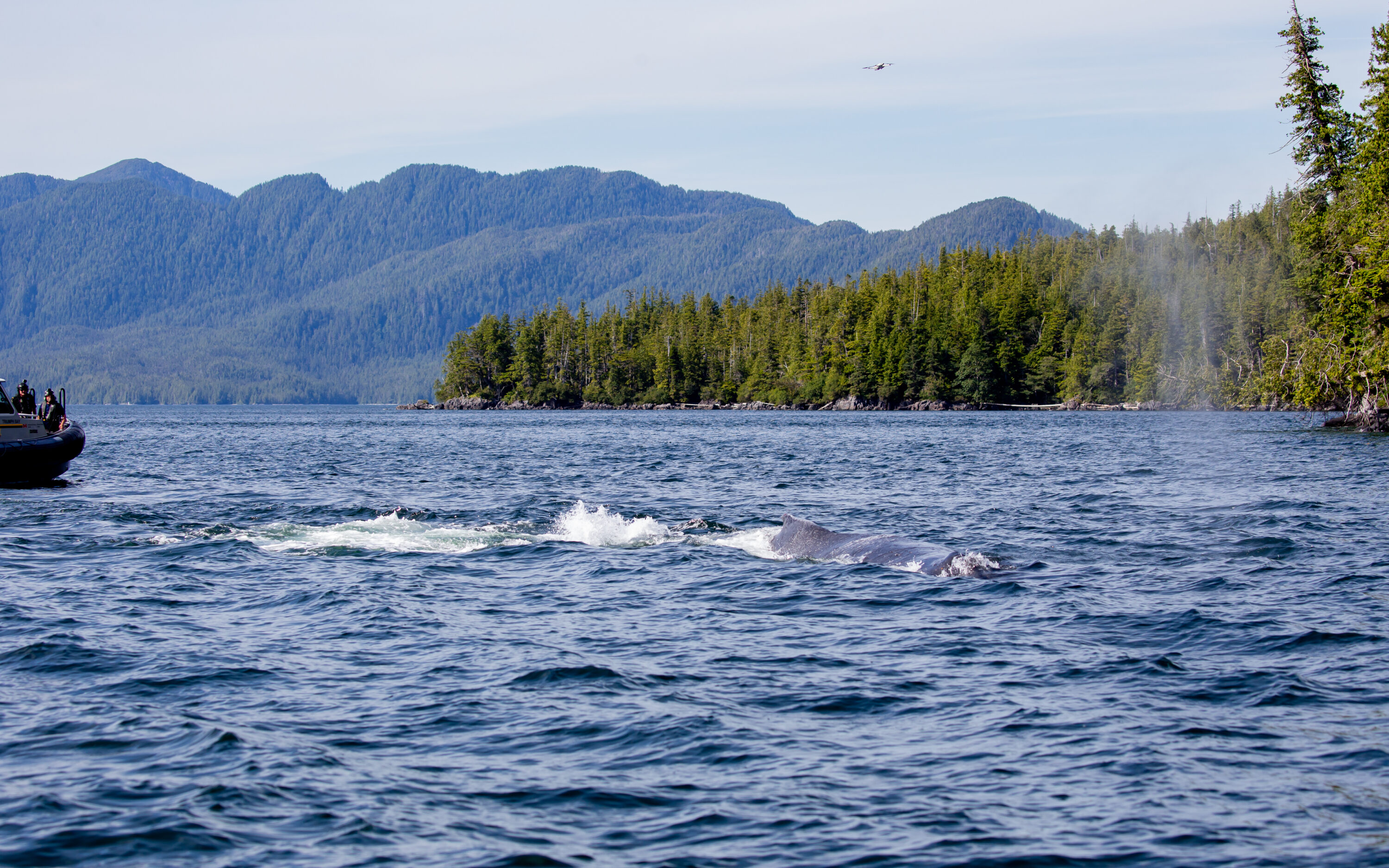
Marble swimming freely once again in Gitga’at Territory. Photo © North Coast Cetacean Society
We slept soundly that night and saw Marble again not long after as she foraged, free at last, in Gitga’at Territory.
If you believe you have seen a whale, marine mammal, or turtle in distress in BC Waters: report it immediately by calling the DFO Marine Mammal Incident Reporting Line at 1-800-465-4336, or on the VHF radio using Channel 16.