
Fishing with Data: Magdalena Communities Unite to Protect Rays
In the Colombian Caribbean, artisanal fishing is more than an economic activity, it is a way of life deeply rooted in coastal culture. Yet this practice also intersects with one of the most vulnerable groups in marine ecosystems: rays and other batoids. Throughout 2025, a project coordinated by Dr. Carlos Polo through Sharky Management and Consulting, with support from the Save Our Seas Foundation (SOSF), worked alongside fishing communities in the department of Magdalena to better understand this interaction and co-develop practical solutions.
The project, “Strategies to Reduce Bycatch of Batoids in the Colombian Caribbean,” combined scientific monitoring with strong community engagement in Playa Salguero, Puebloviejo, and Tasajera. Between April and November, researchers conducted more than 300 port visits, documenting 1,247 batoid specimens landed by the artisanal fleet.
The findings revealed a clear cause for concern. The spotted whipray (Hypanus guttatus) dominated the records, accounting for over 70% of all batoid captures. Most individuals were juveniles or in early stages of maturity, and more than 60% were females. Alarmingly, the study also documented the capture of neonates evidenced by males with claspers as small as 2 cm, confirming direct pressure on the reproductive potential of local ray populations.
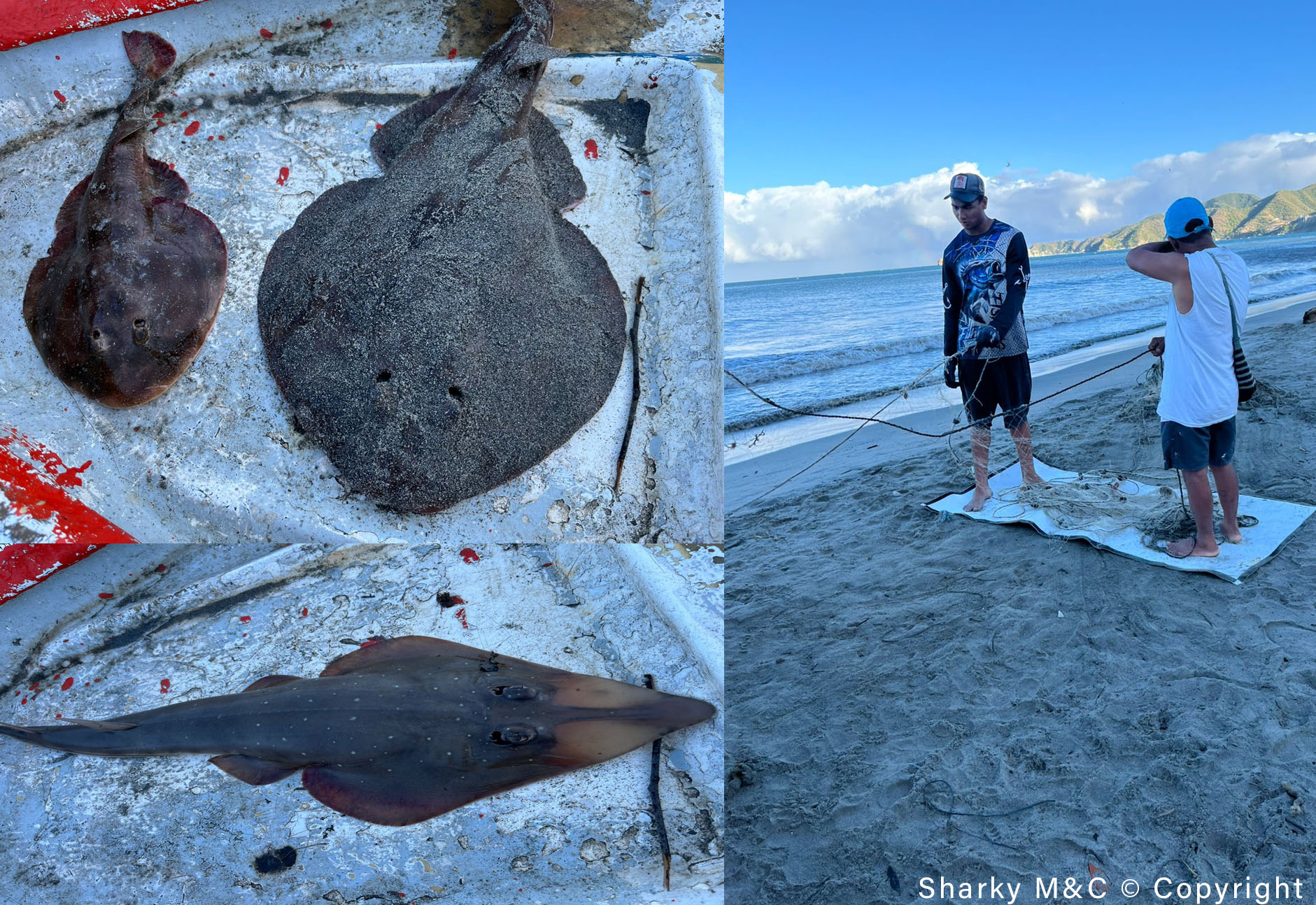
Artisanal fisheries in the Colombian Caribbean as key allies in ray conservation. Photo © Sharky MC
Importantly, the data showed that this bycatch is not intentional. Instead, it results from the use of low-selectivity fishing gear, such as bottom gillnets and longlines with up to 1,600 hooks, deployed in benthic areas critical for ray feeding and nursery habitats. These findings reinforced a central message of the project: ‘fishers are not the problem they are essential partners in the solution’.
Through participatory workshops, 31 fishers shared their local knowledge, reflected on long-term declines in ray abundance and size, and discussed realistic strategies to reduce bycatch without threatening their livelihoods. In Playa Salguero, fishers committed to releasing not only juveniles but also pregnant females. In Puebloviejo and Tasajera, communities expressed strong interest in testing alternative fishing practices.
As a result of this collaborative process, three mitigation strategies were selected for pilot testing in 2026, the use of circle hooks, frozen bait, and adjustments to longline height to reduce contact with the seafloor. This joint effort shows that effective marine conservation is built on data, dialogue, and trust and that protecting rays today is an investment in the future of both marine ecosystems and coastal communities.