
Decoding a season on the water: behind the scenes of dogfish tracking
As researchers at Oregon State University’s Big Fish Lab, we investigate a number of research questions all across the world. While shark research can look glamorous – long days on the water, dorsal fins cutting through its glassy surface, the perfect team of scientists in matching field gear – there’s one part you may not hear about as often. Whether we are in tropical waters or closer to home in the Pacific Northwest, all of our projects require careful and detailed data compilation and analysis.
Pacific spiny dogfish are small sharks common to the Northeast Pacific and are caught as bycatch in local fisheries. As part of a larger study tracking dogfish movements in offshore waters, in 2024-2025, our research team and collaborators placed acoustic transmitters onto ten individual dogfish in two bays in Washington, where adult dogfish are frequently captured and thought to potentially pup. As the dogfish swim through bays, estuaries, and open waters in this region, they are detected along an array of receivers that will “listen” and record when an individual passes by.
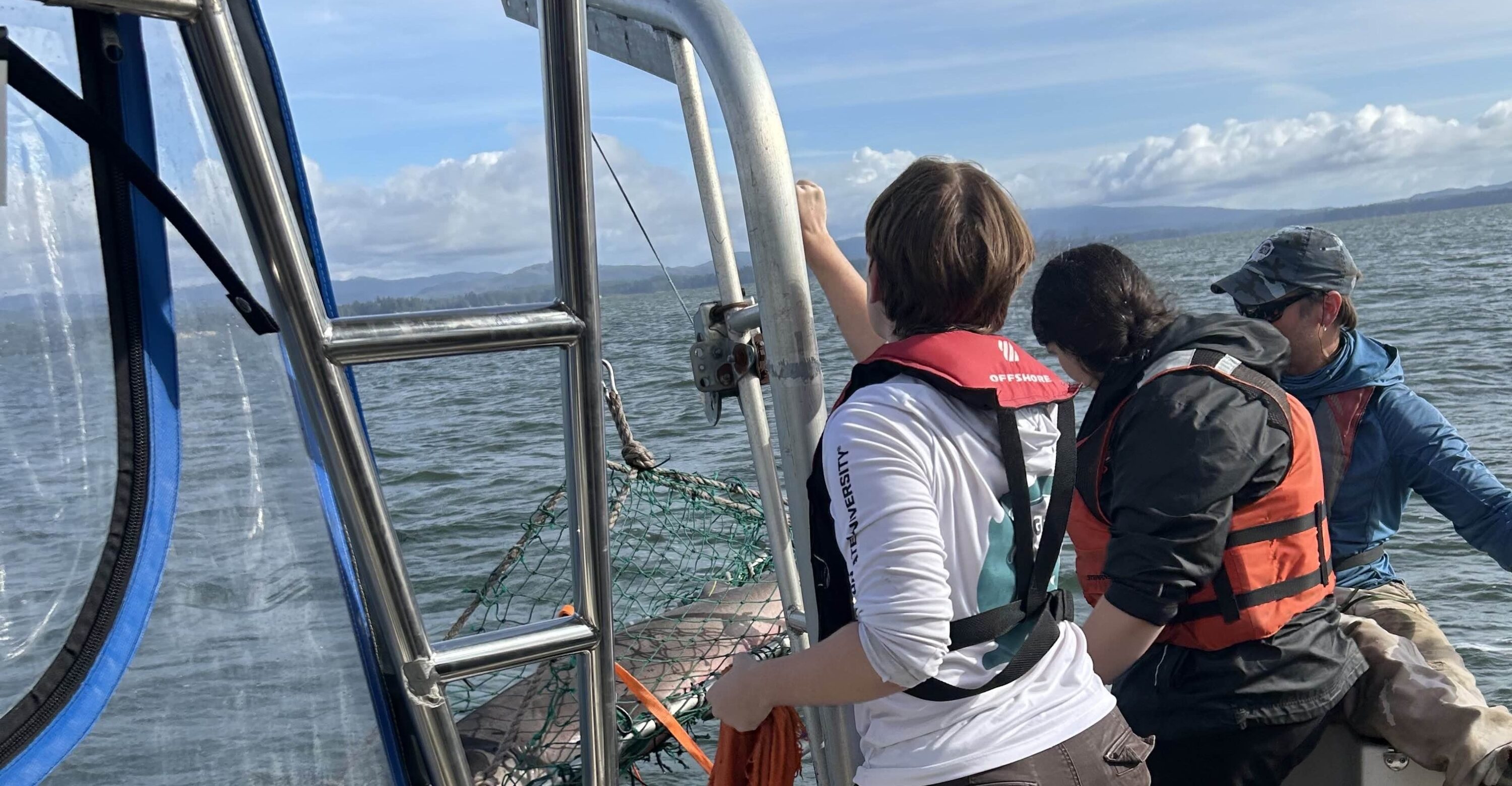
Undergraduate researcher Auguste Tveit in the field in Willapa Bay, Washington (USA), one of the bays where Pacific spiny dogfish were acoustically tagged in this study. Photo © Deven Guerrero
Now, two years later, these detections have been downloaded and a story is emerging. What looks like a bunch of numbers in a spreadsheet is actually the story of how these dogfish have moved between the arrays of receivers in the bays where they were tagged. Combined with local environmental data, we are putting the pieces together of how and why these fish are moving around and using this ecosystem.
Yet acoustic detection data bring about unique kinds of problems that researchers, like undergraduate researcher Auguste Tveit, must figure out back on dry land. Acoustic receiver data can include repeated detections of the same animals or even false detections. Tags also are put out on the fish at different days and times, meaning that one tag may be out for longer than other tags, giving us a false sense of whether an animal may be present or absent for longer periods of time. To make sense of all this noise, researchers must clean and filter data, while still maintaining the patterns and trends we see.
It may not make for dramatic pictures, but this phase is what gives meaning to every day in the field. Without this, even the rarest encounters are nothing more than an observation. It turns our observation from “we saw a shark here” to “temperature is a driver in dogfish movement in the Northeast Pacific”.
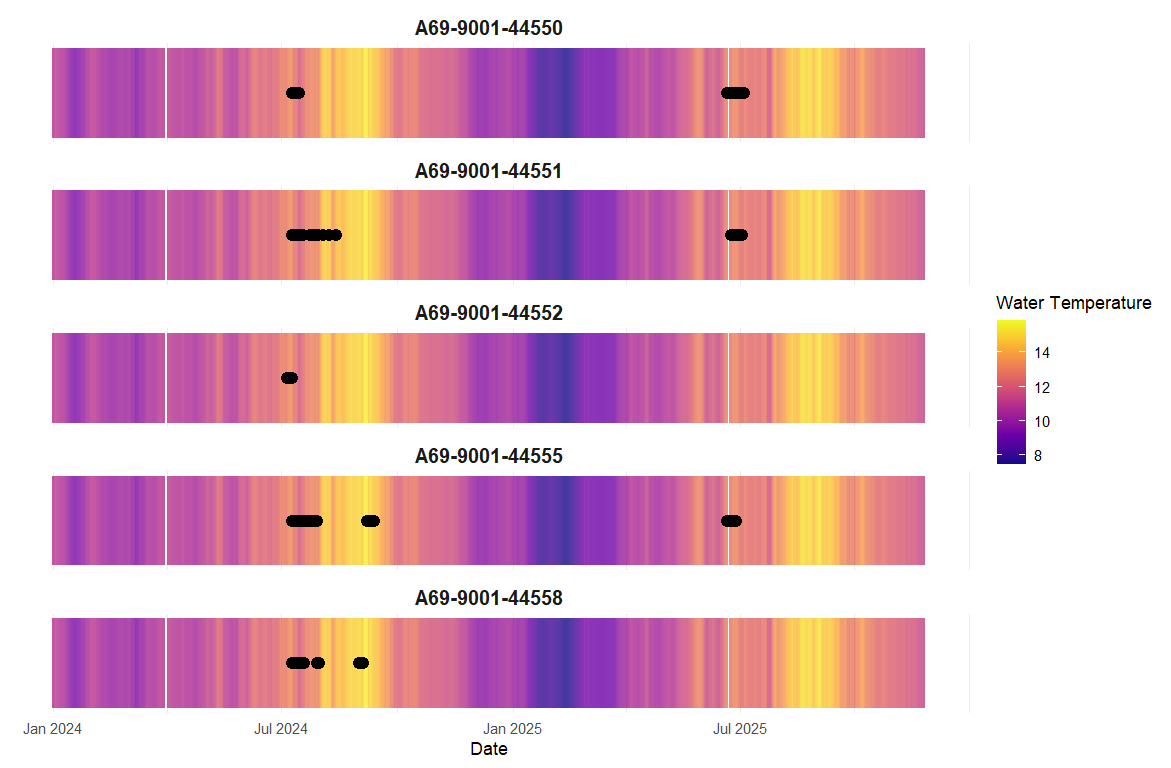
Abacus plots created by undergraduate Auguste Tveit to visualise dogfish detections in Puget Sound, Washington (USA) as compared to water temperature. Each number indicates an individual tagged dogfish, with colours corresponding to water temperature and black dots indicating acoustic detections (animal presence) in the Puget Sound. Photo © Auggie Tveit
Understanding when and where dogfish are moving helps make informed decisions about fisheries, bycatch mitigation, and habitat protection. It also helps us predict how these fish may respond to changing conditions. While sharks may deserve all the glamour shots, being the charismatic megafauna that they are, data visualisation and analysis are what turn animal moments into a bigger pattern that can help us protect our seas and the species living in them.
Undergraduate researcher Auguste Tveit in the field in Willapa Bay, Washington (USA), one of the bays where Pacific spiny dogfish were acoustically tagged in this study.
Abacus plots created by undergraduate Auguste Tveit to visualise dogfish detections in Puget Sound, Washington (USA) as compared to water temperature. Each number indicates an individual tagged dogfish, with colours corresponding to water temperature and black dots indicating acoustic detections (animal presence) in the Puget Sound.