
The Galápagos Marine Reserve is a haven for silky sharks, but overfishing still looms large
Although the silky shark is one of the ocean’s widest-ranging nomads, individuals tagged at Darwin and Wolf islands spend nearly half their time in the Galápagos Marine Reserve. A new publication shows the surprising value of this marine protected area to a mobile and highly threatened shark species, but cautions that other such areas in the region may currently provide limited protection and that silky sharks are at risk from overfishing where they roam outside them and on the high seas.
Knowing where sharks move is essential to understanding where to protect them. And for highly threatened silky sharks in the Eastern Tropical Pacific Ocean – at risk of overfishing from intense pressure by several fishing nations and exacerbated by entanglement and incidental catch in the region’s longline and purse-seine tuna fisheries – protection is vital. But the silky shark is known to be one of the ocean’s greatest nomads, clocking record distances, and so the usefulness of spatial conservation tools like marine protected areas needs to be assessed if we are to pick the right tools to manage its declining populations.
In a collaborative effort between the Save Our Seas Foundation Shark Research Centre (SOSF-SRC), the Guy Harvey Research Institute at Nova Southeastern University in Florida, USA; the Charles Darwin Foundation for the Galapagos Islands and the Galapagos National Park Directorate in Ecuador, researchers set out to assess how effective marine protected areas in the Eastern Tropical Pacific are at protecting this wide-ranging species. They wanted to know how much time was being spent by silky sharks in marine protected areas in the region’s recently expanded network, and also wanted to examine how much silky sharks overlapped with fisheries when they moved outside protected areas. Dr Jeremy Vaudo from the SOSF-SRC led the publication of the research paper published this week in the journal Biological Conservation that found that silky sharks spent a surprising amount of time in the protected waters of the Galápagos Marine Reserve. However, they also moved widely beyond marine protected area borders and overlapped with the fisheries that keep them at risk.

Map by Kelsey Dickson | © Save Our Seas Foundation
What are silky sharks and why are they in trouble?
Large, migratory and with a distinctive sheen that gives them their name, silky sharks are found across the planet’s tropical oceans. Once abundant, they are widely overfished and are the second most commonly traded species in the global fin trade.
As open ocean (pelagic) nomads, silky sharks are easily captured in longline and purse-seine fisheries and even though they are not the target species, they are typically retained for their valuable meat and fins. As they move widely across the open ocean, they are particularly at risk from purse-seine fisheries that use fish aggregating devices, which are large floating objects that attract fish (usually tuna, the fishery’s target species). Social silky sharks are also irresistibly drawn to these floating attractions and are killed incidentally (as bycatch) in tuna fisheries.
The combination of the intense, sustained fishing pressure on this shark and the risk of its extinction as a result of global trade (it is also the second most common shark species in the fin markets of Hong Kong) means that the silky shark is considered Vulnerable on the IUCN Red List and has been listed on Appendix II of CITES, which regulates international trade in the species.
In the Eastern Tropical Pacific region specifically, large numbers of silky sharks are caught and their declines are pronounced. Some protection measures are set by the Regional Fisheries Management Organization (RFMO) – the Inter-American Tropical Tuna Commission (IATTC) – out of concern for their status. Silky sharks caught in the purse-seine fishery may not be retained, and there is a 20% limit on silky shark bycatch in the longline fishery.
Satellite tracking of silky sharks shows they spend about half their time beyond the safety of Eastern Tropical Pacific marine reserves. Photo © James Lea
The Eastern Tropical Pacific and its protected area network
The waters that stretch from Mexico’s southern coast to northern Peru are some of the world’s richest. In the Eastern Tropical Pacific Ocean, whales, tuna, rays, sea turtles, seabirds and some of the highest concentrations of sharks in the world make for a region of unbelievably abundant and varied life.
But there’s a conservation conundrum at the heart of this marine treasure trove. Maintaining the valuable commercial fisheries of the region – in particular, tuna purse-seine and longline fisheries – must be balanced with creating ecotourism opportunities because both underpin the economies of many countries in the region.
One way to sustain fisheries and protect vulnerable species is to create marine protected areas, which are discrete areas of ocean in which human activities are regulated and essential habitats and threatened populations (among other things) are protected. Costa Rica, Panama, Ecuador and Colombia have each protected the Cocos Islands, Coiba, Galápagos Islands, and Malpelo and Gorgona biodiversity hotspots, respectively, for decades – and then jointly established the Eastern Tropical Pacific Marine Corridor (CMAR) initiative in 2004.
Between 2010 and 2023, 53 new marine protected areas were designated in the Central and South American Pacific. This extraordinary bid to create refuges – breathing spaces for the ocean to recover, regenerate and become more resilient – now encompasses more than 2.5 million square kilometres (965,255 square miles) and CMAR represents 90% of the region’s marine protected area network.
In 2021, the governments of Panama, Ecuador, Colombia and Costa Rica agreed to create more large marine protected areas to link biodiversity hotspots and create protected corridors that manage vulnerable species moving to feed, breed and gather. With evidence of many different species dispersing across country borders and throughout the Eastern Tropical Pacific, these nations signed a joint memorandum of understanding to create a 500,000-square-kilometre (193,000-square-mile) transboundary biosphere reserve to connect and protect the individual marine protected areas in their respective exclusive economic zones (their sovereign territorial waters).
Many of the marine protected areas in the Eastern Tropical Pacific incorporate sharks in their management plans – and the silky shark is explicitly named as of conservation value by Colombia.
But, as Jeremy and his team point out, marine protected areas can only protect the sharks that use them. And no one knew quite how silky sharks were using the marine protected area network that has bloomed across the region.
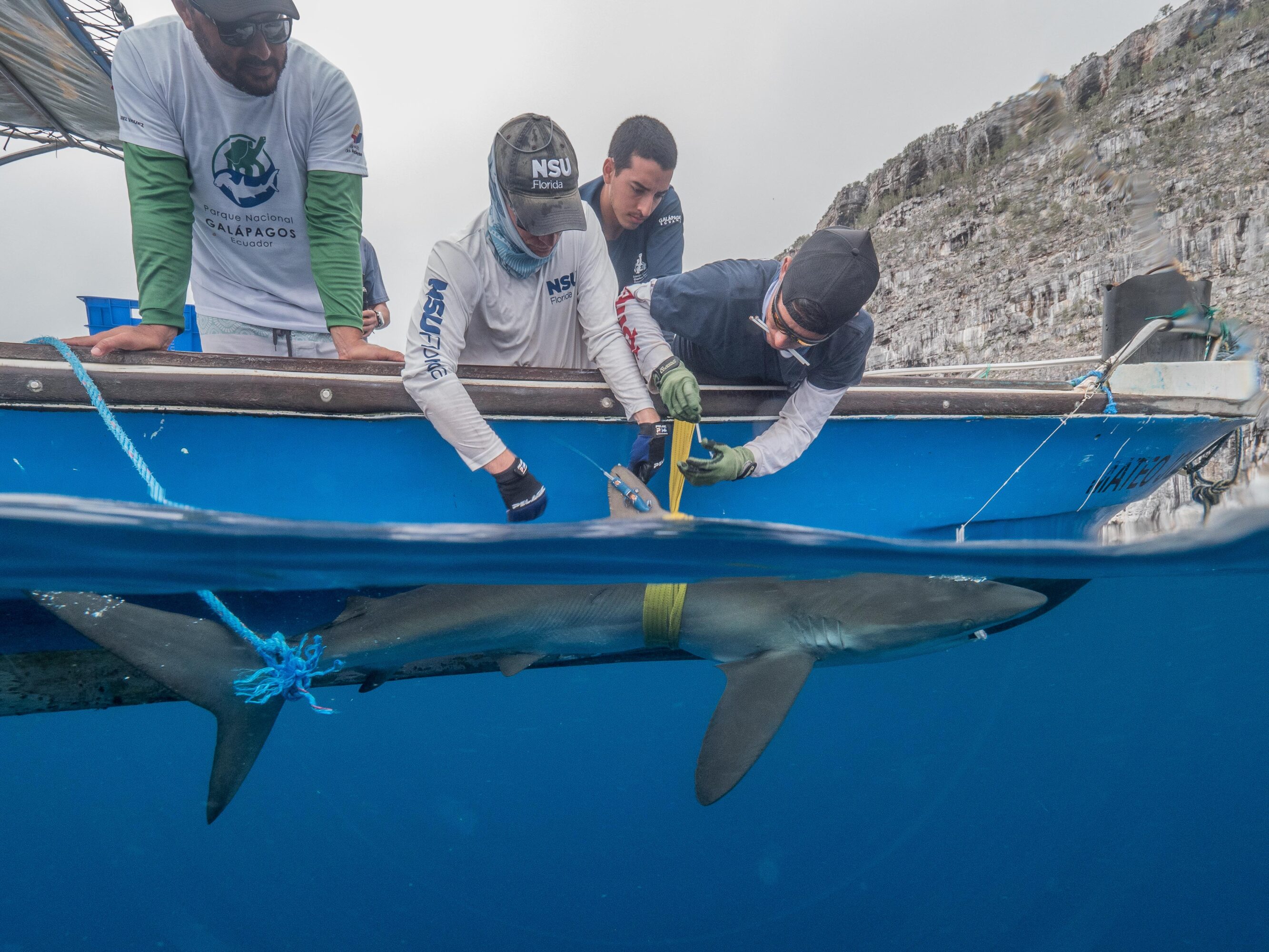
Researchers warn that highly mobile silky sharks remain vulnerable to industrial fishing fleets despite a growing MPA network. Photo by Pelayo Salinas | © Charles Darwin Foundation
The Galápagos Marine Reserve is a hotspot for sharks
Dr Pelayo Salinas de León is a senior marine ecologist at the Charles Darwin Foundation and has been conducting applied shark research in the Galápagos Marine Reserve. Since 2021, CDF’s shark ecology and conservation project, with the support of rangers from the Galapagos National Park Directorate, have deployed satellite tags in over a hundred silky sharks at Darwin and Wolf Islands, the reserve’s northernmost islands and known shark hotspots. The aim of this long-term tracking study is to evaluate how efficient the GMR is in protecting this highly migratory species; understand how movements outside of the protected area overlap with industrial fishing fleets operating across the region; and how this MPA use and overlap with fishing changes over the seasons and during multi-annual El Niño-La Niña cycles. This information will be key to inform the sustainable management of overexploited silky shark populations.
The Galápagos Marine Reserve is located 1,000 kilometres (620 miles) from the coast of Ecuador and, thanks to the mixing of warm- and cold-water currents, an extraordinary diversity of life exists there. With cold, nutrient-rich upwelling and a warm equatorial sun, Galápagos sustains a bewildering mix of warm-water species like corals and mangroves alongside cold-water species like Galápagos penguins and fur seals. The 133,000-square-kilometre (51,350-square-mile) Galápagos Marine Reserve was declared in 1998.
And it was here that Jeremy and his team discovered that, although silky sharks are able to undertake vast migrations, the ones tagged at Darwin and Wolf islands showed high residency to the Galápagos Marine Reserve. In fact, female silky sharks spent about one-third of their time in the reserve, with males spending a higher 45% of their time there – across both the wet and dry seasons typical of the region.
Despite their ability to undertake vast migrations, the 40 silky sharks tagged at Darwin and Wolf Islands in 2021, and included in Jeremy’s recent study, showed high residency to the Galápagos Marine Reserve. In fact, female silky sharks spent about one third of their time in the reserve, with males spending a higher 45% of their time there – both across the wet and dry seasons typical of the region.
The finding is surprising, but not entirely inexplicable: silky sharks are known to aggregate in their hundreds, often concentrating around oceanic islands and sea mounts where they can stay for long periods of time.
‘I wasn’t really surprised to see the silky sharks spending extended periods within the Galápagos Marine Reserve,’ notes Jeremy.
Schooling silky sharks. Listed as ‘Vulnerable’ on the IUCN Red List of Threatened Species, global data has shown that overfishing has caused silky shark populations to decline by 47–54% in the last 30-40 years. Photo © Erick Higuera
How much time are silky sharks spending in other marine protected areas?
The Galápagos Marine Reserve stands out in the region as of high value for the protection of the silky sharks that were tagged in its waters. Silky sharks spent nearly half their time inside protected areas (the scientists calculated that 46.95% of time was spent by both males and females, across seasons, inside the Eastern Tropical Pacific’s marine protected areas). And when they were in protected areas, they spent the bulk of their time (36.41% of both males’ and females’ time across the wet and dry seasons) specifically in the Galápagos Marine Reserve.
‘Our study revealed positive, but also concerning, news regarding the effectiveness of the current marine protected areas in the region, which are situated mainly to the east of the Galápagos Marine Reserve,’ says Professor Mahmood Shivji, who is the director of the Save Our Seas Foundation Shark Research Centre (SOSF-SRC) and Guy Harvey Research Institute at Nova Southeastern University.
That speaks to the value of this marine protected area – and confirms that place-based conservation tools can work for migratory sharks, especially where they tend to aggregate and socialise or are attracted to specific features within a marine protected area. There is a note of caution, nonetheless: protection and management vary between marine protected areas, and even in highly protected designations, enforcement and illegal activity remain challenging.
But the time the sharks spent in the remaining nine marine protected areas across the Eastern Tropical Pacific that were assessed in this study was limited. Aside from their obvious preference for the Galápagos Marine Reserve, the sharks visited primarily the Hermandad Marine Reserve (Ecuador) and the Bicentennial Marine Management Area and Cocos Island National Park (both in Costa Rica). And despite the frequency of their visits, the length of their stays was negligible; they spent 3.96% of their time in the Hermandad Marine Reserve, while the time spent in the others barely made a numerical blip in the results. The total time within all marine protected areas, including the Galápagos Marine Reserve, was between 44% and 55%.
‘It was concerning to learn that the sharks, when deciding to migrate, preferred to travel to the west and north-west, rather than east of the Galápagos Marine Reserve,’ explains Mahmood. ‘So they spent a lot of time in unprotected oceanic waters where a huge amount of industrial fishing occurs.’
The suggestion is that the current network of marine protected areas in the Eastern Tropical Pacific Marine Corridor offers limited protection to silky sharks from the Galápagos Islands.
Researchers have called for more research into the movements of silky sharks in order to better protect this vulnerable species. Photo © Matthew During
Silky sharks are still wide-ranging nomads
‘The surprising thing’, says Jeremy, ‘was that so many of the sharks left the Galápagos Marine Reserve and travelled vast distances, and then returned to the reserve.’ Given the attraction of food and protection, the Galápagos Marine Reserve seems like an obvious place to park off, even if you’re a shark that wants to move for reasons we won’t always be able to discern. ‘But if that’s the case, there should be few reasons to ever leave such a productive place,’ he adds. ‘And that makes the distance Genie travelled even more remarkable.’
Jeremy is speaking about Genie, a record-breaking silky shark that was tagged at Wolf Island in 2021 and clocked more than 27,666 kilometres (17,190 miles) of ocean travel in less than two years. Pelayo, who led the scientific report of Genie’s travels, comments “The question that arises from this new study is: why would you leave the safe haven of the productive marine reserve and set on a 1000s of kms long journey across the region? To me there are only two possible answers: it is either to reproduce or to feed. We still do not know which one of the two it is, but what we do know is that they are moving to productive areas to the west of the Galápagos Marine Reserve, in the Pacific Equatorial Front, where industrial fishing fleets frequently operate. So, it is not surprising that silkies are one of the most heavily fished species in the region”
We know that, while silky sharks are social and known for gathering in their hundreds, they also move a lot – and move far. In fact, in the first 10 months of Genie’s record-breaking travels, she clocked an impressive 16,300 kilometres (10,129 miles) on a jaunt west to the open ocean and back east. That particular stretch beat the former silky shark swim record – held by a shark in the Indian Ocean – by more than 11,500 kilometres (7,145 miles). Genie did similar westerly movements two years in a row.

Infographic by Jamy Silver | © Save Our Seas Foundation
In this study, the sharks tagged at Darwin and Wolf islands moved far beyond the borders of the Galápagos Marine Reserve and other marine protected areas. And Jeremy could quote some details that can help future management. For example, silky sharks spent more than 70% of their time within the exclusive economic zones of countries in the Eastern Tropical Pacific. This means that these nations are responsible for managing and protecting them, but will need to cooperate with one another because the sharks move with little regard for visas and our invisible geographic boundaries. They used the waters of eight countries: Ecuador, Costa Rica, Panama, Colombia, Mexico, Nicaragua, Guatemala and El Salvador – cause for serious passport confusion in any other case!
When they left the Galápagos Marine Reserve, these silky sharks spent most of their time in Ecuador’s jurisdictional waters. Ordinarily this would mean that, the necessity for international cooperation aside, the management of silky sharks from the Galápagos Islands falls largely in the ambit of Ecuador’s jurisdiction – but, since Ecuador forms part of the IATTC, the RFMO that sets the fishing regulations across the region, any decisions in their exclusive economic zone must be made by consensus.
How much do silky sharks overlap with fisheries?
In all their wanderings, these silky sharks ranged into the high seas for a significant portion of their time – enough to raise serious risks from fishing by multiple nations. This highlights the responsibility of the IATTC. Luckily, the plight of the silky shark is already on the IATTC’s radar. It is considered a species of conservation concern and purse-seine fishers are banned from keeping any silky sharks they inadvertently catch. But the IATTC still allows longliners to retain silky sharks up to 20% of their bycatch by weight and silky sharks still represent one of the most heavily fished species in the region.
But how often are silky sharks really bumping into fisheries across the region? To understand this, Jeremy used data gathered from Global Fishing Watch, a programme that harnesses satellite technology to make available vessel tracks and other human activity at sea. However, the dataset that was available for this study relied on the vessels’ automatic identification system (AIS), which transmits a ship’s position so that other ships are aware of where it is. While the International Maritime Organization and other management bodies require large ships to broadcast their position with AIS to avoid collisions, this still represents an incomplete picture of fishing effort in the region. Vessels can disable the AIS to hide illegal activities, and whilst the Global Fishing Watch data are an amazing first step for transparency, over 75% of industrial fishing vessels around the world are not publicly tracked. Vessel monitoring systems (VMS) are used by regional governments, but only four countries in the Eastern Tropical Pacific have made those data available to Global Fishing Watch for analysis. These VMS data from the Eastern Tropical Pacific cannot be downloaded for further analysis – they can only be visualised on the Global Fishing Watch website, and therefore the researchers acknowledge that “our quantification of fishing risk based on AIS data alone underestimates the actual risk posed by fisheries in areas used by our tagged sharks”.
Bearing in mind these caveats and using what he calls a ‘best-case estimate’ from the AIS data, Jeremy found that there is a great deal of overlap between silky sharks from the Galápagos Islands and commercial fisheries – but that risk is limited in both space and time. For instance, silky sharks experienced most fishing effort during the dry season within Ecuador’s exclusive economic zone, north of the Hermandad Marine Reserve. Here, the risk from longliners was concentrated, and higher, than from purse-seiners. But fishing effort decreases in the wet season and shifts to the west of the Galápagos Marine Reserve, and fishing risk dropped off significantly during this period. We should, however, interpret this risk with due caution: Global Fishing Watch data are clear underestimate, since the vast majority of small fishing vessels do not carry satellite positioning systems, so the real risk is probably orders of magnitude higher than what could be measured.
Photo © James Lea
What are the solutions?
The value of the Galápagos Marine Reserve in protecting silky sharks is undeniable. This is a great take-home message from the study and contributes evidence to the idea that some large marine protected areas might well be able to provide a haven for wide-ranging shark species. But the Galápagos Marine Reserve is not without its complications, and illegal fishing is an issue that will need to be addressed if silky sharks are truly to have a future in this important place.
Some of the answers for silky sharks and their conservation can be found in creating and enforcing marine protected areas; as Mahmood notes,
But there’s a key point that Jeremy insists should not be lost in the buzz of marine protected areas and their expansion as we race to meet global protection targets. ‘I hope that the people in fisheries management will realise that they still have an important role to play in the long-term survival of these wide-ranging species, despite the protections sharks receive from the marine protected areas,’ he says. ‘If the sharks can still be caught and overfished as soon as they leave the protected areas, then we haven’t achieved our goal of conservation. Marine protected areas are just a piece of the puzzle. We still need scientifically based catch limits, bycatch mitigation, improved catch reporting and effective enforcement of regulations – and they all fall on fisheries management at national and international levels.’
Reference
Pelagic sharks in parks: Marine protected areas in the Eastern Tropical Pacific provide limited protection to silky sharks tracked from the Galapagos Marine Reserve. Biological Conservation.
Jeremy J. Vaudo, Pelayo Salinas-de-León, Ryan K. Logan, Jenifer Saurez-Moncada, Bradley M. Wetherbee, Mahmood S. Shivji. dio 10.1016/j.biocon.2025.111658
Read the full paper here.