
Reconnecting with Nature: in conversation with Craig Foster
Our crisis is one of connection, and the quality of our future depends on this single realisation: we are deeply woven into the fabric that holds all life in balance on this planet. Watch Oscar-winning filmmaker and naturalist Craig Foster, Save Our Seas Foundation CEO Dr James Lea and science journalist Christophe Ungar discuss whether we are suffering from a malady of our modern making, and how we might heal ourselves – and our planet.
‘We patronise them for their incompleteness, for their tragic fate for having taken form so far below ourselves. And therein do we err.’ When Henry Beston, American naturalist and author of Outermost House (1928), wrote about our place in the natural world, there was no television, internet or social media. There were no screens beaming blue to draw the eye away from the sky; no insistent beeping of notifications wresting his attention from the horizon to the device in his hand.
His world was very different from ours and yet his writing touched on truths that seem to apply then as much as now. He wrote (in his book, the one that Rachel Carson said was the only one ever to influence her): ‘For the animal shall not be measured by man. In a world older and more complete than ours, they move finished and complete, gifted with the extension of the senses we have lost or never attained, living by voices we shall never hear. They are not brethren, they are not underlings: they are other nations, caught with ourselves in the net of life and time, fellow prisoners of the splendour and travail of the earth.’
Beston’s reflections echo something of the sense of our disconnection from the natural world; our hierarchical approach to dominating those ‘other nations’, and divorcing ourselves from the earth, that another natural history storyteller would raise as a call to action with audiences nearly a century later.
Photo by Jannes Landschoff | © Sea Change Project
Craig Foster, Oscar-winning South African filmmaker, naturalist and co-founder of the Sea Change Project, an NGO dedicated to protecting the Great African Sea Forest, spent the better part of three years in the Central Kalahari living with San master trackers in southern Africa.
His time in the Central Kalahari was, Craig reflects, ‘an incredible experience, but made me feel very uncomfortable because I realised I was outside of the wild, outside of nature. And I wanted to be inside, like them.’
Telling stories to create powerful change
Foster was speaking in discussion with Save Our Seas Foundation (SOSF) CEO Dr James Lea as part of the SOSF’s 20th anniversary celebrations in Geneva, Switzerland, in 2023. Hosted by Christophe Ungar, science journalist for Radio Télévision Suisse, the three ruminated on several themes: what has led to our conservation crises, how to reconnect to the natural world and how to use storytelling to catalyse change.
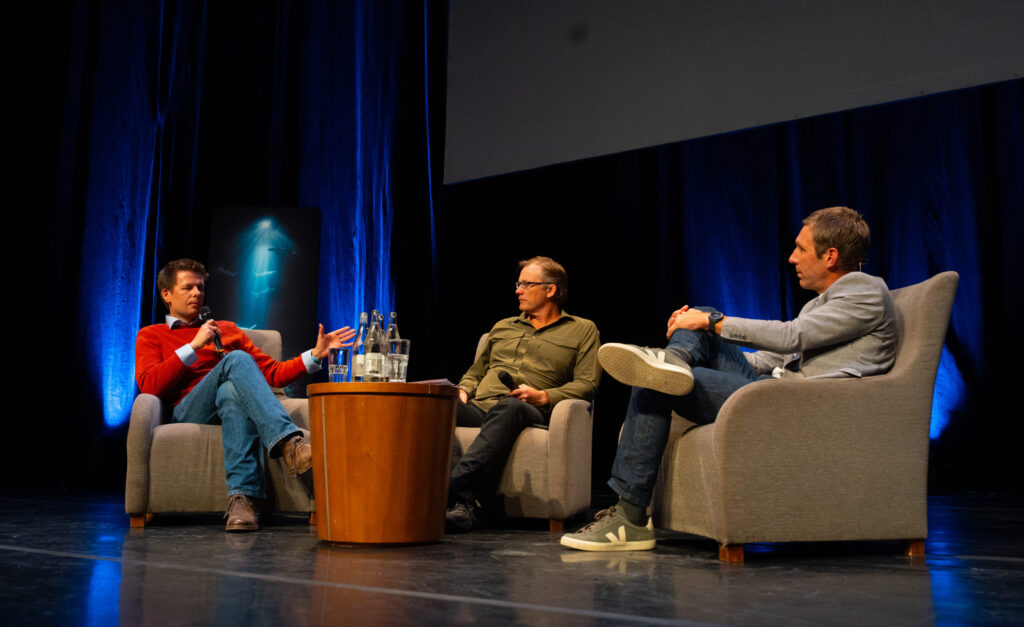
Dr James Lea (left), Craig Foster (middle), and Christophe Ungar in conversation. Photo by Mathilda Leibzig | © Save Our Seas Foundation
After the Kalahari Desert, Craig focused his efforts on forging connections with the natural world right on his doorstep. For him, that meant diving every day in the Atlantic Ocean off the Cape Peninsula, near Cape Town. It was a journey that would ultimately lead him to meet an octopus in the kelp beds that the Sea Change Project now advocates for, and to help create the Oscar-winning film My Octopus Teacher.
‘We’ve got these thousands of messages from people all over the world who’ve been able to connect closer with nature after watching the film. The Great African Sea Forest has now become this global icon, so it’s much easier to do the conservation that’s so desperately needed.’
The message at the heart of My Octopus Teacher was, as Craig says, much the same as the theme of the evening’s discussion.
But how to connect people to the natural world?
One way is through powerful visual storytelling. But for a story to really connect with people, there must be intimacy. It’s hard, says Craig, to generalise and still strike some emotional chord. So, one storytelling tool is to connect audiences to the personal lives of individual animals that become ambassadors for their species and biodiversity.
Another way is to follow our individual connections to an animal or a place. And it was in this way – through the journey that was documented in My Octopus Teacher – that Craig says he also became more comfortable in himself, inhabiting nature that he’d felt an outsider to when living among the San. ‘This experience with this octopus and diving every day … I started to get that feeling of being inside nature and I was much more comfortable in myself when that started to happen.’
Photo by Jannes Landschoff | © Sea Change Project
Connecting with wild creatures
One result of our disconnection from nature is that we have lost our sense of place in the world; that false idea of hierarchy that Henry Beston was speaking about in Outermost House. We have relationships with animals; sometimes profound ones, with pets and domestic animals. But our true reconnection to the natural world, and the restoration of our place within it, relies on a shift in the power dynamics: it must be on their terms.
‘The difference,’ proposes James, ‘is choice.’
Pets are often beloved family members, but the difference with a wild animal, says James, is that ‘it’s their choice to approach you’.
And our concept of ourselves as somehow exceptional – more curious, more intelligent than any other species – is deeply flawed. A misconception, perhaps, that betrays our diminished ecological understanding. ‘Animals are in many ways, I feel, far more intelligent than we are, and are far better at survival than we are,’ says Craig.
Our ancient brains still seek nature
‘You sometimes forget that for 97% of our time as a species living on this planet, all early people had relationships with at least a hundred animals and thousands of plants. We had these close relationships with and understanding of our wild kin. And only very recently in our history has that suddenly been cut off. So that’s why I think it’s so important to try and include ourselves, connect ourselves back to our wild origins.’
What Craig is echoing here is what EO Wilson called ‘biophilia’ and what Erich Fromm first pointed out as our innately human drive to seek out what is living. It is a drive that is deeply rooted in our evolution; only recently have we been plucked out of the natural world we evolved in and placed in urban, industrialised settings (although there are still people whose culture and spirituality are still intricately connected to the earth). Our Homo sapiens hunter-gatherer brains haven’t caught up with our neon-lit, traffic-scored, digitally-suffused 21st-century cityscapes.
‘I think that, you know, every person is born wild,’ says Craig. ‘We’ve had 300,000 years of our species; two million years of our hominid line – even longer, in many ways. And only in this tiny, last bit have we changed. And it’s actually traumatising at a deep level.’
Photo by Jannes Landschoff | © Sea Change Project
What does disconnection do to our brains?
There is much written about the need for a connection to nature that will foster the desire to care for a natural world that we know and understand. We need to fix our relationship with nature and end our destruction of species and ecosystems that deliver us a host of life-sustaining services. To do that, we need to value what nature provides for us, understand our impact on it, and want to reconcile our actions with our need for a life-sustaining planet.
But the value of contact with intact nature is not just about our survival. We also need nature to thrive. It has, as Craig and James both affirm, a radical effect on the human psyche.
‘Being in a place like [D’Arros Island, Seychelles], surrounded by so much abundance and diversity of life … you almost forget about everything else,’ says James, discussing a video clip that showcases the near-pristine region of Seychelles’ Amirantes where the SOSF D’Arros Research Centre (SOSF-DRC) is based. ‘The most present I’ve ever felt is in this place.’
And as our access to places with intact ecosystems, wildness and pristine life dwindles, an entire sector of research to investigate the impact of nature on our stress-addled, urbanised and techno-focused brains has opened up.
‘When you wake up in the morning and you hear the birdsong, you kind of feel “ah” – you remember. That’s a million years’ worth of remembering that,’ adds Craig.
Science agrees with James and Craig. Studies have shown that birdsong has a real effect on our brains. For one thing, it reduces irritation from traffic noise. Contact with nature can improve your mood, focus your attention and reduce stress and anxiety. Researchers posit that anxiety and depression cost Europe €187.4-billion annually] – negative feelings that reflect a rising concern linked to urbanisation and our increasingly sedentary lives, and the severance of the connection between ourselves and nature.
Of such concern is our disconnect and its consequences on our health, well-being and proclivity to care for our environment that it has been given a name: ‘the extinction of experience’. Lepidopterist (butterfly and moth scientist) Robert Pyle coined the term in his 1993 memoir The Thunder Tree, writing ‘As cities and metastasizing suburbs forsake their natural diversity, and their citizens grow more removed from personal contact with nature, awareness and appreciation retreat. This breeds apathy toward environmental concerns and, inevitably, further degradation of the common habitat… So it goes, on and on, the extinction of experience sucking the life from the land, the intimacy from our connections … people who don’t know don’t care. What is the extinction of the condor to a child who has never known a wren?’
What do we lose when we disconnect from nature?
‘We’re just not getting the nature that we need,’ says Craig. He cites ‘nature deficit disorder’, a phrase first used by Richard Louv in 2005, when he described the chasm that has been opening between us and nature. Louv’s particular concern was for children and teenagers who experience less outdoor play, are less in contact with natural spaces and wild creatures, and whose vocabulary has been haemorrhaging terms that keep our cultures linked to our origins. So pronounced has this disappearance been that nature writer Robert MacFarlane penned The Lost Words in collaboration with artist Jackie Morris as a response to the Oxford University Press Junior Dictionary culling words like bluebell, heron, acorn and kingfisher.
And so, what of it? Why can’t children be as content on asphalt with all the virtual offerings of our digital age?
To borrow from Aldo Leopold, ‘We only grieve for what we know.’ And researchers have long been cautioning that ‘nature deficit disorder’ and the ‘extinction of experience’ are cooling our affection for nature. Social ecologist Stephen Kellert wrote in 2002 that society has become ‘so estranged from its natural origins, it has failed to recognise our species’ basic dependence on nature as a condition of growth and development’.
The consequences, warn researchers Masashi Soga and Kevin Gaston, include our declining mental health, a rising public health crisis, our increasing inability to identify (and empathise) with nature, and a decline in pro-environmental attitudes and behaviour.
Photo by Jannes Landschoff | © Sea Change Project
What’s the fix?
The good thing, reassures James, is that nature is astoundingly resilient. ‘We need to increase biodiversity everywhere and give spaces for animals to flourish wherever we possibly can,’ chimes in Craig. This includes, for him, a shift in our priorities and focus to invest in rewilding, green corridors and allowing nature to return and replenish wherever we can. Science should inform the continued creation of safe places where sensitive habitats and highly threatened species can recover.
There are numerous reasons for this conscious effort: climate resilience, the restoration of the ecosystem services we need to survive (everything from the pollination of food crops to the provision of clean water hinges on biodiversity delivering life-giving functions), social justice, job security and our ability to survive on the only planet that has evolved to function as our home. But the themes Craig and James return to are these: we need nature to survive, and to thrive. We are only better, healthier humans – physically and psychologically – when we have equitable access to the nature we need.
And in the growing absence of first-person experiences to jolt us awake, powerful natural history storytelling steps into the breach. The detailed, personal re-connections delivered through films like My Octopus Teacher and Older Than Trees (a film about a hopeful future for sharks and rays centring on James’s life as a shark biologist and directed by Oscar-winning Pippa Ehrlich) serve as reminders of what we are allowing to slip away from us. And they give us glimpses of what a rekindling of our connection to – and affection for – those ‘other lives’, as Henry Beston dubbed them, can do to enrich us.
Watch James, Craig and Christophe in conversation and listen to their insights into how storytelling is particularly important and impactful for sharks (and our perceptions of them). And how the story we tell ourselves needs to shift from one of consuming from nature to communing with nature: caring for ourselves, each other and our planet, the axis on which our very survival depends.
You can watch Older Than Trees here.