
ZoMBiE’s Take New Orleans: The 2026 American Elasmobranch Society Annual Meeting
The American Elasmobranch Society (AES) is a global professional society whose mission is to advance research and understanding of elasmobranch fishes (sharks, skates, rays). The Society meets annually, often in conjunction with the Joint Meeting of Ichthyologists and Herpetologists, to share recent research findings, promote conservation, and support student research.
The 2026 meeting took place 8-12 July in New Orleans, LA. This year, the AES meeting hosted a symposium, “Learning from unusual sawfish mortality events: causes, effects, and conservation applications.” Since early 2024, there has been at least 45 mortalities in Florida, coupled with hundreds of accounts of a fish “spinning disease.” The symposium brought together researchers, conservationists, veterinarians, and government officials to share collective knowledge around the potential causes and consequences of this unusual mortality event.
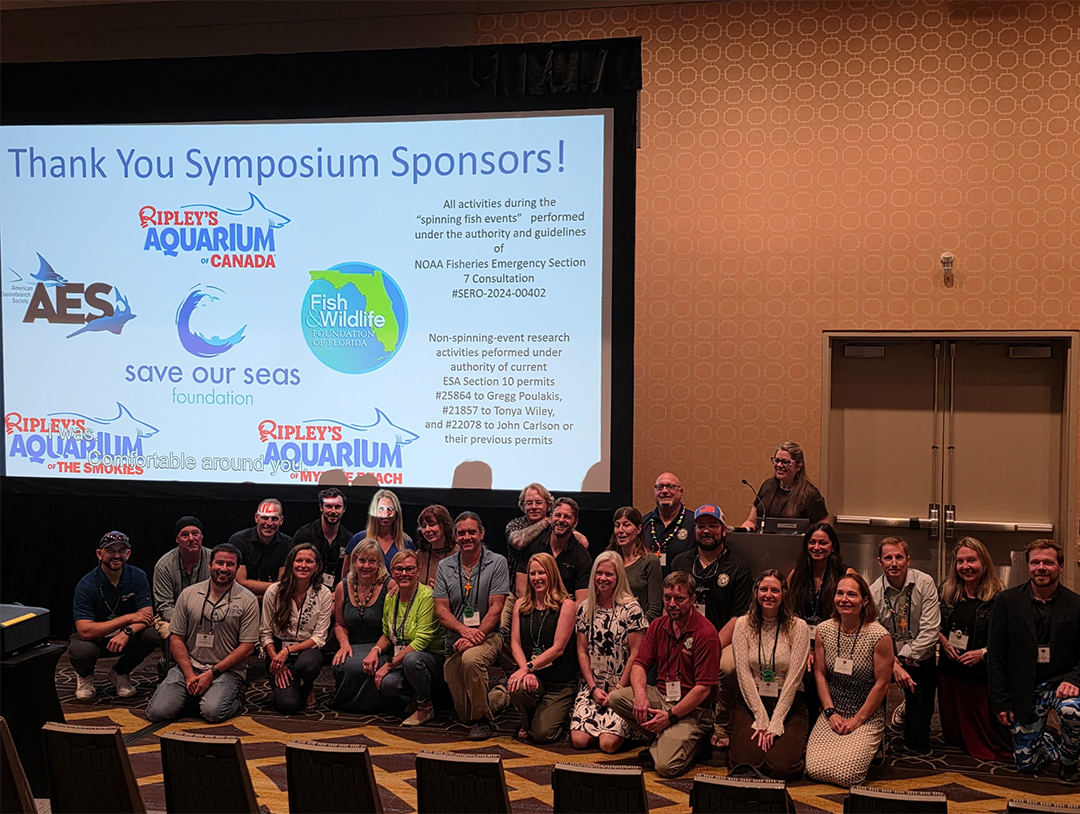
Organizers and presenters in the 2026 sawfish symposium, “Learning from unusual sawfish mortality events: causes, effects, and conservation applications.” Photo by © Emily Sapp
ZoMBiE Lab members (University of North Carolina Wilmington, UNCW) Dr. Kara Yopak, Dr. Emily Peele, and Maria Pierce were fortunate enough to attend this symposium and participate in the collective efforts to understand this event, learn from one another how to manage responses in the future, and hopefully develop mitigation strategies around potential causes. Graduate student Maria Pierce gave an incredible presentation in the symposium entitled, “Using MRI to Assess Brain Growth & Morphology of the Smalltooth Sawfish, Pristis pectinata, for Comparison to Neurocompromised Individuals from the 2024 Spinning Event.”
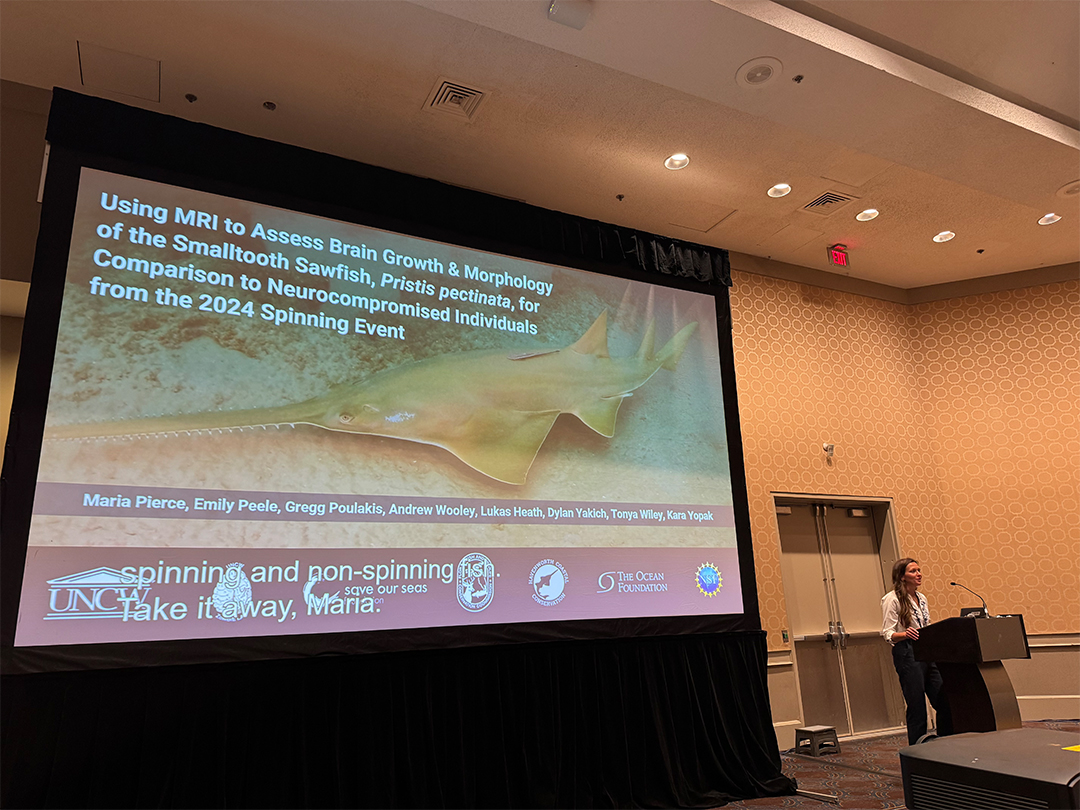
Graduate student Maria Pierce presenting preliminary data on changes in the brain in neurocompromised smalltooth sawfish at the 2026 AES Meeting in New Orleans, LA. Photo by © Kara Yopak
Here, she shared some of her SOSF-funded work quantifying how the brain of the smalltooth sawfish grows and changes throughout life (see this blog post for more info) and how we are using these patterns of brain growth to better understand changes in the brain that may underly this “spinning” behavior in sawfishes. Early results are showing broad neural anomalies, and we are now working to identify the brain regions where issues might be localized.
Attendance at this conference also allowed us the opportunity to connect with our close collaborators on this project – Dr. Gregg Poulakis (a Researcher at the Florida Fish and Wildlife Conservation Commission and founding member of the US Smalltooth Sawfish Recovery Implementation Team) and Tonya Wiley (President of Havenworth Coastal Conservation and Team Leader of the US Smalltooth Sawfish Recovery Implementation Team).
We were thrilled for the opportunity to share our early findings in this important research and connect with researchers worldwide who are invested in the research and conservation of sawfishes.
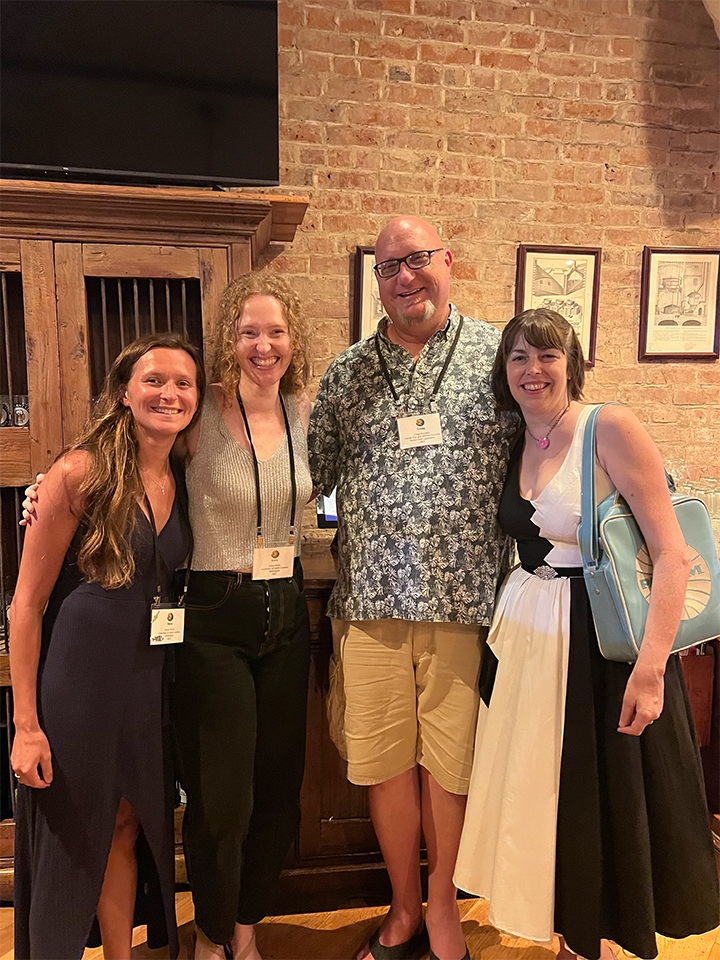
ZoMBiE Lab members Maria Pierce, Dr. Emily Peele, and Dr. Kara Yopak connecting with SOSF collaborator Dr. Gregg Poulakis at the annual AES meeting in New Orleans, LA. Photo by © Kara Yopak
A project such as this requires collaboration across a massive team of amazing researchers. In addition to support from SOSF, this work is bringing together FWC, the Fish and Wildlife Foundation of Florida, Havenworth Coastal Conservation, and the Bonefish Tarpon Trust
Want to read more about some of our lab’s work? Check out our publications page!