
Where have all the whale sharks gone?
A declining population — and a clue found 1,200 kilometres away
Every season, the Madagascar Whale Shark Project team heads out to sea to survey the waters of Nosy Be, northwest Madagascar, with the same mix of excitement and hope. We look for juvenile whale sharks, now a 546-strong population, one of the biggest in the Indian Ocean, who feed at the surface seasonally on baitfish; specifically juvenile sardine and anchovy species.
The bay feels familiar — mainland Madagascar on the horizon, the beautiful calm blue water, the baitfish flickering at the surface. And we hope, a whale shark under the baitball.
But over the years, something feels different. The water is becoming unusually clear. And our searching time, by sight only, increases exponentially. Day after day, we return to shore with fewer sightings than the season before.
This year marks our eighth field season, where we recorded 67 encounters with just 39 individual whale sharks — the lowest number since we began our monitoring work in 2015, when we identified 113 sharks in one three-month season. Despite our efforts to go out as often as we could, vary itineraries and timing, and rely on other operators to collect data, the sharks simply weren’t there the way they used to be.
Since 2022, the numbers have been falling steadily, without an obvious explanation. This year, that decline continued, and we wonder: where have they gone?
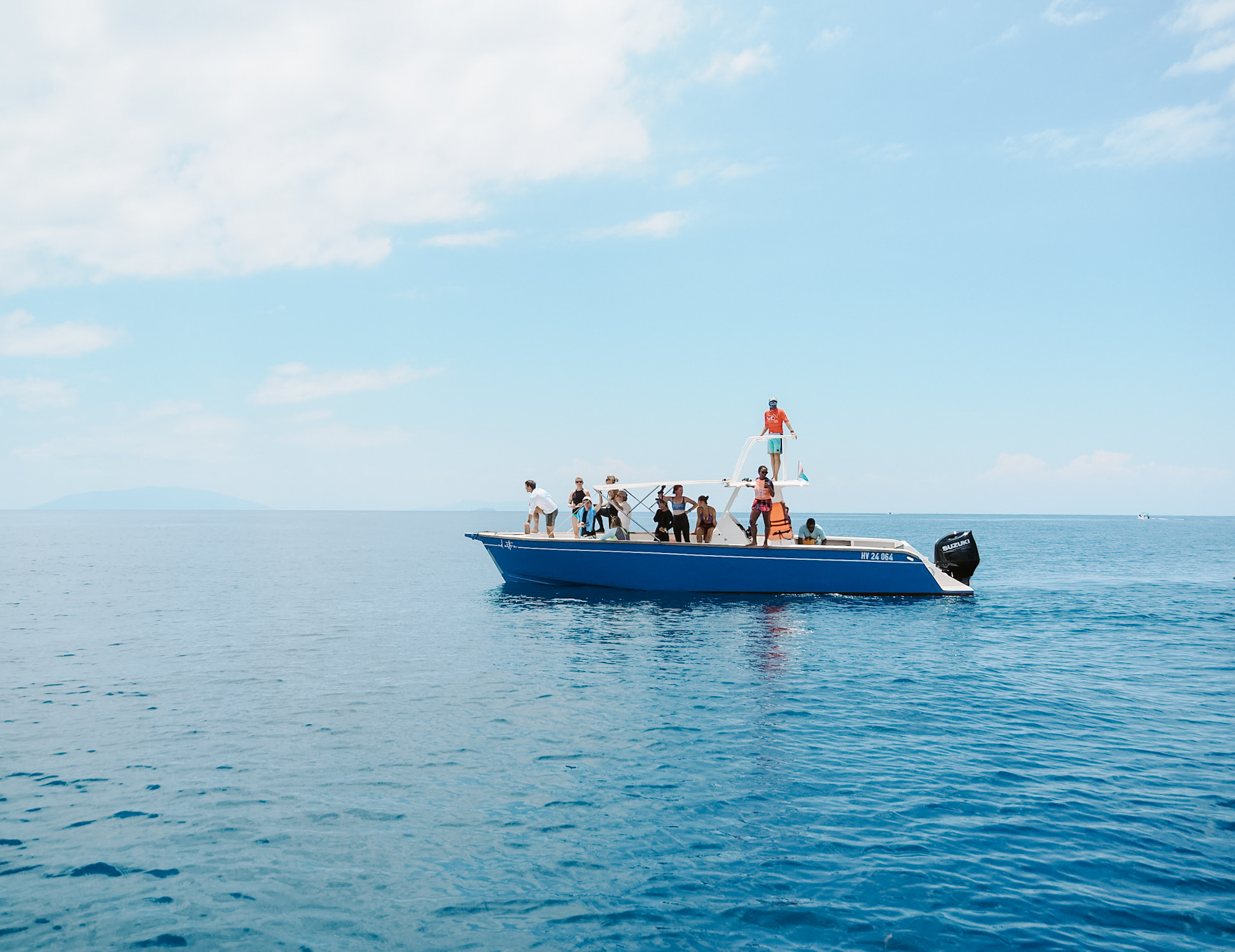
The Madagascar Whale Shark Project team out at sea. Photo © Alizée Guimbaud
Something is changing
One hypothesis we are considering is that the sharks may be shifting their range. Whale shark prey — baitfish and plankton — is influenced by ocean temperature and productivity. The unusually clear waters we observed this season may suggest a change in the plankton-rich conditions that bring sharks to Nosy Be in the first place. Climate-linked changes in ocean productivity may be pushing their food, and therefore the sharks themselves, elsewhere.
We started to wonder, did they move somewhere else, where there are better conditions, and plenty of food?
And then, in December 2025, we found a clue.
In light of the observed decline, we contacted whale shark scientists in the region, to check whether whale sharks from Madagascar could have visited a different feeding aggregation. In particular, we wanted to find out what was happening in the Seychelles, where a similar declining trend had occurred a decade ago, but since a few years, the whale sharks seem to be back.
Thanks to the collaboration of the Marine Conservation Society Seychelles (MCSS), we compared identification photos from both Seychelles and Madagascar using the I3S photo-matching program. One individual from our database — a whale shark we named Mistral, recorded in Nosy Be back in 2019 — had turned up in Seychelles waters in 2025. More than 1,200 kilometres away.
This is the first confirmed movement of a whale shark between Madagascar and the Seychelles. It is a rare and extraordinary discovery — and it changes how we need to think about protecting this species.

Photo-ID image of Mistral (MD-393)] Mistral, photographed in Nosy Be in 2019 and later recognised in the Seychelles in 2025. Photo © Madagascar Whale Shark Project
Migrating across borders
Whale sharks don’t follow national borders. Mistral’s journey tells us that the animals we study in Madagascar are part of a wider, transboundary population — one that moves across the western Indian Ocean in ways we are only beginning to understand.
This matters enormously for conservation. Whale sharks are listed as Endangered on the IUCN Red List, and are protected in the Seychelles since 2003. While we have supported a new decree updating sharks and ray protection, they currently don’t benefit from formal protection status in Madagascar. A shark can spend years being carefully monitored in one country, only to swim into unprotected waters elsewhere.
The finding, published in the journal Oryx, is a call for regional cooperation. Long-term monitoring, shared photo-identification databases and communication are the only reason this movement was ever detected. Without them, Mistral’s journey would have been invisible.
Meanwhile, in Madagascar, threats remain real and present. Industrial fishing vessels operate in the wider region, and in August 2025, a whale shark was deliberately killed in the village of Sarodrano in southwest Madagascar. The popularity of swimming with whale sharks, inherently linked to the rise of unregulated tourism, is impacting whale shark behaviour and impacting the animals physically through collisions.

One of the MWSP team members taking a photo-ID. Photo © Stella Diamant
Out of sight but not out of mind
Another hypothesis we have explored, is the presence of whale sharks at depth. From the boat, despite the experience of our field team and eyesight of our skipper, our searching effort remains limited, and depends of cloud cover, sea state and the presence of a whale shark at the surface.
Thanks to our acoustic tagging network — now depending on 20 receiver stations deployed across the bay, is listening for the detections of tagged sharks year-round.
What the data revealed surprised us. On days when we saw no sharks at the surface, 69% of our acoustic stations still registered detections. The sharks were there — feeding at night, moving offshore, staying out of sight. Around 62% of sharks detected at night were absent during the day. It turns out these animals are far more present than what the visual surveys tell us.
This hidden activity — and the fact that 74% of all acoustic detections fall within the boundaries of the proposed future Tandavandriva Marine Protected Area, Madagascar’s first marine corridor linking two existing Marine Protected Areas — strengthens the case for formal protection. We are now working towards management recommendations to support the MPA’s design.
The 2025 season brought us fewer sharks than ever before. But it also brought us one of our most significant discoveries. Mistral’s 1,200-kilometre journey from Madagascar to the Seychelles is a reminder that conservation cannot stop at the surface, or at the border. These animals need protection across their entire range, and as we’ve discovered, the best way to do this is through cross-border and inter-organisational collaboration.
The Madagascar Whale Shark Project conducts long-term research and conservation work on whale sharks and other marine megafauna in Nosy Be, Madagascar. The movement paper is published in Oryx (2026). Learn more at www.madawhalesharks.org