
Studying the biology and distribution of common and rare batoids in the North Aegean Sea, Greece
The Mediterranean Sea is home to some of the world’s most threatened shark and ray species, yet many aspects of their biology and behaviour remain poorly understood. In this context, the study “Biological traits, distribution patterns and spatial segregation of common and rare batoids in the North Aegean Sea, Greece” provides important new insights into the ecology of skates and rays in the North Aegean. Drawing on data collected between 2014 and 2021 through the MEDITS scientific surveys, the research examined nearly 4,000 batoid specimens from at least 13 species. The findings revealed that females were consistently larger than males and that several species reached maturity at smaller sizes compared to other Mediterranean populations, highlighting possible adaptations to local environmental conditions and fishing pressures.
Using advanced modelling approaches, the study also explored how different batoid species are distributed across the North Aegean Sea. Species such as Dipturus oxyrinchus, Raja clavata, and Raja polystigma were found to occupy broad areas, while others, including Raja radula and Torpedo marmorata, were mainly associated with shallow coastal habitats (Figures 1-2). The research further identified patterns linked to age and life stage, with some species showing depth-related segregation between juveniles and adults. These findings are especially significant because many batoid species are frequently caught as bycatch in Mediterranean trawl fisheries, while several populations continue to decline under increasing anthropogenic pressure.
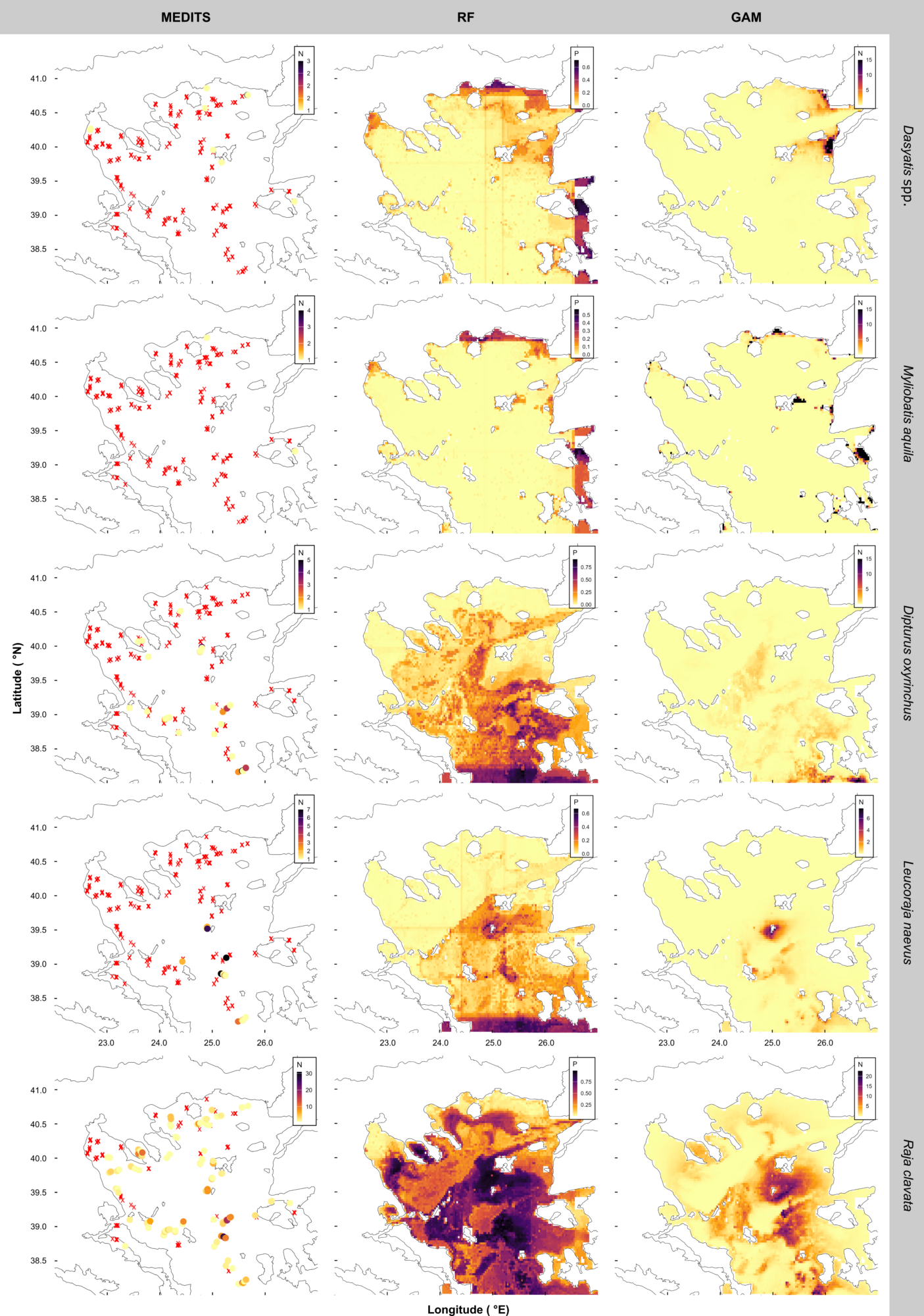
Figure 1: Prediction maps for occurrence and abundance using random forests (RF) and generalised additive models (GAM), respectively, for Dasyatis spp., Myliobatis aquila, Dipturus oxyrinchus and Leucoraja naevus in the North Aegean Sea, Greece. The MEDITS column depicts the raw number of individuals per haul, x: absence; ●: presence. The RF maps display the predictions of occurrence; orange: presence; grey: absence. N: number of individuals.
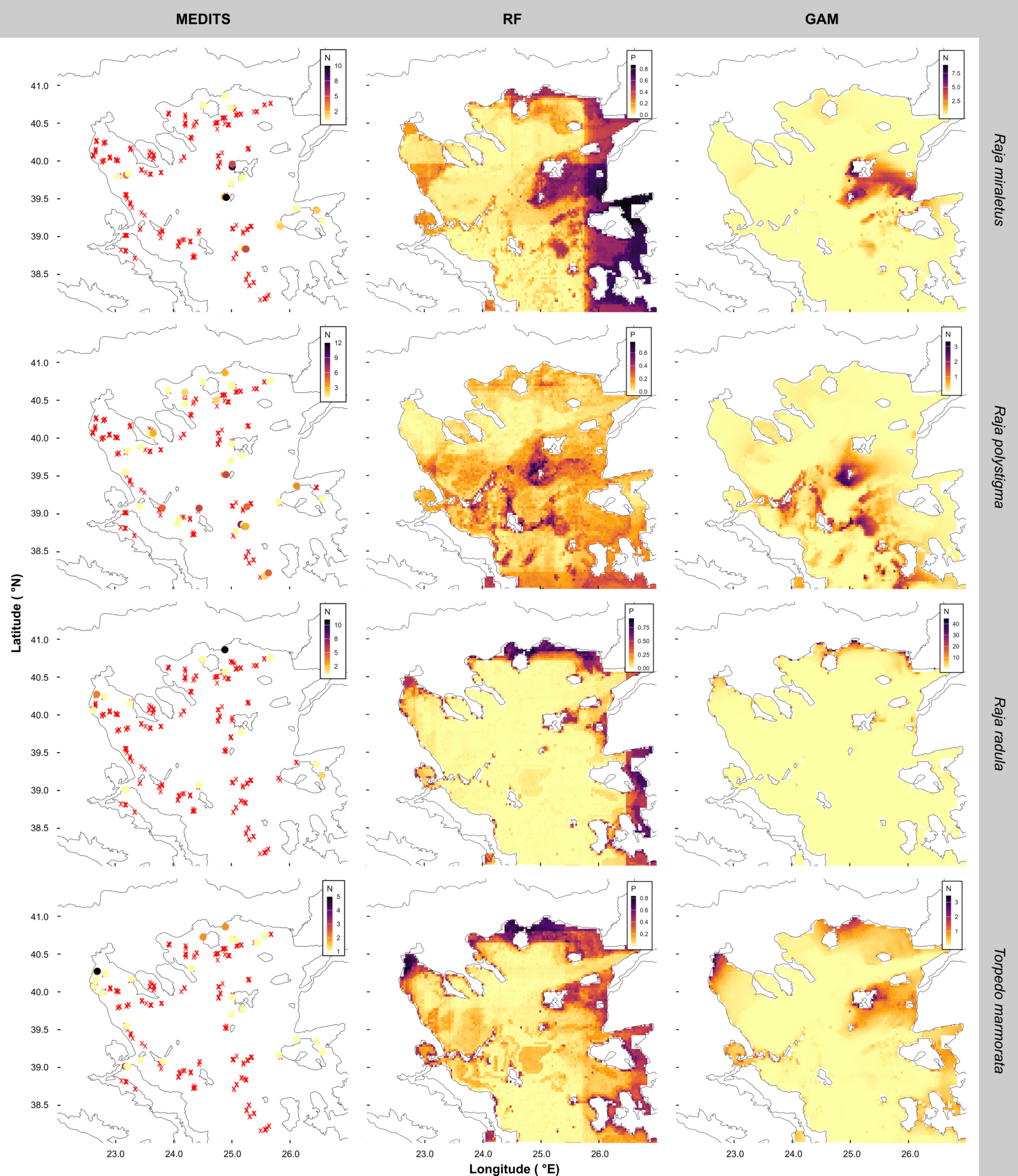
Figure 2: Prediction maps for occurrence and abundance using random forests (RF) and generalized additive models (GAM), respectively, for Raja clavata, Raja miraletus, Raja polystigma, Raja radula and Torpedo marmorata in the North Aegean Sea, Greece. The MEDITS column depicts the raw number of individuals per haul, x: absence; ●: presence. The RF maps display the predictions of occurrence; orange: presence; grey: absence. N: number of individuals.
By improving our understanding of batoid life-history traits, habitat preferences, and spatial ecology, this work contributes valuable scientific knowledge for the sustainable management and conservation of elasmobranch species in the eastern Mediterranean. The study highlights the urgent need to incorporate ecological information into fisheries management and marine spatial planning, including the potential designation of protected areas and targeted fishing restrictions in key aggregation habitats. Ultimately, safeguarding these vulnerable species will benefit both marine biodiversity and the long-term sustainability of regional fisheries.
Special thanks to the staff of the trawler ‘Megalohari’, Zoe Giagkazoglou, and the staff of the Hellenic Agricultural Organization –DIMITRA Fisheries Research Institute for their help during sampling.
The full article is available online here.