
Seychelles Hawksbill Turtle Found Dead in Kenya
On 17 August 2025, an adult female hawksbill turtle washed up dead on a beach in the Kipini area in Kenya. She had been seriously injured with a cracked head and carapace. There was evidence of heavy and continued bleeding at the scene.

Badly injured female hawksbill turtle, previously tagged while nesting at St Joseph Atoll in Seychelles, washed ashore dead on a beach near Kipini Kenya on 17 August 2025. Photo © Abigail Kidd | Ulinzi Africa Foundation
The turtle was wearing two flipper tags, one on each front flipper. Each tag bore a unique identification number on the front and a return address on the reverse side: ‘REWARD RETURN, P.O. BOX 445, SEYCHELLES.’
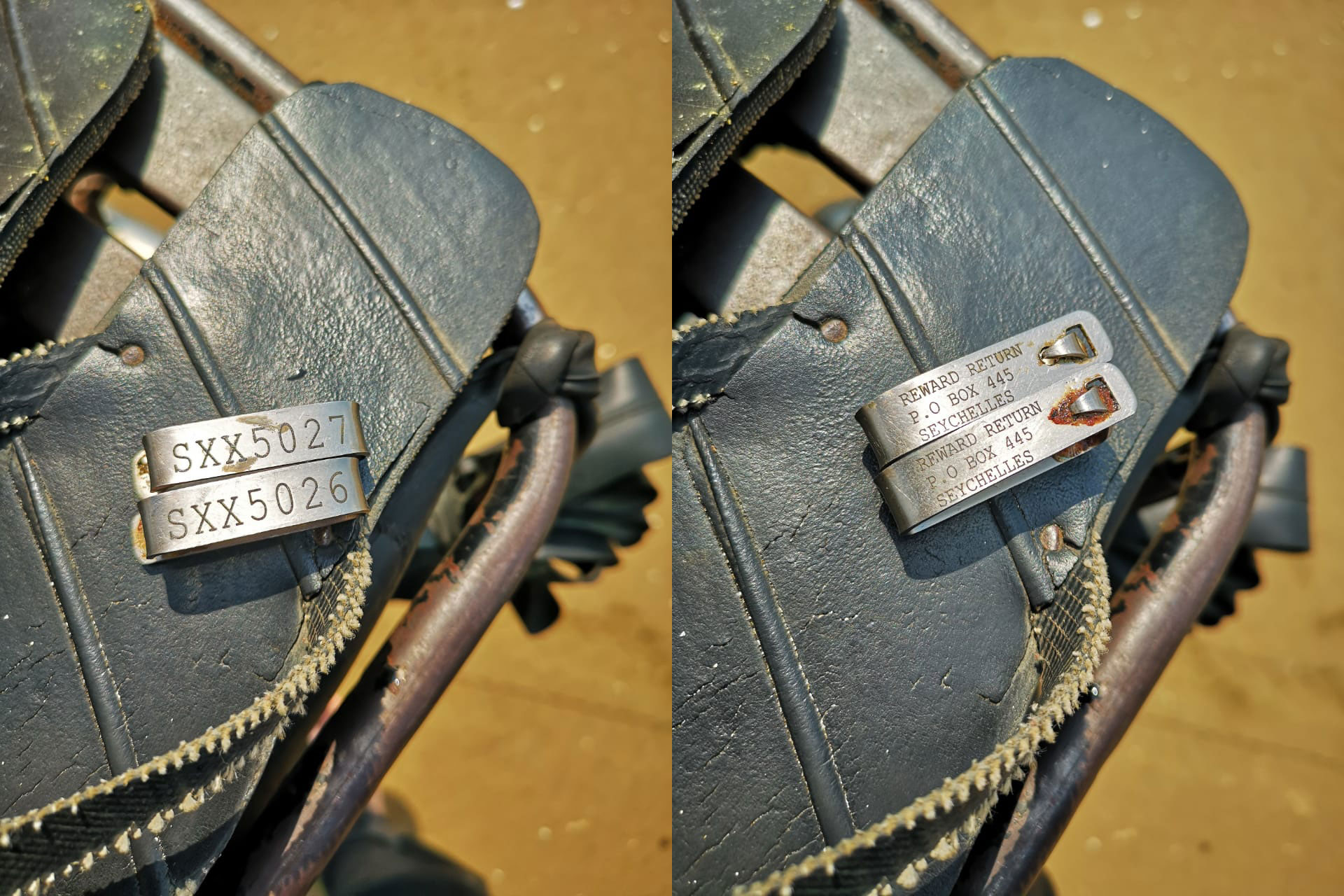
Metal tags found on the front flippers of the dead female hawksbill turtle. Photo © Abigail Kidd | © Ulinzi Africa Foundation
The turtle was found by beach manager Mr Awadh Mbarak Hassan. He and Said Nyara reported the incident to Ulinzi Africa Foundation (UAF) who contacted marine biologist Joey Ngunu at Local Ocean Conservation (LOC) group in Kenya for assistance in tracking the origin of the flipper tags. Conservationist Abigail Kidd who works with Ulinzi Africa Foundation in Kipini learned about the dead turtle, took photos, and sent them to conservationist Annabelle Brooks in Kenya, who contacted Dr Jeanne A Mortimer in Seychelles by WhatsApp the next day, on 18 August 2025. All these events took place within a period of less than 24-hours which shows how interconnected the conservation community of the Western Indian Ocean has become.
During the previous five days, two other turtles reportedly washed ashore dead along the same beach. Trawler activity had been noted in the area during that period, and the turtles were likely caught in trawl nets and died as a result. Sea turtles drown when they are unable to escape from nets.
The flipper tags, SXX5026 and SXX5027, had been applied to a nesting hawksbill by personnel of the Save Our Seas Foundation / D’Arros Research Centre during the most recent 2024-25 nesting season. She was tagged while up on the beach at Banc Coco, an island inside the St Joseph Atoll, at 08:10, on 24 September 2024.
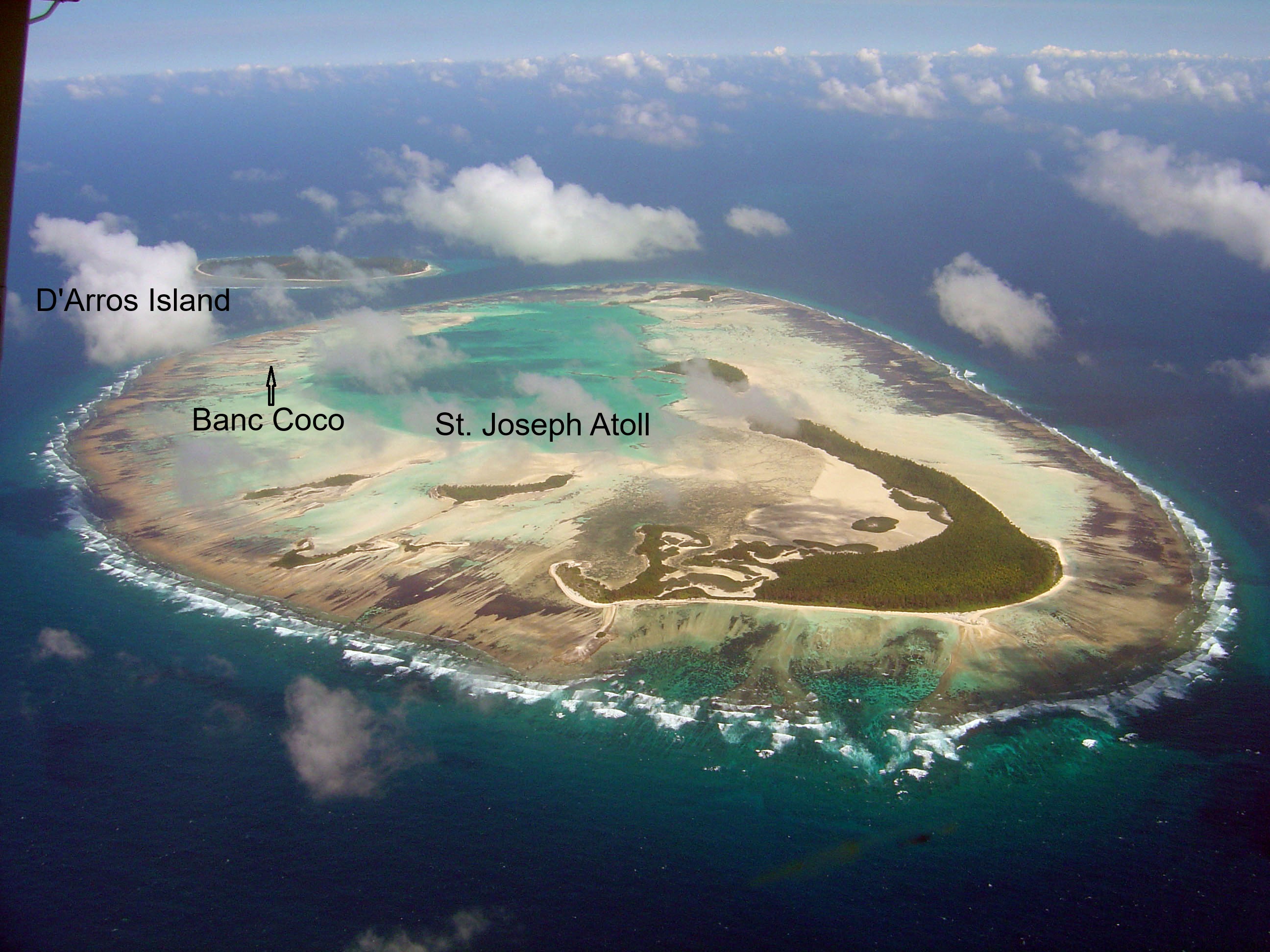
Aerial view of D’Arros Island and St Joseph Atoll where the D’Arros Research Centre is located and managed by Save Our Seas Foundation in Seychelles. The female hawksbill was encountered and flipper tagged while nesting on the small island of Banc Coco on 24 September 2024. Photo © Jeanne A Mortimer | © Save Our Seas Foundation
The team who tagged her included Dr Robert Bullock (Research Director, D’Arros Research Centre) and Alana Robert (Research Trainee, Intern).
In the Kenyan photo, we can see that she did have a lot of barnacles on her, and her left front flipper looks like it might be incomplete. She was quite a large hawksbill, measuring 87 cm in carapace length.
The straight-line distance between St Joseph atoll Seychelles and Kipini Kenya is approximately 1,500 km.
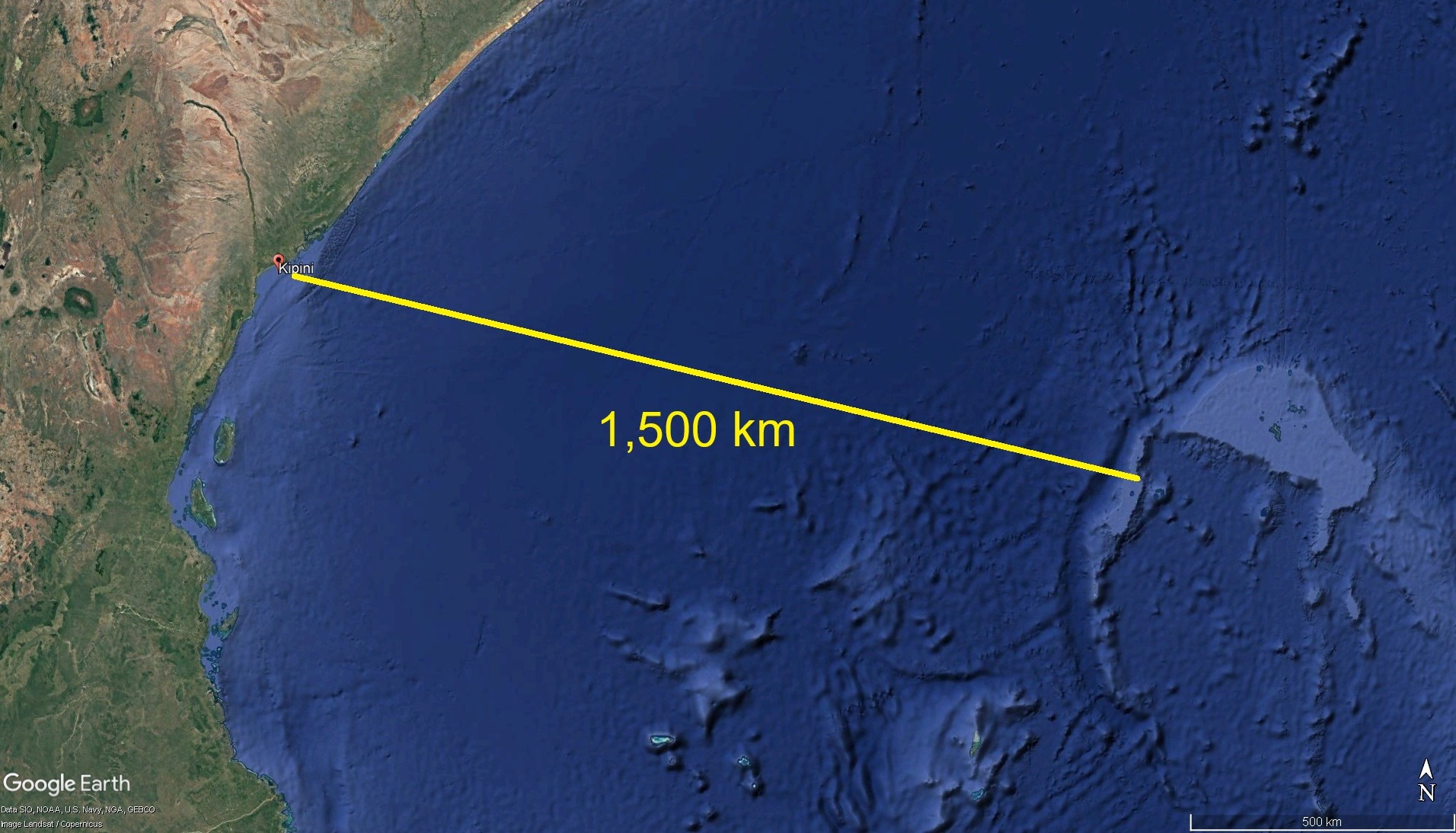
Google Earth map showing the locations of St Joseph Atoll in Seychelles where the turtle was tagged while nesting in September 2024, and Kipini Kenya, located 1,500 km away, where she was found dead in August 2025, eleven months later. Image © Google Earth, imagery date 2025 | Google
Why this observation is important
Satellite tracking studies have demonstrated that when nesting hawksbills depart the breeding beaches of Seychelles at the end of the season, they usually remain in deep waters in the vicinity of the Seychelles Bank, the Mascarene Islands and Madagascar.
This is only the second adult hawksbill from Seychelles known to travel all the way to the East African coastline. The first was also a female, flipper-tagged on a Seychelles nesting beach, but later intercepted at Lindi Tanzania in 2010.
These records show that nesting hawksbills of Seychelles migrate to feeding grounds located much farther west than satellite tracking studies had previously indicated.
Unfortunately, it also suggests that some of them are suffering mortality caused by fishing gear in foreign waters.