
Scientists are also stakeholders: recovering hidden knowledge
When we talk about stakeholders in conservation, we often think first of people who directly use natural resources, such as fishers. However, there is another important group whose knowledge also shapes how we understand marine ecosystems: scientists who have worked in these areas for many years.
Researchers spend long periods at sea, collect data under challenging conditions, analyse results, and publish their findings. Yet not all scientific knowledge ends up in journals or reports. Many valuable observations remain in field notebooks, technical reports, student theses, or unpublished datasets. Sometimes results are considered outside the main focus of a study and remain in the background. In other cases, they simply become forgotten as projects end and new ones begin.
But this knowledge does not disappear. It remains within the experience of researchers who have worked in the field, often across many different projects and regions. When scientists come together and begin asking the right questions, this accumulated experience can suddenly reveal patterns and details that were not obvious before.
In our project, by communicating with scientists who have worked in the Eastern Mediterranean, we were able to look at available information from a broader perspective. Data collected in different years, locations, or for different purposes suddenly became relevant when viewed together. As a result, our understanding expanded not only in space but also in time, helping us see long-term patterns rather than isolated observations. This broader scientific perspective also helped us evaluate our own results more carefully. It allowed us to better understand the limits and uncertainties of our surveys, and at the same time provided a useful background against which we could compare the information shared by fishers.
Conservation science often advances not only through new data collection, but also through reconnecting existing knowledge. Revisiting past work, sharing experiences among researchers, and reinterpreting previously collected data can significantly improve our understanding of ecosystems.
In this sense, scientists themselves are also stakeholders in conservation. Their accumulated knowledge, even when unpublished or scattered across different projects, forms an important part of the information needed to protect endangered species and vulnerable habitats.
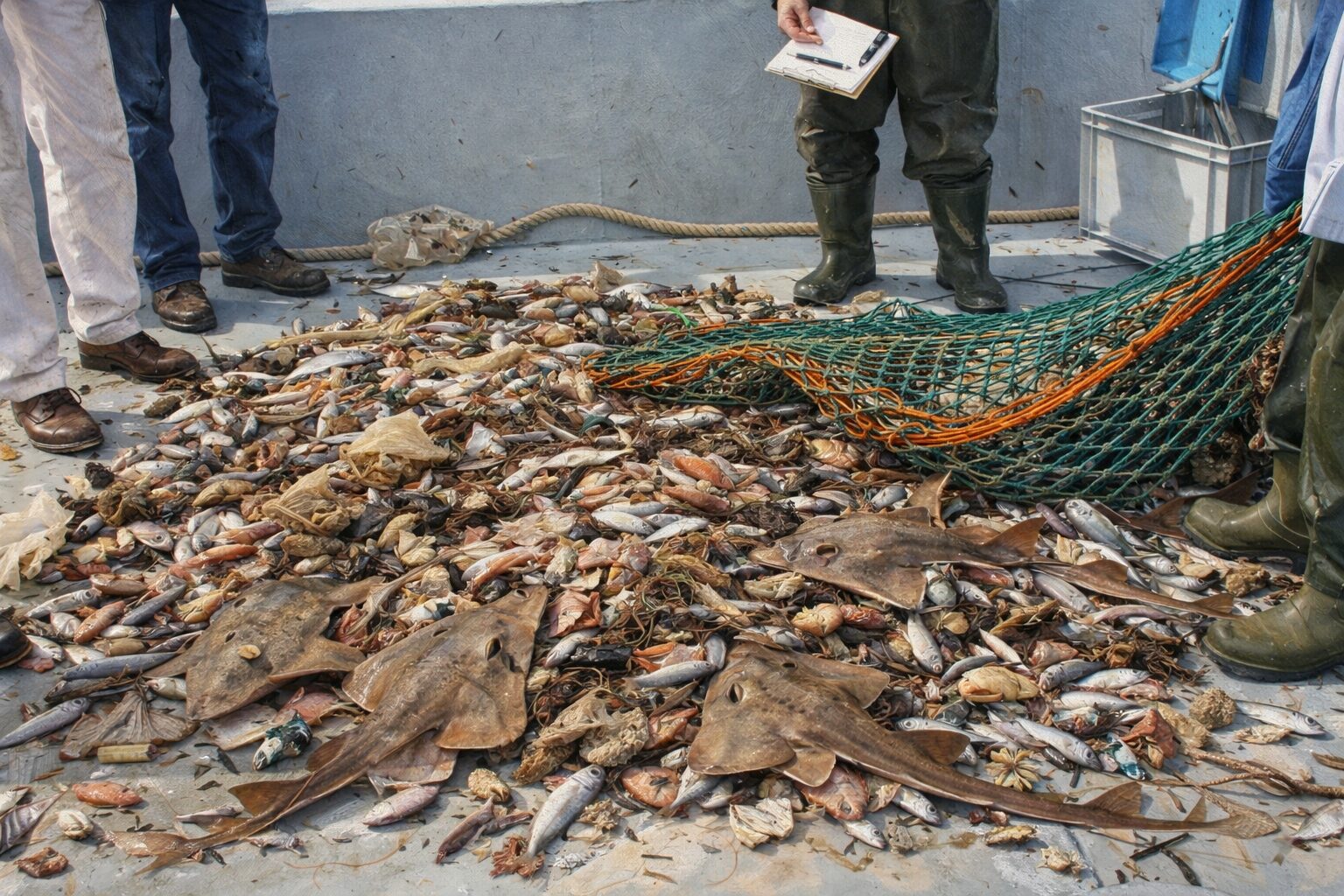
Science at work on deck. AI-enhanced illustration based on original field photographs. Photo @ Ismet Saygu