
Now You See Me, Now You Don’t: Eagle Rays Playing Hide and Sea-k
Over the past three years, we’ve been busy tagging more than 50 common eagle rays (Myliobatis aquila) at four sites along the South African coastline. For the most part, the rays have been pretty predictable homebodies. The False Bay, Algoa Bay, and Port Alfred crews all stuck to their neighbourhoods like loyal regulars at their favourite fish-and-chip shop. So naturally, we thought we had eagle rays figured out. But then the West Coast population decided to throw out the rulebook and pull off the ultimate disappearing act.
In April 2024, Reel Science Co., in collaboration with ATAP (the Acoustic Tracking Array Platform) , deployed the first-ever acoustic receiver array on the West Coast of South Africa at a site known as Varkenvlei. A huge milestone for coastal research. The goal? To monitor the secret comings and goings of the common eagle ray (biscuit skates and blue stingrays were also opportunistically tagged, but that’s a story for another day).
Fast-forward 11 months later, and we’ve got our first batch of results from April 2024 to March 2025, and they’re making waves (pun very much intended).
We tagged 14 eagle rays in total, six in April 2024 and another eight in January 2025. So far, 10 of those rays have checked in, giving us a whopping 3425 detections. Some rays were chatterboxes, pinging more than 1300 times, while others were a bit more mysterious, showing up fewer than 50 times.
Then things got weird.
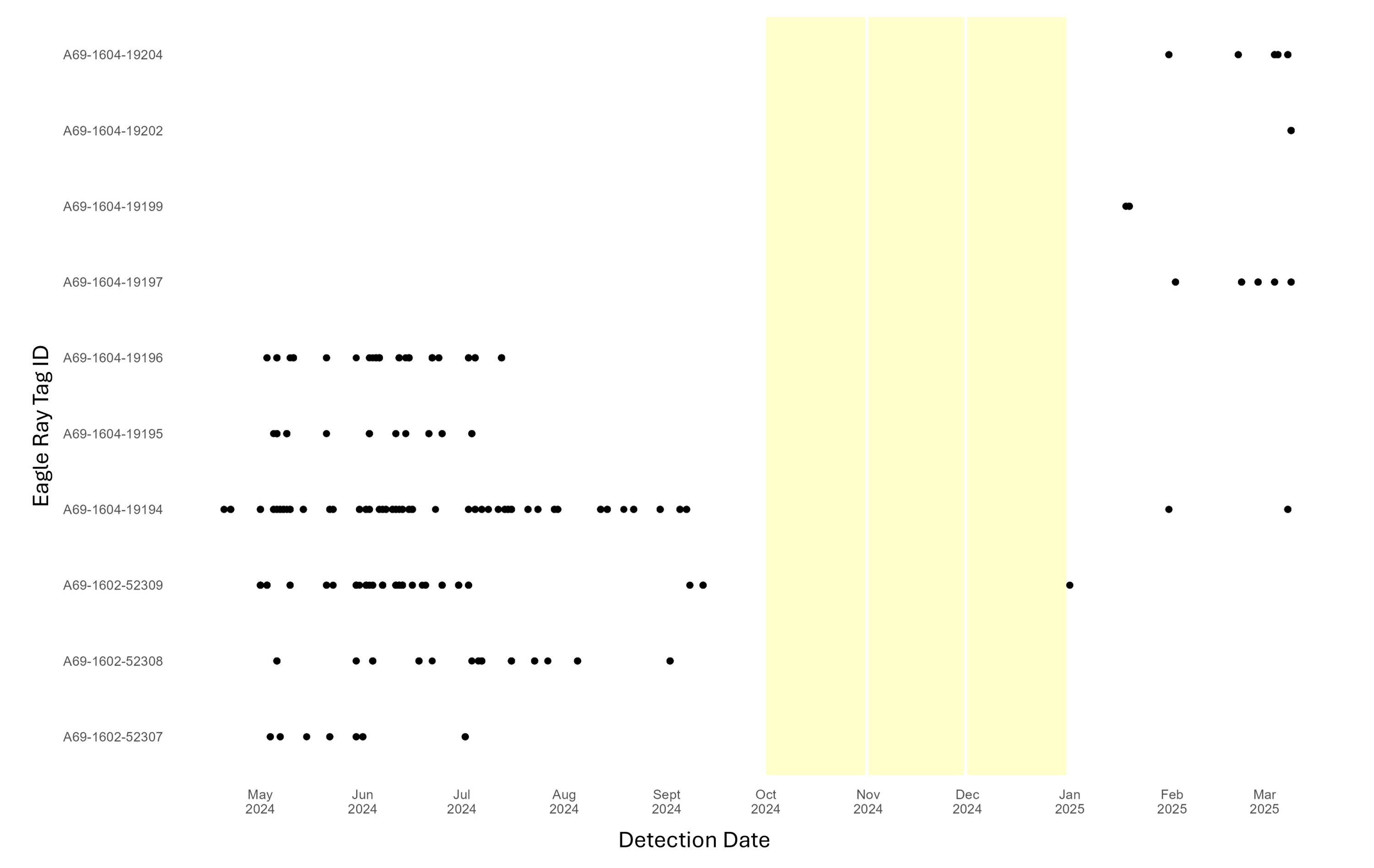
Daily detections of common eagle rays from the West Coast of South Africa. Photo © Michelle Soekoe
The eagles suddenly went quiet from October through December 2024, with barely a blip in January 2025. It looked like our rays had pulled a Houdini right in the middle of summer, which made no sense, because that’s exactly when recreational anglers catch them in their highest numbers from the shore. To double-check, we analysed the West Coast Shore Angling Association’s competition data (2021–2023). Sure enough, 78% of all eagle ray catches happened between October and January – peak summer in South Africa.
So, what gives? Have the rays truly vanished? Not quite.
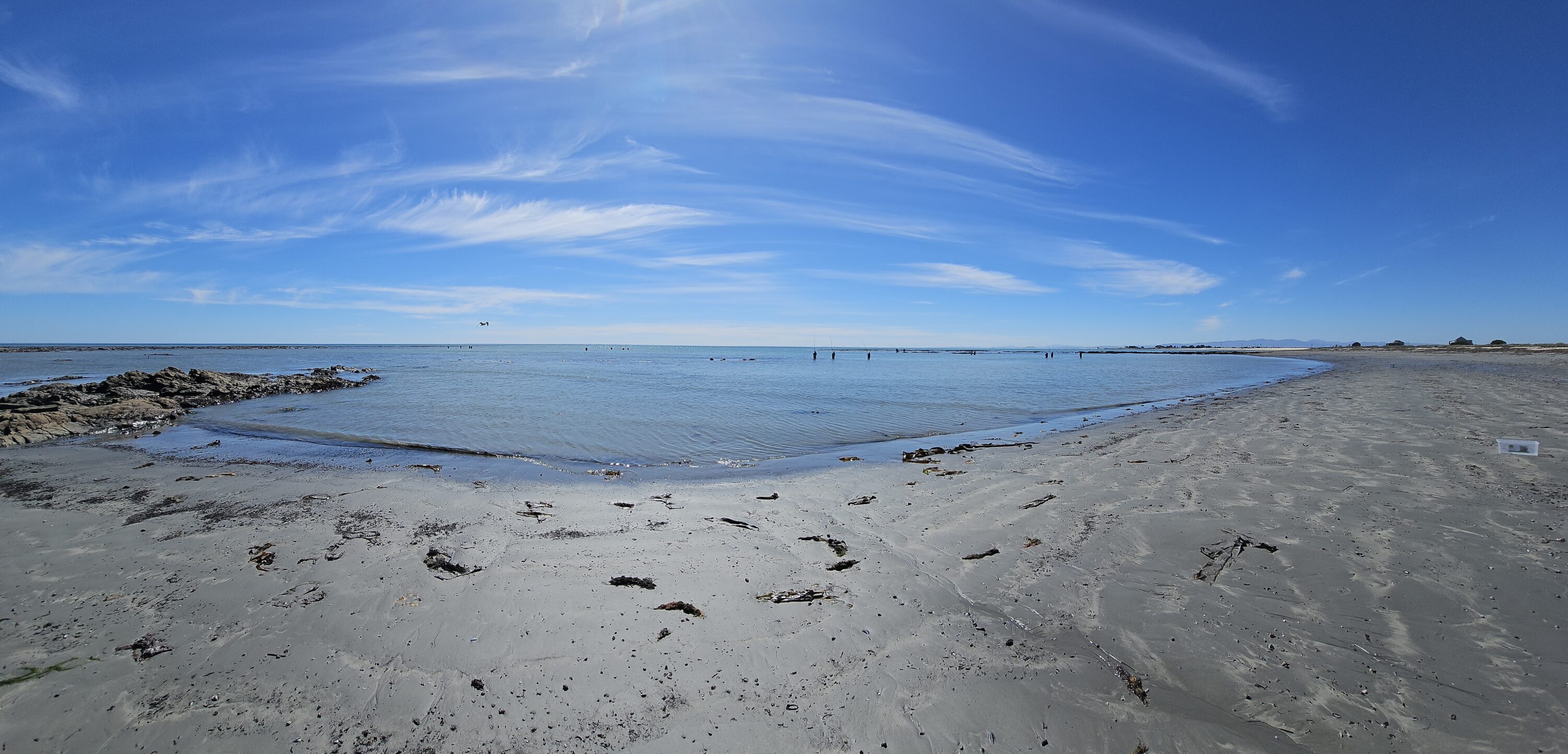
Anglers from the West Coast Shore Angling Association standing in knee-deep, water at Varkenvlei, casting into the shallows where the eagle rays were caught for tagging. Photo © Michelle Soekoe
Our best hypothesis? They’ve simply moved closer inshore, right into the shallows where our receivers can’t “hear” them. In other words, they didn’t disappear; they just ducked off our radar, playing a real-life game of hide and sea-k. And honestly, it tracks! On the West Coast you can literally stand in knee-deep water and watch these guys and gals glide around your legs like they own the place.
And if that wasn’t enough of a twist, it turns out these sneaky rays are also night owls. Of the 3425 total detections, 2560 happened at night, compared to just 865 during the day. Clearly, eagle rays prefer moonlight over the limelight.
So, while our receivers may have been fooled by a few underwater illusionists, one thing’s for sure… these eagle rays know how to keep scientists on their toes. As we continue to decode their movements, one thing has become clear: they’re always around… even when they’re not.