
Before the Bite Off: behind the scenes of cross-disciplinary shark work (part two)
In my last blog, I introduced the complexities of shark depredation, a growing fisheries and conservation conflict within Maldivian reef fisheries. Shark depredation—which is more commonly known in Maldives as miyaru tax (miyaru being the Dhivehi word for shark)—begins with an interaction between a shark and fisher, and snowballs into deeper sustainability issues for fisheries and conservation alike. The goal of our research is to take a cross-disciplinary look at this issue. This means using tools from social science, ecology, physiology, and modelling to gain a more holistic understanding of depredation.
Multi-disciplinary research comes with trade-offs: it is needed to understand human-wildlife interactions, but the more disciplines you incorporate into a research project, the more work it takes to execute. In part one of this blog, I wanted to provide an insight into the training that has gone into this work, and now I’d like to share a behind the scenes look at another riveting part of shark research—the admin.
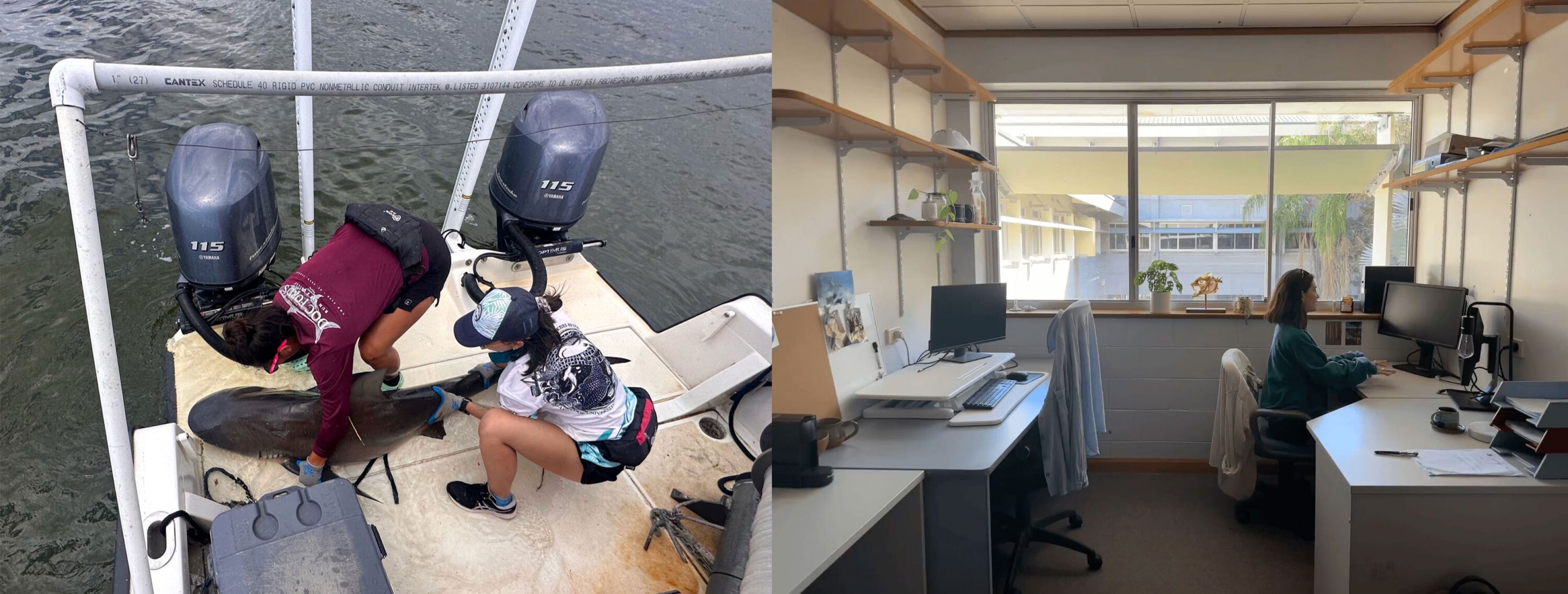
‘Instagram versus reality’: What my research has looked like 30% of the time versus the other 70%. Photo © Mina Hatayama
For the past year, approximately 70% of my workload has been administrative, while only about 30% has been field or lab work. This project is a collaboration between James Cook University, Maldives National University, and Florida State University Coastal and Marine Laboratory—which means triple the paperwork when it comes to applying for research permits and ethics. It also means taking meetings at absurd hours of the day to make time zones work, coordinating agreements between institutions, and triple the communications to ensure that everyone is up to date on research logistics.
As a student researcher, I have learned that being a scientist means wearing many hats. Some days, yes, you get to wear your science hat, but other days you must wear other hats that feel weird and silly looking on your head. Throughout this past year, I have been a finance officer, grappling with budget software and expense reports; an administrator, translating fieldwork into risk assessments; and a customs broker, coordinating shipping and customs clearance of research gear between Canada, Australia, and Maldives. Today, I get to be a blogger, something I’ve never really tried in the past, am not confident with, but learning to do anyways.
It has been a privilege to be able to learn a new skill every day, but at times, it has also felt overwhelming and taxing trying to juggle so many different roles at once. Ultimately, all the admin means that I get to conduct research that feels meaningful and exciting to me. Now, looking at other SOSF project profiles, I feel even impressed because I now know how much work really goes into bringing these projects to life.