
Algoa Ray: Tracking common eagle rays in South Africa
Over the past four years, more than 50 Critically Endangered common eagle rays (Myliobatis aquila) have been acoustically tagged in four main sites along the South African coastline, two in the Western Cape and two in the Eastern Cape, all as part of the greater common eagle ray project led by Dr Michelle Soekoe of Reel Science Co. These sites include Varkenvlei on the West Coast, in the Helderberg Marine Protected Area in False Bay, van der Riets in Algoa Bay, and Kleinemonde along the Port Alfred coastline.
While the project as a whole is progressing nicely – the Varkenvlei rays having almost a year’s worth of data under their belt and the Kleinemonde dataset is now mature – we find our focus shifting to the eagles cruising around Algoa Bay. Situated approximately 110 km west of the Kleinemonde site, Algoa Bay is one of South Africa’s few large sheltered coastal embayments, and is home to many different marine animals, ranging from large megafauna like whales and dolphins, to white sharks and raggedtooth sharks, to prized angling species like dusky kob, white steenbras and leervis, to African penguin and Cape fur seal colonies, to the largest Cape gannet colony in the world! Amidst all this incredible wildlife, the bay is also home to several species of ray, including the Critically Endangered common eagle ray.
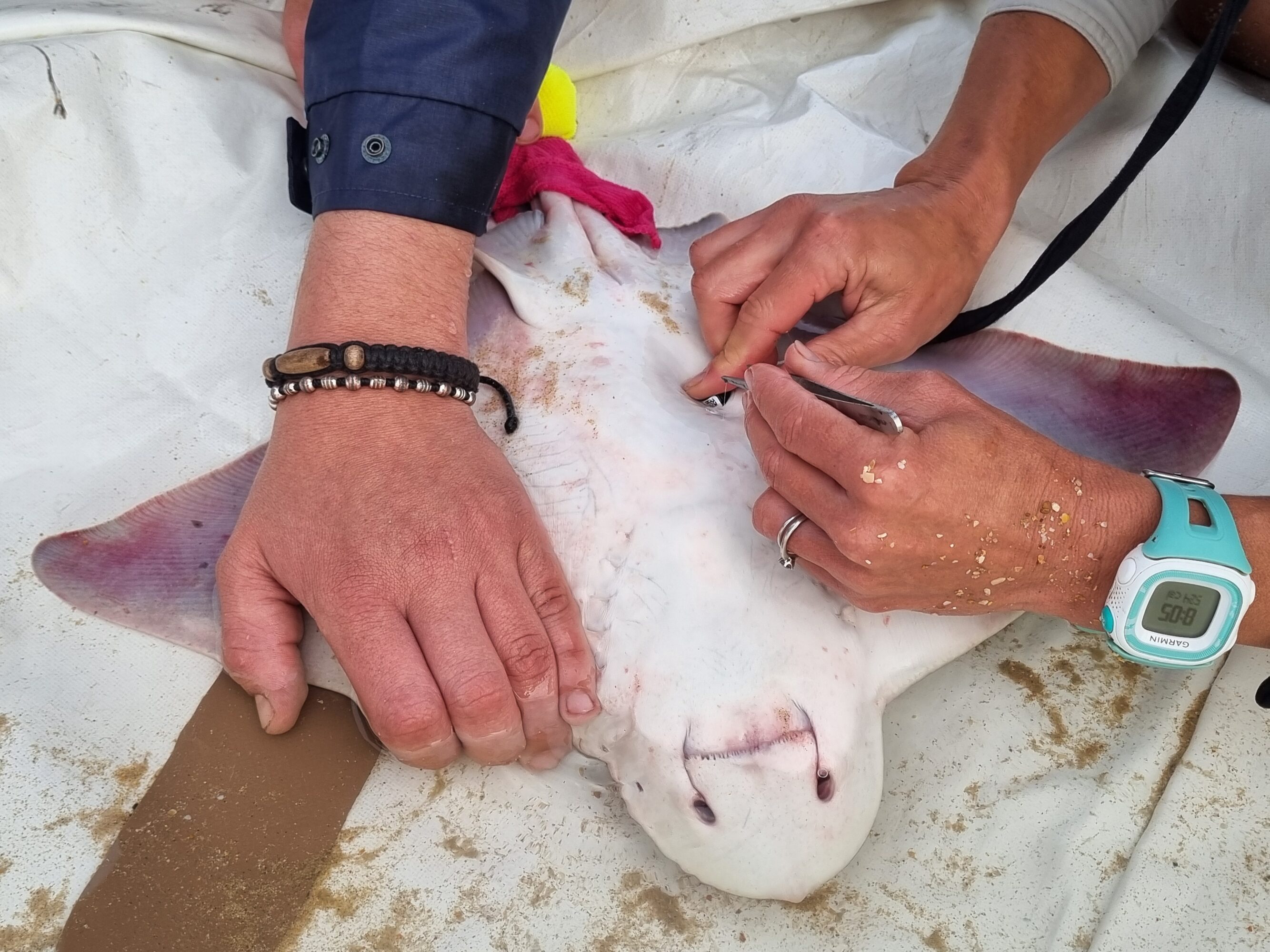
Insertion of an acoustic transmitter into a common eagle ray. Photo © Taryn Murray Berriman
In April 2024, 14 rays were tagged during a competitive angling event (definitely capitalising on all those rods in the water), ranging in disc width from 45 to 75 cm. While data collection is ongoing, several receivers deployed throughout Algoa Bay have been successfully retrieved and downloaded (with many to go), and to say that exciting things are afoot would be an understatement! First of all, all 14 rays have been detected a total of 29 020 times, with the average number of detections per eagle ray being around 2 070. Secondly, there seems to be some interesting seasonal movements happening, with a shift from the more central/western part of the bay to the eastern part of the bay during certain times of the year. This was, however, gleaned from a quick glance, and we would need to do a deeper dive into the data to find out more. There also doesn’t appear to be major differences in movements between sexes, which is interesting. Sharks and rays often display different movement behaviours depending on whether they are male or female. But again, just a quick observation. What we’d give to be a student again to sink our teeth into the data!
All of this tells us four things: (1) all rays survived the tagging procedure (we didn’t have any doubts); (2) they are generally remaining in Algoa Bay, not really moving anywhere else; (3) there appears to be some kind of difference in the area of the bay used depending on what season it is; and (4) there are no apparent differences in movements between males and females.
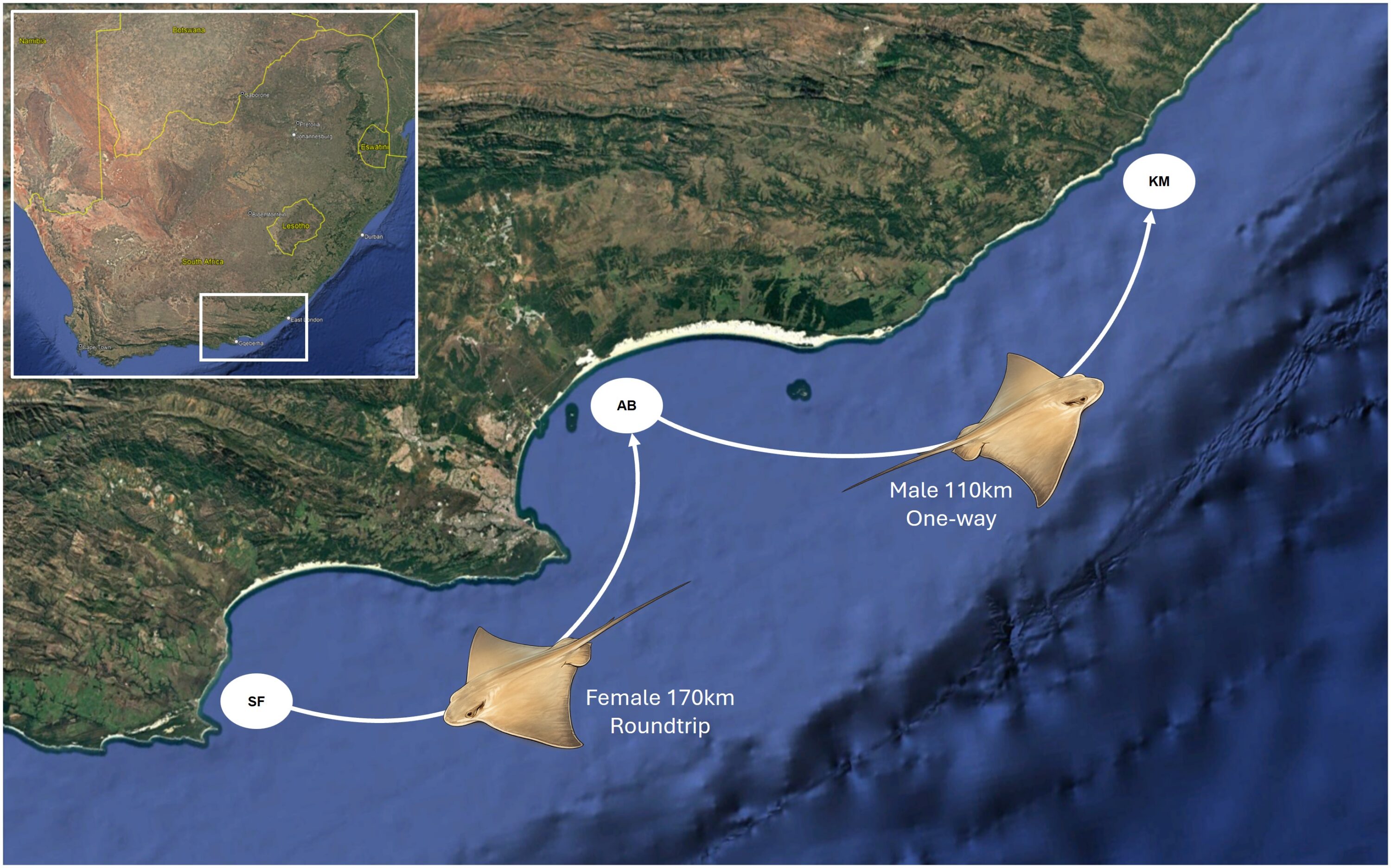
Tracking the big movements of a male and female eagle ray from Algoa Bay (AB) to Kleinemonde (KM) and St Francis Bay (SF). Photo © Michelle Soekoe
Just when we thought things couldn’t get more interesting, two rays decided that Algoa Bay wasn’t quite enough for them and had to broaden their horizons. What makes these two larger movements so interesting is that one was a male and the other a female; talk about a battle of the sexes! The male was recorded visiting its friends in the Kleinemonde array approximately 110 km east, while the female moved 85 km westwards to the neighbouring St Francis Bay, but then still returned to Algoa Bay. So perhaps the females win this round.
What is making this greater eagle ray project so exciting is that each batch of tagged rays appears to be doing something slightly different. We always knew that one species can display varied movements, but this varied? Who knew! Either way, this Algoa Bay batch is really gearing up to be exceptionally exciting. With at least another year of data to collect, we can’t wait to piece together the larger movement puzzle of these rays.