
Age is not just a number for guitarfishes….
Most of the gears that operate along the coasts of Bangladesh are predominantly nonselective, and these catch many tropical elasmobranchs from the Bay of Bengal. Guitarfishes, among them, are weirdly looking fishes that are not-so-popular in our bustling local fish markets, and end up being incidentally caught and brought to the landing centres frequently. These demised guitarfishes, sometimes 200 cm long, are the protagonists of a conservation production, playing the roles of a Lord of the Rings-like scenario. It’s said so because these threatened elasmobranchs hold so much mystery in their vertebral rings, which are often so silly to look at, but signify their conservation efficacies. Ring-like structures in the vertebrae can basically be counted as their age, as they are formed annually through mineral deposition.
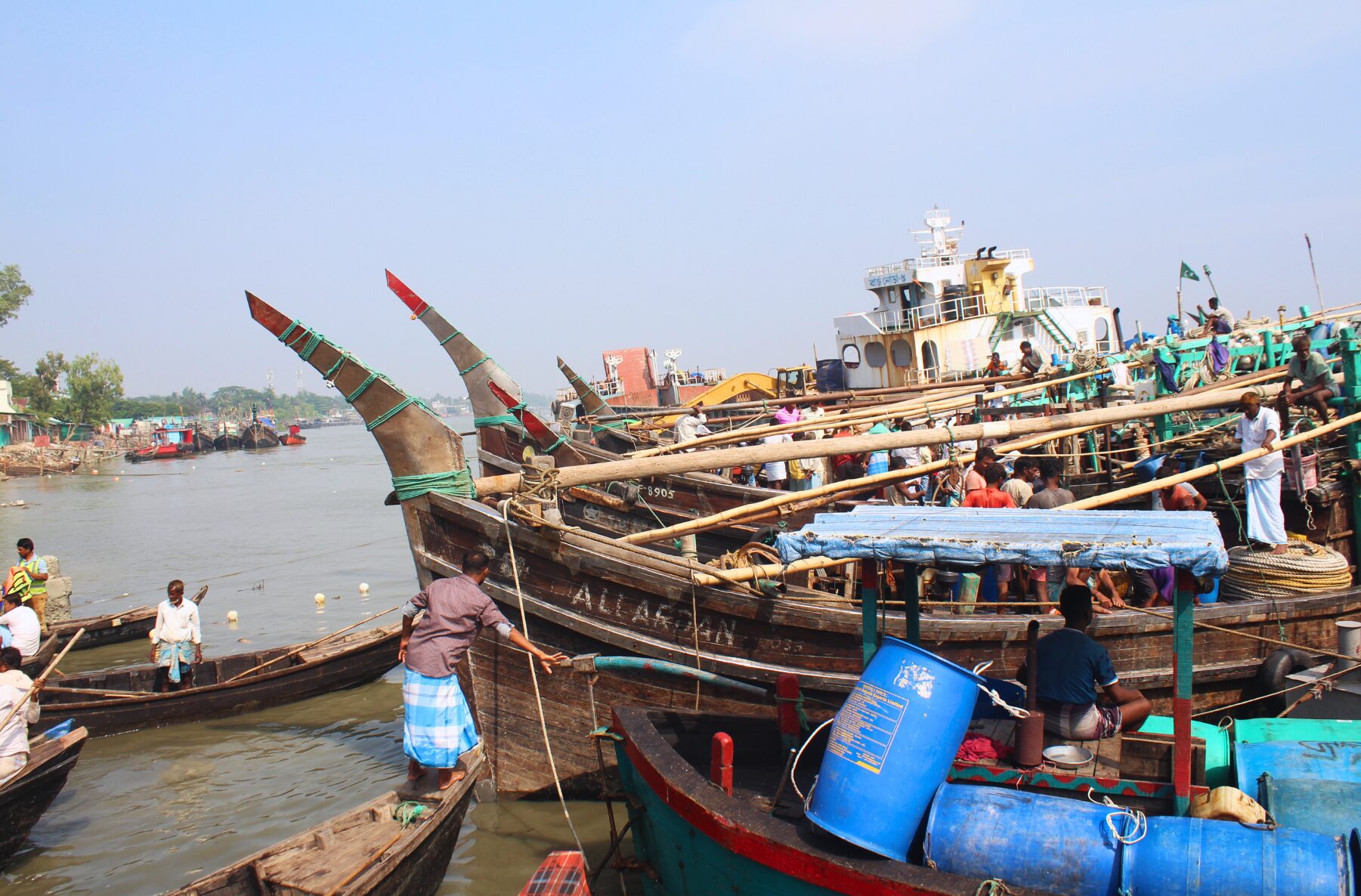
Fishers unloading their hauls in front of the fish landing centre of Cox’s Bazar, Bangladesh. Photo © Nahla Khan | Bengal Elasmo Lab
Before science could advance, we had to be simple customers, buying already dead guitarfishes from fishmongers. Our lab is located far from the coast, making it challenging to transport many individuals in a single trip. Our plan was straightforward: using networks with fishers and traders who willingly help by setting aside specific guitarfishes and storing them until we have enough to work on. Once collected, our team can visit the coastal landing centres to work on the frozen guitarfishes to take the morphometric data and remove the vertebrae. Kudos to our Research & Field Coordinator, S. Khan, who made this significant task possible with his exceptional networking and relationship-building skills. He builds trust and keeps a stable connection with fishers, which, in turn, becomes a powerful tool in sample collection. After this daunting task is completed, the vertebrae are carefully removed, which can then be transported to the laboratory for further processing. After myriad magic spells and tedious hours, the vertebral rings of guitarfishes, which are made of cartilage, the velvet bones, are ready to reveal what they have been holding for centuries. Under the microscopes, different lighting settings make the hideous growth rings visible and interpretable.
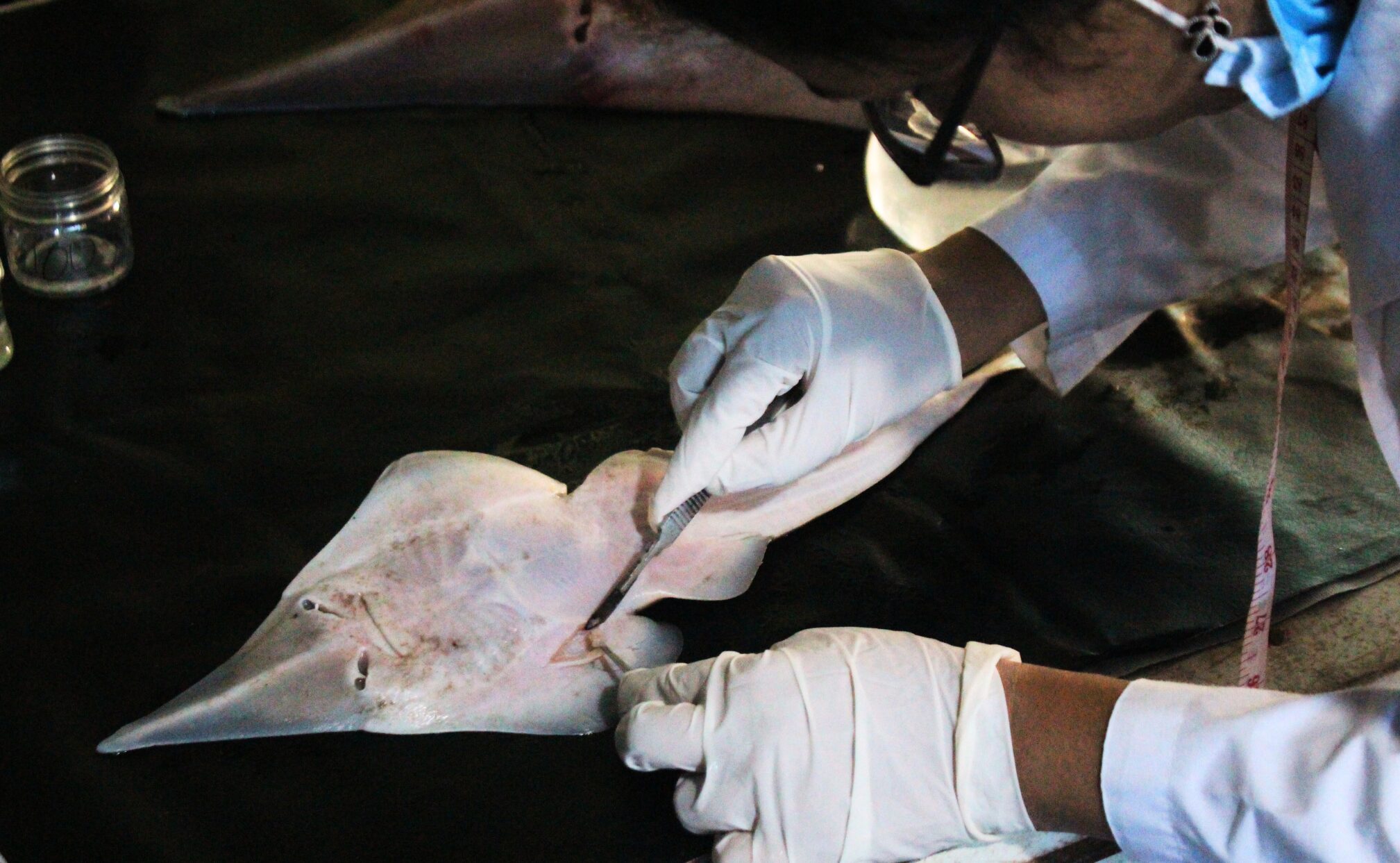
Dissecting specimen for collecting vertebrae and genetic samples at the corner of a fish processing center, Cox’s Bazar. Photo © Shabnom Momtaz & Shahrup | Bengal Elasmo Lab
These glimpses inside these velvet bones speak about how fast they grow, the maximum length they achieve and most importantly, how well they can thrive in our ocean. These all help in connecting the dots, understanding how vertebrae can be the timekeeper, which can even provide the evidence to make the plea to protect the species, more eloquently and more effectively, so that age can actually be just a number, not a time bomb to reveal how vulnerable they become in the current threatening conditions.