
Nina Faure Beaulieu
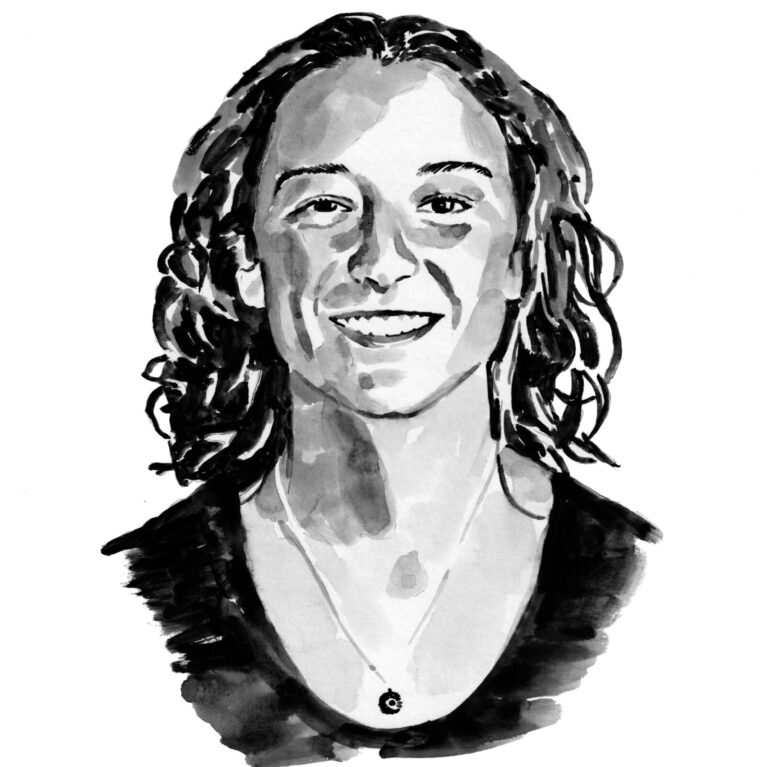
Who I am
I can’t pinpoint the exact moment I formed a connection with the ocean; it feels like it has always been there. My earliest ocean memories include being carried out to sea on my mum’s back before I could swim, discovering underwater life by scuba-diving at the age of 11 and being transfixed by the sight of white sharks breaching in slow motion in the first Planet Earth series.
The ocean has always meant home, and while working for my undergraduate degree in biology I decided it would also become my office. One day, a lecturer was telling us about a research expedition he was leading to study deep-sea habitats in the North Atlantic. Not expecting much to come of it, I stayed back and asked if I could join as a research assistant. A few weeks later I was aboard the RRS James Cook, watching a remotely operated vehicle (ROV) livestream deep-sea coral habitats back to the ship. After an incredible three weeks exploring the ocean floor, I knew there and then that studying the ocean was the only way forward for me.
I moved from London to Cape Town for my Master’s, eager to explore another ocean. This is when I stumbled into the complicated world of marine protected areas, fisheries science and sharks and rays. I immersed myself in this work and the community of scientists here. Through my PhD I have focused on different strategies to reduce fishing pressure on the shark and ray species that live in South African waters. A central lesson has been that no one solution fits all. Only by understanding the social and environmental system as a whole can we ensure that these vulnerable populations survive in the long term. This belief continues to guide my work and my commitment to ocean conservation.
Where I work
This project is based in South Africa, one of the world’s biodiversity hotspots for sharks and rays and home to about 200 shark and ray species. More specifically, for this project I am working with the bottom-trawl hake fishery and with the independent observer programme that functions across the fishery’s vessels.
This fishery operates along the country’s west and south coasts, targeting shallow-water and deep-water hake, species that are sometimes referred to as groundfish. The fishing grounds range from 50 to 1,000 metres (164 to 3,280 feet) deep and overlap with the cold and nutrient-rich Benguela upwelling region on the west coast, and with the warmer waters and biodiversity-rich Agulhas Bank on the south coast.
These fishing grounds are also home to several shark and ray species, many of which are endemic and/or threatened. Sharks and rays are unfortunately caught as bycatch across the fishery, due to the unselective nature of its bottom-trawl gear. This project aims to improve the data collected on shark and ray bycatch in the fishery’s offshore and inshore sectors, mainly through the development of an observer programme specifically for sharks and rays. Independent observers are an invaluable part of sustainable fisheries. They collect data on what is caught, often at a fine taxonomic scale, which ensures that we have a better understanding of the exact species taken.
What I do
For this project, I will be spending time at sea and on land. Initially, I will be working closely with other observers across the trawl fishery to develop a sampling protocol specifically for sharks and rays. Fisheries observers play a critical role in sustainable fisheries, independently recording what is caught at sea and often providing far more detail about the species caught than the skippers’ logbooks do. It is especially important to note that in South Africa’s trawl fishery the discarded catch is recorded only by observers, and this is the part of the catch that contains many shark and ray species.
By conducting workshops with the observers, we will highlight the practical realities of life on board: how the layout of the ship’s factory affects what and where shark and ray species can be sampled, what additional equipment or training may be needed to identify species quickly and how new sampling protocols can be fitted into their already busy routines.
After the workshops I will spend time on trawl boats working as an observer alongside the crew and testing the protocol. A typical day as an observer involves sampling a portion of the catch, identifying and measuring every individual in that sample and recording data on sharks and rays alongside all other species. This work can be intense and physically demanding, as sampling happens below deck in the vessel’s factory, sometimes in heavy seas! But it provides an invaluable window into what is being caught. When at sea, I also want to spend time engaging more closely with the fishing crew to raise awareness about sharks and rays and to explain why the work of observers is so important.