
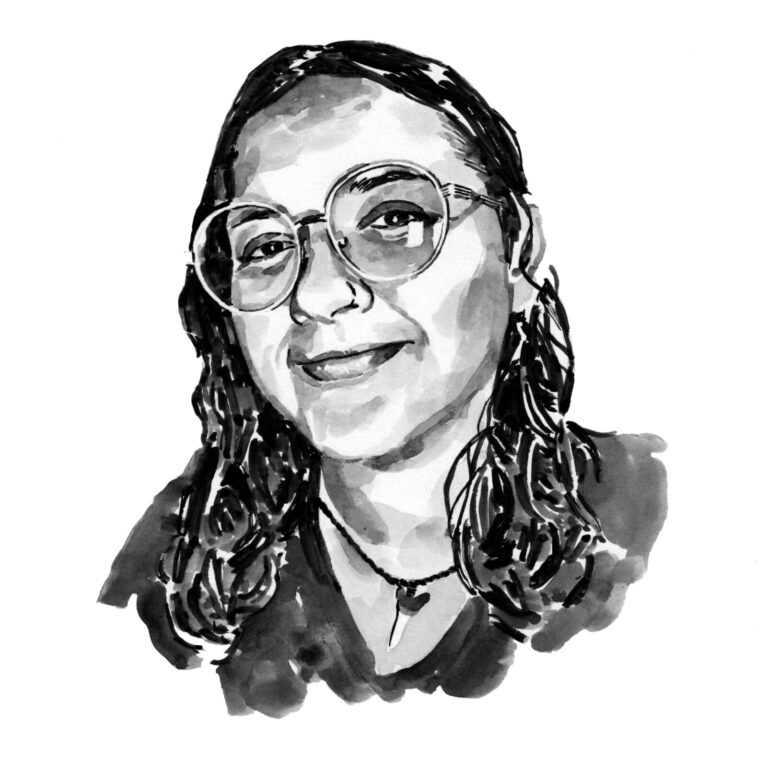
Ana Carolyna Diógenes Bezerra
Who I am
I was born in Mossoró, a city in the Brazilian state of Rio Grande do Norte and close to the country’s north-eastern coast. Growing up near the beach, I often saw stranded or dead marine animals lying there, and this made a deep impression on me. It sparked my curiosity about their lives, inspired me to pursue a path in conservation and made me determined to protect the ocean and its creatures.
During my undergraduate studies in biology, I worked with aquatic animals in different environments, initially with cetaceans and sea turtles and later with freshwater fish. Since 2022, my work has been guided by my greatest passion: elasmobranchs. As part of Sharks and Rays of Noronha, a project dedicated to the conservation of sharks and rays in Fernando de Noronha, I manage its citizen science component, monitoring data submitted by local residents, divers and tourists.
Now living in Natal as I work towards my Master’s degree in systematics and evolution at the Federal University of Rio Grande do Norte, I am focusing my research on the lemon shark. I am developing skills in ecological niche modelling and molecular genetics to investigate its distribution, connectivity and population structure.
Where I work
My research focuses on three key locations in Brazil: Atol das Rocas, Fernando de Noronha and the Abrolhos Archipelago. Together, these sites are essential for understanding the ecology and population connectivity of lemon sharks in the western South Atlantic.
The only atoll in the South Atlantic and Brazil’s first biological reserve, Atol das Rocas represents one of the most important marine ecosystems in the country. It serves as a nursery for several species, especially lemon sharks. Studies from 1990 to 2002 highlighted its shallow waters as ideal for the development of shark pups, providing protection from predators. Given the lemon shark’s ecological role, declines in its populations could disrupt the atoll’s food web, affecting organisms from reef fish to seabirds. Recently, the atoll was recognised as an Important Shark and Ray Area (ISRA), which emphasises its critical role as a refuge for elasmobranchs.
Fernando de Noronha is an oceanic island protected by the Fernando de Noronha Marine National Park and the Environmental Protection Area of Fernando de Noronha – Rocas – São Pedro and São Paulo. It is a biodiversity hotspot and a recognised nursery for lemon sharks, whose pups inhabit shallow waters in early life stages. Recent capture and biological sampling studies have improved our understanding of their behaviour and ecology. Sueste Bay, the main nursery, benefits directly from science-based conservation measures. Comparing data from here with data from Atol das Rocas and Abrolhos will help clarify population connectivity.
Located 70 kilometres (43 miles) off southern Bahia, the Abrolhos Archipelago comprises five main islands and hosts Brazil’s largest coral reef bank. Lemon sharks, mainly juveniles in shallow reef areas, were first observed at Abrolhos in the 1990s. Unlike at Atol das Rocas and Fernando de Noronha, systematic studies here are lacking, leaving a significant knowledge gap despite the species’ ecological importance.
What I do
In addition to my research at Atol das Rocas, Fernando de Noronha and Abrolhos, I am involved with the Sharks and Rays of Noronha project. The project regularly conducts field expeditions, including the capture and handling of lemon shark pups in shallow nursery areas, an activity that provides crucial insight into the species’ early life stages and behaviour. I will soon participate directly in these field collections to increase my practical experience. Currently, I manage and analyse citizen science data submitted by local residents, divers and tourists. These contributions enable us to track the presence and movements of sharks and rays and help to inform conservation strategies in these important habitats.
While developing skills in ecological niche modelling and molecular analyses for my Master’s in systematics and evolution, I am also reviewing scientific literature about the lemon shark to guide my analyses and ensure my research is grounded in the most current knowledge. Although at the beginning of my career, I am eager to contribute to the conservation of this species while gaining hands-on experience in field research and advanced analytical methods.