
Investigating habitat utilization patterns of Zambezi sharks and their prey
Our team of researchers have recently returned from the first field trip of 2012, during which time we embarked on a study which aims to unravel the ecological role of Zambezi sharks in South Africa’s Breede River. Along with a team of scientists from South Africa’s Department of Agriculture, Forestry and Fisheries (DAFF) – as well as myself and a SA Shark Conservancy (SASC) intern – we departed Hermanus for Witsand on January 23rd, hopeful our fishing trip would be as lucrative (meaning we would catch at least one shark!) as past ones.
The first week of the two-week expedition was spent testing equipment and determing the best deployment strategy for an array of 20 acoustic receivers – designed to enable us to passively monitor the movements of the sharks and their primary prey (dusky kob and spotted grunter) in the estuary. Having never worked with these receivers before, I certainly underestimated the amount of time and work required to deploy the equipment in a manner designed to maximize results and give us the best data possible over the coming two years. Needless to say, the presence of DAFFs scientific and technical teams – who are well-versed in this type of field work – was greatly appreciated!
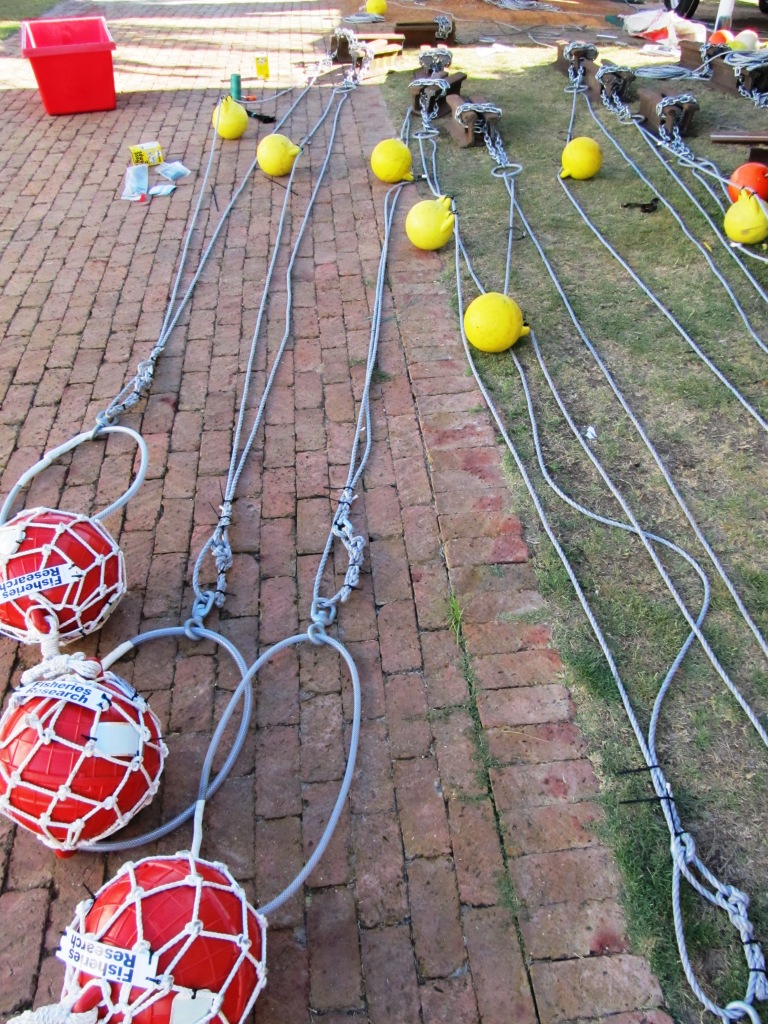
Although the weather was as variable as ever – with the wind blowing up to 25 knots – all went according to plan and the moorings were successfully deployed by day 7 of the expedition. And just days later, only a few hours apart, our dedicated team of fishers managed to capture four spotted grunter and one male Zambezi shark – each of which were fitted with an internal tag (with a battery life of at least one year) and released back into the river where the acoustic array will continue to monitor inter- and intra-specific interactions, short-term, seasonal and broad-scale movement patterns of Zambezi sharks and their primary prey.
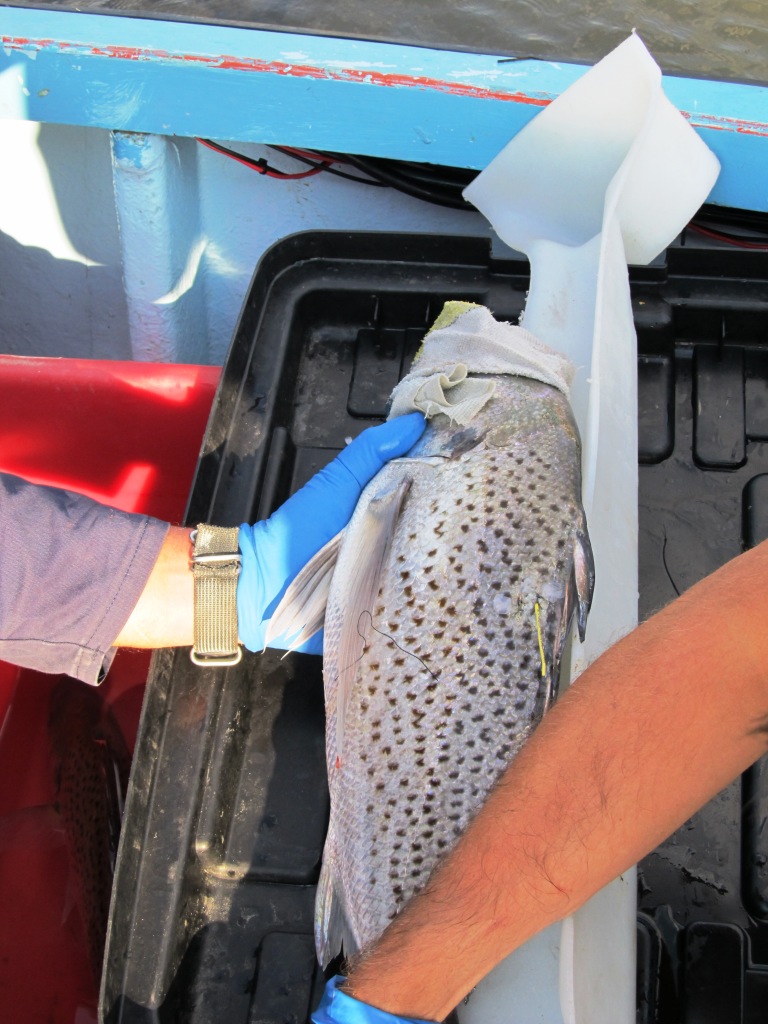
Perhaps one of the most interesting findings from this trip was that the male Zambezi shark – measuring 2.56m total length – was immature. Surprising to all involved who expected – based on existing scientific knowledge of size-at-maturity – the animal to be sexually mature. Once again, findings from our research on the Breede River Zambezi sharks are causing us to re-evaluate everything we think we know about the species…
A special thanks to everyone who assisted with this expedition, including Mark Woof Charters (fisher extraordinaire) and the team from the Department of Agriculture, Forestry and Fisheries.