
When fishermen become shark guardians
It feels like it was yesterday that we arrived for the first time to this small village in the Colombian Pacific and asked some fishermen to take us out and show us where we might find sharks. At the time, our goal seemed relatively simple: find scalloped bonnetheads (Sphyrna corona), learn more about this little-known species, and begin filling some of the many gaps in our understanding of its ecology. Little did we know that those first fishing trips would grow into a long-term project, or that the people taking us out on the water would become friends and such an important part of it.
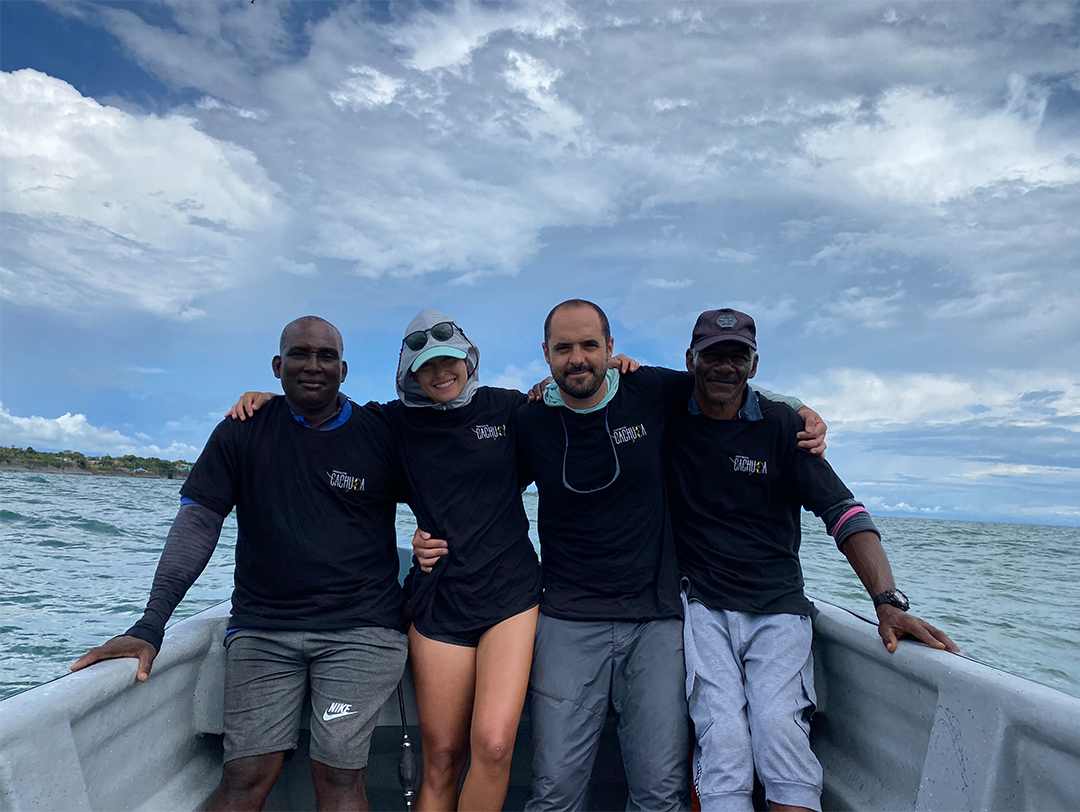
One of our fishermen team that has been with us since day 1 in 2021. Photo by © Diego Cardenosa
The scalloped bonnethead is one of the smallest hammerhead sharks in the world and is currently listed as Critically Endangered. Yet, like many small coastal sharks, we still know remarkably little about its movements or population dynamics. Because these sharks live so close to coastal communities, their future is also closely tied to the people who share these waters with them.
During the first phase of the project, which wrapped up in 2023, we worked closely with local fishermen to catch, measure, tag, and release scalloped bonnetheads. But something else was happening alongside the science. The fishermen were becoming increasingly invested in the sharks themselves. They wanted to know where they went, whether we had recaptured any, how much they had grown, and what could be done to protect them. Plus, all the sharks were named after daughters, moms and grandmas, so they were often asking us “Have you detected Matilde lately? When was the last time you detected Yamilé and Juliana?”.
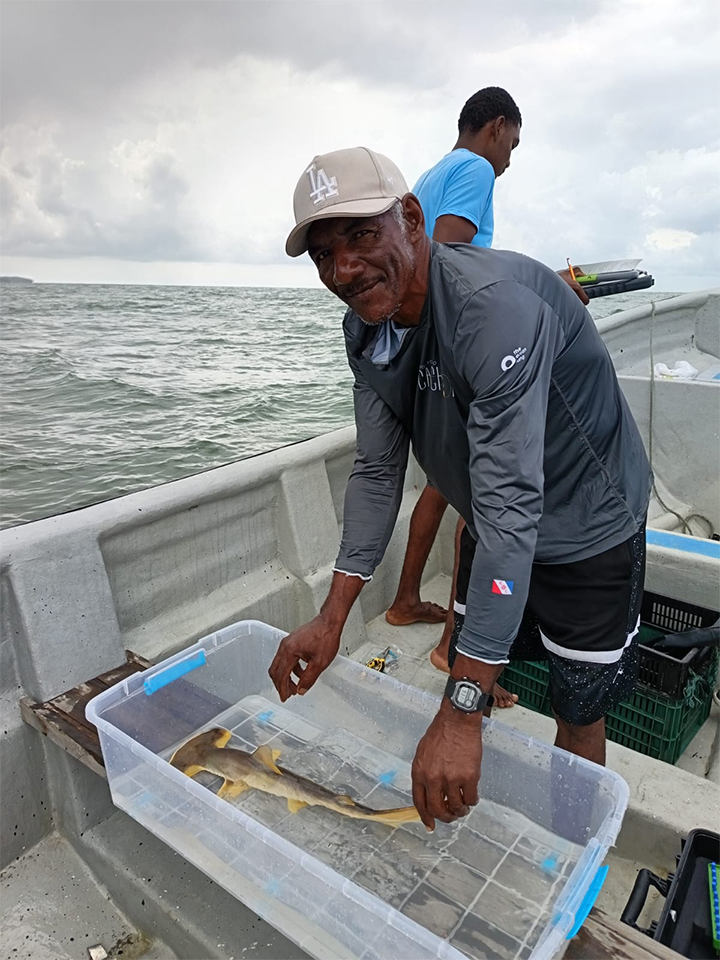
Don Alfonso, the funniest fisher we know holding a scalloped bonnethead. Photo by © Diego Cardenosa
By the end of that first phase, it became clear that we couldn’t simply pack up our equipment, leave, and hope for the best. The communities were engaged, the fishermen wanted to continue, and the future of this Critically Endangered shark was, in many ways, in all of our hands. So, in 2024, the second phase of the project began.
Since then, fishermen have been conducting weekly shark surveys within a newly established, community-managed no-take zone. What was once something we asked fishermen to help us with has gradually become part of their routine. Week after week, they head out to search for scalloped bonnetheads, collecting data and tagging sharks with PIT tags so that individuals can be identified if they are encountered again.
So far, we have tagged 290 scalloped bonnetheads with PIT tags, 17 with acoustic tags and recaptured eight individuals. Some of those moments have been especially exciting: sharks first tagged more than a year earlier have turned up again, still using the area and, in some cases, about six centimeters longer than when we first met them.
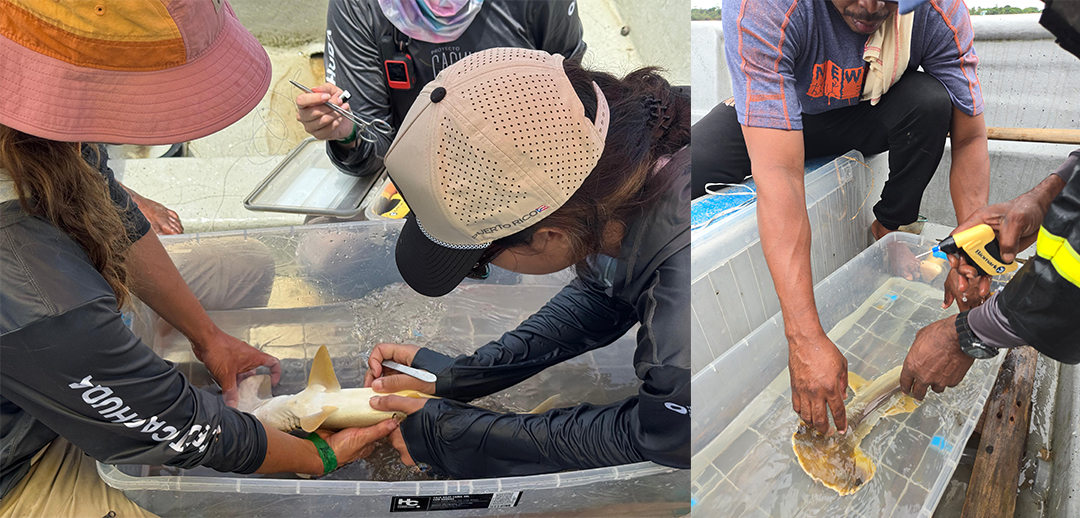
On the left, Daritzel the PhD student tagging a shark with the acoustic tag, on the right, two of the fishers tagging a shark with a PIT tag. Photo by Diego Cardenosa & Daritzel Cintron
But some of the most meaningful outcomes of this project cannot be captured in a dataset. After years of working together, we have built relationships with these fishermen and their families that go far beyond sharks. We have shared long days on the water, celebrated exciting captures and recovery of what we thought was a lost receiver (See photo), dealt with equipment that refuses to cooperate, and spent countless hours talking about fishing, sharks, conservation, and life in the community. When an earthquake affected the area, the relationships built through the project also allowed us to help raise funds to support rebuilding efforts.
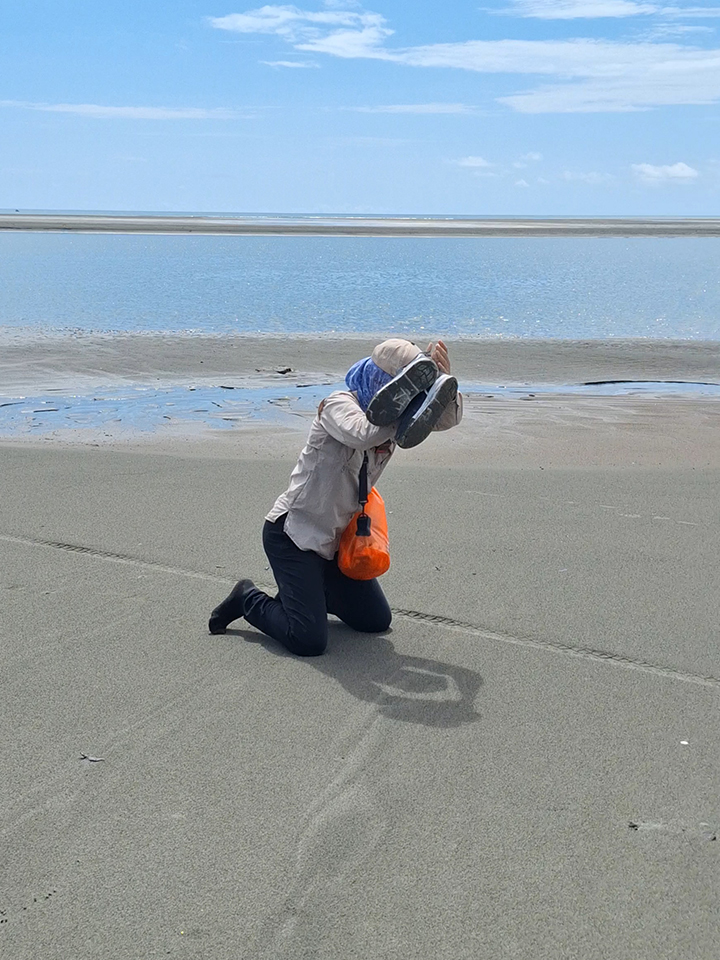
Daritzel Cintron when we recovered a receiver we thought had been lost to a gillnet. Photo by © Daritzel Cintron
That, to me, is one of the most special parts of this project. Conservation has become less about researchers arriving somewhere to study a threatened species and more about a group of people working together to protect something that has become important to all of us.
There is still a lot to learn and a lot of work ahead. We want to better understand how scalloped bonnetheads use this protected area, how long individuals remain there, where they move, and ultimately whether community-led protection can make a meaningful difference for the species. But already, something important has changed.
The fishermen who once took us out because we were looking for sharks are now the ones heading out every week to find them. They know individual sharks can come back months (or even a year) later. They are generating the data that will help us understand and protect the species living in their waters. And, perhaps most importantly, the project is no longer just ours. It is theirs too.
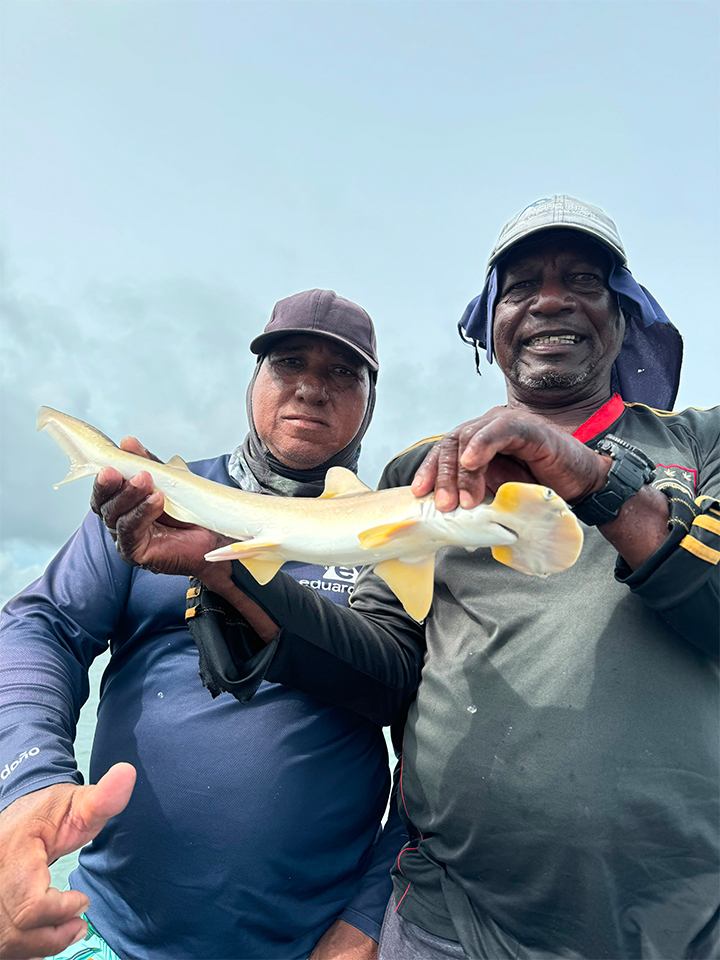
Isá and Chambimbe, two of the key members of our team, holding the shark they just tagged. The shark was later released safely. Photo by © Diego Cardenosa
For a Critically Endangered shark living along a coastline where people and the ocean are inseparable, I can’t think of a more hopeful outcome than that.