
What’s on the Menu for a scalloped hammerhead?
Hammerhead sharks are among the most iconic species in our oceans, yet much about their lives remains hidden especially in West African waters. Along the Nigerian coast, sharks are landed mostly as bycatch in artisanal fisheries in various coastal communities, but very little is known about where they have been, what they have been feeding on or how they interact with their environment before they are caught.
Understanding these hidden aspects of their ecology is essential if we are to protect them effectively.
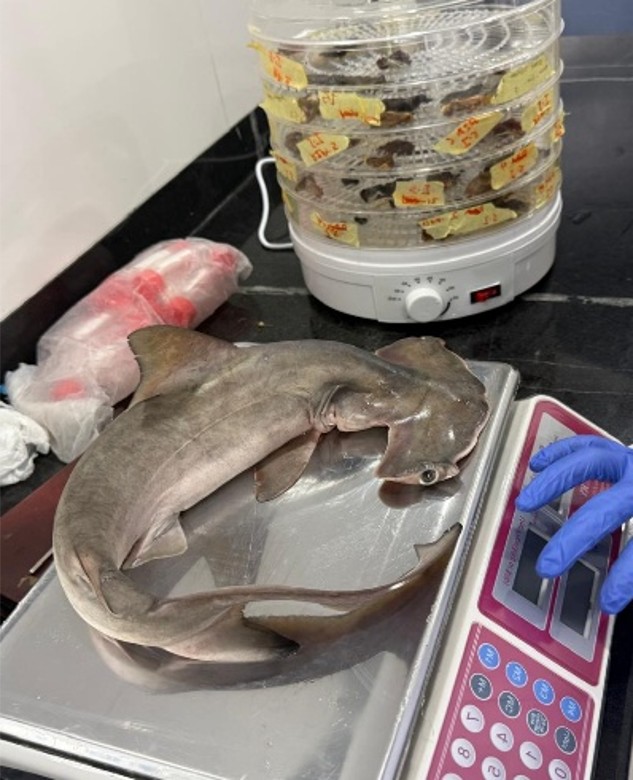
Extraction and preparation of tissues for stable isotope analysis. Photo © Lara Fola-Matthews | Sharks Connect Network
Beyond stomach contents
For many years, scientists relied on stomach content analysis to understand what sharks eat. While useful, this method only provides a snapshot of the most recent meal and often misses soft-bodied prey that are quickly digested. In highly mobile species like the scalloped hammerheads, this approach can underestimate the full complexity of their diet.
To gain a more complete picture, scientists now turn to techniques that capture feeding behaviour over longer time scales.
Stable isotopes?
Stable Isotope Analysis (SIA) offers a powerful way to uncover the hidden diet of marine animals. Every organism carries a chemical signature that reflects what it has eaten. When sharks consume prey, the chemical composition of that prey becomes incorporated into their tissues. Over time, this creates a record of feeding behaviour that can be analysed.
Two key elements are used in this process:
Carbon (δ¹³C): provides information about where feeding occurs
Nitrogen (δ¹⁵N): indicates the animal’s position in the food web
Unlike stomach content analysis which captures a single feeding event, stable isotopes integrate diet over weeks to months, offering a more representative view of feeding ecology. In the lab, tissue samples (muscles and liver) were excised from a few hammerhead sharks caught as bycatches from various artisanal landing sites, the tissues were dehydrated at 40°C for three days.
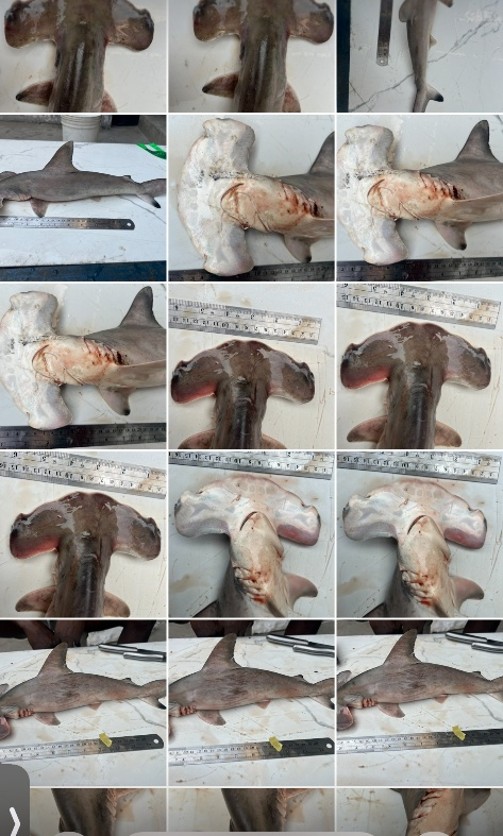
Hammerhead sharka (Sphyrna lewini). Photo © Lara Fola-Matthews | Sharks Connect Network
Tracing where sharks feed
Carbon isotopes act as natural tracers of habitat use.
Coastal ecosystems such as mangroves, estuaries and lagoons tend to have more enriched δ¹³C signatures due to higher primary productivity. In contrast, offshore and pelagic systems typically show more depleted δ¹³C values.
By analysing these signatures in shark tissues, we can determine whether an individual has been feeding primarily in coastal environments or further offshore.
For scalloped hammerheads along the Nigerian coast, this is particularly important.
Understanding trophic position
Nitrogen isotopes provide insight into what sharks are eating.
As energy moves up the food chain, δ¹⁵N values increase in a predictable way. This means that higher δ¹⁵N values are associated with predators feeding at higher trophic levels.
By measuring δ¹⁵N, we can estimate whether hammerhead sharks are feeding on smaller fish and invertebrates or on larger, higher-level prey such as other fishes or cephalopods. This helps us understand their ecological role as predators and how they influence marine food webs.
Do hammerhead diets change with age?
One of the most important questions in shark ecology is whether feeding behaviour changes over time. Research has shown that scalloped hammerhead sharks often undergo ontogenetic shifts. Stable isotope analysis would allow us to detect these shifts even when direct observation is not possible. Understanding these life-stage differences is critical for conservation.
Why this matters for conservation
Hammerhead sharks are not just predators they are key components of marine ecosystems. By regulating prey populations, they help maintain the balance and structure of food webs. Changes in their feeding behaviour can signal broader ecosystem changes, including overfishing, habitat degradation and declining prey availability.
In Nigeria, where coastal ecosystems are under increasing pressure, identifying critical habitats for species like the hammerhead shark is essential. If nursery or feeding areas are lost, the consequences can ripple through the entire ecosystem.