
Uncovering the story of lemon sharks in Brazil
When I started doing remote volunteer work, I never imagined how far it would take me. The Tubarões e Raias de Noronha Project welcomed me in a way I will never be able to thank enough. Today, it is impossible to talk about this research without talking about this project.
For years, I watched sharks and rays through a computer screen, helping with remote data collection through citizen science. Even from a distance, I was already happy to have some kind of contact with them. Seeing records and behaviours, learning how to identify species and recognising the places where they appeared were essential parts of my growth as a researcher. Before I was ever in the field, I was already learning from photos, videos and records.
The first time I saw a juvenile lemon shark was in Sueste Bay, one of the places that impresses me most in Fernando de Noronha. I love walking on the sand, looking towards the shoreline and almost always seeing fins moving through the water: juveniles swimming together, or adults passing through the shallows. In the past few months, thanks to the expeditions carried out by the project, I was able to learn how to handle and take part in research with live lemon sharks for the first time.
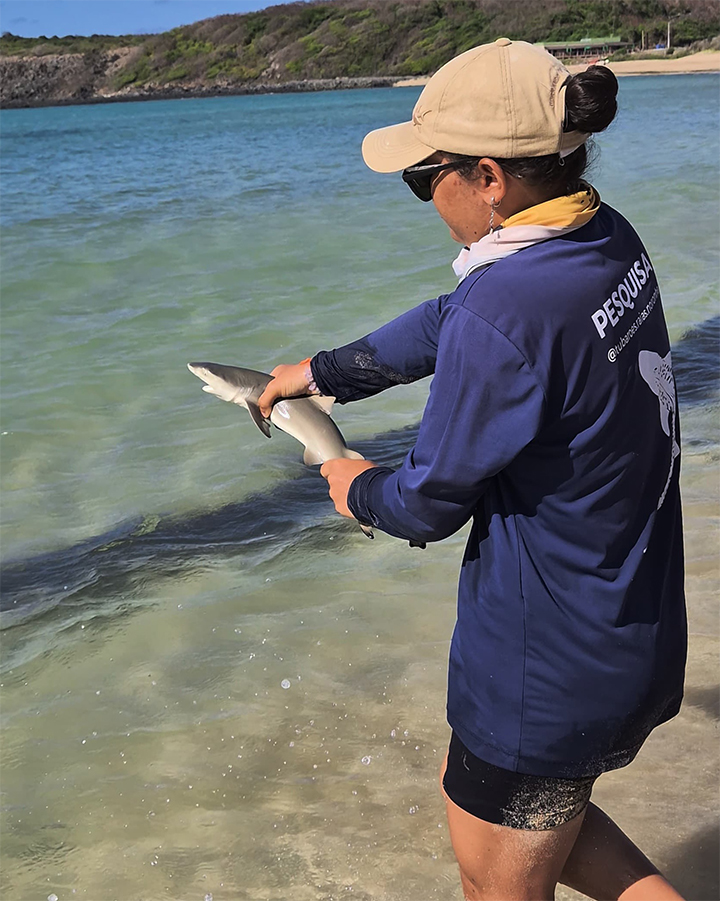
Handling a juvenile lemon shark (Negaprion brevirostris) during fieldwork in Fernando de Noronha for the non-lethal collection of biological samples. Photo © Sharks and Rays Of Noronha
Another important place is Porto de Santo Antônio beach, one of the sites where we capture sharks to collect samples. Although it is a beautiful place, full of life, it also shows the challenges these animals face. During fieldwork, we found juveniles injured and with fishing hooks caught in their mouths. Whenever possible, the project team carefully removes these hooks, reducing the immediate impact on the animals. Even so, the problem continues to happen, showing that even in protected areas, they are still exposed to threats.
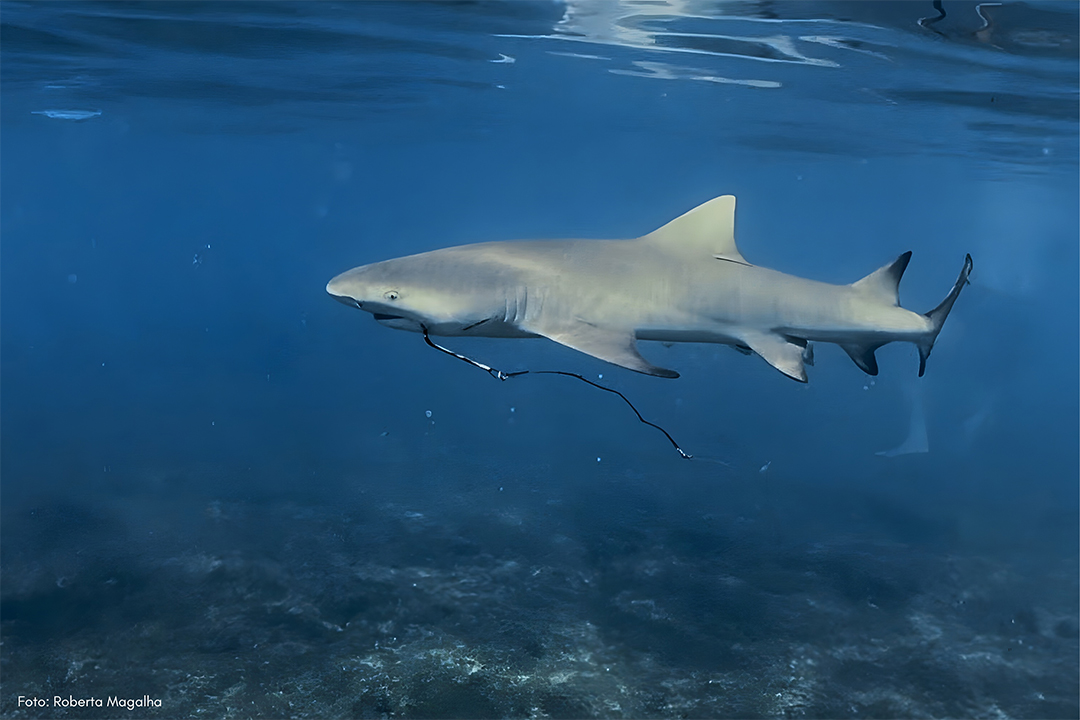
A juvenile lemon shark with a fishing hook and line lodged in its mouth. Photo © Roberta Magalha
Being in the field and learning from these animals has been one of the most beautiful and rewarding experiences of my journey. But even though being part of this research is incredible, there are also challenges. One of the greatest, for me, is being a woman in science. We often still have to prove our knowledge in spaces where women’s work is questioned or undervalued, even when there is study, care and daily planning behind everything we do for the animals.
That is why I deeply admire the way the Tubarões e Raias de Noronha Project was created and is coordinated by a woman, Bianca Rangel. Bianca has taught me, and continues to teach me every day, about sensitivity, care and respect. It was with her that I learned, for the first time, how to touch and handle a shark: where to place my hands, how to stay calm, how to observe the animal and how to understand that, before any sample or data point, there is a life there that needs to be respected.
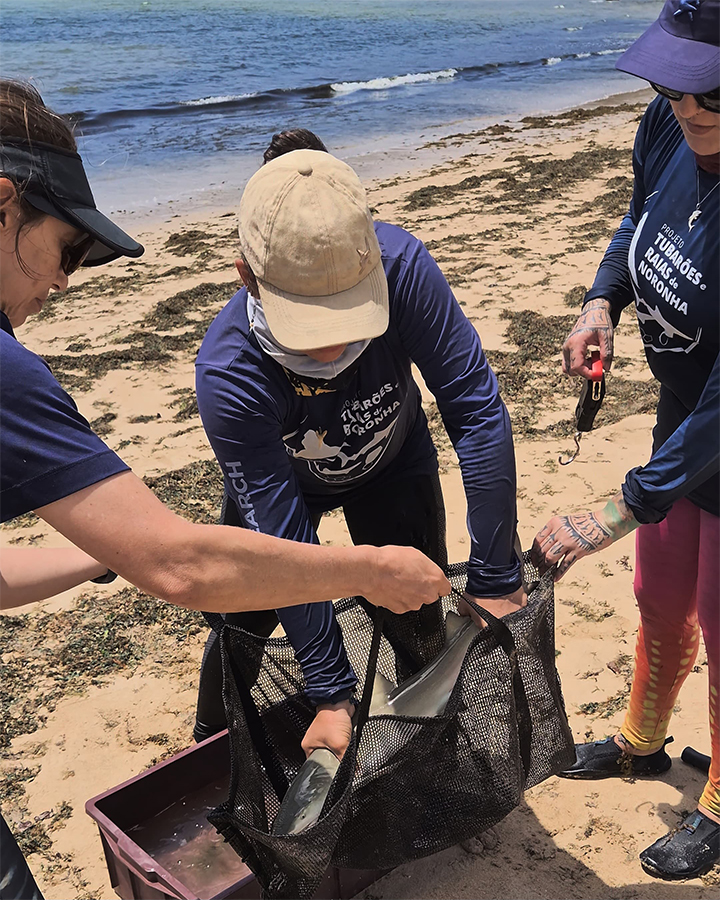
Capture of a lemon shark in Fernando de Noronha. Photo © Sharks and Rays Of Noronha
During the last three expeditions, dermal samples were collected from 71 lemon sharks. These samples will be used for genetic analyses. They mark only the beginning of a story that still has much to tell. Genetics will help us better understand the lemon shark population of Fernando de Noronha and its connection with other places.
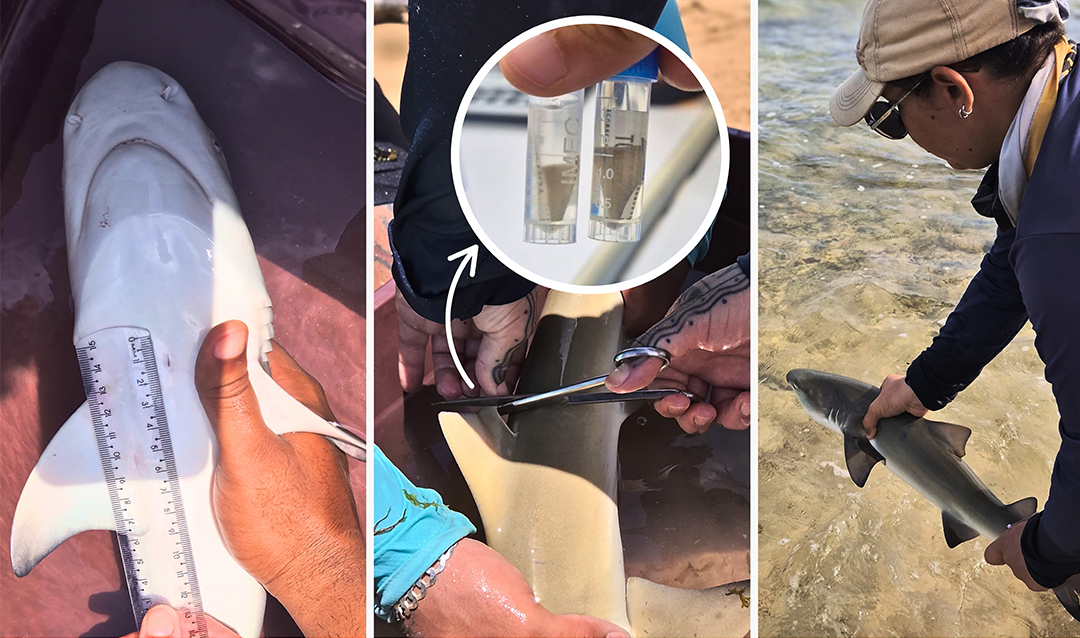
Tissue sampling procedures and handling of a lemon shark (Negaprion brevirostris) during fieldwork in Fernando de Noronha. Photo © Sharks and Rays Of Noronha
We will also launch Projeto Caipirinha Brasil, a citizen science initiative focused on searching for lemon shark records along the Brazilian coast. Although this is a coastal species and is frequently recorded around oceanic islands, its records still seem scarce in many coastal areas. With the support of the Save Our Seas Foundation, we will be able to expand this research to other locations and better investigate how lemon sharks in Brazil are connected to places such as the Abrolhos Bank.
But, for me, this story begins in Fernando de Noronha: with the project that welcomed me, with the people who taught me, and with the juvenile lemon sharks that made me learn to love what I do every day.