
The unpredictable business of Greenland Shark research
If there is one thing I’ve learned from studying Greenland sharks in the deep waters of Skagerrak, it’s that these animals have absolutely no respect for our schedules. This year, a large film crew from Swedish national television had set aside two weeks to join us on a Greenland shark tagging expedition. It was a major production, involving a team of eight people and considerable planning and logistical coordination. But despite constantly checking weather forecasts, moving plans around and keeping everyone on standby, the winds simply refused to cooperate. After two weeks, the film crew had to pack up and head home without ever getting out to sea. And then, just a few days after they left, the weather cleared. We immediately headed offshore, and before long, we had caught and tagged our first Greenland shark of the year, a beautiful 3 meter fish which we tagged internally with an acoustic transmitter. Great news for the research of course, although I suspect the television crew might have had mixed feelings about our success.
Unfortunately, Greenland sharks remained few and far between this season. We catch them using rod and reel at 700 metres depth, and this method bring a particularly exciting aspect, you never really know what is going to take the bait. And this year, we seemed to catch just about everything except our intended target species. One particularly memorable catch was an enormous roundnose grenadier (Coryphaenoides rupestris), also known as a rattail. These strange deep-sea fish, with their large heads and long, tapering tails, look like a mix between a dragon and a fish. Our specimen turned out to be the largest ever caught in Sweden! Not exactly what we were hoping for when lowering our bait into the darkness, but certainly a memorable encounter. We know next to nothing about the behaviour and ecology of most of these deep-sea fish. Unfortunately, unlike Greenland sharks, many of these species suffer severe barotrauma when brought to the surface and have very poor survival prospects after release, making tagging and tracking them very challenging.
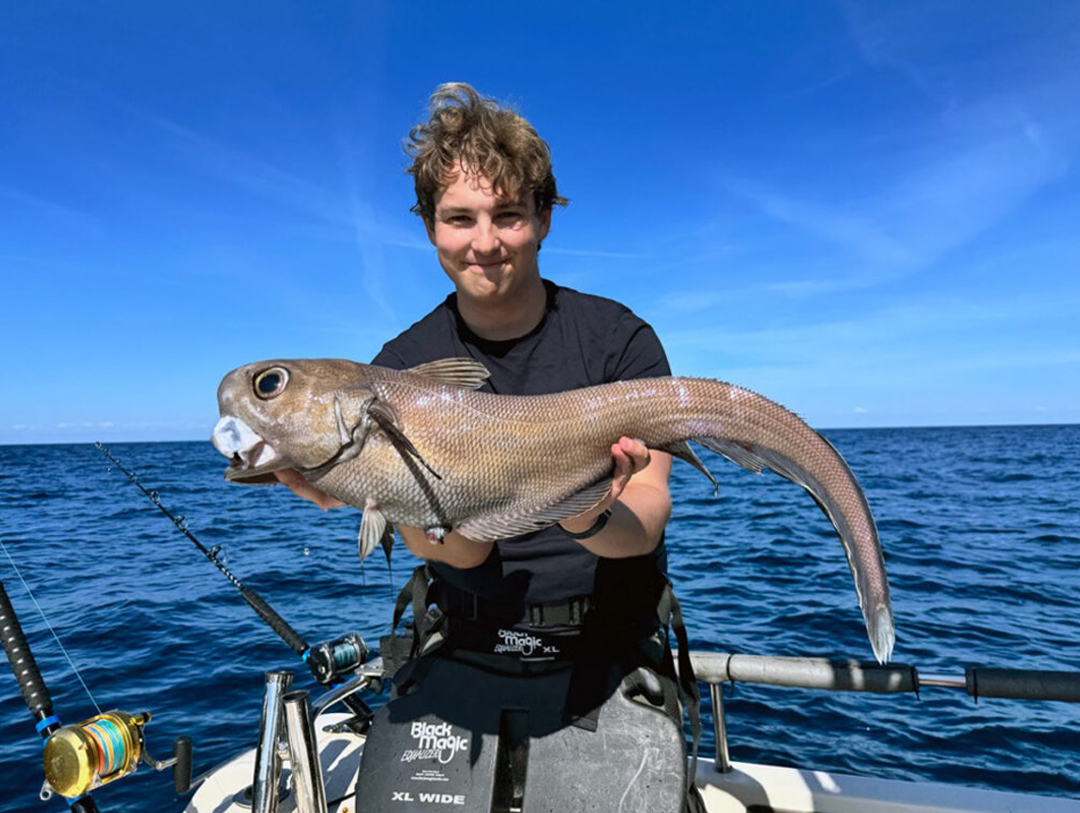
Max Larsson with a large roundnose grenadier caught during Greenland shark fieldwork. Photo by © Joakim Larsson
Although few sharks were caught and tagged this season, something very encouraging is happening above the surface. When we started this work three years ago, our research group was essentially alone in studying Greenland sharks in Skagerrak. Today, four different research groups from Sweden, Norway and Denmark are involved. We are increasingly coordinating our tagging efforts, sharing knowledge and developing a more complete picture of these mysterious animals. And there is one question that makes this collaboration particularly exciting.
Greenland sharks caught in Skagerrak range a lot in size, from giants exceeding five metres to tiny individuals measuring less than a metre. The presence of such small sharks raises an intriguing question: could Skagerrak be a nursery area, or perhaps even a pupping ground, for Greenland sharks? We still know very little about where these animals give birth and spend their earliest years across their distribution range, and no pupping ground has yet been identified. Establishing whether Skagerrak plays such a role would be a major step forward in understanding the life history of this amazing fish. The Greenland sharks may not cooperate with our schedules, but they are certainly giving us plenty of reasons to keep coming back.