
Ten Seconds to See Inside a Manta
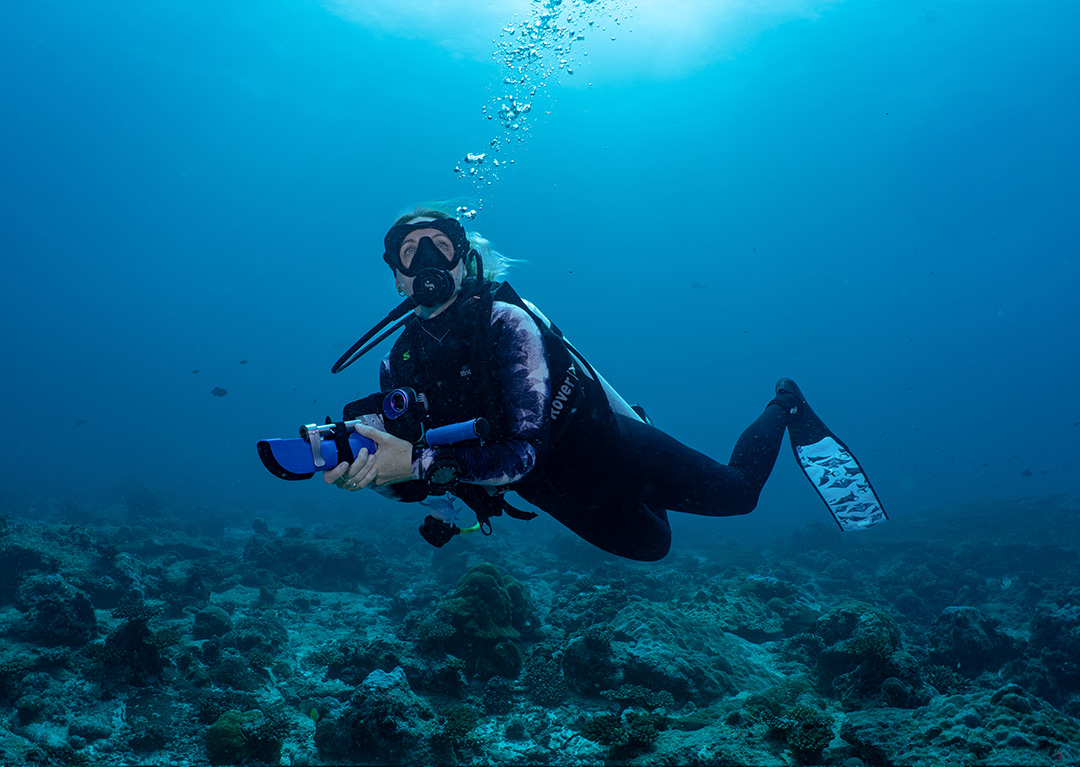
Image © Guy Stevens
I have spent a lot of time underwater.
I am a Divemaster, a Commercial Class IV diver, and have around 2,000 dives under my belt. I have worked in pitch-black water, strong currents and challenging conditions, in places where being comfortable underwater is not optional. So, when I say that learning to ultrasound wild manta rays has been one of the most challenging things I have ever done in the water, I mean it. But it has also been one of the most rewarding.
My ultrasound journey began when I first met Ray Rochester, one of the driving forces behind the development of the technology. The idea was developed here in Laamu, eventually leading to the world’s first contactless underwater ultrasound scanner through a collaboration between The Manta Trust, Six Senses Laamu, Vetsonic, Yorkshire Reefs and IMV Imaging. By the time I started learning to use the technology, I already knew many of Laamu’s manta rays well. I knew their personalities, their behaviour and, importantly, how they behaved at our cleaning stations.
But it was a slow process. Before I could even attempt to scan a manta, there were permits to secure, equipment to organise and a lot of preparation behind the scenes. Eventually, everything was ready, and the moment I had been waiting for finally arrived.
The theory sounded simple enough: approach the manta slowly from above and behind, get close, position the ultrasound probe over the left dorsal area and scan. Simple, right? Not quite. First, there has to be a manta. Then she needs to be cleaning. And if we are interested in reproductive information, she also needs to be female. Once all those stars align, the real challenge begins.
I have to hold my position in the current without disturbing her, often at a cleaning station where the current can be strong. I then need to bring the scanner to within about 10 centimetres of her. The probe is tiny — roughly the width of two fingers — and needs to remain almost perfectly still, because even a small movement can distort the image. Somewhere on this enormous animal, I have to position that tiny probe in exactly the right place to find an organ whose precise location we are still refining, all while the manta is moving.
And I have about ten seconds to get it right.
My first scan, in November 2025, was far from perfect. The image wasn’t particularly clear, and there was plenty I would do differently now. But honestly, none of that mattered. I had just successfully ultrasounded a wild manta ray. Even more remarkably, the manta I scanned was Sheen (M2913), the same manta I first encountered when I arrived in Laamu in 2024.
I was completely hooked.
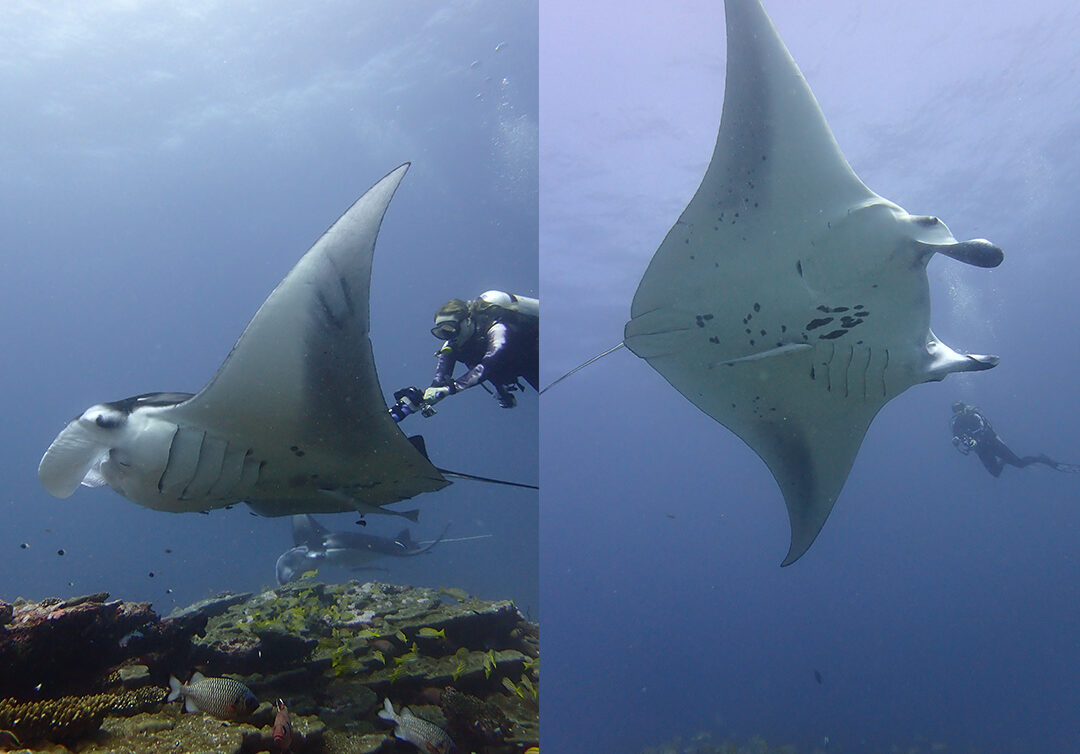
Image © Guy Stevens
Since then, I have attempted around 27 scans of 13 different females. Many have been less than ideal, but then there are the scans that make all the effort worthwhile. The biggest breakthrough came when I successfully captured an image of a developing pup inside Oulaya (M4499).
Seeing a manta pup developing inside a wild manta ray on the ultrasound screen is something I don’t think I will ever get used to. Sometimes there are obvious external signs that a manta is pregnant; sometimes, as was the case with Oulaya, there aren’t. Being able to look inside and find evidence of a developing pup when there are no visible signs of pregnancy is an incredible feeling — and a huge win for research.
Manta rays reproduce slowly, and there is still so much we don’t know about their reproductive biology. By combining ultrasound with the long-term photo-identification work we do here in Laamu, we can follow individual females and learn more about pregnancy, reproductive maturity and developing pups — information that simply cannot be gained by observing the animals from the outside.
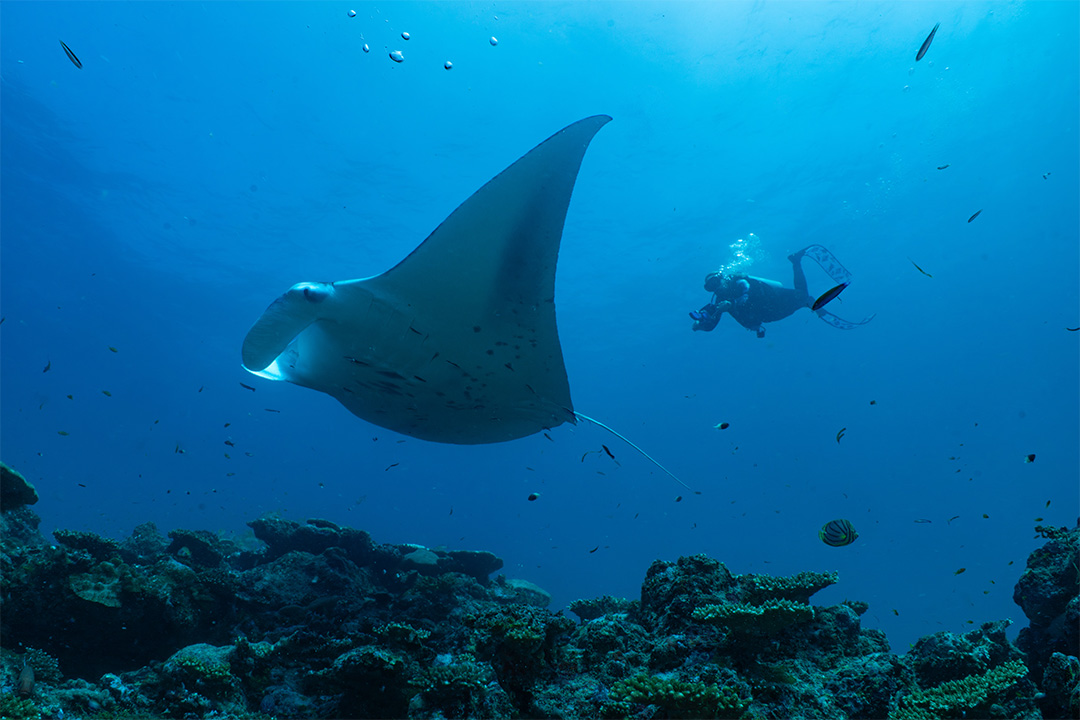
Image © Guy Stevens
For me, though, the science is only part of what makes it so rewarding. Sheen, Oulaya and the 160-plus mantas identified in Laamu aren’t just data points on a spreadsheet. I know their markings. I recognise them underwater. I know their personalities. And now, in some small way, I feel even more connected to their lives.
Learning to ultrasound manta rays has pushed me far outside my comfort zone as a diver. It has tested my patience, my buoyancy, my positioning, my fitness and my ability to stay calm when a manta swims away just as I finally get everything lined up. Ultrasounding these rays might only take a few seconds, but getting those few seconds right can take months or even years of learning.
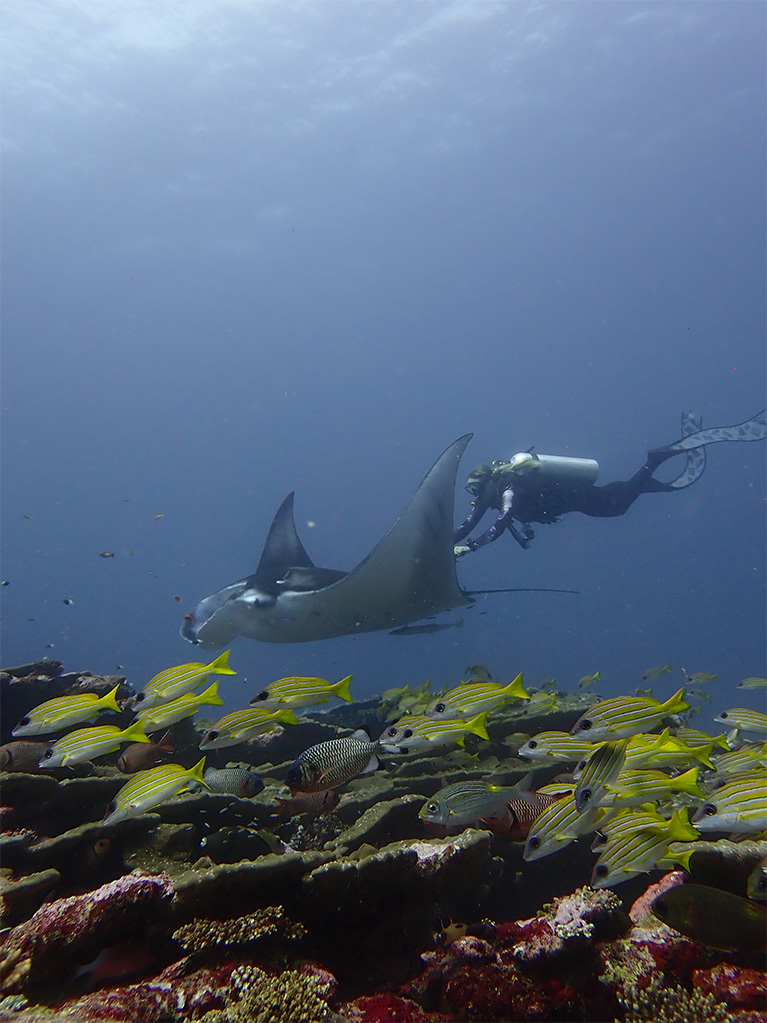
Image © Guy Stevens
But every time that ultrasound image appears on the screen, it is worth it. After all, there aren’t many jobs where you can spend ten seconds fighting your way through a Maldivian current, hold two fingers of technology over a wild manta ray, and suddenly see a new life developing inside her.
That is something I will never take for granted.