
Monitoring human-shark interactions in one of the world’s largest marine reserves
Conflicts between humans and top predators, such as sharks, present a significant conservation challenge globally, particularly where they threaten human lives, livelihoods, and wellbeing. While it is often claimed that such conflicts are increasing, in practice, they are very difficult to monitor, especially in the marine environment. Studies of human-wildlife conflict typically rely on either voluntary reporting of interactions – which can suffer from low participation – or stakeholder surveys, which are limited in scale and can be affected by “recollection bias” (where people’s recollection of events changes over time).
This was a challenge that faced our current SOSF-funded project, which aims to investigate the causes and consequences of increased human-shark interactions in the Ascension Island Marine Protected Area. Recently, recurring movements of large numbers of (primarily) Galapagos sharks into coastal waters have created conflicts with the local community, including increased predation of fish catches and two unprovoked attacks on bathers. These events were perceived as unprecedented by many island residents, leading to understandable speculation over what caused them. However, no data were available to trace how the frequency and nature of human-shark interactions has changed over time, making it difficult to set recent increases in context and identify the underlying drivers.
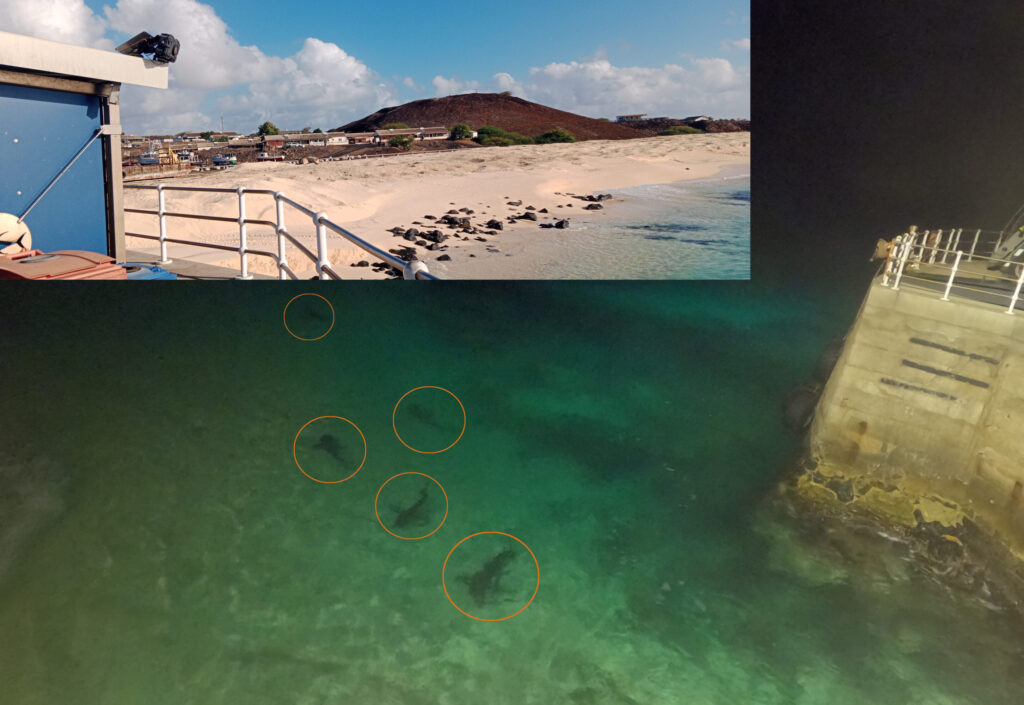
A “SharkCam” timelapse monitoring camera located at Georgetown Pierhead on Ascension Island, along with an example image. Photo © Daniel Simpson.
To address this, University of Exeter PhD student Lucy Clarke, combined data from several different sources to reconstruct trends in human-shark interactions at Ascension Island over different timescales. Initially, time-lapse camera systems (“SharkCams”) were placed at known conflict hotspots, including popular bathing beaches and the Island’s main pier. The cameras take photos every 10-minutes, which are then analysed to count the number and species of sharks present. Using this approach, Lucy and undergraduate student Esben Lomholt were able to accurately track how shark activity in key coastal areas has varied over the past year, demonstrating its potential as a future monitoring tool. However, this method only covers recent years at a few sites and does not reveal how varying shark activity impacts people.
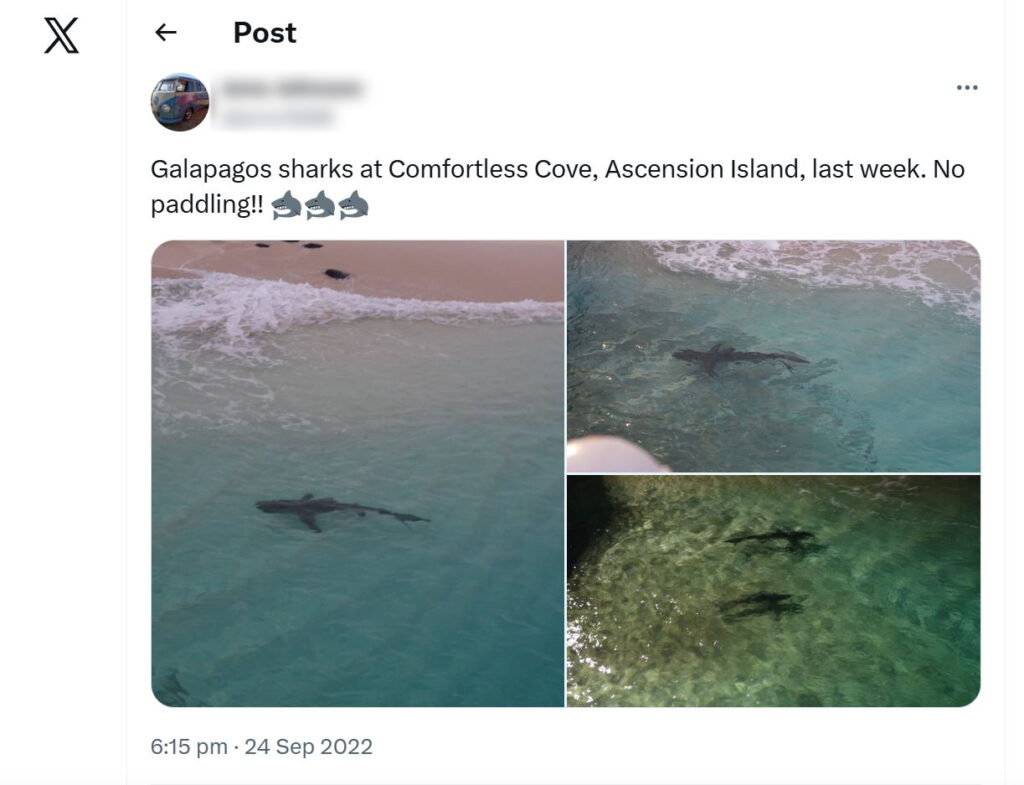
An example of social media content used to profile trends in human-shark interactions within Ascension Island’s nearshore waters. Image © Jono Johnsson.
To help fill these gaps, Lucy and MSc students Livvy Goodchild and Laura Chapel accessed publicly available social media data from all major platforms and extracted posts describing encounters with sharks at Ascension Island since 2010. Analysis of post frequency and shark counts within posted images revealed that two major spikes in human-shark interactions occurred in 2016-2017 and 2020-2021, matching local anecdotal reports. To look even further back in time, the team then compiled and analysed text from various historical sources, including interviews with long-term island residents, social media commentaries from former Island residents, and material from museum archives (e.g. newspaper articles, government reports, book texts). Interestingly, while reported encounters with sharks were rare in the 1990s and 2000s, earlier records tell a different story, with sources from the 1960s and 1970s describing rapid changes in shark abundance and behaviour, mirroring those reported recently and captured in our social media and SharkCam data.
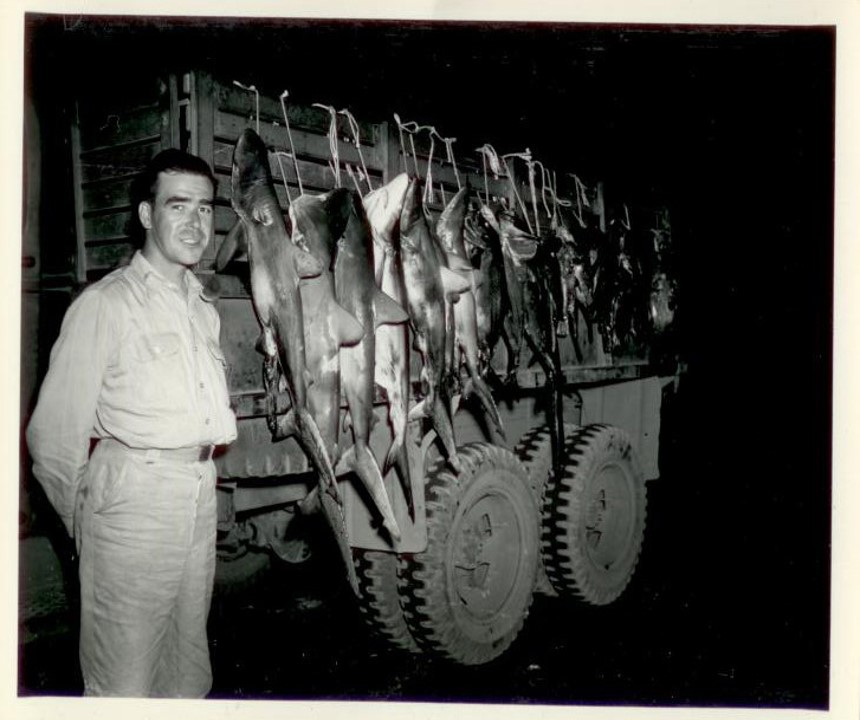
Museum archive image of sharks captured at Ascension Island. Analysis of archive sources suggest that human-shark interactions were historically common. Image © Ascension Island Heritage Society.
The results from this work, which were recently published in the journal Nature Scientific Reports suggest that, rather than being freak events, recent spikes in human-shark interactions at Ascension Island are part of a recurrent natural cycle. Moving forward, our project is trying to understand what is driving this variation. We suspect it is likely a combination of environmentally driven changes in shark distribution superimposed on a long-term demographic cycle in shark abundance. Ultimately, we hope that by sharing this information with the Island community we can demystify sharks and address the uncertainty surrounding recent conflict events, which is key to building long-term tolerance and coexistence.
Reference
Clarke, L., Collins, C., Burns, P. et al. A multi-method approach to characterising dynamic human–shark interactions at a remote oceanic island. Sci Rep 16, 13010 (2026). https://doi.org/10.1038/s41598-026-46394-0