
How a community-driven tagging project is reshaping what we know about giant freshwater stingrays
When we wrote our previous blog post, we had finally overcome the customs delays that had slowed down our giant freshwater stingray tagging project in the middle and lower Paraná River. What happened next was beyond anything we expected.
Through newspapers, radio, TV programs, and especially our Instagram account @rayasderio_argentina, the project quickly reached a much wider audience. More importantly, social media became a bridge between scientists and recreational fishers. Dozens of fishers from different localities along the Paraná River joined the initiative, reporting captures, helping identify stingrays, and participating directly in the tagging effort.
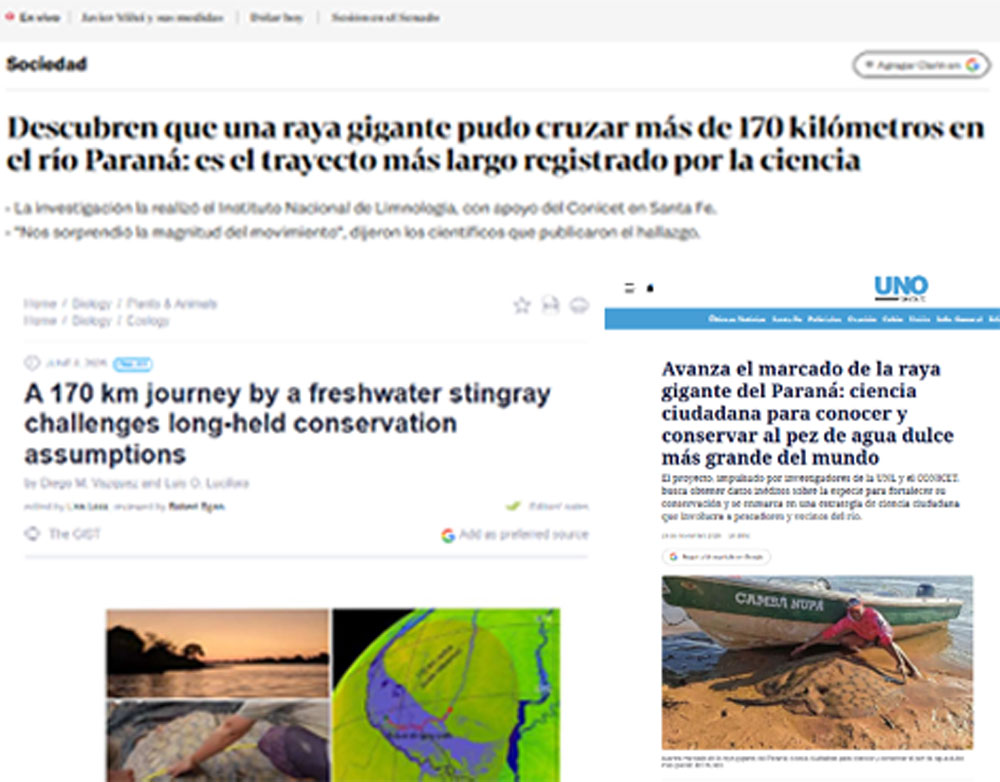
Examples of the regional, national, and international media coverage of our giant freshwater stingray tagging project. Image © Martín Vazquez
Thanks to this growing collaboration, by the end of the most recent stingray season we had tagged around 50 giant freshwater stingrays across four Argentine provinces, covering roughly 650 km of the Paraná River floodplain. The tagged animals included both juveniles and adults, from small individuals to exceptionally large stingrays weighing close to 100 kg or even more. Indeed, our team successfully tagged and released a remarkably large individual that we estimated to weigh close to 100 kg — an absolutely beautiful specimen and a memorable milestone for the project.
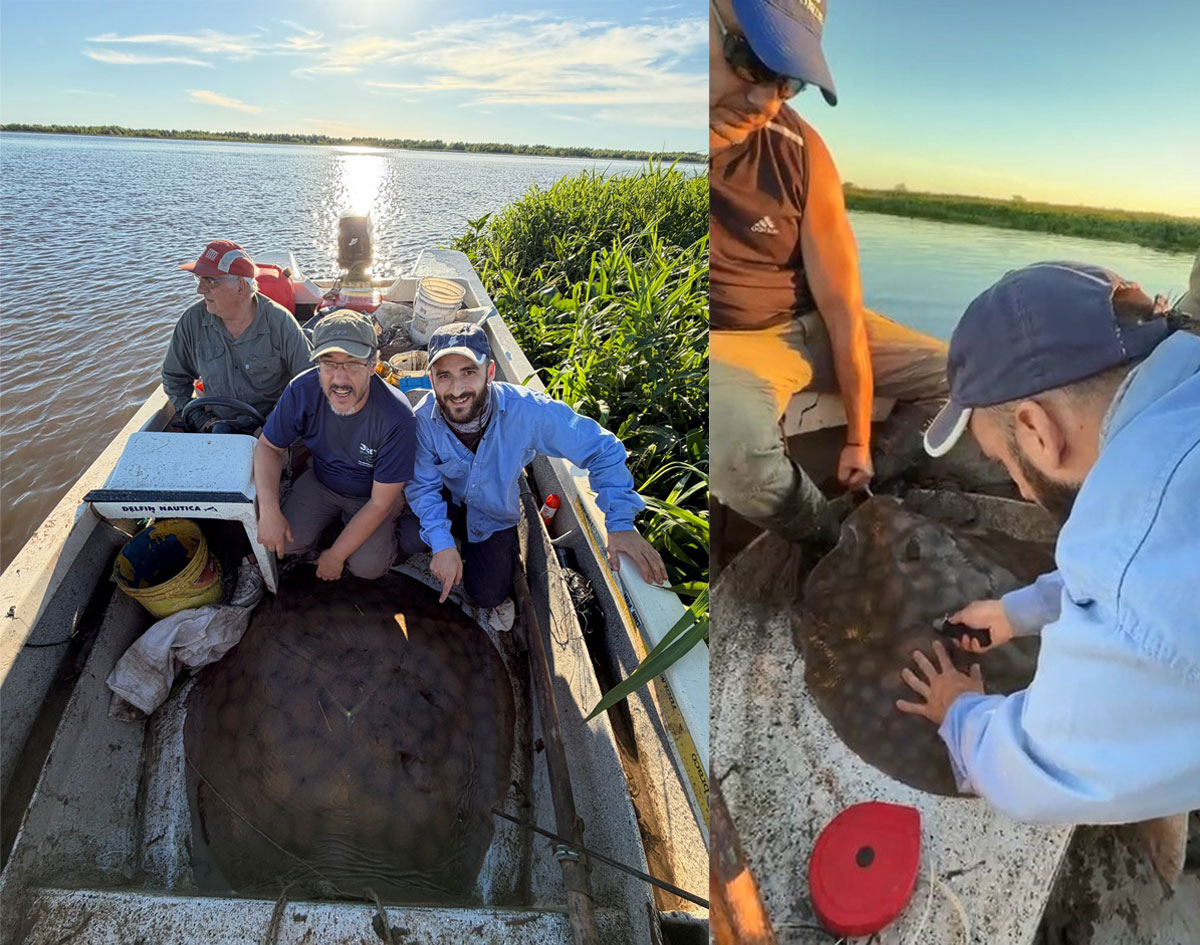
Upper left: Project leader Martín Vazquez and team member Luis Lucifora pose with the largest giant freshwater stingray captured, tagged, and released by the research team in the San Javier island area, Paraná River. The stingray was an adult female measuring 1.12 m disc width. Photo © Martín Vazquez. Upper right: Martín Vazquez holding and tagging a juvenile female giant freshwater stingray prior to release. Photo © Matías Decoud
But the most exciting part came later: two tagged giant freshwater stingrays were recaptured. The first individual had moved only about 12 km, which seemed to support the idea that freshwater stingrays are relatively sedentary. But a second recapture completely changed the way we think about the movements of this species. A juvenile female tagged in April 2025 was recaptured in February 2026 after travelling approximately 170 km along the Paraná system.
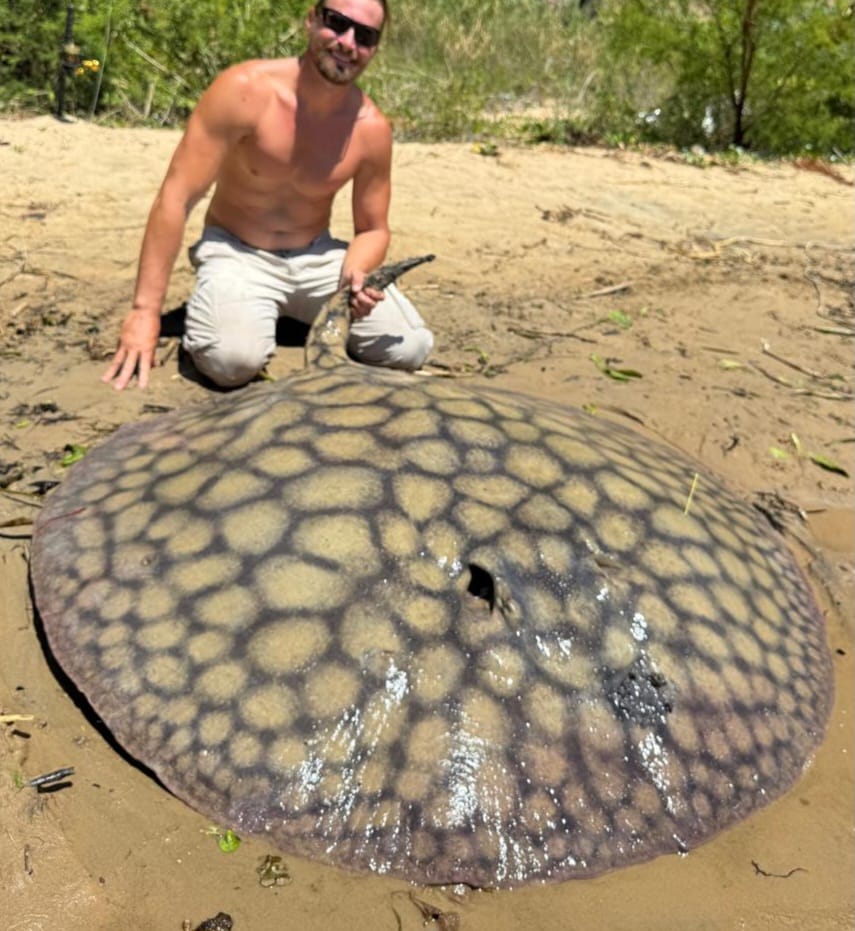
Recreational fisher Mauricio Curetti with a giant freshwater stingray of 1,30 m disc width, one of the largest stingrays tagged for the project up to now. Photo © Mauricio Curetti
This was an astonishing result, representing the longest movement ever reported for an obligate freshwater elasmobranch. Until now, recorded movements of freshwater stingrays were limited to only a few kilometres per year. Our finding showed that the world’s largest freshwater stingray is capable of much larger-scale movements than previously believed.
Recreational fishers Franco Romagnoli and Daniel Doroni holding and tagging a female giant freshwater stingray (74 cm DW), with a yellow tag in the lower Paraná River, Argentina, prior to release. This individual was recaptured after 10 months. Video © Franco Romagnoli and Daniel Doroni
Why does this matter? Because inland fisheries in Argentina are managed separately by each province. If giant freshwater stingrays regularly move across provincial boundaries, local management measures may not be enough to protect their populations. Their conservation will likely require coordination across the entire river system.
Perhaps the most important lesson from this project is that community participation matters. Fishers provided photographs, measurements, recapture reports, and local knowledge that proved essential for project success. What began as an outreach effort became a genuine collaboration between science and society.
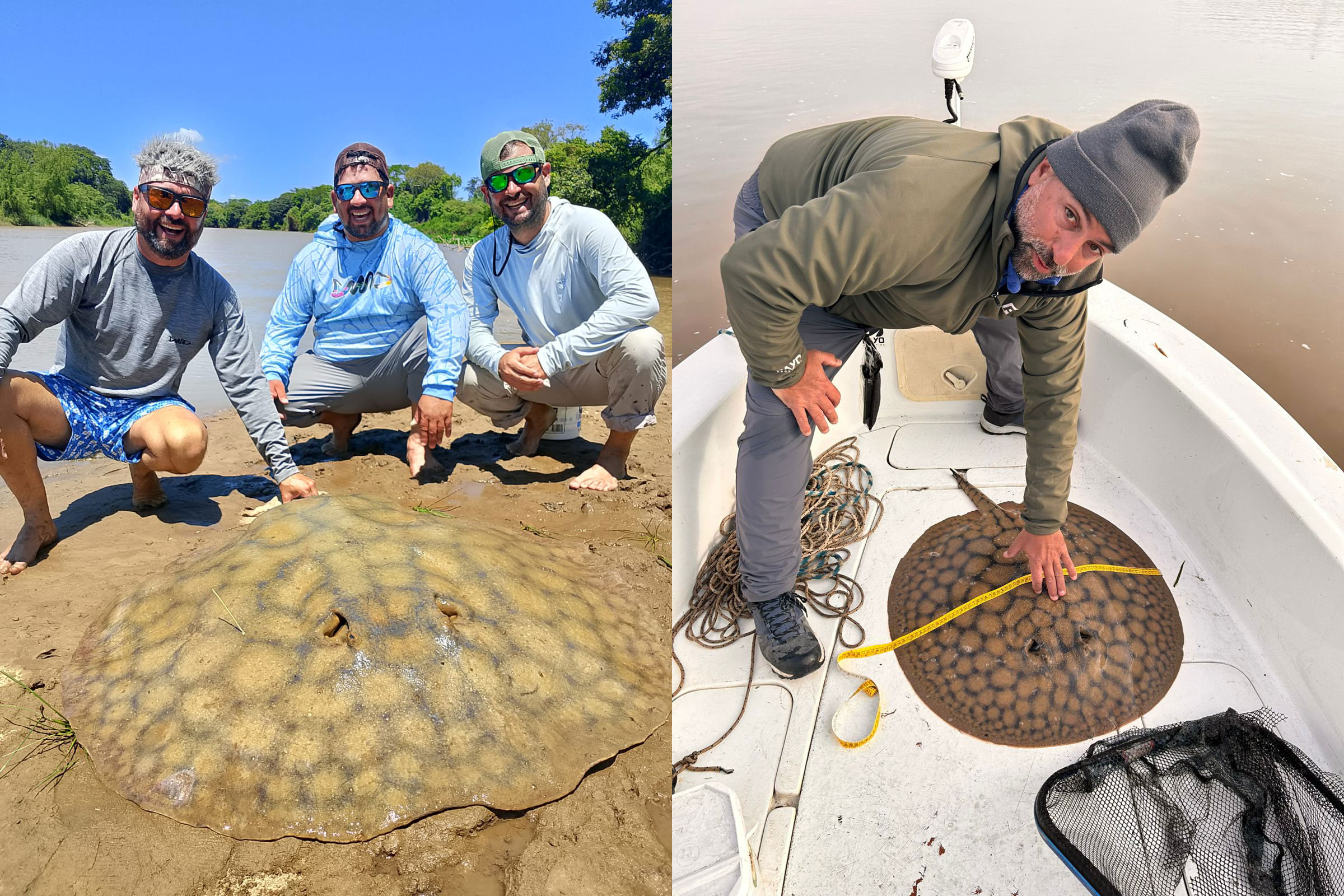
Left: Collaborating recreational fishers with a tagged adult giant freshwater stingray near Bella Vista, Corrientes. Photo © Patricio Barreto. Right: Another recreational fisher measuring a juvenile giant freshwater stingray for the project in San Nicolás, Buenos Aires. Photo © Juan Pablo Codina
The tagging program will continue during the next fishing season, and every new tagged stingray increases the chances of future recaptures and new discoveries. Somewhere beneath the muddy waters of the Paraná, dozens of stingrays are still carrying our small yellow tags—waiting to reveal the next chapter of their remarkable journey.