
Following the traces of disappearing sawfishes
My first experience with sawfish conservation didn’t begin in a genetics lab. As an undergraduate student, one of my first opportunities to participate in field research was volunteering for a juvenile Smalltooth sawfish tagging trip in Florida, USA. It was one of my first introductions to what studying and conserving a threatened species actually looked like in the field. Years later, now as a Ph.D. student, I recently had the opportunity to return to the field and participate in Smalltooth sawfish abundance surveys. Being back on the water brought me full circle, but it also highlighted a question that has become central to my Ph.D. research: what does sawfish conservation look like when encounters have become so rare that finding an animal to tag may not even be a realistic starting point?
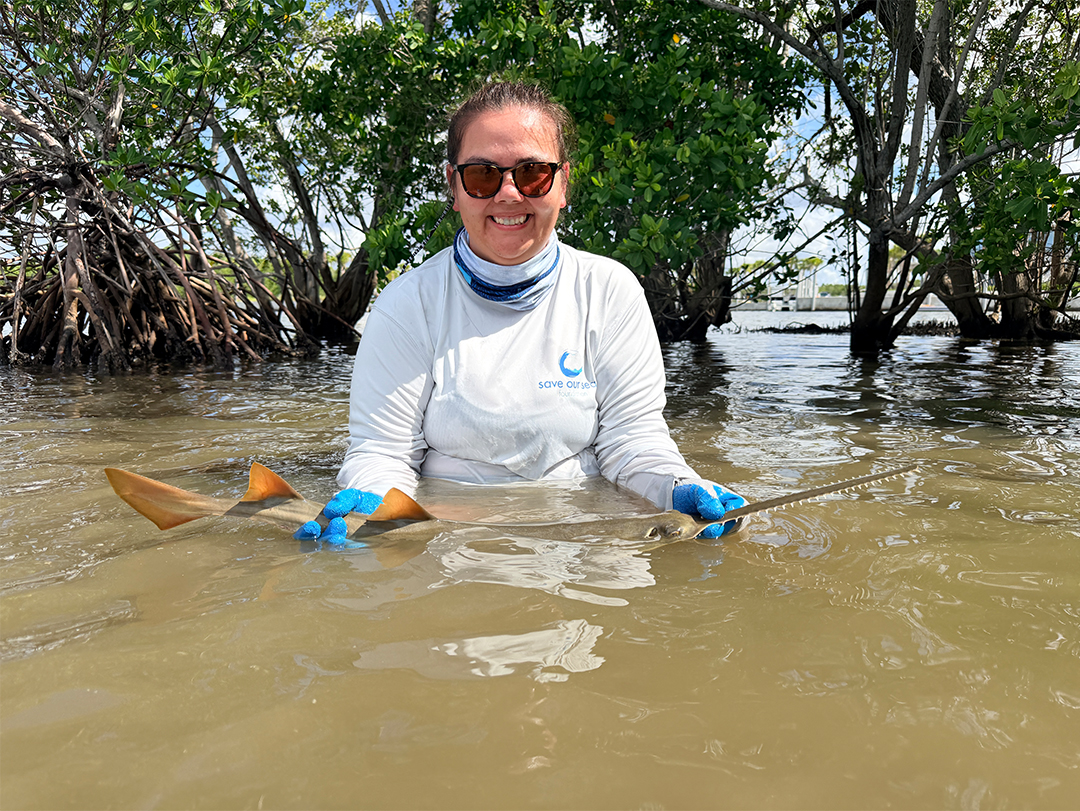
Kayla McCulloch holding a juvenile Smalltooth sawfish during research surveys in Everglades National Park, USA. All research activities were conducted under SAL-25-1292-SRP, ESA permit # 22078, EVER-2025-SCI-0028. Photo by © John Carlson
Across the Atlantic, along the West and Central African coast, sawfish conservation faces exactly this challenge. Historically, Largetooth and Smalltooth sawfish were distributed throughout the region, but contemporary records are scarce, making it difficult to determine where populations may still persist. Our project focuses on the Bijagós Archipelago of Guinea-Bissau, an extensive coastal island system characterized by mangroves, shallow estuaries, and other habitats associated with sawfishes. Guinea-Bissau has also had some of the more recent sawfish records in West Africa, suggesting that the region may still provide important habitat for remnant populations.
So, how can we look for sawfish when finding the animals themselves may be so difficult? One approach is environmental DNA (eDNA), which allows us to search for genetic evidence of a species presence from water samples. Fortunately, species-specific eDNA assays have previously been developed for both Smalltooth and Largetooth sawfish. As part of my Ph.D. research, we are bringing these existing tools together by into a duplex Droplet Digital PCRTM(ddPCRTM) assay, allowing us to search for DNA from both species simultaneously. By combining these tools, we hope to expand their application to help determine whether sawfish still persist in this region. We already have eDNA samples in our lab that were collected by collaborators from the University of Groningen and Instituto da Biodiversidade e das Áreas Protegidas (IBAP) during fieldwork throughout the Bijagós Archipelago, Guinea-Bissau. The next stage of this project will focus on applying these molecular tools in the laboratory to analyze samples collected by our collaborators.
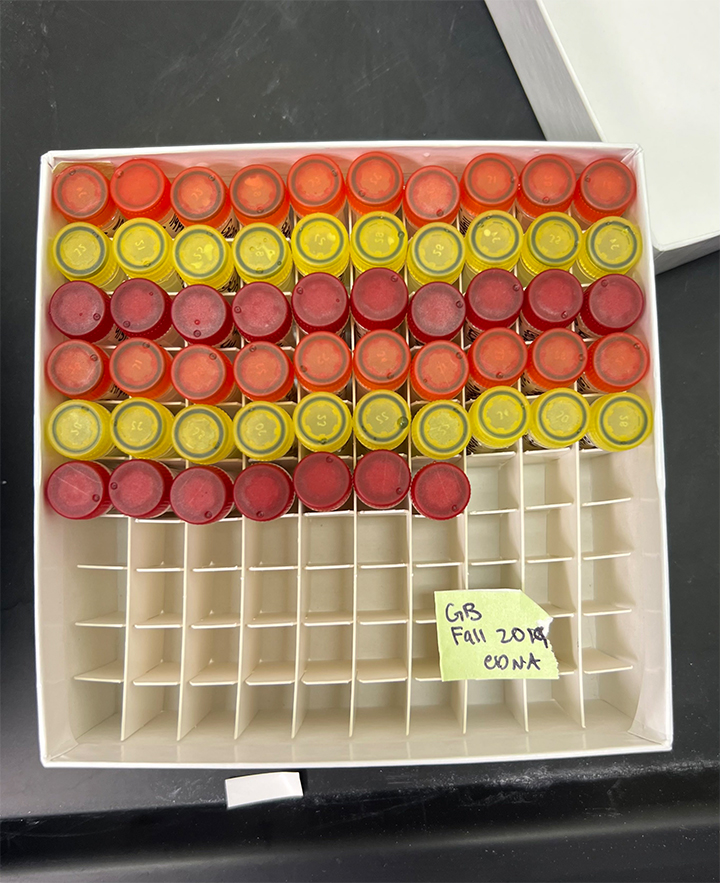
Archived environmental DNA (eDNA) samples collected by collaborators during fieldwork in Guinea-Bissau and now available for laboratory analysis. Photo by © Kayla McCulloch