
Fishing out tales about the shallows: seine netting
Time. Precision. Strategy. If any one of these elements is out of place, the mission could fail.
We’re waist-deep in the waters of False Bay along the Cape Town coastline, working across sites from Milnerton to Hangklip. The team was brought here through a collaboration between the City of Cape Town (CoCT) and the Department of Forestry, Fisheries and the Environment (DFFE) and Shark Spotters. We all bring the experience to the plate with a shared focus on getting a good haul and ensuring that the data collected is consistent and reliable to fairly represent and understand these dynamic coastal ecosystems.
The mission this season is to sample juvenile fish recruitment in our estuaries and surf-zone environments from Hangklip to Milnerton, and one of the tools of choice is the seine net. Similar to the trek-netters seen along the False Bay coastline, nets are used to pull fish to shore, where they are identified, photographed, measured, tagged (if necessary) and released. Because this method has relatively low equipment costs and requires minimal infrastructure, the method is easily repeatable across different sites in False Bay.
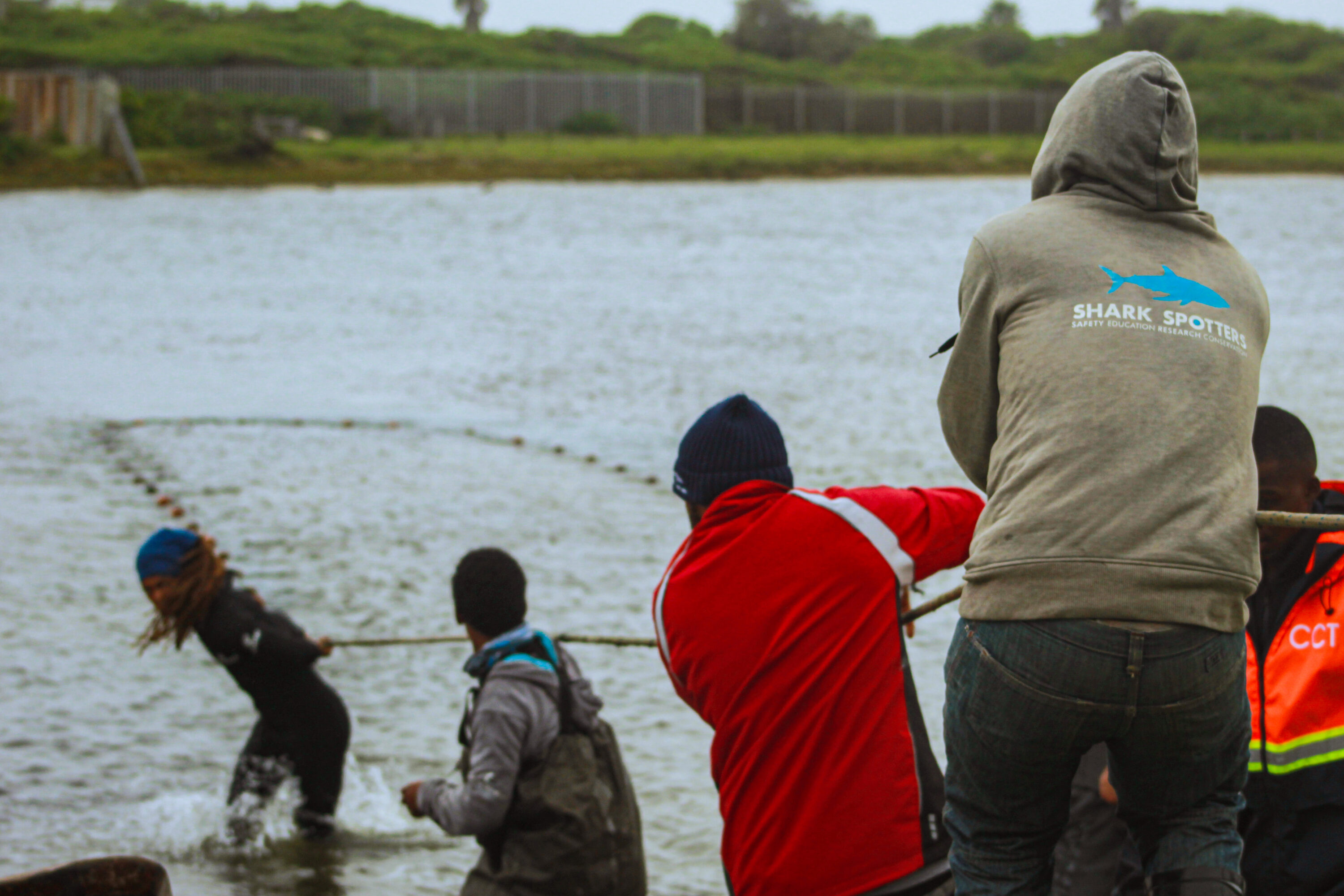
CoCT and Shark Spotters pulling in a seine net. Photo © Jamila Mlambo
HISTORY OF THE SEINE-NET
Looking back in history, ‘dragnetting’ (or beach seine-netting) is the earliest form of seining and was used by artisanal fishers more than one thousand years ago. This method of fishing existed on almost every continent, and here in False Bay, the seine-net fisheries dates back more than 250 years.
Today, there are different versions of the dragnet (beach seine net), such as the seine net, purse net and lampara net. The seine net used by our team that day has lead weights at the bottom and buoys at the top that act as surface markers. The method is most effective in areas with large shoals of fish and species that cannot out-swim the netters. Once in the water, the team, positioned parallel to the shore, moves the net toward land, capturing both juvenile and adult fish (and other aquatic animals), depending on the mesh size. The non-lethal, low impact nature of this method in the nearshore environment reigns supreme to other methods (example BRUV’s – form of underwater surveillance) which are impractical in high energy, low visibility environments.
SEINE NETS & THE SHALLOW AQUATIC ENVIRONMENTS
What makes this tool most suited for the shallow aquatic environment is its simplicity. The dynamic nature of shallow aquatic environments: the chemical, environmental and physical change they undergo, tend to influence the types of animals found in deep and off-shore ecosystems. Human impacts on the natural environment are evident through the destruction and modification of habitats, overuse of natural resources, pollution of waterways, climate change and invasive species. This is a concern as biodiversity is declining at an accelerating rate. Over the past 50 years (1970-2020), biodiversity has declined by 73%, with 56% of marine populations reported lost by WWF (2024). In Africa, the decline in biodiversity has been an alarming 76%.
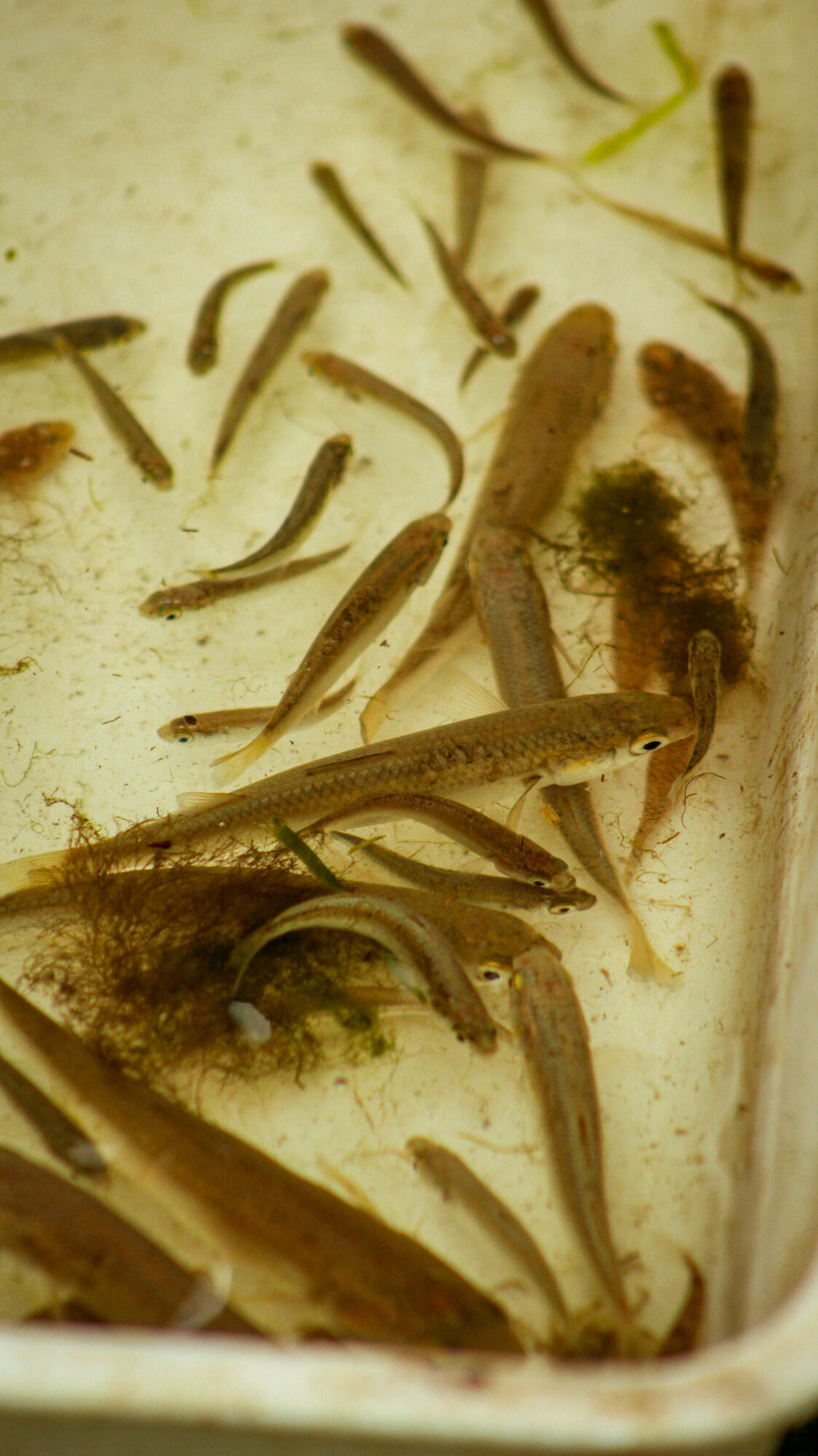
Juvenile fish collected from Zandvlei. Photo © Jamila Mlambo
A key indicator of environmental changes (positive or negative) in aquatic systems is fish. As one of the most species-rich aquatic groups, the presence or absence of specific species provides valuable insight into ecosystem health when compared with similar areas or historical data. Seine netting makes it possible to detect changes in species composition, abundance, and size structure providing a consistent and repeatable way to monitor change across both space and time confidently.
CONSERVATION OF AQUATIC ENVIRONMENTS
For the management and conservation of aquatic systems, it is important to monitor changes. For example, tracking how fish abundance across seasons and across different parts of the system have changed. Essentially, a net full of tails can tell us many stories about estuaries and surf-zone environments; some important in preserving rare, endemic, endangered and threatened species. The 2021-2022 Helderberg Marine Protected Area (MPA) monitoring efforts, for instance, indicates that several vulnerable fishes, and sharks and rays may be using that MPA as a refuge.
While seine netting is not the only method used to monitor the health of estuarine and surf-zone environments or monitor conservation efforts, it remains one of the approaches best suited to shallow aquatic environment and can be used in conjunction with other methods.
With Shark Spotters now in possession of its own seine nets, equipment and operational capacity there is a great opportunity to scale this work up into a more consistent, long term monitoring programme across False Bay. This is critical, as standardised sampling has been shown to be an effective tool for identifying ecological change, both locally and international systems. Going forward, with every haul of a net, we are contributing to a detailed tale of the bay and the life it supports.
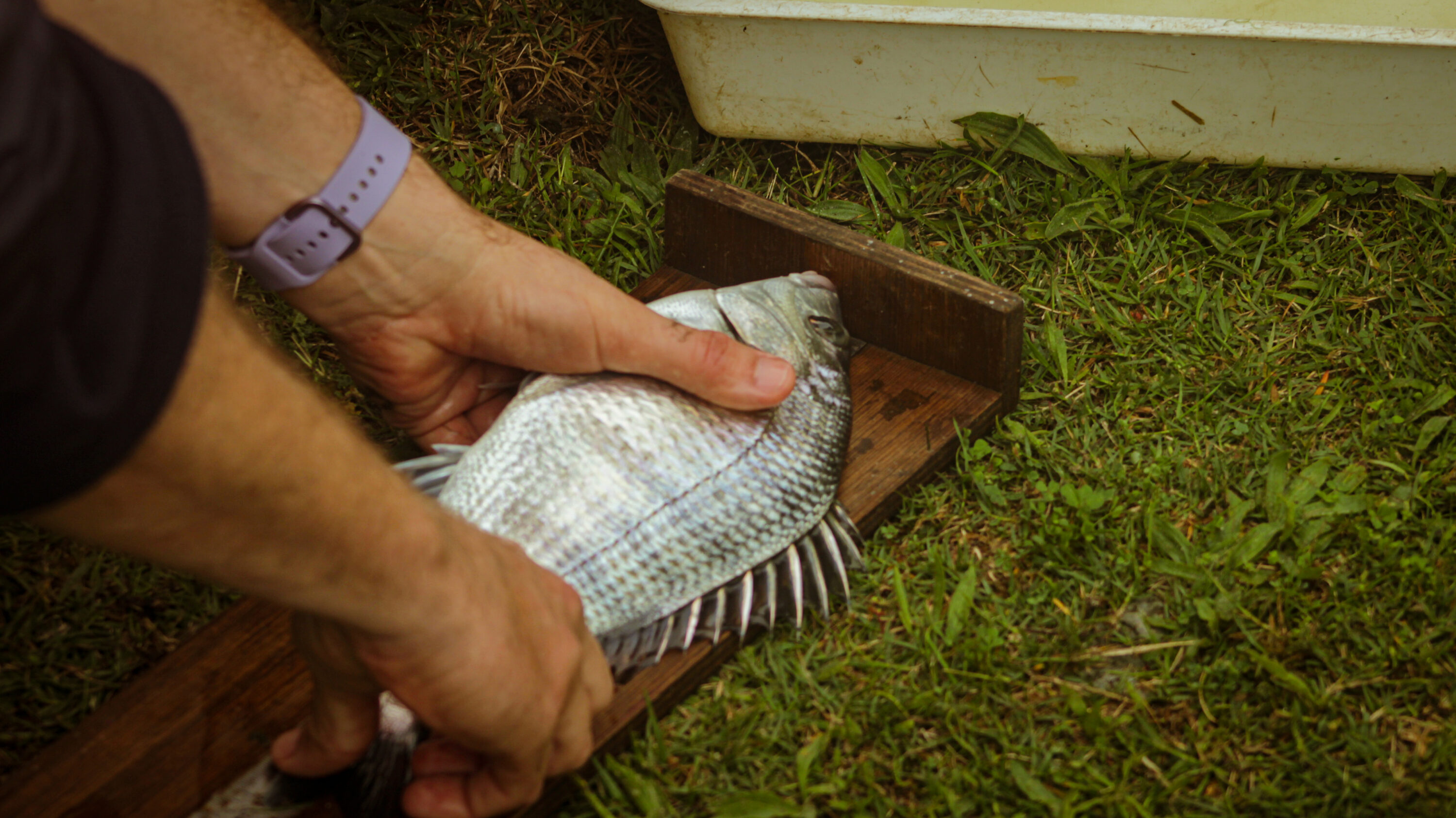
A fish being measured after being caught in a seine net. Photo © Jamila Mlambo
**References
Chovanec, A., Hofer, R. and Schiemer, F., 2003. Fish as bioindicators. In Trace metals and other contaminants in the environment (Vol. 6, pp. 639-676). Elsevier.
Hahn, P.K., Bailey, R.E. and Ritchie, A., 2007. Beach seining. Salmonid field protocols handbook: techniques for assessing status and trends in salmon and trout populations. American Fisheries Society, Bethesda, Maryland, pp.267-323.
Lamberth, S.J., Bennett, B.A. and Clark, B.M., 1994. Catch composition of the commercial beach-seine fishery in False Bay, South Africa. South African Journal of Marine Science, 14(1), pp.69-78.
Rogers, T., 2025, Biodiversity Report for the Helderberg Marine Protected Area 2021 –
2025. Technical report for the City of Cape Town – Coastal Management
Whitfield, A.K. and Elliott, M., 2002. Fishes as indicators of environmental and ecological changes within estuaries: a review of progress and some suggestions for the future. Journal of Fish Biology, 61(sA), pp.229-250.
WWF (2024) Living Planet Report 2024 – A System in Peril. WWF, Gland, Switzerland.