
Changing fisher behaviour is challenging – it takes time for values to be embedded
Changing fisher behaviour sounds simple from the outside. We can design a rule, offer an incentive, or ask people to release threatened species. But in a small fishing community like Lunyuk, change is much more personal than that.
As we know that, fishers in Lunyuk do not catch hammerheads and wedgefish because they want to harm them. These species are mostly caught as bycatch. When they are caught, they are part of the daily reality of fishing and part of the income that supports households. This is why our compensate-to-release trial is not only about saving individual animals. It is also about helping fishers carry the cost of conservation, so that releasing threatened species does not mean losing income they depend on.
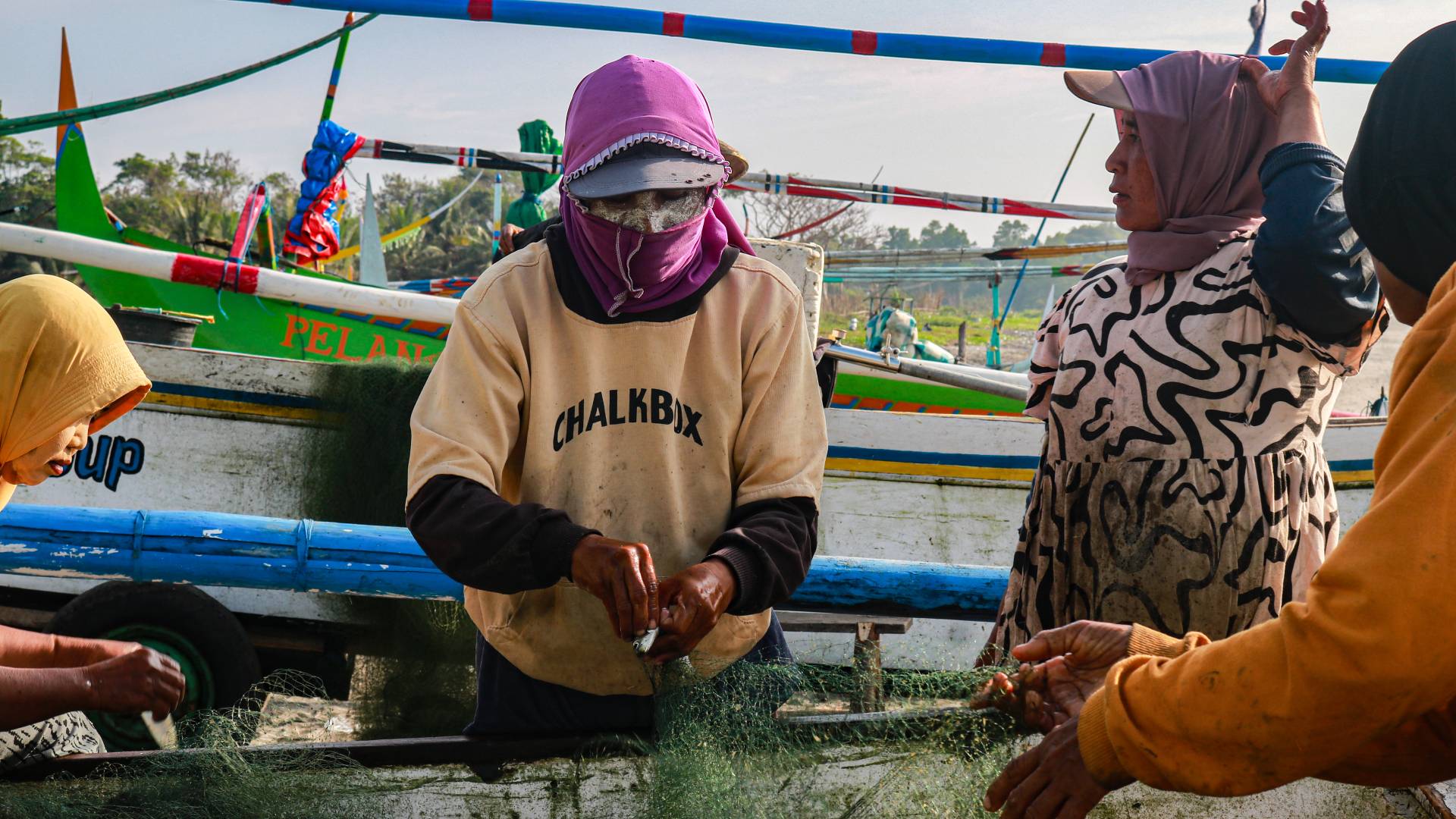
Female fishers in Lunyuk help their husbands untangle the day’s catch from fishing nets after landing. Photo © M Said Ramdlan
After almost one year of running the trial, started from June 2025 to May 2026, we have recorded three wedgefish releases (which can be watched here and here). It may sound like a small number, but in Lunyuk it is meaningful. Wedgefish are rarely caught, and when they are caught alive, they have a better chance of surviving release than hammerhead sharks. Hammerheads are much more difficult. Many are already weak or dead when the gear is brought in. So even when fishers are willing to release them, the chance to release a live hammerhead is often very limited. This is one of the hardest lessons from the trial: willingness alone is not enough if the animal does not survive the capture process.

Night discussion with the fishers for their opinion about compensate to release program. Photo © M Said Ramdlan
The social data gave us hope. In our interviews, 96% of fishers said they were willing to reduce catches of hammerheads and wedgefish if they were compensated for the income they would lose. Many fishers also saw the positive incentive as fair, and as either positive or neutral for their wellbeing. This matters. It shows that many fishers are open to conservation when they feel respected and when the costs are not placed only on them. In contrast, many fishers said they would be less willing to follow rules and fines if they felt unfair or harmful to their families.
The catch data also tells a careful story. Looking at catch per trip gives a more honest picture than looking only at total catch. For wedgefish, catches were lower during the treatment condition, falling from 0.09 to 0.04 wedgefish per trip. The model also suggested that the odds of catching wedgefish were about 58% lower under treatment than under control, although the result was not strong enough to say this was clearly caused by the treatment. For hammerheads, the pattern was different. Catch per trip was slightly higher during treatment, increasing from 0.28 to 0.35 hammerheads per trip. The model suggested the odds were about 29% higher under treatment, but again the result was uncertain.
This does not mean the trial failed. It means we are working with real fishing conditions, where bycatch is unpredictable and survival is not always possible.
For me, the main lesson is that positive incentives can open the door. They can help fishers try a new behaviour without feeling punished. But over time, the deeper goal is for live release to become part of local values: something fishers see as fair, useful, and connected to the future of their sea.
Changing fisher behaviour is challenging. It takes time. But when the value becomes embedded, conservation can move from being a project activity to becoming part of everyday fishing practice. This is why I believe conservation is not only about protecting the endangered species, but it is also about providing options for people.