
Before sunrise: A field journey to study guitarfishes
The alarm went off at 4 a.m. Still in the dark, between quick sips of coffee and boxes of equipment being loaded, another field day began in search of one of Brazil’s most threatened marine species: Brazilian guitarfish, Chola guitarfish, Shortnose guitarfish (hereafter guitarfish).
Our project aims to understand how these species manage to survive in environments increasingly impacted by human activities. To do this, we are investigating the heavy metal composition and molecular mechanisms that may be linked to their adaptive potential, comparing populations living in protected areas with those exposed to intense environmental pressure.
Our first field campaign took place near Anchieta Island, in Ubatuba, on the northern coast of São Paulo, Brazil, a region known for hosting aggregations of Brazilian guitarfishes and bordered by an important marine protected area.
Before sunrise, we boarded a double-rig trawling vessel alongside local fishers, whose knowledge proved essential in locating the best fishing grounds. Our team consisted of myself and three graduate students, all sharing the same mixture of sleepiness, excitement, and anticipation that accompanies any field expedition.
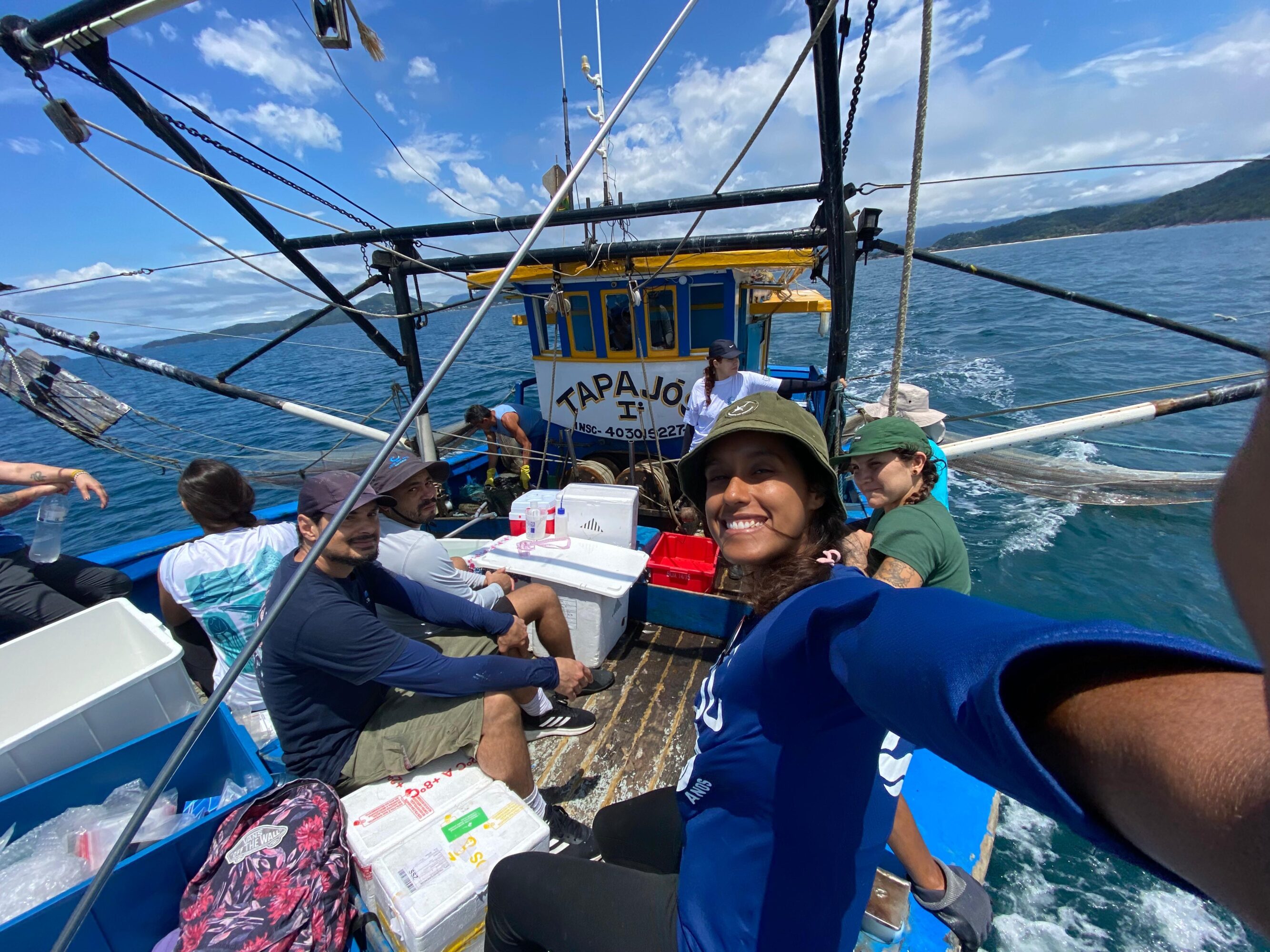
Research team training for the collection and sampling of guitarfishes around Anchieta Island. Photo © Rodrigo Domingues
Out at sea, we headed toward areas where guitarfishes are commonly found. Because these animals inhabit the seafloor, especially in shrimp fishing grounds, we conducted short trawls lasting about 20 minutes. And during the very first haul, they appeared.
There is always a special moment when the net begins to emerge and, among fish, shrimp, and sediment, the unmistakable silhouette of a guitarfish comes into view. Even though scientific fieldwork demands speed and precision, it is impossible not to pause for a few seconds to admire such a rare and threatened animal.
As soon as they were brought onboard, the guitarfishes were carefully transferred into tanks with continuously circulating seawater to minimise stress and maintain proper oxygenation until processing.
Each individual provided a valuable set of information. We recorded species, sex, and total length, and collected small tissue samples for genomic and transcriptomic analyses. These studies may reveal which genes are associated with resistance to environmental stress, contamination, and other challenges imposed by changing coastal ecosystems.
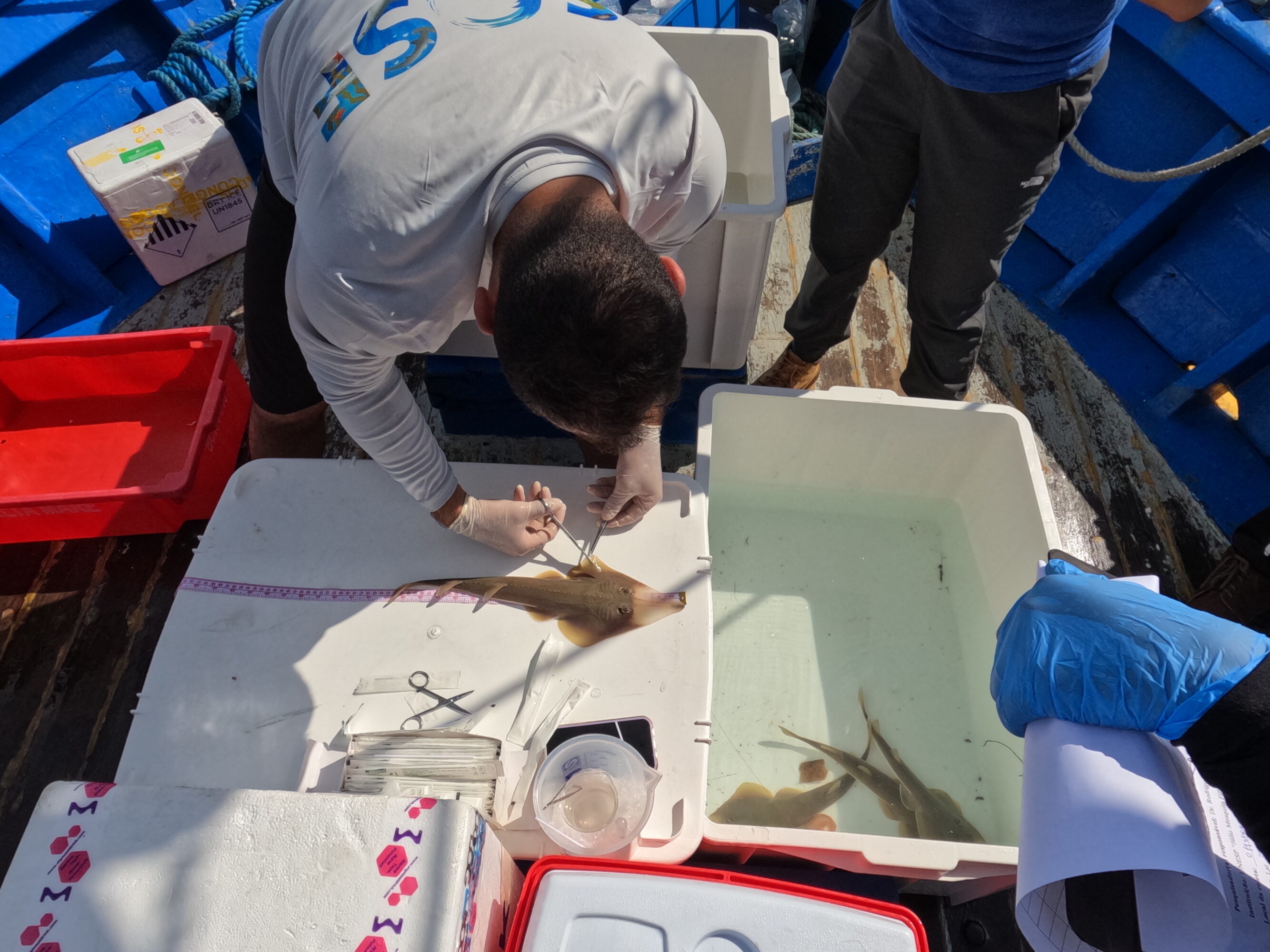
Collecting biological samples from guitarfishes. Photo © Julia Terra
But we did not stop there.
Using sterile swabs, we also sampled the skin microbiome, the microbial communities living on the animals’ surface that may play important roles in health and immunity. Another swab was inserted into the cloaca to investigate both gut microbiota and diet through metabarcoding techniques, allowing us to understand what these animals eat without the need for invasive methods. After sampling, the guitarfish were released safely back to sea and swam away.
By the end of the expedition, we returned to shore tired, soaked, and smelling of saltwater and diesel, but carrying something far more valuable than boxes of samples: critical data for understanding and conserving one of the most fascinating and threatened species in the South Atlantic.
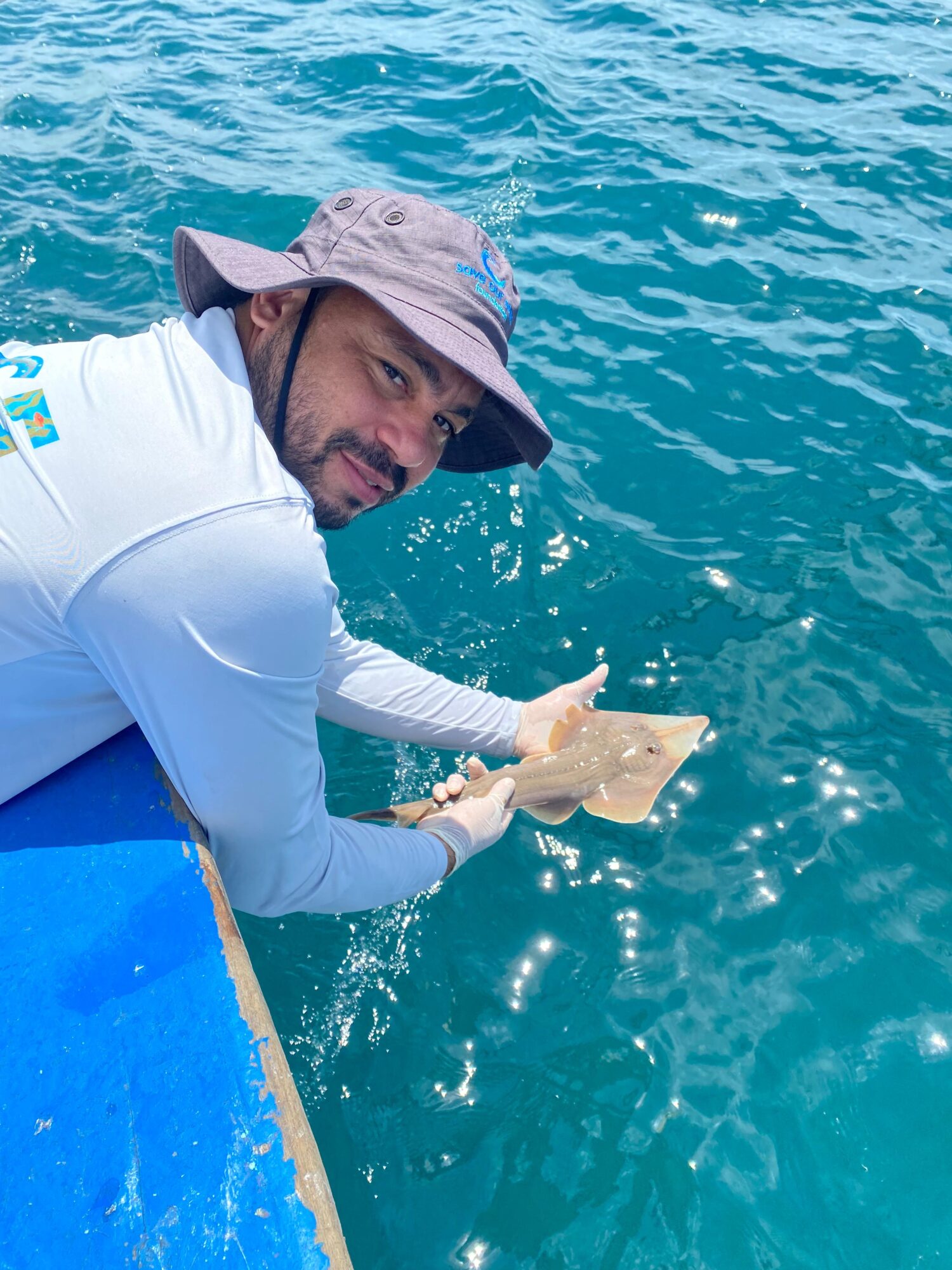
Rodrigo Domingues returning a sampled Brazilian guitarfish to the water after biological sampling. Photo © Isabelle Nakaima
And although this expedition was a success, fieldwork rarely goes exactly as planned.
But that is a story for the next blog.