
Back to basics part 2: unlocking the secrets of age and growth analysis for sustainable fisheries management
Understanding how sharks grow and how long they live is fundamental to protecting them. Age and growth analysis gives scientists critical insight into a shark’s life history—information that helps determine how vulnerable a species is to fishing pressure and how quickly populations can recover from decline.
Unlike trees, sharks don’t have obvious growth rings you can count from the outside. Instead, scientists like myself, estimate age by examining hard structures inside the body, most commonly the vertebrae. Shark vertebrae are made of cartilage and contain bands of mineralised tissue that form over time. When thin sections of vertebrae are viewed under a microscope, these bands appear as alternating light and dark rings, similar to tree rings. Each pair of bands is often assumed to represent one year of growth.
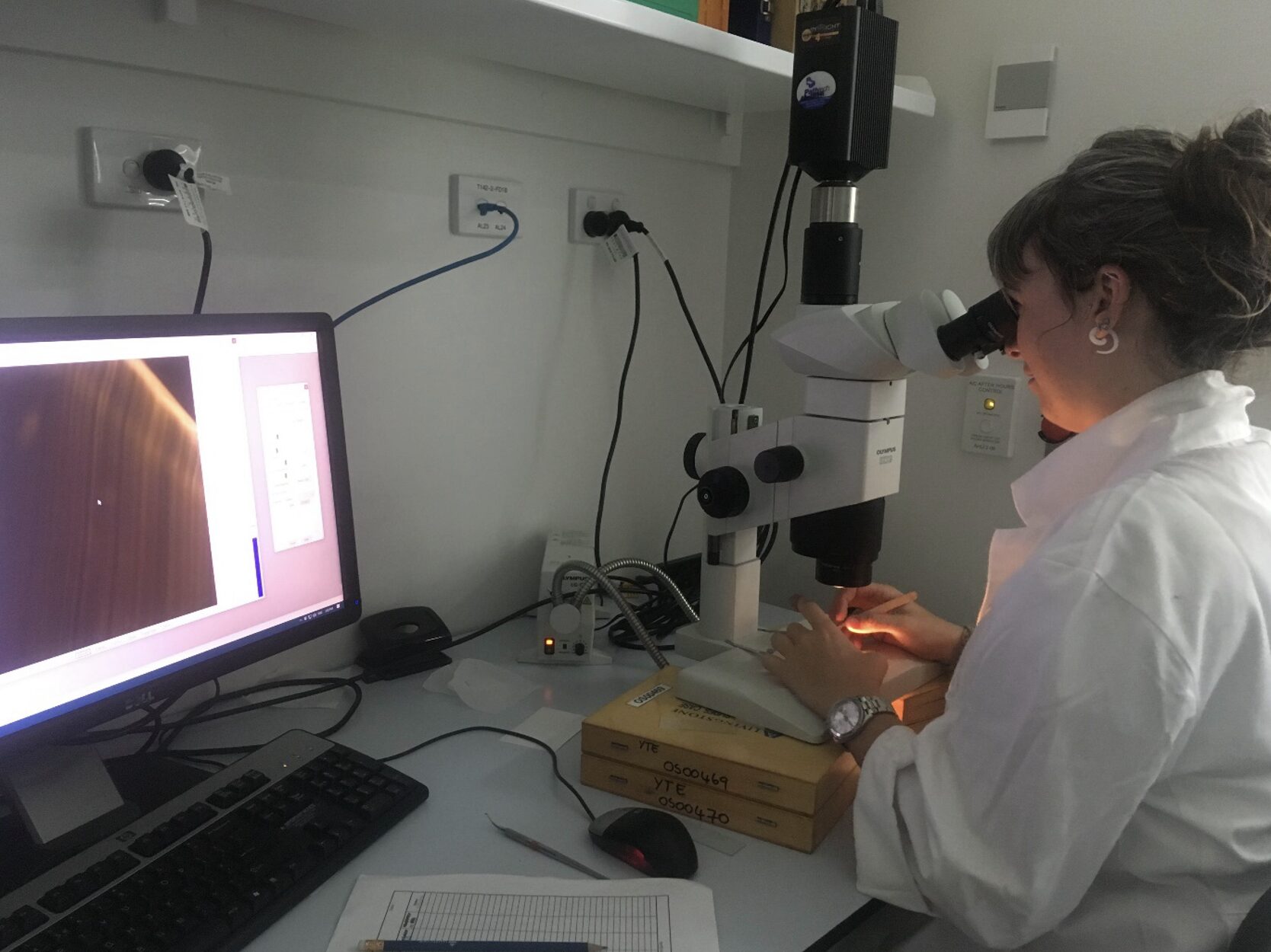
Analysing growth bands in shark vertebrae using a microscope. Photo © Brooke D'Alberto
By counting these growth bands, I can estimate both the age of an individual shark and then use this age and length to generate a growth curve. This describe how quickly sharks grow over time from juveniles to adults. If we also know if the shark was mature or immature, you can also estimate the age of maturity at a population level.

Slicing a thin piece of a shark vertebra to examine the growth rings underneath a microscope. Photo © Brooke D'Alberto
Why does this matter? Shark and rays that grow slowly, live a long time, and reproduce late tend to be especially vulnerable to overfishing, like wedgefish. If these wedgefish are removed from the population faster than they can reproduce, recovery can take decades, or may not happen at all. Age and growth data feed directly into stock assessments and conservation models, helping managers decide whether fishing levels are sustainable.

A piece of shark vertebra that has been sliced thinly to count the growth bands. Photo © Brooke D'Alberto
Ageing sharks isn’t always straightforward. Growth band formation can vary between species, and validating whether bands truly represent annual growth often requires long-term studies or chemical markers. Despite these challenges, age and growth analysis remains one of the most powerful tools we have for understanding shark biology.
In short, counting growth bands isn’t just an academic exercise, it’s a crucial step toward informed fisheries management and better conservation outcomes for sharks and rays around the world.
For further information, check out my publication, Preliminary life history of the Critically Endangered bottlenose wedgefish Rhynchobatus australiae from Southeast Asia