
A smooth sea made a skilled marine scientist
Last year did not go as planned. The weather was not on our side, and neither was time. Our prayers for calmer seas went unanswered. We only made it out once, and under those conditions, we could only take simple measurements and samples. In summary, 2025 was truly not our year when it came to fieldwork at sea.
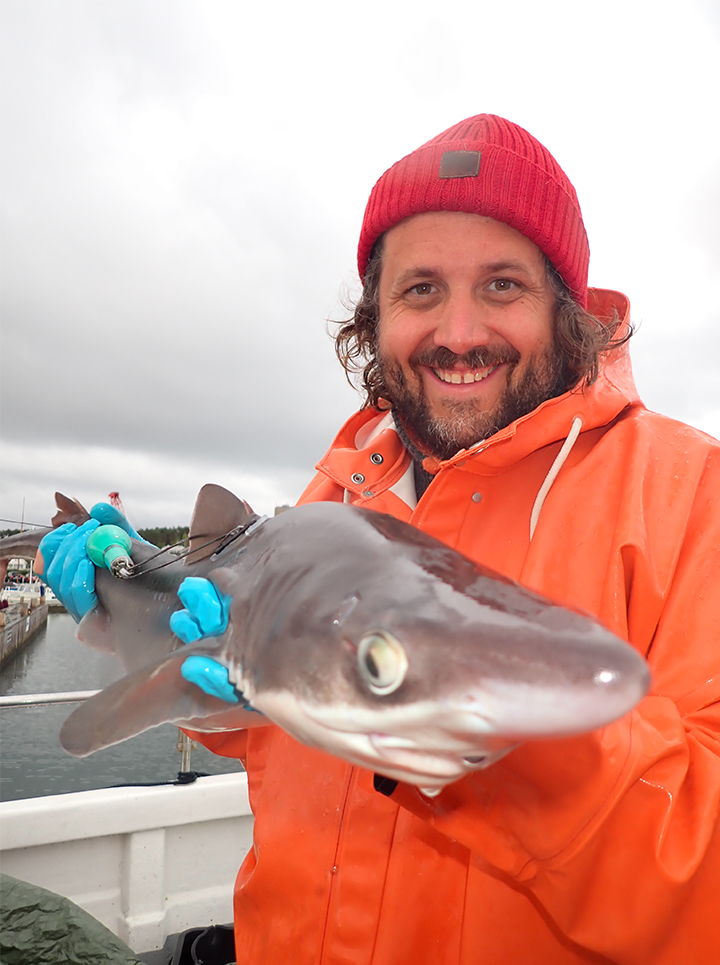
A PSAT-tagged mother-to-be held by a very tired scientist, judging by the bags under my eyes. Photo © Daniel Palm
Therefore, we had to rethink our plans and, as so often in shark science, came to the inevitable conclusion: we’re going to need a bigger boat. In early 2026, we started looking for alternatives that would not completely destroy our budget, and eventually found the 15-metre charter fishing boat Tuna Clipper. We decided to charter her for two weeks, starting in early August—allegedly the prime time for spiny dogfish along the Swedish coast—and pretty much put all our eggs in that basket.
Then came August. The prevailing heatwave over Central Europe brought unsettled weather to the north. We boarded Tuna Clipper and decided to start our expedition by heading to the very north of the Swedish west coast, where the archipelago might allow us to fish even in more challenging winds. We headed towards Strömstad and quickly realized that we probably should have checked the seaworthiness of our vessel before setting off. The strong headwinds sent water washing over the cabin, and let’s just say that neither we nor our planned bunk beds stayed particularly dry. But it was what it was, and we had to make the best of the situation. This ended up becoming something of a motto for the expedition, as both our boat and the weather would continue to challenge us.
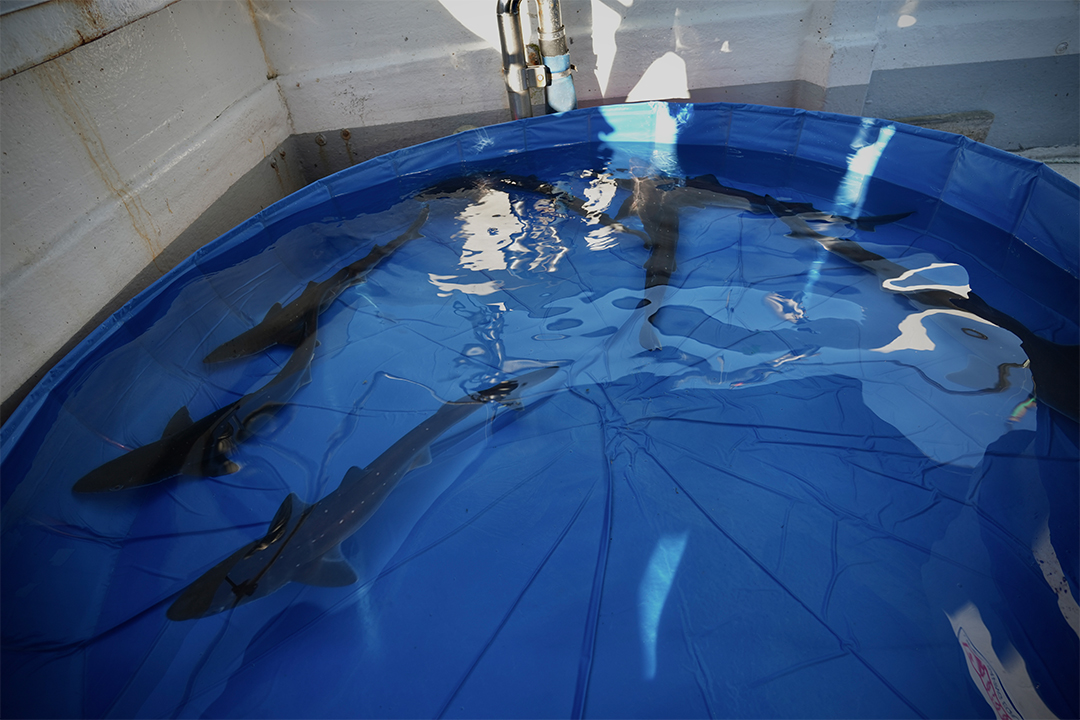
The shark waiting room. We kept the sharks in pools designed for dogs on the aft deck, with a continuous flow of seawater, both before tagging and while they recovered afterwards. Once recovered, they were moved to the larger live wells before being returned to sea. © Vide Brodin
In retrospect, we can laugh about it. The glamorous life of a marine biologist portrayed in documentaries is often quite far from our everyday reality. But we make it work, because we want to explore, learn more, and ultimately contribute to a better future for the species we study and the ecosystems they are part of.
The fishing started off slowly. We had talked to basically every recreational fisher in the area about where to find spiny dogfish, and we tried all the prime spots. But nothing. Not even a single bycatch. And this is supposed to be the area with the highest species richness in Swedish waters. As the days passed, we fished our way southwards without success. Doubts started creeping into our minds. Until we finally found them. At about 60 m depth, outside Väderöarna, at a spot called Svaberget.
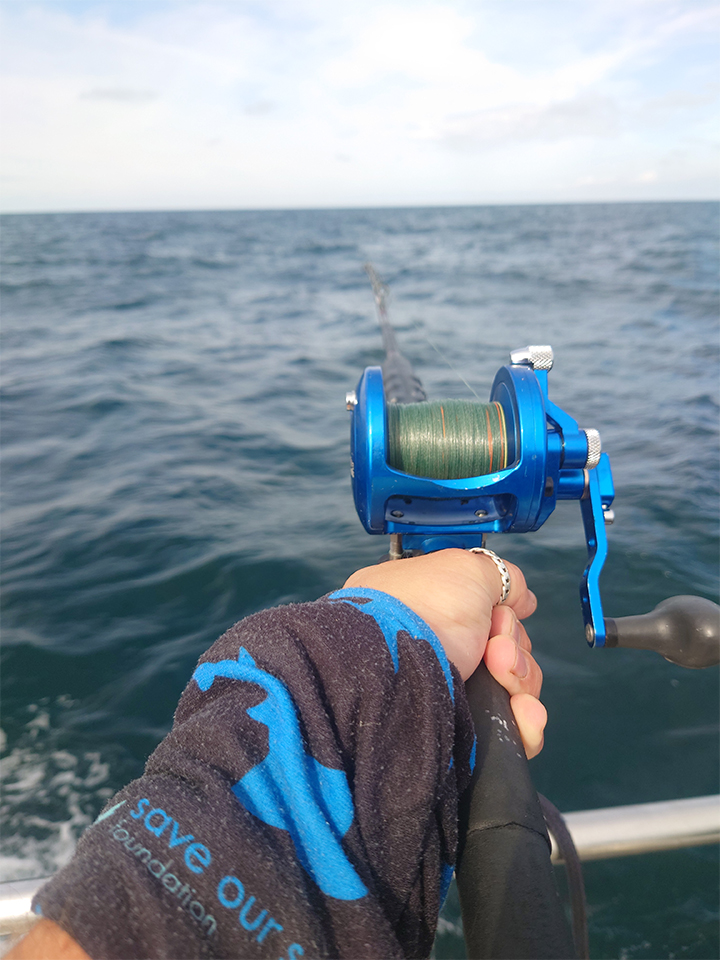
Fishing for science. Photo © Petter Lundberg
And suddenly, we could barely get our hooks down before we had to reel them back up. Then came the next challenge. The sea was too rough to carry out all the sampling and tagging we had planned. So, we placed the sharks in two very large live wells and headed for shore. Once sheltered from the waves, we could methodically work through them one by one: sedate, sample, measure, and tag them before returning them to the well-oxygenated live wells. Once we were done with all the sharks, we headed back out to sea and released them where we had caught them.
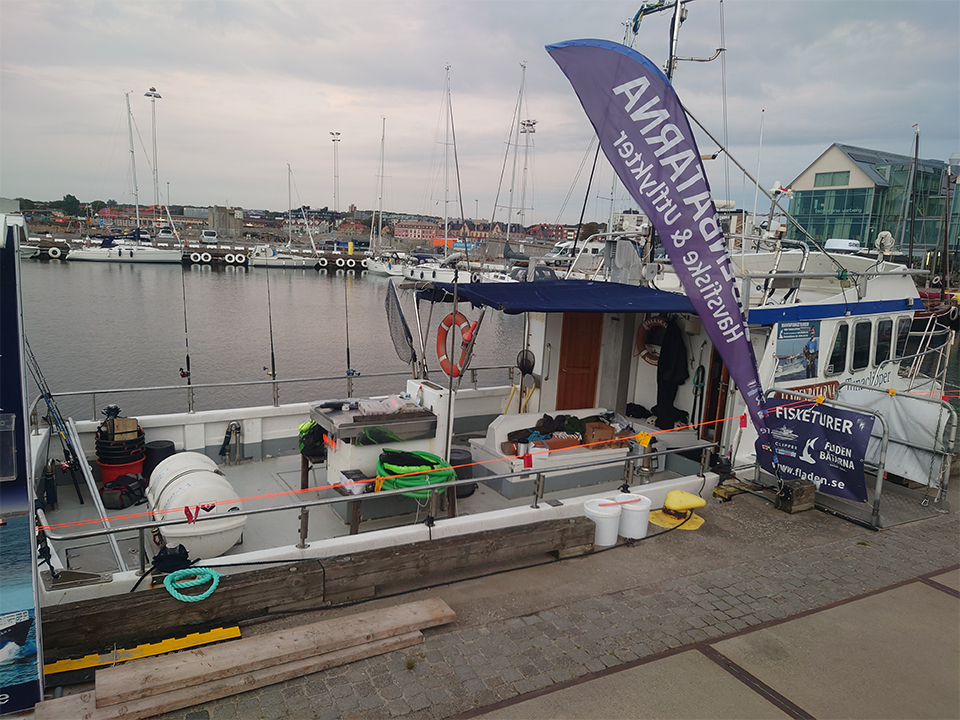
Tuna Clipper—our “bigger boat” and home at sea for two challenging weeks. Photo © Petter Lundberg
This method ended up becoming our routine for the rest of the expedition. It felt like the best option for the sharks, with the slight drawback that our days became very long.
From Svaberget southwards, we could basically find sharks every day the weather was calm enough for us to get out. But contrary to what we had believed—and what we had been told—the sharks were very patchily distributed along the coast. So, each day, we first had to find that day’s “spot”.
We fished our way from north to south, covering different parts of the coast each day. The weather kept messing with us, and even when the forecast looked promising, conditions out at sea often proved challenging.
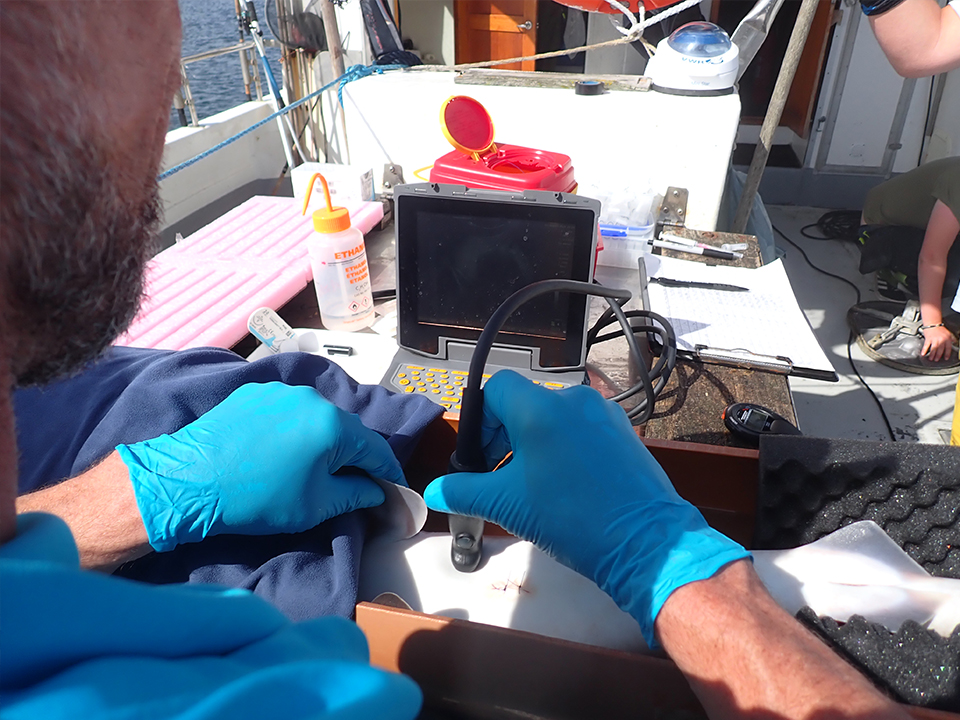
Our field lab setup. Keeping the shark calm and in well oxygenated water while sampling and tagging—and, in this case, checking for pregnancy with the ultrasound. Photo © Petter Lundberg
Looking back at the expedition, we are pretty pleased with what we achieved. Despite everything, we managed to sample 116 spiny dogfish, collecting fin clips, tissue, and blood, and tag them all conventionally, with the majority also receiving acoustic tags, across four different areas along the Swedish coast. About two-thirds were females, and with the help of ultrasound, we could confirm that most of them were pregnant. Sadly, some even gave birth as a result of the stress of capture and handling, but we made sure to return those pups to the sea as quickly as possible. The sharks ranged in size from 57 to 107 cm, and we even managed to equip eight of them with PSATs.
These 116 sharks, together with those sampled in previous years, bring us close to our goal of 150. And although we’ve blown our budget by quite a bit, we will likely try to find resources for some additional sampling, probably in the north once we hear that the sharks are actually there. Additional resources will also be needed to complete the analyses of all the samples we have collected. But before I start working on that, I will try to catch up on some sleep—and a long list of unanswered emails.
Also, I can’t wait to offload the receiver array next spring. It will be so cool to see what our new friends have been up to.