
Tagging the untaggable: New study finds the ‘right fit’ for reef manta rays
SOSF project leader and PhD researcher Rachel Newsome has been testing different methods of attaching biologgers – a kind of animal Fitbit – to reef manta rays to unlock secrets about their movements and behaviour.
Few experiences sound more idyllic than swimming in the warm, cerulean waters of Western Australia and the Seychelles Outer Islands, surrounded by the ocean’s gentlest giants: reef manta rays.
But for marine scientist Rachel Newsome, the reality was far from serene. The usual stresses of conducting research in the field, like locating your study species in the wild and battling the elements, were compounded by the fact that Rachel was trialling two new methods for attaching biologging tags to the mantas. ‘We foolishly went into that season expecting it to be quite straightforward,’ she recalls, half-laughing. ‘But the fact of the matter is, manta rays are these beautiful, but fast-moving creatures. It turned out to be an extremely challenging process.’
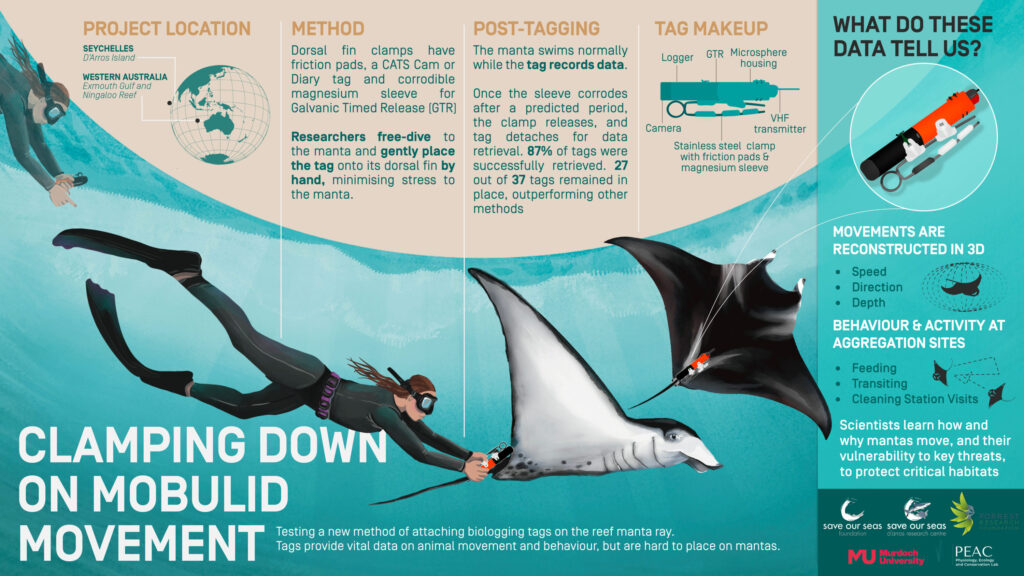
Infographic by Kelsey Manners Dickson | © Save Our Seas Foundation
Biologgers are devices that work in a similar way to a Fitbit. They contain a plethora of sensors that can collect data about an animal’s physiology, movement and behaviour. Depending on what sensors are included, they can tell us how fast an animal was moving at any given time, the direction it was moving in and at what depth – even its heart rate. Data like these allow scientists to answer important questions about how and why animals move and their vulnerability to certain pressures like environmental changes and human activity. Crucially, an advantage of using these types of tags is that they can be attached to an animal’s skin or dorsal fin while it is still swimming, enabling researchers to collect motion-sensitive data about species that are inherently challenging to study: large-bodied, agile, pelagic animals like whales, dolphins, sharks and rays. In short, biologgers have really changed the game when it comes to understanding and protecting highly mobile marine megafauna.
But until recently, manta rays had proved a unique challenge. ‘To date, we have been unable to put these tags on manta rays as their distinctive body shape means the techniques used on sharks, turtles and cetaceans cannot be transferred across to these species,’ Rachel explains. Part of the problem is that in order for the sensors to collect accurate data, the biologgers must be placed on the animal using a rigid attachment. This means that the sensors can distinguish actual movements of the animal’s body from the movements of the tag itself as it is bashed around by the surrounding water (which scientists have nicknamed the dreaded ‘wobble’).
A close up of a reef manta ray donning a tag attached to its dorsal fin. Once the biologging tag's sleeve corrodes, and it deatches, the tag is retrieved for data colection. Photo by Rachel Newsome | © Save Our Seas Foundation
For smooth-skinned animals like whales and dolphins, these attachments can simply be stuck onto the skin using suction cups. Or, for larger sharks with substantial dorsal fins, tags can be attached using a clamp or tagging pole. But neither method works for manta rays.
This leaves significant gaps in our knowledge about a species that is special in terms of its physiology and energetics. ‘We consider mobulids to be on this phenomenon known as an energetic knife edge, where there’s a tight balance between the energy they can get in through foraging and the energy that they expend on growth, survival, reproduction and all those other features,’ Rachel says. ‘Understanding how they are adapted for energy conservation can help us understand how energy acquisition is partitioned across their daily cycle – and the consequences that could have on their survival, particularly in relation to the conservation and management of important areas for movement and behaviour, especially foraging areas.’
With that in mind, Rachel set out to test the efficacy of two different rigid attachments for biologging devices on free-swimming reef manta rays. One mechanism involved a J-shaped attachment that looped over the manta’s top jaw, and was held in place by light clamping force. The other was a dorsal-fin clamp optimised for small fins, which included two contact pads placed on each arm of the clamp to increase friction and ensure the clamp remained on the animal, even as it performed its signature acrobatics. Both designs included housing for the biologging device and, like many biologging tags, both would ‘pop off’ after an allotted time so that they could be picked up on the surface. With support from colleagues at the Save Our Seas Foundation D’Arros Research Centre (SOSF-DRC), Murdoch University, the Manta Trust and Customised Animal Tracking Solutions (CATS) and her new devices in hand, Rachel then conducted trials across three different sites where reef mantas are regularly sighted: D’Arros in Seychelles, and Exmouth Gulf and Ningaloo Marine Park in Western Australia.
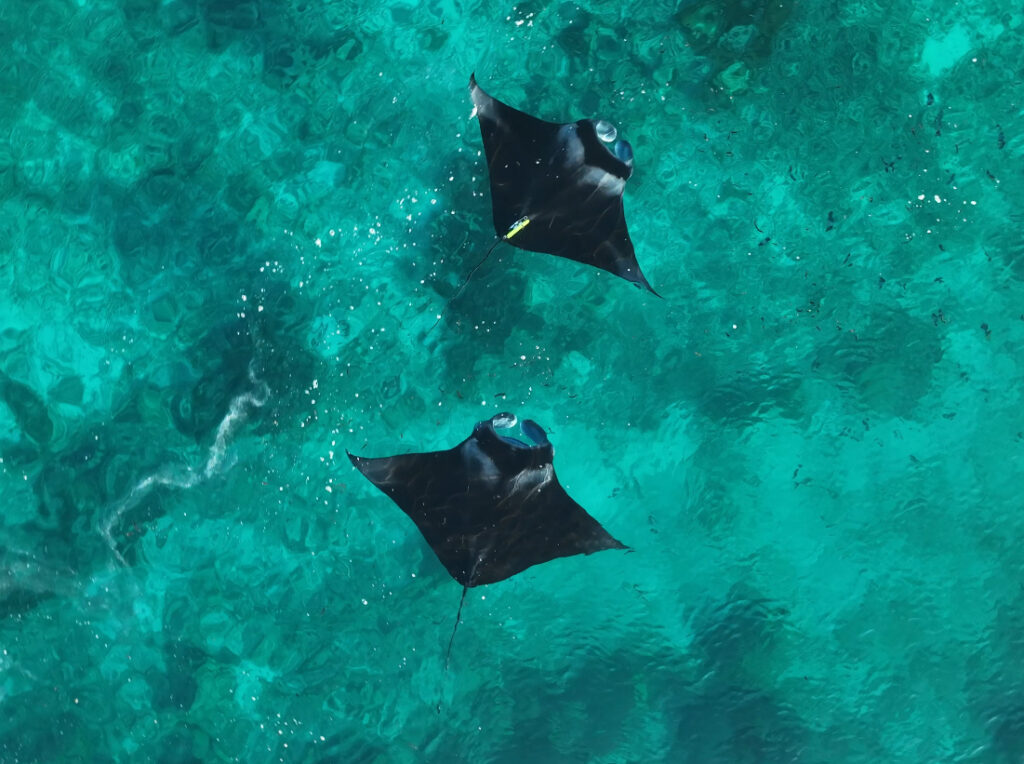
An aerial image of reef manta rays with one having a Diary tag and corrodible magnesium sleeve for Galvanic Timed Release (GTR). Photo by Rachel Newsome | © Save Our Seas Foundation
It was no easy task. Mantas first had to be spotted, either by plane or boat, and then it was countless hours of trial and error. ‘It took time just learning how to approach the animals in water for each of these designs,’ Rachel recalls. Each time, Rachel had to swim above and in front of the manta, trying to keep up with an animal designed for speed and agility, all while accounting for currents and the manta’s trajectory. Then, once in position, she would freedive down to attach the tag.
As well as being physically demanding, the work was made significantly more challenging by the intelligence and playfulness of her study subjects. ‘It did feel like some of them, particularly the younger ones, were teasing me a little bit!’ Rachel laughs. ‘They’d go upside down and appear to check me out with their big, beautiful, intelligent eyes … and then they’d slow down, I’d get close to them and get into position to tag them, and they’d speed up again. So they were being a little bit cheeky!’
Despite the logistical challenges and mischievous manta rays, Rachel managed to deploy 42 tags. With each deployment, she noted the responses of tagged individuals, how long the tag stayed on the animal, and any issues she had in deployment. And one method clearly came out on top: the dorsal fin clamp. Of the 37 clamps she deployed of this design, 87% were retrieved and 27 stayed on the animal for the duration of its allotted time – between 51 minutes and 55.5 hours. All the jaw clamps, however, released prematurely. They were also much more difficult for Rachel to deploy. ‘For both [methods], you have to get really close to the animal to be able to attach the device. But the top jaw clamp, you really had to have all the stars aligning to be able to fit it into the mouth and get the release mechanism to trigger so that it would clamp down. So it was much more difficult to do successfully.’
Another key difference was how the manta rays themselves reacted. Although all individuals initially responded by swimming quickly away (as you would if someone unexpectedly touched you!), those tagged with the dorsal fin clamp rapidly returned to their normal behaviour. But those with the jaw clamp showed signs of discomfort, and some even attempted to dislodge the tag themselves. ‘So we wouldn’t recommend that anybody tries to optimise that design or trial it on any other mobulid rays,’ Rachel concludes. ‘But the dorsal clamp works just fine in collecting the data needed to answer the questions we want to ask.’
The success of the dorsal fin clamp method now means that the physiology, movement and behaviour of this enigmatic species can be examined in closer detail and the information gleaned can be used to protect it. The reef manta ray is classed as Vulnerable on the IUCN Red List and it faces threats from fisheries, unsustainable tourism and boat strikes. Understanding where these rays go and what they need to survive and thrive can help inform strategies to minimise impacts.
So, for Rachel, was all the stress of fieldwork worth it? The short answer: of course. ‘It was incredible. It was incredibly challenging, but it was so special to get to work with these beautiful, charismatic, agile animals.’
You can read the full article, published in Animal Biotelemetry, here.