
Shark pups show the way
WORDS BY
Dimuthu Attanayake
OCEAN STORYTELLING WRITING GRANT WINNER
ILLUSTRATIONS BY
Jasmine Hortop

Dimuthu chose journalism to bring about a positive impact to the society and the environment she lives in. She hails from Sri Lanka and believes that journalism works as a powerful tool not only to bring to light conservation issues that the public and policy-makers know little about, but also to advocate for change.
Illustration by Jasmine Hortop | © Save Our Seas Foundation
In the world’s largest shark sanctuary, scientists are attempting to map out how blacktip reef sharks can survive climate change.
There’s an air of melancholy on the island of Mo’orea in French Polynesia, a sprawling tapestry of five archipelagos in the Pacific Ocean. No stars are visible through the steady downpour and, unusually, the night is dark and chilly. The only main road winding around the island is, for the most part, empty; rain is keeping people indoors. Despite the bleakness of the night, four figures huddle under a tree next to the ocean at Pepetoi, in the north-western part of the island. They are drenched to the bone, shivering in the chilly weather, but they are clearly there for a purpose.
At regular intervals, one of the four breaks away from the group and enters the shallow ocean, walking away from the shore as they search with a headlamp for something. Several times they wade back to the beach, shoulders hunched, arms wrapped tightly around their bodies, trying to keep the rain at bay.
Suddenly there’s an excited shout and a flurry of activity. More people start wading through the water to a spot where the light bobs up and down. There is a scuffle beneath the waterline in what appears to be a net. Within seconds, two pairs of hands propel a thrashing, torpedo-shaped object through the water, then place it in a portable tank on the shore. The animal is the size of a large salmon, its pale grey body writhing in and out of the water and its inky, black-tipped fins flapping. Just a few moments earlier, this juvenile blacktip reef shark had been swimming in the shallow water surrounding the islands of French Polynesia.
A keystone predator in coral reef ecosystems, the blacktip reef shark is listed as globally Vulnerable on the IUCN Red List due to overfishing and habitat degradation. In the expansive seas of French Polynesia, however, these sharks swim free.
Droplets of water splash onto the four people as they gather around the tank, carrying out their rhythmic, coordinated work. They are researchers tagging blacktip reef shark populations in Mo’orea for the Physioshark project, a decade-long study looking at how shark pups in shallow water near coasts cope with conditions that foreshadow how climate change will transform the ocean.
Lagoon lab
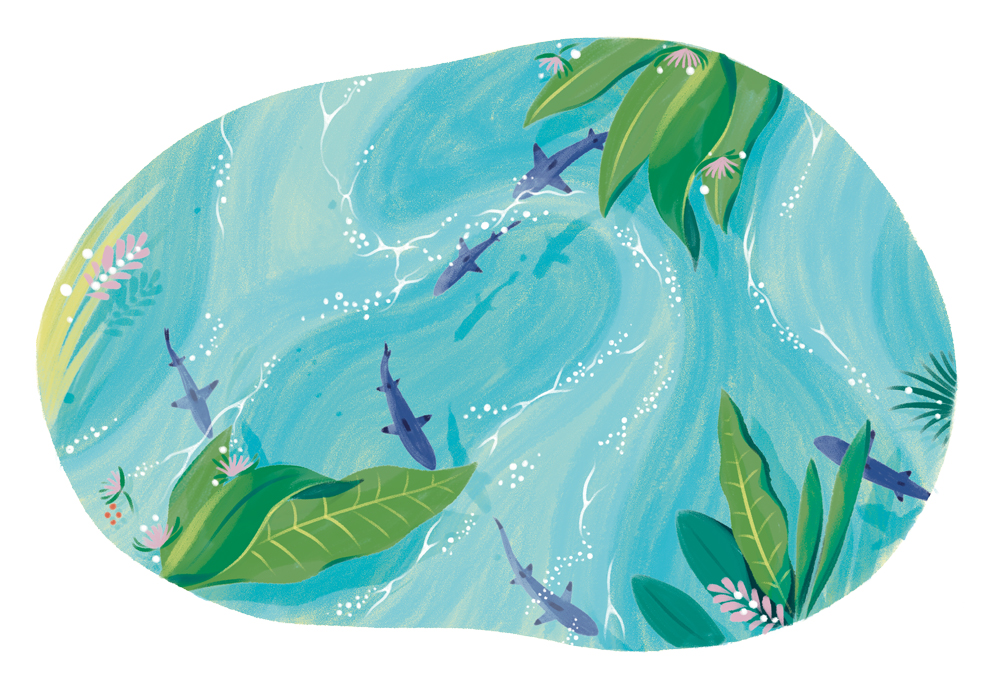
With its ash-grey volcanic tips, lush green foliage and white sandy beaches, Mo’orea is a smaller, more tranquil neighbour of Tahiti, where Papeete, the vibrant capital of the archipelago, sits. A flourishing coral reef encircles the island, protecting it from the restless waves of the Pacific Ocean. Closer to shore, the shallow waters of the lagoon are turquoise blue and crystal clear, providing an expansive window into the mysteries of thriving undersea ecosystems. Here can be seen schools of tiny fish, sea kraits, rays and many other creatures swaying in and out of the colourful corals and sea plants that are scattered across the soft, sandy seabed.
During the blacktip reef shark’s breeding season, which runs from mid-September to February, female sharks in the last few months of their pregnancy enter the glassy, shallow waters around Mo’orea to give birth before swimming back out to sea. The newborn pups swim in the opposite direction, making their way closer to the warm-water nurseries near the coast. These enclosed waters make ideal natural laboratories in which scientists can study how blacktip reef sharks react to the stresses of climate change.
As pups, these sharks are experiencing conditions that scientists predict will be widespread in the oceans by the middle of this century, says Dr Jodie Rummer, the head of the Physioshark project, and some of their physiological traits may be able to tell us what sharks will need to survive in the future. Ten nursery sites around the island – some closer to the tourist hotspots than others – were identified as sampling locations by the Physioshark team.
On this particular night in December, undeterred by the incessant rain beating down, the team members got to work on the blacktip reef shark pup in the tank of sea water. Their first job was to check if this particular shark had been caught previously and tagged with an electronic chip. The scanner did not beep, so it was a new shark in the hands of the Physioshark team, who then swiftly set about tagging, measuring and photographing it.
‘It’s like a machine,’ says Rummer of the speed and synchronisation of the process to tag and measure the sharks before releasing them back into the ocean as quickly as possible. ‘It has perfect harmony – like a choreographed dance,’ she adds. ‘It is also non-lethal and minimally invasive.’
Rummer first arrived on Mo’orea in 2013 to begin what would become the Physioshark project, a collaboration between James Cook University, Australia, and CRIOBE, the international research station on the island. In the early days she worked alone, which she admits was tough. Then she recruited one PhD student after another and together they researched topics from the temperature and carbon dioxide tolerance of the shark pups to their recovery from exercise, and shark predator–prey patterns.
A core part of this work includes sampling the blacktip reef sharks’ 10 nurseries around Mo’orea every fortnight during the five-month pupping season. Over the years, the scientists’ sampling techniques have evolved to perfection and become the rhythmic series of steps the team so routinely carried out on the night of the rainstorm. By now, each nursery has been sampled 120 times for 360 hours each. The project currently has 3,600 hours worth of sampling data from approximately 3,000 unique shark pups, from which it has created a gigantic, one-of-a-kind database of physiology, image and DNA data of juvenile blacktip reef sharks. ‘It’s a pretty remarkable dataset; there’s nothing like it in the entire world. I am very proud of our efforts,’ says Rummer.
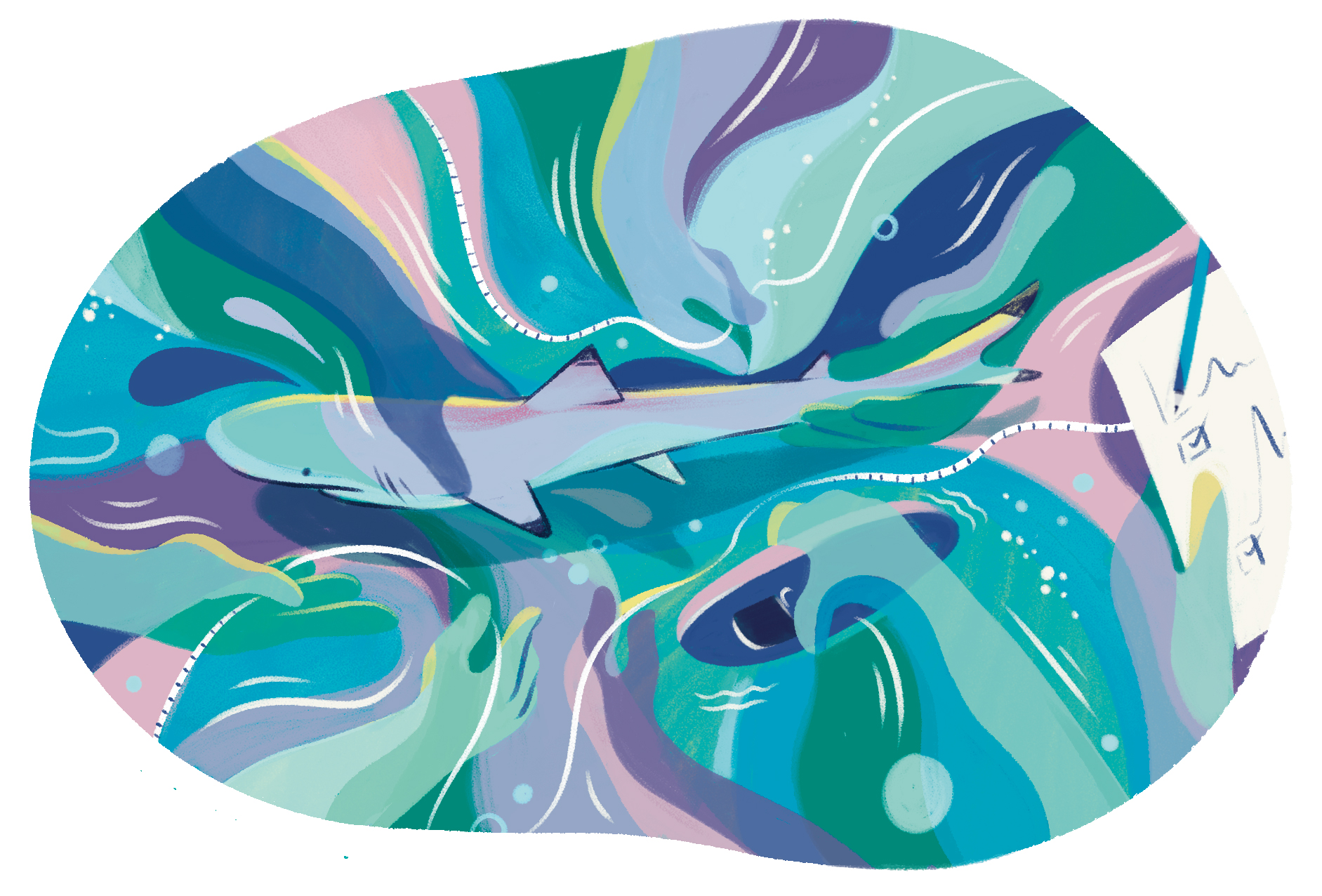
Illustration by Jasmine Hortop | © Save Our Seas Foundation
Climate change in a shark sanctuary
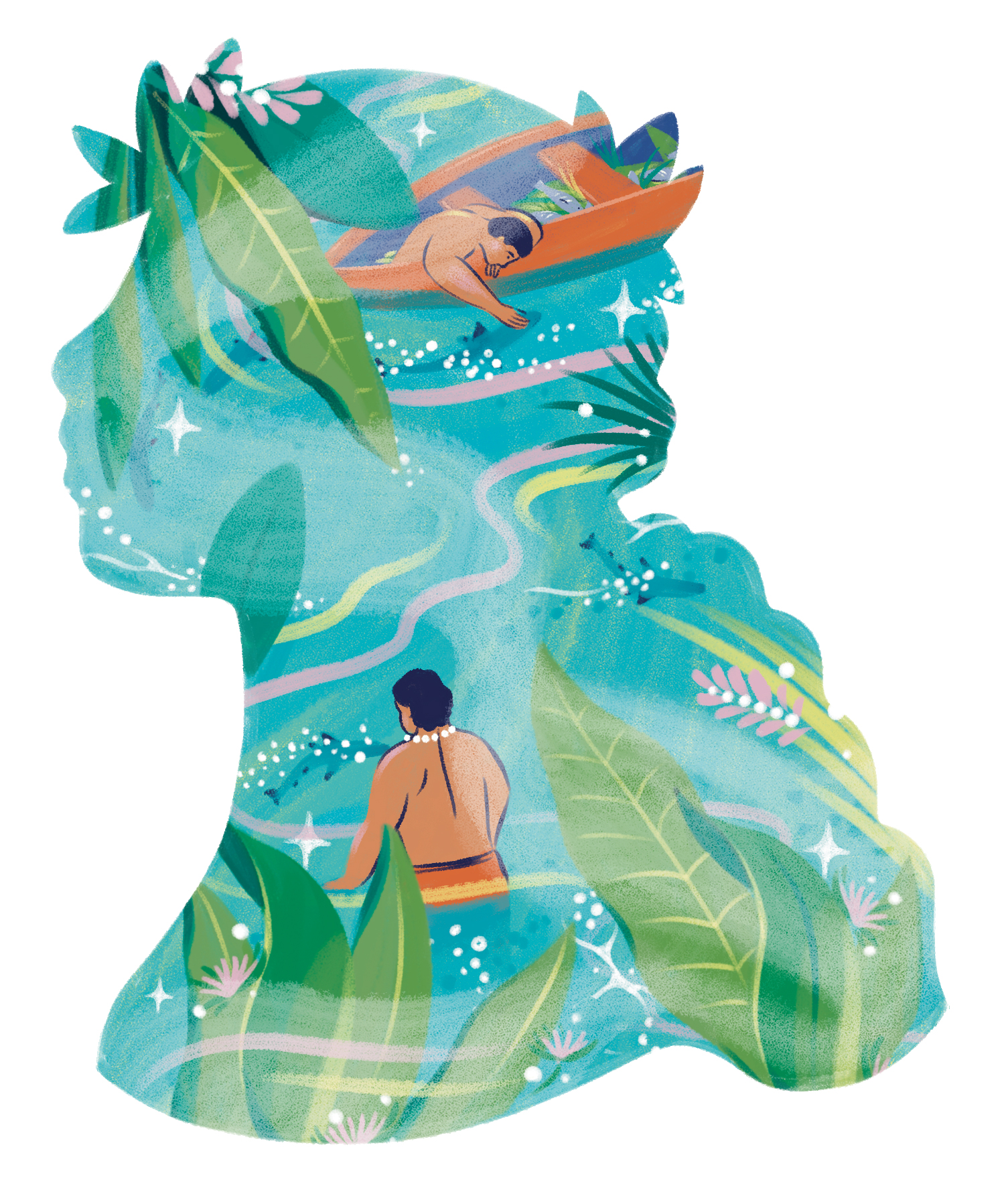
Illustration by Jasmine Hortop | © Save Our Seas Foundation
During the shark breeding season, the juveniles in these shallow areas experience three major climate change stressors: elevated temperatures, low oxygen levels and high carbon dioxide levels. In some areas close to the shore, where the water is no more than 40 centimetres (16 inches) deep, the tropical sunshine beats down during the day, heating the water and making its temperature soar. While sunlight rippling through the water makes iridescent patterns, algae and coral are photosynthesising and generating oxygen. At night, as the algae and coral respire, this process reverses. ‘We get a low-oxygen, high-carbon dioxide situation at night,’ explains Rummer – and these conditions are expected to become more widespread across the ocean as the climate crisis continues.
Elsewhere in the world, overfishing and bycatch are the most common challenges to sharks. But in these remote Pacific islands the situation is different. The vast expanse of sea that makes up the exclusive economic zone of French Polynesia with its 121 islands and atolls – a sweeping 4.5 million square kilometres (1.7 million square miles) or so – has been a sanctuary for sharks since 2006. In fact, it is the largest shark sanctuary in the world. And as a bonus, the reefs surrounding the island of Mo’orea shield it from tidal influence, which allows Rummer and her team to study how shark physiology changes with climate stress – and without having to take into account the fact that their subjects may be legally caught and killed by fishers.
But the dotted lines drawn around countries and bodies of water do not hold back ocean warming, ocean acidification and atmospheric emissions. As the latest facets of the climate crisis unfold, the Physioshark scientists are focusing on how blacktip reef sharks react to new stresses such as increasingly frequent oceanic heatwaves. As ocean temperatures rise, there may be disproportionate effects on the coral reefs and in the shark nurseries, Rummer says – and gradual and sustained ocean warming can be lethal to corals, as can shorter, sharper heat spikes.
So far, the field research shows that in these shallow, crystal-clear nurseries, the temperature can easily increase to 35 or even 36 °C (95 or 97 °F). As Rummer knows only too well, this is very warm. ‘There could be a 10 °C (50 °F) change in a day,’ she says. Despite this, the data indicate that there has not been a significant drop in the number of newborn blacktip reef sharks over the past decade. This, taken together with the physiological data the team has been collecting, gave them the critical breakthrough they were looking for: it is clear that these shark pups can tolerate and live in these extreme climate conditions. ‘It’s actually pretty amazing,’ marvels Rummer.
She and her team speculate that the conditions in these nursery areas provide the juvenile sharks with an advantage during the early stages of their life, be it protection from predators or access to food and shelter. ‘But we are still trying to understand that,’ she admits. She thinks that such an advantage may improve the juveniles’ fitness, enabling them to tolerate the more extreme conditions brought about by climate change. ‘But we don’t know whether, as adults, they would still be able to tolerate the new conditions,’ she adds.
The blacktip reef shark grows more slowly than similar-sized species of bony fish such as tuna, and it takes at least eight years to reach sexual maturity. And despite a relatively long gestation period of 10 months, current trends indicate that only one out of four pups usually survive to adulthood. ‘Generations are too long to allow these sharks to keep pace with the rate at which we are changing their habitats,’ Rummer says.
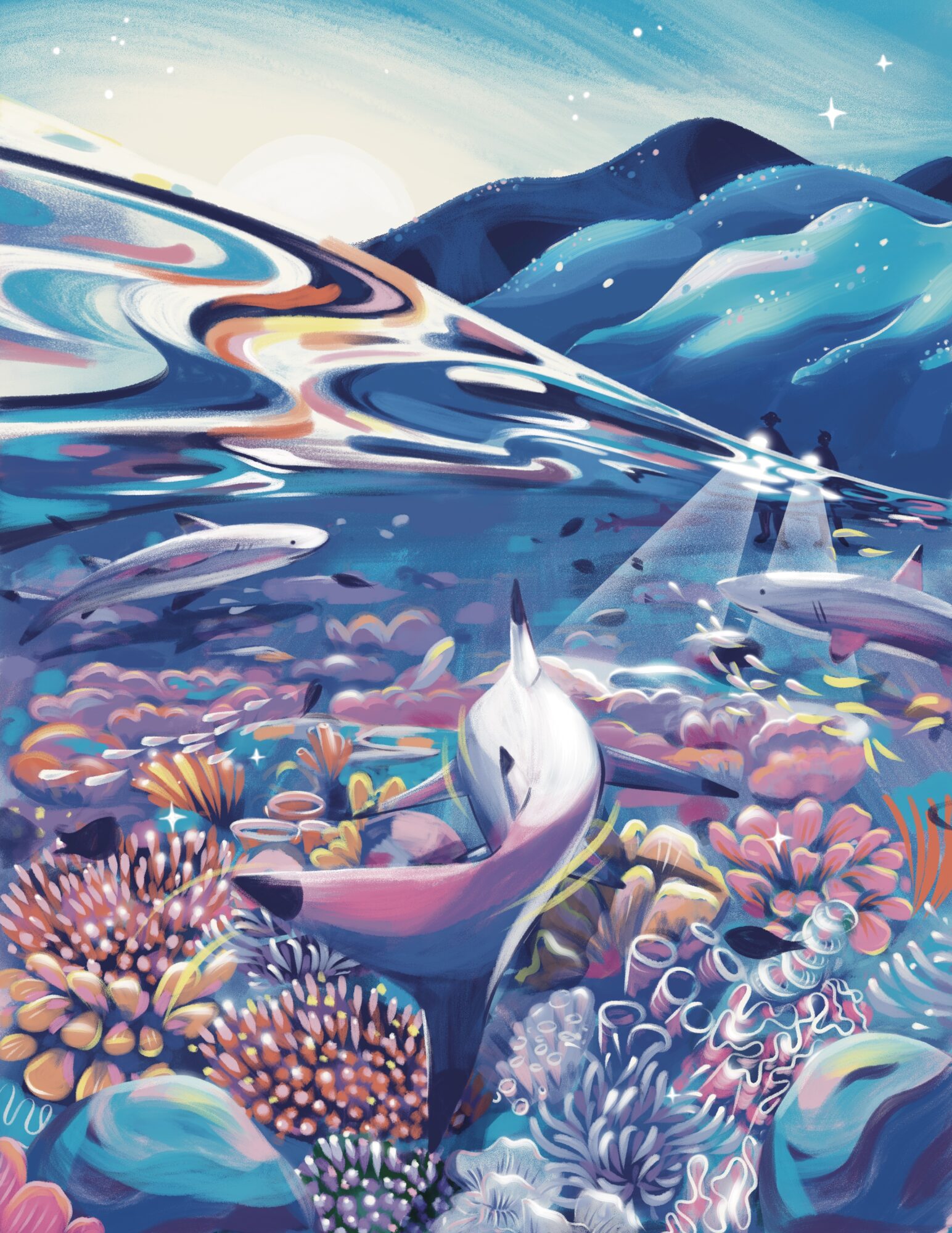
Illustration by Jasmine Hortop | © Save Our Seas Foundation
The Physioshark project
Over the years, the project has developed into an interdisciplinary, collaborative research programme that involves researchers at different stages of their careers. Rummer says she aims to not only inspire but also inform, and to share what they learn with the community, and hopefully policymakers too.
Each scientist joining the team tries to answer questions about blacktip sharks, tapping into the data and published research, building on it and coming up with something new – sometimes even more questions. For instance, Shamil Debaere, a PhD student from Belgium, carried out the first quantitative study on how umbilical scars of shark pups could be used to estimate their age. His findings provide a crucial upgrade from the existing qualitative techniques, which used classifications such as ‘open’, ‘partly healed’ and ‘recently closed’. Debaere’s method will contribute to more accurate estimates of how climate change and other stresses influence the life cycle of the blacktip reef shark.
In 2023, Rummer’s research focused on monitoring the behaviour of shark mothers, in collaboration with colleagues in the USA. She wanted to know ‘what makes a good mama and how that translates into strong, healthy babies’, she explains, adding that pregnant sharks are as vulnerable as newborns or shark pups. Scientists from Physioshark are currently tracking the routes taken by female sharks when they are about to give birth to identify exactly where in the aquamarine waters they deliver the pups and the conditions they experience during this process. The tags on these female sharks also indicate where they go to recover after giving birth, providing a sliver of understanding in the vast expanse of undiscovered facts about the sharks’ lives. DNA samples are extracted too and will eventually match mothers and pups, adding another layer to the knowledge of these species.
So far, the existing research indicates that female sharks do not care for their newborns the way humans do. Instead, they give birth in specific areas of the shark nurseries where ambient temperatures are suitable for them and food is in plentiful supply. ‘So if this environment is getting too warm or if habitats are lost because of coral bleaching, then that’s going to compromise the pups eventually,’ Rummer notes.
It has been close to two decades since French Polynesia was proclaimed a shark sanctuary and the Physioshark team is looking at what extra layers of protection could strengthen shark conservation in this region. Its existing database shows where the nurseries are and the time of the year the shark pups are in the nurseries. ‘If we can add an extra spatial and temporal level to conservation efforts – to say, let’s just try to keep any extra stress out of these areas during this period – then that will give the pups a little more of an advantage and maybe a little more of a fighting chance at surviving and making it out beyond the reef to become adults,’ says Rummer.
It was another day on the island of Mo’orea. The Physioshark team was sampling again, this time at Tiki, a picturesque little beach with white sand and cornflower-blue water. Team members pull the fishing net across the water. Then they wait until the first shark pup shows up. In the distance the sun is setting, a golden fireball making a perfect reflection on the sea’s calm surface.
Tuiterai Salmon is a native of the island and one of the Physioshark scientists leading the sampling efforts in Rummer’s absence. He sits on the beach, enjoying a sandwich before the flurry of activities begins once more. Others in the team play with a stray dog.
Suddenly the net starts shaking. But this time the shark swims away before the team reaches it. Salmon wades out to the net and removes other fish that have been caught, releasing them back to the ocean. And so the wait continues, as the sun sets and dusk settles. Finally, a shark is caught and a familiar wave of excitement spreads through the team as they spring into action, repeating the same rhythmic movements as they started recording the first set of data for the day.
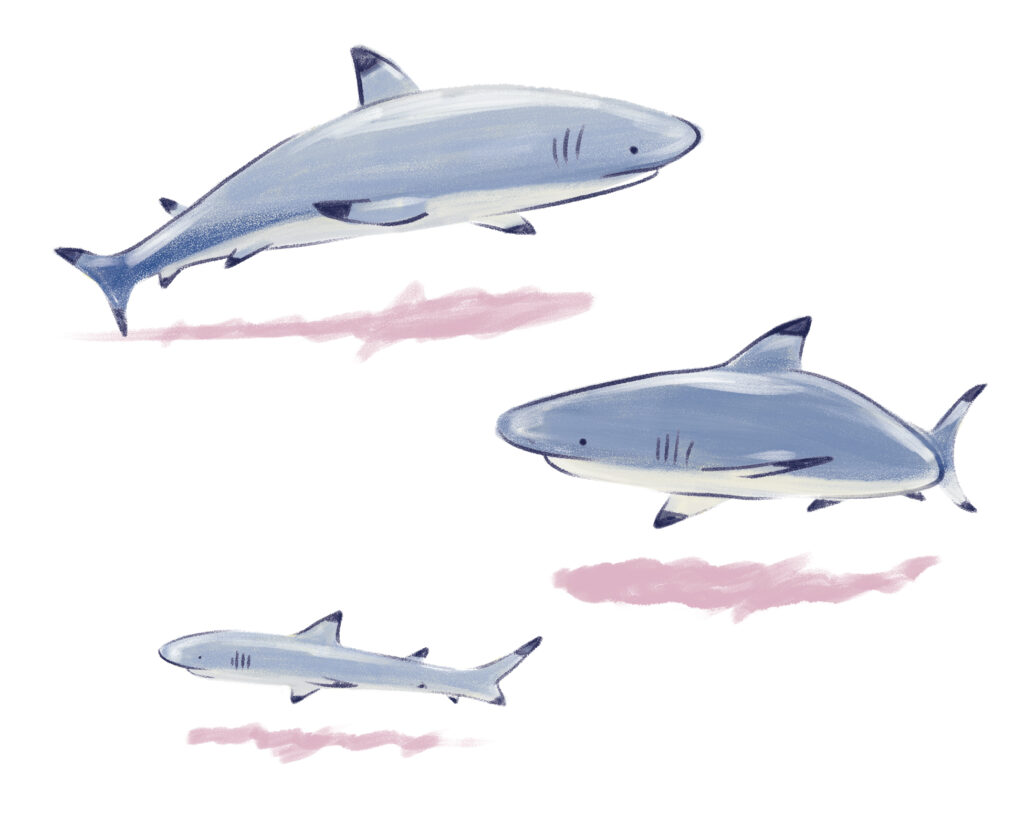
Illustration by Jasmine Hortop | © Save Our Seas Foundation