
Q & A Storytelling: Thomas Peschak
Q & A
Thomas Peschak
How to have impact
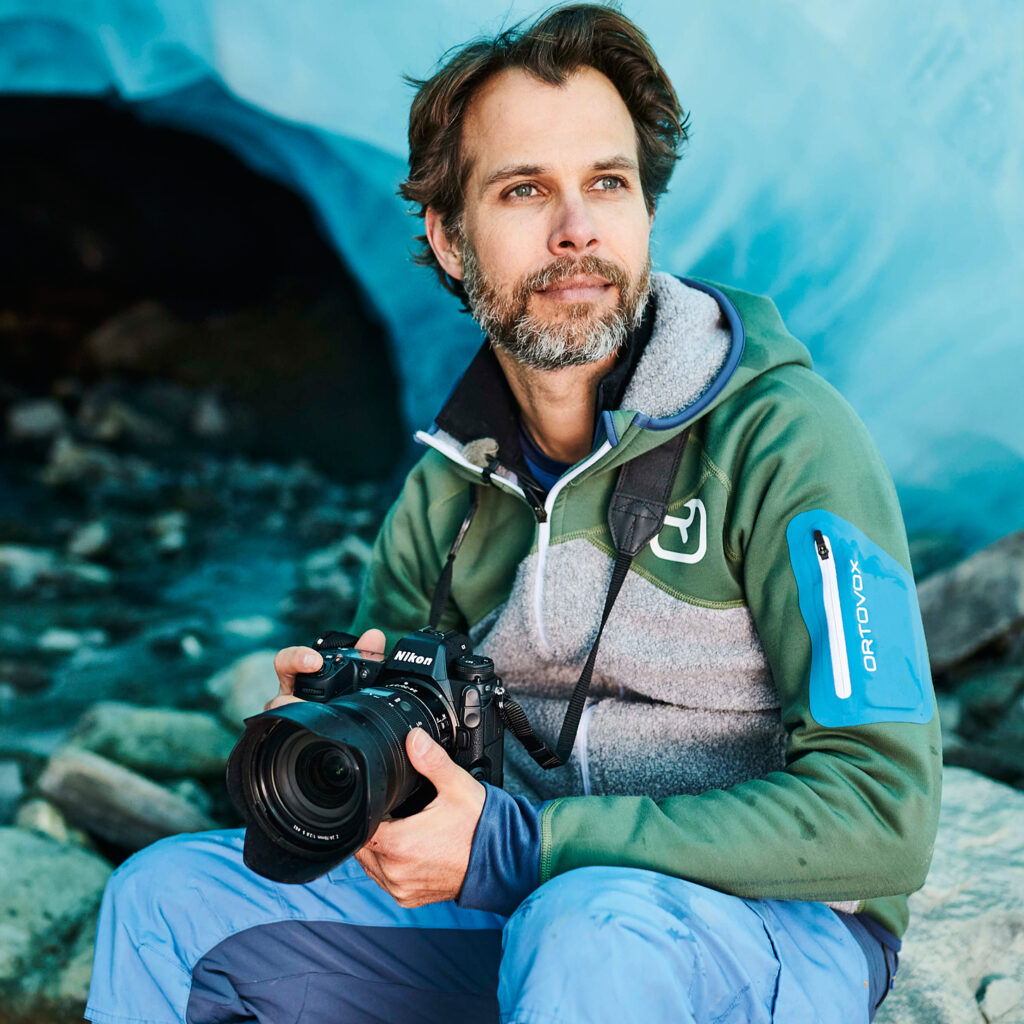
Thomas Peschak has spent more than twenty years bringing stories about our oceans and rivers – their beauty, their importance, and the scale of our impact on them – as a National Geographic Photographer and Explorer and as the Save Our Seas Foundation Director of Storytelling, to audiences across the planet. Lauren De Vos chatted to him about impact-driven conservation storytelling, and the urgency of crafting stories to catalyse change.
© Daniel Ziegert
Mice, introduced to sub-Antarctic Marion Island 200 years ago, flourish on a diet that now includes live albatrosses. This scalped grey-headed albatross chick has no instinctual fear of this new danger and sits passively while being slowly nibbled to death. Photo © Thomas Peschak
Storytelling is as old as our species. What is its relevance today, and what’s especially important about conservation storytelling?
There’s storytelling for pleasure, and storytelling for impact. We have been telling stories for hundreds of thousands of years, and initially, probably to modify our behaviours for survival. Whether we were recounting stories from a hunt, or warning about the great monster that lives deep in a river, stories helped us to learn about each other and the world, and to teach the next generation how to survive. Then we had a moment in history where we could follow a storytelling model largely for pleasure: action films, science-fiction books, cartoons, and comedies. Sure, some of them translate morals, teach us something, or hold commentary. But a lot that was purely escapism. Even the natural history genre told stories of exploration and wonder: while we can learn a lot from these, we are not really incentivized to change anything about how we’re living on this planet. Now we need to tell conservation stories to change our behaviour to ensure our survival.
All cultures have stories that connect us and nature, but in the modern natural history storytelling genre, some storytellers – like Rachel Carson – are synonymous with changing the conservation storytelling landscape, while others, like Jacques Cousteau and David Attenborough, incorporated conservation much later into their work. How has the urgency of storytelling changed?
We’ve moved on from being able to share just for ‘raising awareness’: we’re at the edge of catastrophe, and today, when we tell stories, we need to be able to measure what that story has done to action change. I think that 95% of the natural history media that’s out there today that rides on the premise of raising awareness – whether it’s content published by influencers or major networks – has little measurable impact on conservation actions.
Collecting olive ridley eggs – during a permitted window – at Ostional, Costa Rica, where the arrival of these turtles heralds dense overcrowding. The turtles nest so close together that they inadvertently crush one another’s eggs. Photo © Thomas Peschak
Conservation science emerged as a “subgenre” of science in the 1970s; it’s science for change. But conservation storytelling is similarly emerging far more recently from natural history storytelling. How is the process different from what’s been done before?
Conservation storytellers must be highly strategic. If you’re a conservation storyteller – whether you’re a photographer, writer, podcaster, or a filmmaker – you must ask a few questions whenever you encounter a story. The first of these is: who do I need to tell this story to – who is my audience? And then, what is the scale and scope of my story – do I have to reach one hundred million people to create a groundswell of change, or do I need to reach one politician?
I think very few people are without ego, and most of us want to have the one hundred million audience reach. Sometimes that can achieve both things: it can tell a powerful conservation story, and it can also hit all the right personal dopamine buttons. While I think everyone’s hearts are in the right places, we have to critically interrogate what we want to achieve. Audience size can be deceptive, so as a conservation storyteller you need to accept that most people might never see your story. If you achieve your conservation goal, then you’ve fulfilled your purpose more fundamentally than if you’ve reached a huge audience or been published by the biggest names in the industry.
Conservation storytellers come from different walks of life. I come from a science background: I’ve always had to measure my impact. But there are so many different pathways into this, and I think that our future will rely on teaching strategy and impact-evaluation as part of the conservation storytelling craft.
We live in a media moment where online visibility is driven by algorithms and ‘going-viral’. How hard is it to make highly strategic conservation communication economically viable?
It is very hard to convince funders to support this kind of impact-oriented media. Making a living as natural history photographer, or an environmental photojournalist, is difficult. This is true even if you’re not considering a conservation message. There are very few people today who are making a living exclusively from that; most have to run photographic tours, or wildlife safaris, or create any number of other income-generating endeavours to make a living while taking photos of wildlife. Most people you see online are making a living another way.
This inquisitive northern elephant seal pup is evidence of a comeback; a century ago, any curiosity would have been met with bloodshed. Elephant seals were hunted for their blubber and teetered towards extinction in the late 19th century. Photo © Thomas Peschak
We have to amplify conservation storytelling if we are going to drive the change we need to fix our planetary crises, but how do we find money to tell conservation stories?
The role of most media outlets is not to drive environmental change, it’s to sell stories. This is where philanthropy and NGOs come in: by definition, the mandate of charities and non-profit organisations is to push for change and try to repair whatever is broken. But while there is some funding out there for conservation storytelling specifically, we are right at the beginning of it all.
We have had decades of funding for science, and then for conservation, but in the last 20 years we’ve introduced this conservation storytelling tool that’s very much in its infancy. When we look at the percentage of funding that’s directed to conservation science versus conservation storytelling, it’s unequal. So, we need to educate the media, philanthropists, and people who want to make a difference. Yes, we need science: it’s important. We need data to understand how our world is changing, but data alone no longer moves the needle by itself. We need to pair the science with innovative, iconic, and moving storytelling. Only once we can raise the profile of storytelling and raise its funding to the point where science and storytelling are equal, will we create more opportunities for conservation storytelling professionals.
I want to become a conservation storyteller. Where should I begin?
If you have the right skillset, passion, temperament – there is a possibility that you might make a living from telling conservation stories. But the odds are stacked against you.
With that in mind, it’s worth knowing that as a storyteller at the beginning of your career, you might not be able to do conservation storytelling exclusively for the first decade or so. You first need to cut your teeth in a lot of different ways. You have to find your voice and figure out what makes your stories, and your way of telling them, different from anybody else. In many ways, your twenties and thirties are there to learn and to figure out how to tell stories; it’s about reading and meeting like-minded people and listening. Storytelling is something that you get better at the more you do it, and the more experience you gain. You won’t be fully formed in your twenties. A lot of photographers at National Geographic peaked in their fifties: they made their most powerful work after practicing their craft for over thirty years.
Two marine iguanas in Galápagos – alert, alive – and their mummified brethren (left) that probably died of starvation. Photo © Thomas Peschak
What role can people across the conservation sector play?
There are any number of highly qualified people who are perfectly positioned to share stories and who are already embedded in networks of conservation expertise and influence, who could benefit from some training in crafting and telling the stories they already carry. Obviously, it would be ideal to have a large group of expert storytellers able to do this fulltime. But what about the conservation scientists? What about the environmental lawyers? You don’t need to be a fulltime storyteller to make a difference in the storytelling field. We need to look at training people who are already making a living in the environmental space to become better storytellers. And while they might never reach the level of a twenty-year professional career with National Geographic, you don’t always need National Geographic level stuff. You can often push the needle with something that might look and feel quite modest.
There is an international audience that most storytellers want to reach, but we also need local voices who tell powerful stories. Do you think we’re making progress in achieving pathways to both?
We’ve made gigantic strides. If you just look at the Save Our Seas Foundation Storytelling Grant, and how the diversity of winners, and the stories they’re telling, have changed, you can see that the days of having only North American, European or Australian ocean storytellers are gone. The trick is in finding a balance. We urgently need more local storytellers on the ground to tell stories in their ‘backyards’, but we also need people to travel halfway across the world, because there is something powerful about getting a fresh perspective. When you have decades of international experience and a truly global perspective on a story, you can often find angles and nuances that others might miss. There are of course also situations where a much needed storytelling skill (underwater photography, camera trapping, etc.) might not be available at a certain geographical location. In that case flying in a storyteller might be the only option, but this should be paired with on the ground skill transfers and subsequent mentorship. I think that as long as we have a healthy balance between both those approaches, we’re moving in the right direction.
A Critically Endangered great hammerhead, caught off Oman’s remote Musandam Peninsula, awaits transport to the Dubai fish market. Photo © Thomas Peschak
There are opportunities to support emerging storytellers, but how should that reshape the industry?
There needs to be fairness in opportunities and expectations: we’ve trained many storytellers now from South America and Africa, and it’s fair for them to ask: “Hang on, you’ll only support and fund me if I stay and tell stories in my home country?” There should be pathways for these storytellers to spread their wings, too. A storyteller from Ghana needs to have the opportunity to go tell a story in Ecuador. Just because you received a grant to tell your story in Indonesia, shouldn’t mean – if you’re a talented, hardworking storyteller – that you have to do that for the rest of your life because funders have become too focused on only ticking the ‘local storyteller’ box. I think it is important to have storytellers able to access both local and global pathways. From a conservation perspective it is also important assess which approach is likely to result in the most impact.
In our increasingly digital world, where should we be placing our efforts to meet our audiences?
This is where we need to again focus on strategy and mindfulness. Who is your audience, and what is your intention? Is this a virtual reality experience, a photographic exhibit in a public space, a slideshow for the president, or a film to move the masses? Social media can be problematic: we’re drowning in content. Some of it packaged as conservation storytelling, but in reality all it often does is sustain the creator’s lifestyle and ego– and what’s the conservation impact of that? We often write this content noise off as ‘raising awareness’ – and to a degree, it’s great to see so much natural history content available – but we risk flooding out messages about urgent conservation work, that often look less aspirational. I don’t know what the solution is here: everyone has the right to do what they want, but I do think that some curation is needed. That’s why I don’t believe that social media is always the best way to tell a conservation story. Traditionally, there has been ‘gatekeeping’ in the media world – and this can be really harmful and unhelpful, but there is also a case to be made for the editorial oversight, the benefit of curation, and the prioritization of expertise to craft accurate, high-quality stories, whether it’s in print, on screens, or in-person storytelling.
Mining for guano – nutrient-rich seabird droppings – in the 19th century sent Peru’s seabird populations into freefall. Overfishing, climate change and the resulting lack of food have now seen the pelicans that once nested in their hundreds of thousands all but disappear. Photo © Thomas Peschak
Where do you want to place your own conservation impact?
Of course it’s amazing when you can photograph a huge National Geographic story and drive measurable change and impact, but that cannot be the only way. That type of storytelling can at the most sustain less than a dozen full time professionals. We can’t have just ten people telling these type of stories, when we are fast approaching environmental Armageddon. My personal drive now is to ask: how do we create a army of storytellers around the world? How do we train hundreds, if not thousands, of scientists, lawyers, journalists and others in the art of conservation story craft? It means having to be realistic about the number of fulltime professionals who can operate at the highest levels of conservation storytelling and understanding that the bulk of immediate, urgent conservation victories need to be tackled and won by people already firmly established in other conservation adjacent spaces.