
Nothing comes without its world
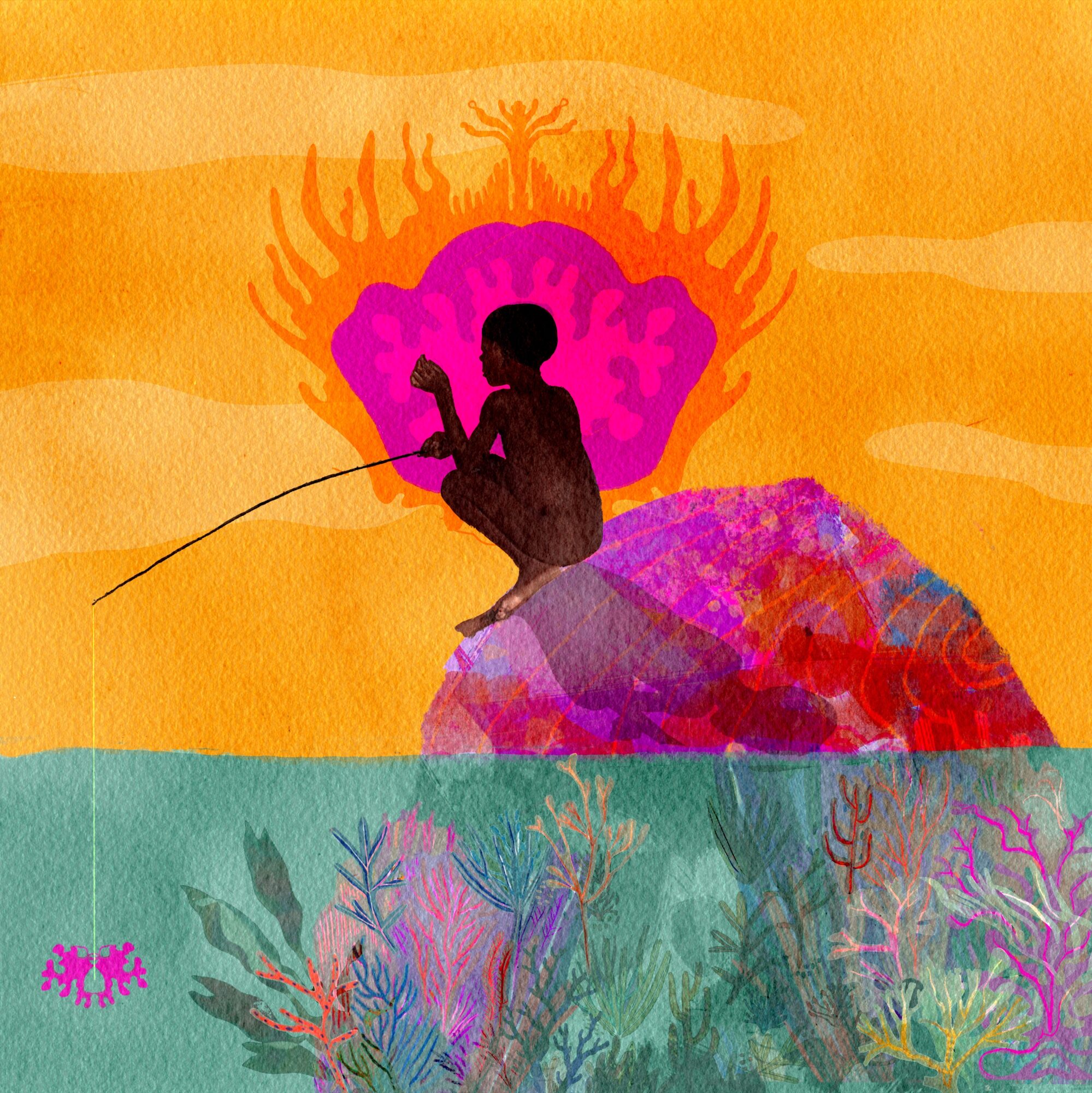
Illustration by Dylan McGarry
NOTHING COMES WITHOUT ITS WORLD
Why conservation storytelling needs a course correction
WORDS AND ILLUSTRATIONS BY
Dylan McGarry
Not so long ago I was invited to curate an exhibition for a turtle conservation project, which was an honour, but also provoked internal discomfort. The conservation of marine wildlife like sea turtles is an ecologically justifiable and deeply needed act. Yet having listened over the years to the ongoing testimonies of displaced peoples along our South African coast in my work with the One Ocean Hub, I couldn’t look away from how these efforts, these acts, often come with a kind of cultural/historical amnesia.
Speaking as a ‘recovering’ marine scientist myself, I was not trained in the historical or philosophical evolution of the science I was taught to practise. I was instructed to prioritise ‘objectivity’ and somehow separate my history, my culture, my body, my spirit, my emotions from my science. Yet no matter how sophisticated our scientific instruments become, no matter how powerful the telescope or microscope may be, the light still enters a human eye, it enters a human being nested in an ecological, social, cultural and political world.
In time, I shifted my research and studies from zoology to environmental science and then to environmental education. Within this last field, I entered the world of transgressive social learning, educational sociology and visual anthropology. I began to practise multi-layered ethnography, learning from post-humanism, critical African feminism, scholar activism and public storytelling. In 2013, with Neil Coppen and Mpume Mthombeni I founded a theatre collective called Empatheatre and for over a decade we have supported community-led research and public storytelling. One of our most recent projects, titled Umkhosi Wenala: The Festival of Abundance, worked with 13 young activists living around the UNESCO World Heritage Site and marine protected area of iSimangaliso Wetland Park.
This is also a part of the South African coastline where turtles migrate each year to lay their eggs.
Conservation has often told its story through individual species – ‘Save the whale’, ‘Save the rhino’ – but this framing isolates creatures from the complex worlds they inhabit. Ursula Le Guin reminds us that even the lone hero was once carried and cared for, pointing to collaboration and community over individual heroism. Sea turtles, though largely solitary, live within rich ecological networks. As Donna Haraway has written, ‘Nothing comes without its world’; turtles, like all beings, exist within layered ecological, cultural and political worlds.
Turtles understand homeland; they understand birthplace and origin stories. They always return to their place where they hatched, a phenomenon known as ‘natal homing’. Yet this stretch of coastline in northern KwaZulu-Natal is haunted. This haunting – the dispossession of Tsonga and Zulu communities to make way for the marine protected area – reveals a grim history of violent settler colonialism.
In making Umkhosi Wenala over two years, and supporting a massive collective public re-telling of history from a Zulu and Tsonga perspective, it became painfully obvious to us that there is a systematic conflation between colonialism and conservation. This legacy of ‘fortress conservation’, which forcibly removed indigenous and local people from their ancestral lands to create protected areas or even to facilitate mining or tourism, is commonplace wherever you look along that coastline. It even transcends the apartheid policy, notably the Group Areas Act of 1950, a law in South Africa that forced people to live in racially segregated areas, often evicting communities from their homes to enforce white minority control over their land. These actions led to the erasure of rich, inseparable customary lore/laws that recognised the relationship between nature and humans and did not make a distinction between humans and ecosystems. As my close friend and marine sociologist Dr Philile Mbatha explains in our documentary film about the play:
‘[I]n isiZulu, the word conservation doesn’t really exist. Historically, people never felt that they needed to conserve nature. A lot of political ecology literature talks about this idea of conservation as having emerged in the industrial period, where humans wanted to create centuries of nature to escape to, which then became nature reserves. But in many parts of the Global South, people have never seen this separation between humans and nature. It’s about them understanding nature and their feeling that nature also understands them. So this is one of the aspects that appears in the play, which I think is so powerful because it represents how many people in coastal areas in South Africa see their relationship to nature, and also in many parts of the Global South as well.’
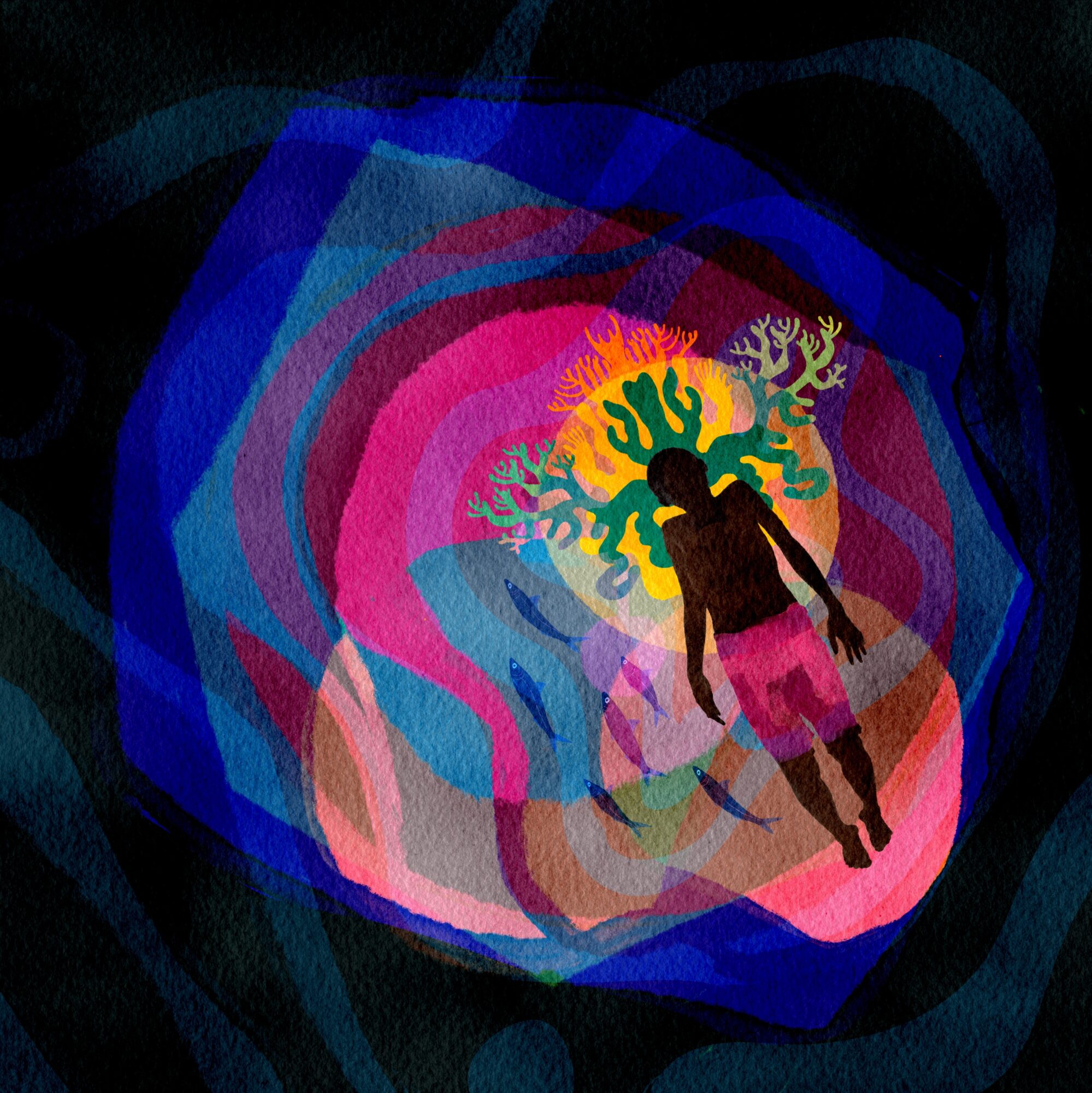
Illustration by Dylan McGarry
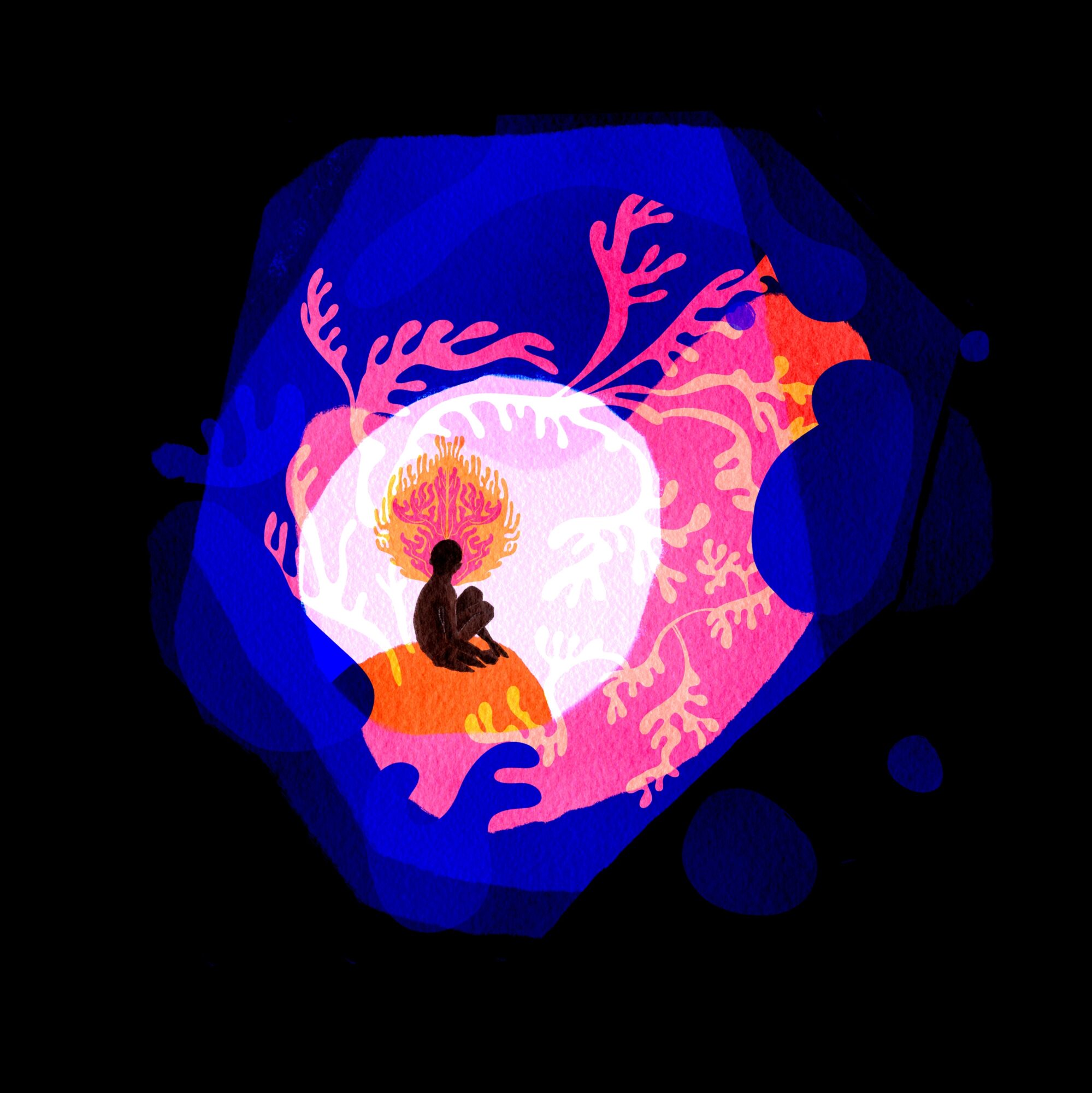
Illustration by Dylan McGarry
Today, if a sangoma or iNyanga (traditional healer/herbalist/diviner) wants to go to the sea to perform rituals and make libations to their ancestors, or if a family wants to visit their loved ones’ graves on what had been ancestral land but is now fenced off in the iSimangaliso Wetland Park, they are chaperoned by park rangers armed with semi-automatic rifles. Indeed, during my time as a researcher at the One Ocean Hub, we witnessed the killing of two brothers by park rangers for fishing in coastal waters where their people had won a land claim. The region still grapples with this legacy, demanding imaginative leaps, empathy, generosity and renewed ties between conservation and culture – bonds that colonialism and old scientific dogma poisoned, fracturing ubuntu-based care.
In this spirit, I draw on the collective of colleagues and friends like Dr Taryn Pereira and the Coastal Justice Network, where over the past six years researchers, civil society partners and small-scale fishery leaders have documented the ongoing historical and contemporary exclusion of coastal communities from ocean governance and access to their customary territories. Through the collaborative citizen-led creation of our Empatheatre play Lalela Ulwandle and film Indlela Yokuphila, we’ve uncovered how deeply the ocean is woven into cultural heritage, identity and spiritual belonging for coastal people.
Perhaps the most mis-narrated and failed conservation storytelling to date in South Africa is how we frame and narrate fishing, especially the struggles of small-scale fishers. For many of these fishers, fishing is not just a livelihood; it’s a way of life. It is heritage. It is survival. In South Africa, small-scale fishers are systematically marginalised, their customary rights overruled by conservation enclosures, mining interests and white-dominated recreational fishing that continues with impunity. Despite clear evidence that the recreational fishing sector contributes more to illegal fishing infractions than small-scale fishers do, conservation storytelling still too often lumps artisanal fishers in with the impact of industrial fleets.
Indeed, even our conservation education uses terms like ‘ocean literacy’, which implies and assumes that the ocean and the care for it is something that needs to be taught or explained away. Having spent time with small-scale fishers over the past six years, I learned quickly that they are more than ocean literate; they are ocean fluent. And they have much to teach marine scientists, marine protected area managers and policy-makers alike. Small-scale fishers globally play a critical role in defending oceans from a variety of pressures, and they are working together to protect them (see the Ocean Defenders Project).
At a local level, it was small-scale fishers who bravely took oil and gas giant Shell and the South African government to court, challenging their plans to explore for oil and gas offshore. Our radio play and short film were used as evidence in court to support their testimonies. Yet even after this heroic ‘David and Goliath’ story, fishers are still persecuted and vilified, and often treated in patronising, and sometimes violent, ways by conservation systems. The Green Connection and Natural Justice recently won another case, against TotalEnergies and Shell. Citing earlier victories led by small-scale fishers, the High Court ruled that a previous authorisation for offshore drilling was unlawful as it ignored, among other issues, the rights of coastal communities.
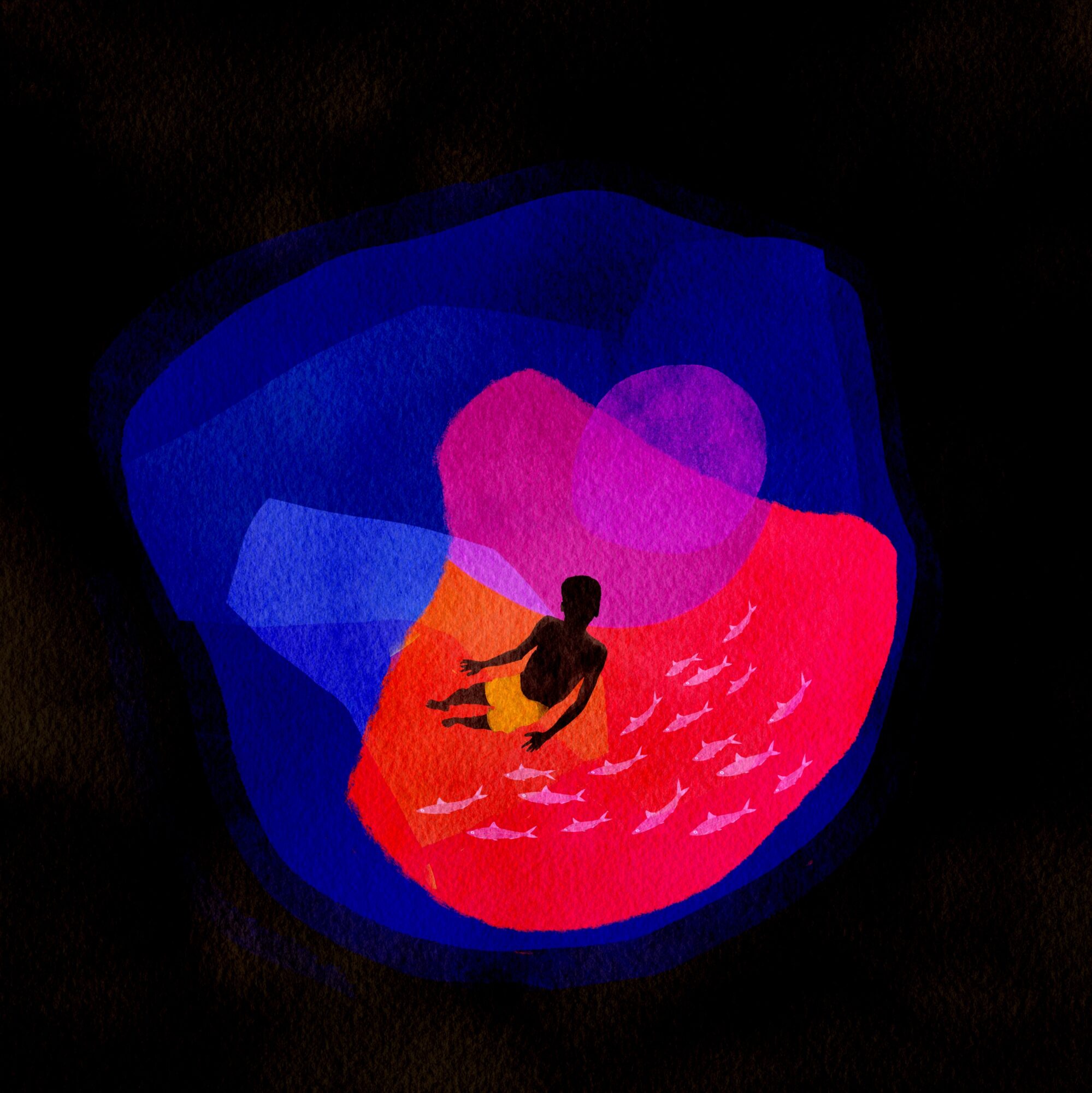
Illustration by Dylan McGarry
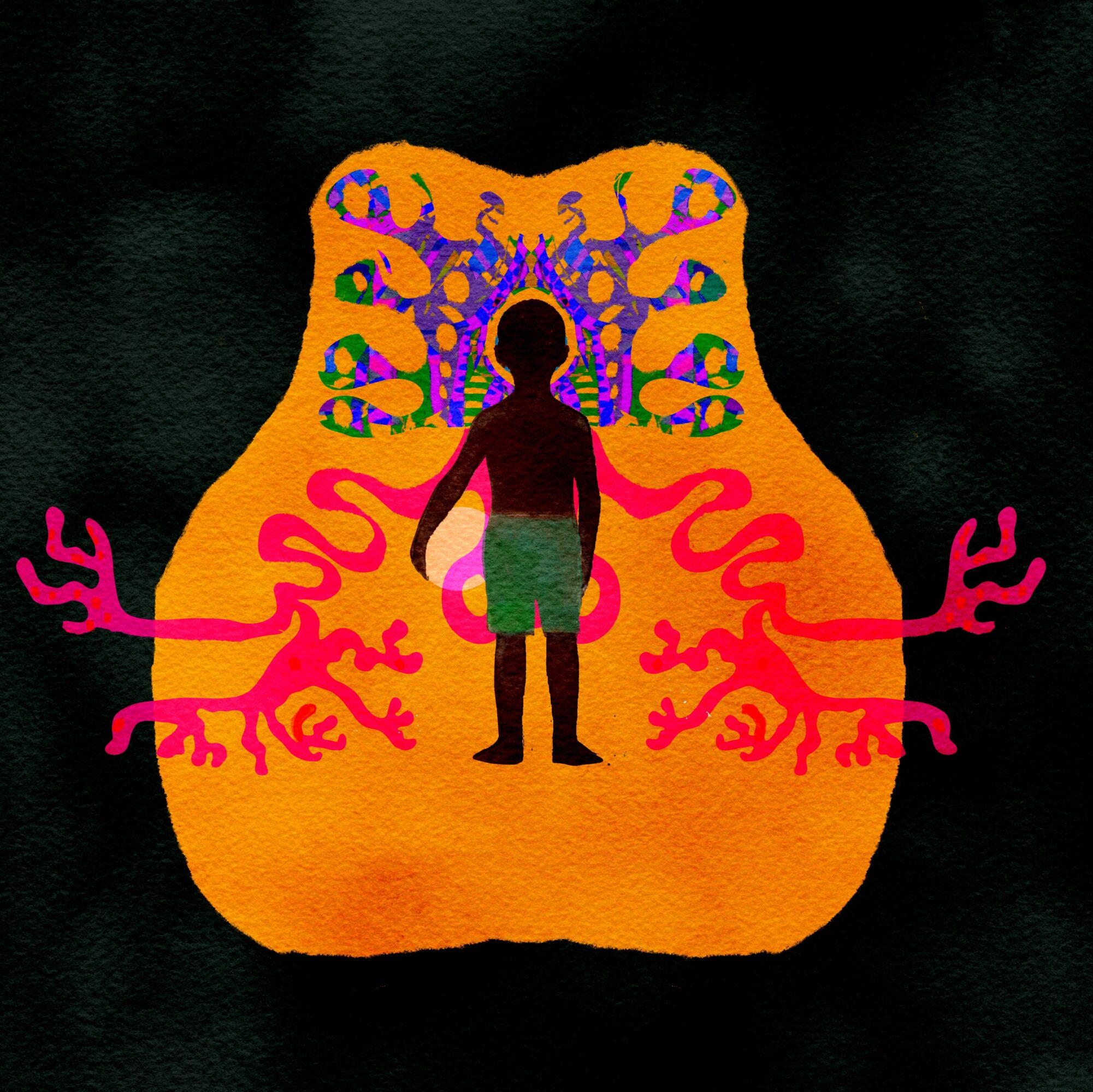
Illustration by Dylan McGarry
Donna Haraway reminds us that it matters whose stories, whose worlds get to accompany the conservation sphere in South Africa today. Who gets to practise natal-homing and who does not? These are contradictions of light and dark, of high tide and low tide, that we are having to navigate. It was questions such as these that I grappled with in curating the exhibition. How, I wondered, do we not drown in the contradictions of conservation care for turtles and care for the justice of South Africans?
By working with artists, fishers, sociologists and scientists, I learned to narrate this contradiction by borrowing the concept of ‘shimmer’ from anthropologist Deborah Bird Rose. Drawing on Aboriginal wisdom, Rose describes shimmer as the dynamic, entangled, ever-changing interplay of humans, animals and environments. It resists Western dualisms – human/nature, culture/ecology, politics/turtles – reminding us that relationships are fluid, indeterminate and in constant motion.
Shimmer asks us to respect interconnectedness and to challenge the colonial constructs of ‘wilderness’ and ‘nature’. Shimmer helps us shift away from assumptions or colonial misconceptions (or propaganda) of ‘wilderness’. A wilderness was never an empty space; it was the homeland of indigenous people but was declared terra nullius to justify conquest. Even today, conservation terms like ‘re-wilding’ risk repeating such erasures. Shimmer instead invites us to recognise our place within ongoing and entangled worlds, rather than imagine a return to some untouched past.
What does conservation storytelling look like when we step away from words like ‘wilderness’ or ‘nature’ – or ‘re-wilding’ – and remember that people are part of nature too? What does it look like when we write ourselves back into earth communities? As I have learnt from Dr Mbatha, when white settlers arrived in Kosi Bay, they looked at the estuaries and wetlands and saw wilderness; not the ancient amadobo systems of farming the wetland. So deeply were these systems integrated into the ecology of the wetland, they were invisible to the colonial gaze. In what other ways have we been unable to see? In what ways are our stories solidifying what Joan Tronto calls ‘privileged irresponsibility’?
In making Umkhosi Wenala, we learned the story of what it was like for fishers before the fences. When they wanted to fish in the estuary they would stand on the shore singing and clapping a particular rhythmic song – a song for hippos. Habituated over generations, the hippos knew it was time to move to the other side of the estuary and they would migrate, followed by the crocodiles, which were made nervous by the rapid and sudden migration. This ancient system of ‘speaking with’ the more-than-human world, through music and customs, meant that there was no need for fences. Embedded in these songs and customs were also forms of governance and environmental custodianship and care that modern conservation still overlooks.
As we tell new conservation stories and as we educate new generations of marine scientists, we must ask ourselves: are we merely conserving species or are we also conserving colonial legacies of blindness, of privileged irresponsibility, of erasure? What might we be missing when we ignore customary lore and laws, when we overlook stories, songs, dances and cultural practices? What wisdom are we missing?
I long for a reparative conservation storytelling ethic, one in which we decolonise conservation and centre the perspectives, voices and legacies of those who have been its casualties. A storytelling ethic that re-orientates conservation towards care that is relational, accountable and locally rooted. And one that brings to the surface the wisdom of local traditions of care, conviviality, communion and reciprocity.
The small-scale fishers who took Shell to court; the healers fighting for spiritual access; the children growing up on coasts still marked by the geography of racial exclusion – these are the ocean defenders we must honour in our storytelling.
To borrow Thom Van Dooren’s thinking here, what does conservation as a multi-faceted, always compromised work of inheritance look like? If we were to think along the same lines as small-scale fishers, scientists, children, sangomas, holders of customary rights, educators, philosophers, ghosts, turtles, swimmers, surfers and their worlds, how would that help us be truer to a multi-species kin-making ethic? How could that shape our approach to conservation here and now?
For many marginalised communities that have been displaced through colonially rationalised conservation, ‘protecting the turtle’ can be seen as a Trojan horse; conserving turtles facilitates further loss of land and rights. Because of this, these communities cannot value and cherish biodiversity in the same way as conservationists have been trained to do. A conservation legacy is a weighted symbol, a powerful enabler of a broader colonising process, a broader fracturing of community and ubuntu.
We need an expansive, recurring and politically rigorous approach to conservation storytelling – one that refutes the false promise of scientific objectivity alone – when our research causes social harm or reinforces immoral legacies of power. Thinking at this level of complexity with fellow artists and activists – as I ended up doing in relation to the exhibition and in our plays and films – opened us up to useful questions: what do we hold on to and what do we let go? What must we remember and what might we remake anew? Who gets to tell these stories? And who creates opportunities for knowledge holders to tell their own stories?
For me, the answer lies in letting people tell their own stories or learning how we might work in solidarity to help bring their stories to the surface. I am learning from ocean storytellers and world makers like Dr Joanne Peers, who is collaboratively sculpting ocean education despite, and because of, our oceans’ haunted history. I am learning from Dr Aaniyah Martin, who is using storytelling to build care pedagogies and practices for new kinds of ocean custodianship. The incredible Traci Kwaai, a ‘fisher child’ as she calls herself, who is decolonising and reshaping how we remember and tell stories about the False Bay coastline. Shamier Magmoet, a National Geographic explorer from the Cape Flats who is reclaiming the ocean for his community and neighbourhood and inviting other worlds into his own. Dr Nasreen Peer, a marine scientist who knows what solidarity science looks like and is nurturing a future generation of scientists who are attentive to how their stories shape worlds. Dr Philile Mbatha, who is helping displaced communities from the ocean to reclaim their customary governance systems through their stories. Dr Loyiso Dunga, a scientist and the grandson of a sangoma who doesn’t accept that these two worlds need to be contradictory and is mapping and bringing to the surface bio-cultural stories of the ocean. Dr Taryn Pereria, who is co-creating ‘in movement’ ethics and ways of solidarity storytelling. Or my beloved sister and brother Mpume Mthombeni and Neil Coppen, co-founders of Empatheatre. They know the power of stories and understand the responsibilities we have when we are gifted other people’s stories and mandated to share them in meaningful ways. If you need a lesson in conservation storytelling that is course correcting, read and watch their stories.
What I learned in my storytelling practice, in this exhibition and in my theatre- and film-making with others, is to not just ask what is the turtles’ story, but rather, what is the story of the world that the turtle comes with?