
Africa refocused
In conversation with Noel Kok, co-founder of Nature, Environment & Wildlife Filmmakers (NEWF) and National Geographic Explorer (Africa Refocused is a collaboration between NEWF and the National Geographic Society).
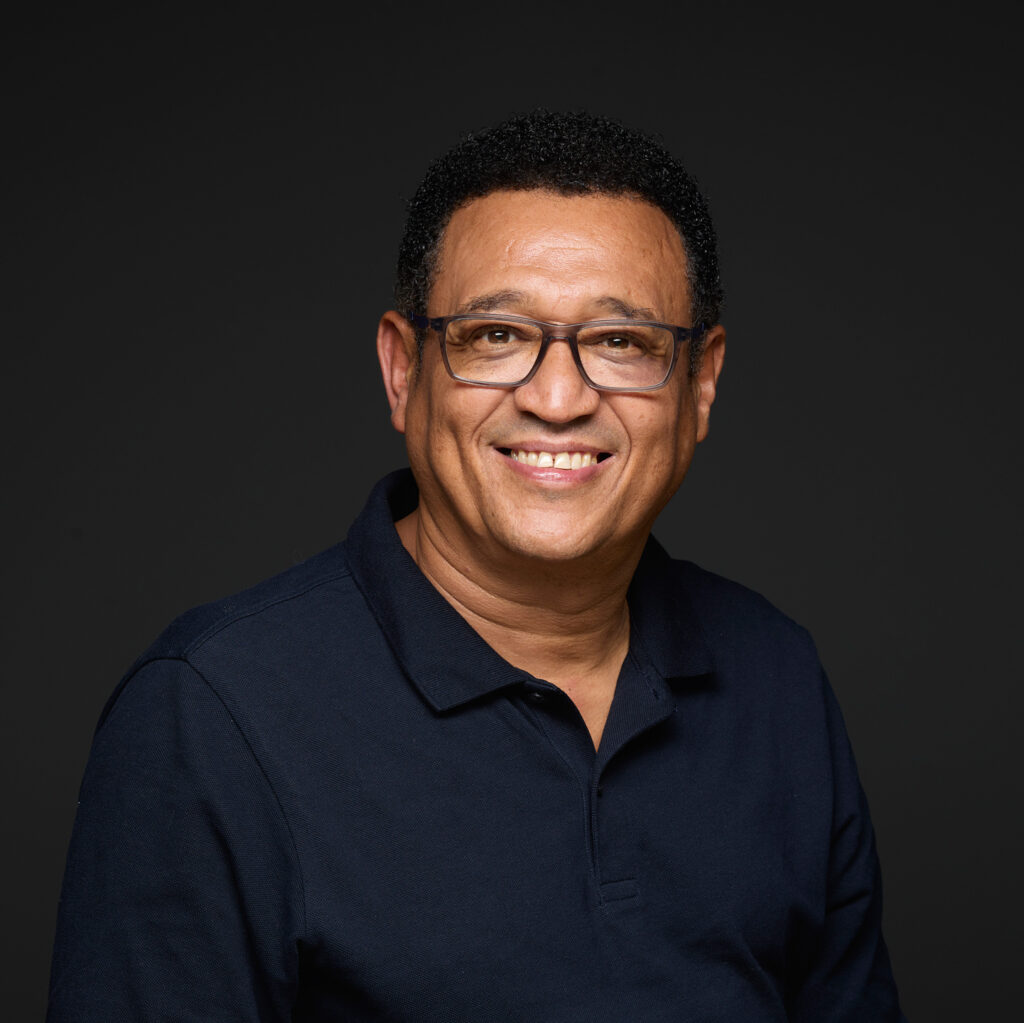
Rebecca Hale | National Geographic
‘Every time you saw a story on Africa, we Africans were portrayed as the poacher, the pirate, the ranger, the guide, or the singing people welcoming you at the entrance to a national park.’ Noel Kok and Pragna Parsotam-Kok started Nature, Environment & Wildlife Filmmakers (NEWF) to flip the script; African natural history and conservation stories, they believe, can be told by an international network of professionals led by indigenous African storytellers and scientists. Lauren De Vos chatted to Noel about breaking barriers, cultivating community and building a fair platform for Africa’s offerings on an international stage.
My journey started when I was seven years old, playing outside a shopping centre in Pinetown, KwaZulu-Natal. A lady and her child walked past; I smiled and greeted them. They packed their parcels into their car boot and as they drove away the lady wound down her window and handed me 20 cents.
You know they say that when you first see a rhino, that moment will stay with you forever? That was when I first saw a rhino: the car’s bumper sticker said, ‘Save The Rhino’. This was the late 1970s in South Africa. The lady and her child were white. As a kid, I noticed that whenever I saw this sticker, the car’s occupants were always white.
Anthony Ochieng Onyango | National Geographic
You went on to have a career in the South African film and media industry, but not initially in natural history. What changed?
Many years after I saw that rhino bumper sticker, I looked for the real animal on a holiday in the Kruger National Park. I understood the hype once I saw it, but variations of the stereotypes I’d grown up with were everywhere: I was the only person of colour on holiday in the park. Whenever I saw conservation on television, the person of colour was the ranger, guide or labourer.
Decades later, film and television were booming across Africa, but why not in the natural history genre? Around the same time, I landed at Oliver Tambo International Airport in Johannesburg and saw my third rhino: a bedazzled statue raising awareness for the renewed poaching crisis in South Africa. I thought, ‘Poaching is back, but this rhino is in the wrong place if we want to stop it.’ Then and there, I wrote a concept for an African nature television series, told in Zulu.
But in 2015 it was unbelievably challenging for us to access South African scientists, particularly black researchers in the national parks. We produced the film, but it nearly broke us. African nature storytellers were rarer than some of the species we were trying to protect. I like to say, ‘How do you change the story? You change the storyteller.’
But Africa’s natural history storytellers did exist. Were we just not hearing their stories?
Absolutely! I believe that Africans – whether Zulu, Afrikaans, Ghanian or Nigerian – are storytellers. So much of our history has been told orally. Whether you are a tannie from the Karoo or a scientist in Benin, there is a tradition of storytelling that you carry with you.
Anthony Ochieng Onyango | National Geographic
Your work has evolved to include building community and creating access. Would you say that at each stage you realised you must go deeper to dismantle the fundamental hurdles?
Initially we needed to create a groundswell to say, ‘Hold on, Africans have always told stories, and they hold generations of ecological knowledge. We just need the trust of the sector to bring these voices into the fold to tell their own stories – and to tell new stories too.’
Our inaugural 2017 NEWF congress and four short films by young, emerging African film-makers created a buzz, just enough for film commissioners to realise that there are storytellers in this space.
But we couldn’t succeed with just an annual congress. The barriers to entry were so institutionalised that we needed to find a way to dismantle them. We started NEWF Labs to target what was keeping people out in the first place.
Stories of African wildlife on land abound, but our oceans seem further out of reach. Why was this important to reframe?
Africa is surrounded by more than 30,000 kilometres (18,600 miles) of coastline and 38 of the 54 countries have a coastline. What stories were being told by Africans about our ocean? How were we getting involved to protect the ocean?
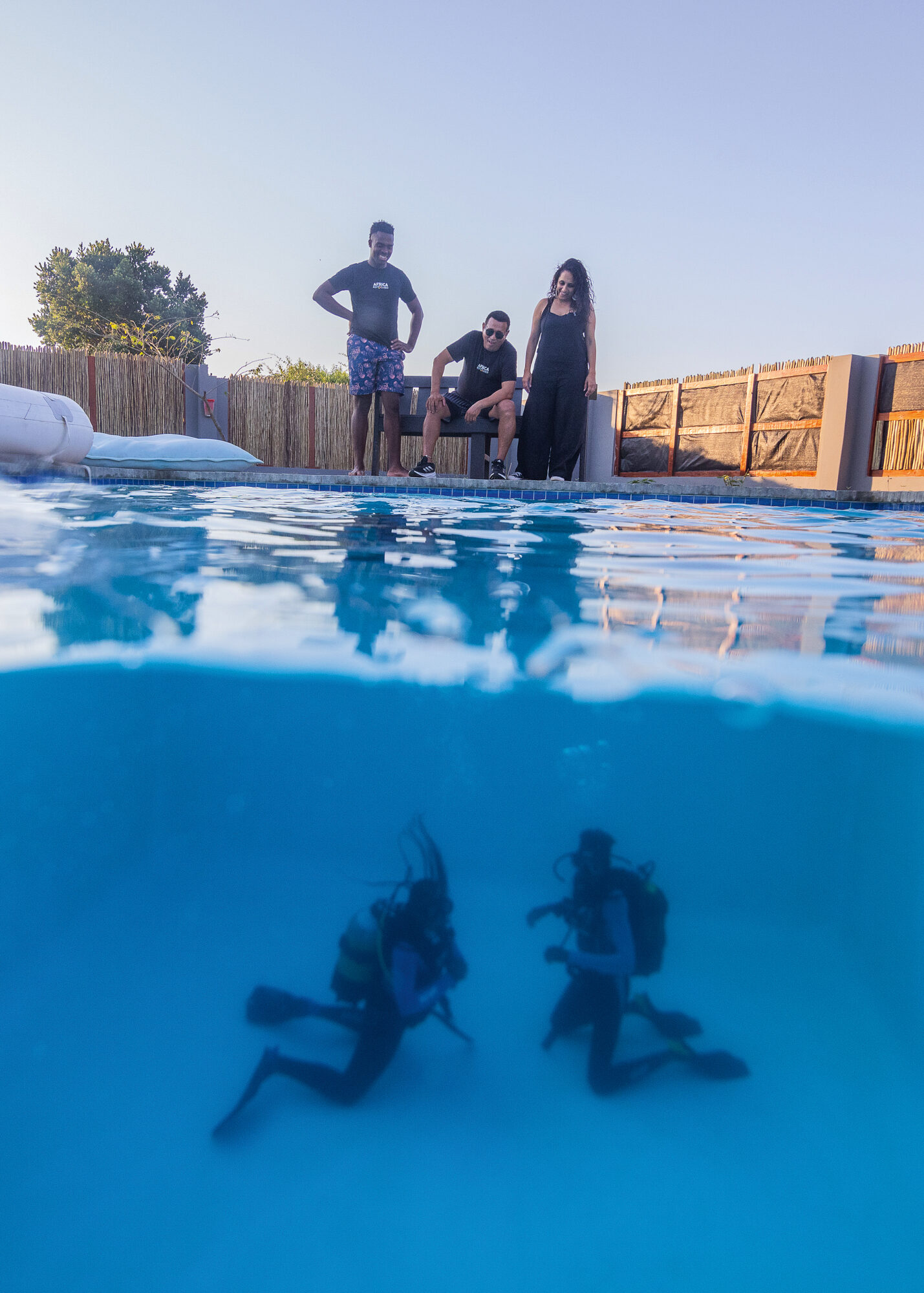
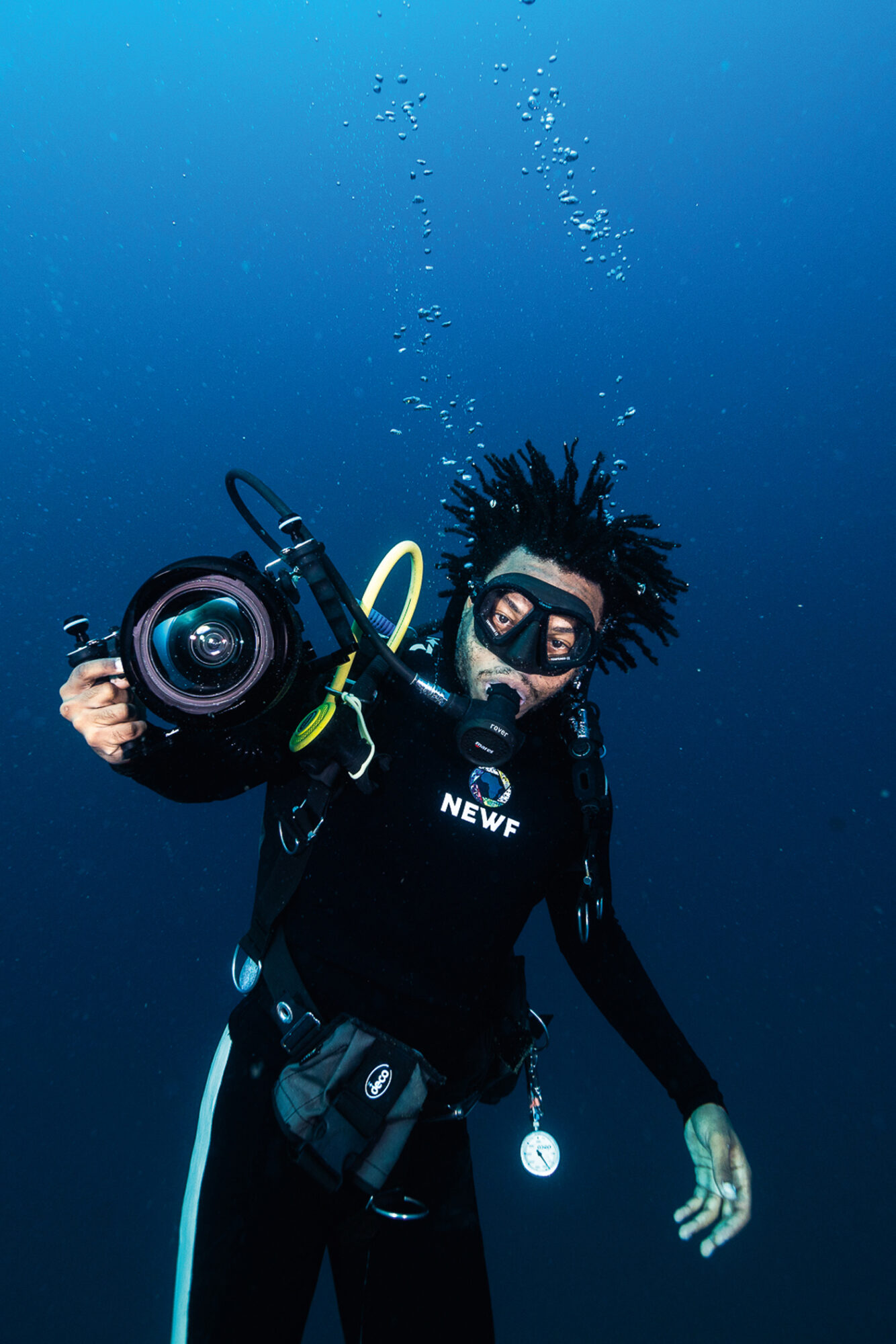
At our 2018 NEWF Congress, we wanted to put a black African underwater film-maker on the discussion panel – and it was like searching for a unicorn. In the process, we met hundreds of African marine scientists who could not dive or swim. There was a generation of marine biologists emerging – a fantastic thing – but they had never laid eyes on the habitats or species they were studying. In response, we started NEWF Dive Labs.
Anthony Ochieng Onyango | National Geographic
NEWF has trained hundreds of African divers from your base in Sodwana Bay. This in itself seems like a story to share?
We now have our own storytelling, research and dive centre. We are officially a PADI (Professional Association of Diving Instructors) university, and we have a community across Africa of over 360 Fellows from 34 countries. And 192 of them are certified divers, including 12 dive instructors, 20-odd dive masters and divers across various levels. There are Fellows who are also National Geographic Explorers, training their own cohorts of divers in Cameroon, Ghana, Tanzania. We’re also starting programmes in Benin and Nigeria.
We started telling the stories of the ocean and our Fellows. We brought scientists and storytellers together to speak of the places and animals they are studying, and their journeys.
It must be huge to go from a desktop computer to a fully qualified diver!
We face so many barriers to entry. Across Africa, many people fear the ocean. In many places, this has become part of the folklore. My surname is Kok and I come from a KhoiSan background. I grew up terrified of the water because my father told me that his brother was taken by a mermaid. Our parents told us these stories to protect us if there wasn’t money, time or the expertise to teach us to swim, and to keep us away from what could harm us. But even further back than that, some of this fear – we believe – stems from the slave trade. It was the water that took our people. And so these stories that were there to protect have been carried for generations.
Anthony Ochieng Onyango
Making underwater films is expensive. Is the cost prohibitive for someone starting out?
It’s cheaper for us to fly Fellows from across Africa to be dive certified in South Africa than in their home countries because everything here is geared towards tourism. Diving and the ocean drive the economy where we are in Sodwana Bay, but even here we have no South African black-owned dive entities, boats, nothing. Why is it that for Africans the ocean can only be for food or spirituality, not leisure or serious economy? Time and money are major barriers to entry. It is incredibly difficult for black Africans to have capital upfront for certification and gear, which keeps us from getting a foothold in ocean-related industries beyond being labourers or desktop scientists.
After the initial investment, you must encounter the stress of graduates finding work to repay their time, qualifications and gear.
Finding a job after acquiring the skills is probably the biggest barrier to entry into the world of conservation, storytelling and science. Often, emerging talents are pushed into a conservation sector that is still operating on a broken funding model where voluntourism can push out local graduates who need to be paid to work, not pay to work. This is something we need to urgently re-think.
Anthony Ochieng Onyango | National Geographic
There is a refrain that repeats across much of your Fellows’ work: I am the first. The first in my family to swim. To dive. To study. To film. How does this show up?
I asked one of our marine biologist Fellows what her biggest challenge was and she said, ‘The Christmas lunch table. I go home and no one in my family can understand what I’m talking about. It’s the loneliest place for me. Because I am the first. I am the first in everything I do.’
This is why we were so focused on building community. We try to say that it’s okay to feel a lot of the heavy stuff of being first. Yes, being the first comes with a sense of responsibility and loneliness, but it’s also not your fault or burden. And here, there is understanding and support.
How do we mentor African storytellers while nurturing their own perspectives?
It’s important to realise that there are many reasons why Africans want to be part of the industry and there are many ways that they each want to interact with the industry, too. Some want to travel and take on international jobs; they want to join the big networks and established broadcasters. There are others who want to run projects in their home countries, lead scientific research or tell African stories for African audiences. We want to normalise that all of these are valid choices. The point is to make these pathways realistic options for African storytellers.
Anthony Ochieng Onyango
How can African-led stories reach an international ear?
As Kaitlin Yarnall, National Geographic’s chief storytelling officer, always tells us: everything comes down to purpose and audience. What is the purpose of that story, and who is its audience?
There are many instances where we can create a project that features an African scientist, that features African conservation work, that even uses a local language – but the narrator has, for instance, an American accent. To tell that story, we must accept that these are the parameters within which we must work. That’s okay when we (Africans) are not the audience. It makes sense to speak to Americans in a format that they will best receive the story’s message.
You mentioned that media were booming across Africa, but not in the natural history genre. Is this the other gap – creating, and reaching, an African audience?
Absolutely. When we’re telling our own stories we have an opportunity to produce our own film and there is freedom in terms of how we frame it. That’s when we can start developing an African audience; we can tell stories the way we, as Africans, want to tell them. The way our elders have passed down stories over generations follows the same storytelling structure as most other cultures. Find a central character that you can make relatable, add a major challenge or a quest, plot some twists and turns, and then rest in a resolution. Our ancestors have been using the same format as National Geographic and the BBC!
Jahawi Bertolli | National Geographic
There’s a balancing act between sending African stories out into the world and developing an audience on the continent. What’s the common thread?
Who is the expert? Who is the genuine authority to inform the story? We recently made a film for an American audience that featured a black African scientist. In the past, an international production company would have picked a white international scientist to relate that story. Today we’re saying no – this is who is front-facing, this is who will tell that story – even if it’s for an international audience. We can make the story so much richer – and we can make the research so much deeper – when we genuinely collaborate.