
Accidental shark sanctuary
WORDS BY
Fanni Daniella Szakál
Ocean Storytelling Writing Grant Winner
ILLUSTRATIONS BY
Kelsey Lee Manners Dickson
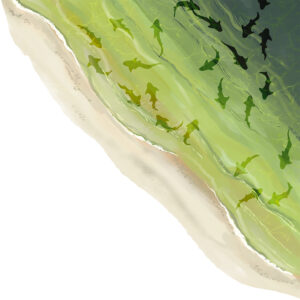
The Port of Ngqura has a higher abundance of fish than anywhere else along South Africa’s coastline. Can it teach us a lesson about supporting nature in the face of increasing human development?
Illustration by Kelsey Lee Manners Dickson | © Save Our Seas Foundation
I knew there would be sharks. But I didn’t expect quite this many.
Within minutes of our small rubber boat leaving the dock, the large brown shapes of several ragged-tooth sharks emerge from below us. They bob their heads above the water, gulping air and showing off their needle-like teeth. Unconcerned by our presence, several dozen more show up until we are surrounded by sharks. We are not on Palmyra Atoll or some other uninhabited shark paradise far from humanity, but in the Port of Ngqura, an industrial harbour 20 kilometres (12.5 miles) east of Gqeberha, South Africa.
On the breakwater to our left, African black oystercatchers scour the dolosse for mussels. To our right, cranes – the industrial kind – are loading hundreds of six-metre (20-foot) containers onto an enormous barge. Blurring the line between human and nature, the whistle of the wind and the cries of seagulls mix with the whirr of engines and the thud of cargo landing on the barge. The salty air and a whiff of guano from a nearby nature reserve mingle with the scent of petrol.
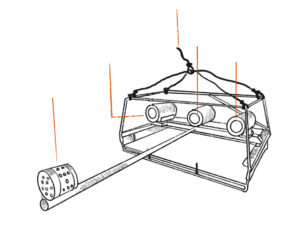
Illustration by Kelsey Manners Dickson | © Save Our Seas Foundation
Vivienne Dames turns off the engine and fits two cameras to a metal frame, pointing them towards a bait box filled with crushed sardines. She hoists the whole contraption over the side of the boat and, using a long rope, lowers it slowly to the sea floor, speaking as she works. ‘The raggies will drag this around like it’s nothing,’ she says, referring to the three-metre-long (10-foot-long) ragged-tooth sharks circling us.
Dames is a PhD student at the South African Institute for Aquatic Biodiversity whose research focuses on fish communities, specifically sharks and rays in the harbour. Based on the video footage that she collects at different locations around the port, she hopes to get a better idea of the abundance and diversity of fish in different types of habitats and to pinpoint what it is that makes artificial structures fish-friendly.
We move away, leaving the fish to discover the cameras in peace. As we head towards the shore, we are again quickly surrounded by a shiver of sharks. ‘They don’t look like much of an endangered species now that there are like 70 around us,’ Dames shouts over the rumble of the engine.
Ragged-tooth sharks are in fact Critically Endangered according to the IUCN Red List. They are slow to grow and reach maturity and they only give birth to two pups every two years, so they are especially vulnerable to overfishing, which has caused their numbers to plummet in many countries over recent years. But seemingly oblivious to the large-scale industrial operations at the harbour, they gather here in large numbers, using the calm waters as a refuge.
Illustration by Kelsey Manners Dickson | © Save Our Seas Foundation
And they are not the only ones. The port is home to an incredible diversity and abundance of fish. In an area of just a little over 1.5 square kilometres (0.6 square miles), there are more than 100 different recorded species, including 12 Endangered and six Critically Endangered sharks and rays. Abundance, which is often measured by the number of catches by an angler in a unit of time, is 2–3 times that of any other nearshore marine protected area in the country. In summer certain sharks, like smooth-hounds, gather in massive shivers where ‘you can’t even put your feet in the water without stepping on a shark’, according to Dames.
Around the world where major urban centres meet the coast, over half the shoreline is covered by artificial structures. While South Africa still has long stretches of its coastline undeveloped, with the country’s recent commitment to ‘unlock the ocean economy’ this is likely to change. By better understanding how this unique environment became a sanctuary for fish, Dames hopes that her research will provide guidelines for building on coastlines that support diverse marine ecosystems, prioritising the interest of humans as well as nature.
‘We’re not going to stop building alongside the ocean,’ she says, ‘so we need to understand how these creatures adapt to artificial structures and make them their own.’
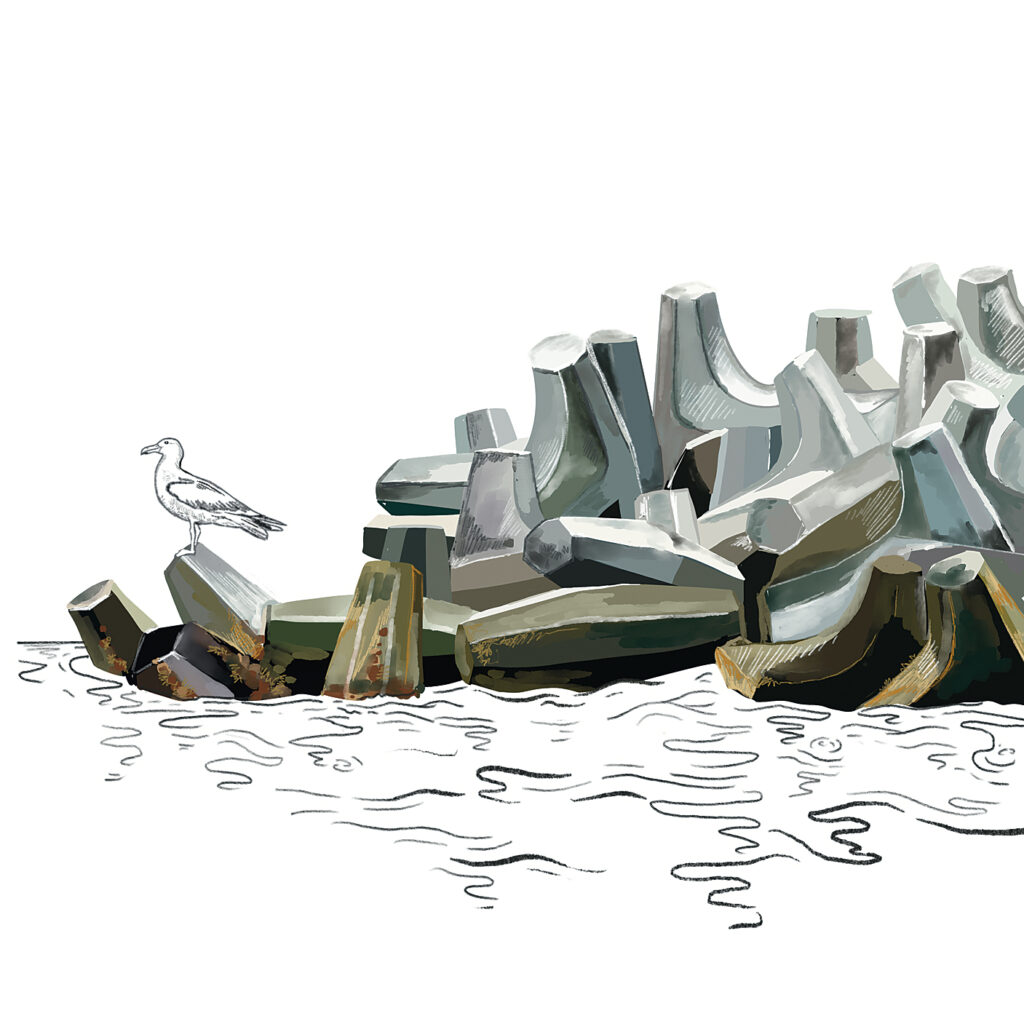
Illustration by Kelsey Manners Dickson | © Save Our Seas Foundation
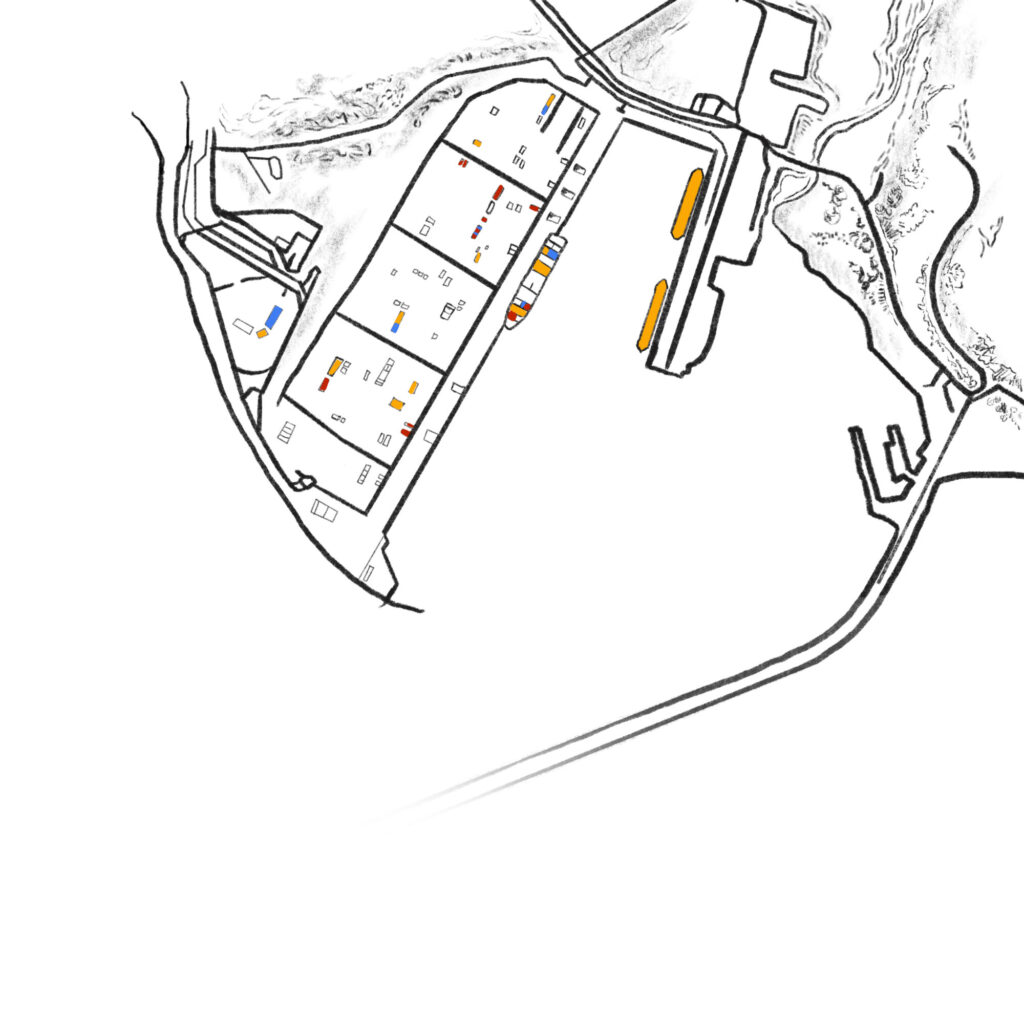
Illustration by Kelsey Manners Dickson | © Save Our Seas Foundation
I look through the fence to the sandy beach beside the harbour. Big, white-capped waves rush onto a shore that stretches as far as the eye can see. Dames points out a riptide, a strong current of water pulling everything with it offshore. The port was built in 2006 over this high-energy surf zone by dredging the mouth of the small Coega River. Today this calm, sheltered bay, about 20 metres (65 feet) deep, bears no resemblance to the harsh environment that was here before.
Matt Dicken, now the head of research at the KwaZulu-Natal Sharks Board, started monitoring fish abundance and diversity when work on the port began. A small team of volunteer anglers dart-tagged fish and, when the port became operational in 2009, they followed how the fish communities changed. More than 12 000 data points have been gathered to date, making this one of the largest – and longest-running – datasets in a port environment.
At first they found species usually associated with sandy beaches in the area. Then, as invertebrate life began to colonise the rock-like structures of the port, they started catching more reef-associated species. A diverse marine ecosystem seemed to have made a home here, with several endangered species using the port as a nursery. Some species that normally occur in warmer, tropical areas, like manta rays and spinner sharks, also began to show up.
‘When man-made structures are created, most people will start thinking that development is going to ruin it,’ says Dicken. ‘But as far as the fish life goes, this port has done the exact opposite. It’s created an incredibly unique, sheltered environment that provides a sanctuary for fish, resulting in the most diverse species composition and highest abundance of fish anywhere in South Africa, if not Africa.’
Illustration by Kelsey Manners Dickson | © Save Our Seas Foundation
Remarkably, the harbour seems to be especially popular with sharks and rays, which account for about a third of the species recorded.
As the second most threatened vertebrate group globally, sharks and rays are in peril, with one-third of their species threatened with extinction. The long time they take to reach maturity – a whopping 150 years for the record-holding Greenland sharks – and their long gestation mean they are not able to reproduce fast enough to keep up with fishing pressure. The practice of shark finning alone is estimated to kill about 100 million sharks each year.
South Africa, a global hotspot for sharks and rays, currently protects only 5% of its waters, and even there certain types of fishing or shark control in the form of shark nets and drumlines are permitted. Lack of enforcement is also an issue; people often refer to protected areas as ‘paper parks’, meaning that in practice there is no one there to uphold the law.
In the port, however, all fishing except for the fish monitoring programme is strictly forbidden. As we enter the premises, we are stopped at the security gate and a guard scans our papers, checks our permits and looks through the car for anything suspicious. Passing the security cameras towering over the road on our way in reminds us that our every move is supervised. Essentially, while they stay within the safety of the breakwaters, all the sharks need to worry about is being eaten by a bigger shark.
Illustration by Kelsey Manners Dickson | © Save Our Seas Foundation
Later that week, we sit down with Dames at the home office she shares with an assortment of rescued creatures to watch the videos that she took in the harbour. Moving a wayward kitten out of the way, I bring my focus to the screen. About a hundred fish are swimming around in the mint-green waters, raiding the bait box in a frenzy. ‘That’s a ridiculous number of fish,’ says Dames as she plops a mealworm into the mouth of a swallow chick – the latest rescue. I can hear the crackle of the reef and the strange murmurs of dusky kob, a very vocal and very endangered resident of the port. Then a massive raggie swims into the picture and bites down on the sardine box, pulling the whole camera scaffold with it, as our view is blotted out for a few seconds by a snowstorm of sand and debris.
We see species that have never been caught by the angling team, like chimaeras, the rare cousins of sharks and rays, and shysharks, stingrays and big bronze whaler sharks. Looking at footage taken at different points around the harbour, we are transported to a new micro-ecosystem in each one: a shiver of sharks circling the bait along the quay walls, rays flapping around in the turbid waters at the sandy beach, bustling reefs of bryozoans and gorgonians along the dolosse. According to Dames, the diversity of habitats is one of the key reasons behind the unexpected ecological success of the port.
‘Oh my god.’ Dames jolts up in her seat. ‘A new species!’ She points to the silvery fish with a yellowish line on its side swimming in and out of visibility. She identifies it as an almaco jack. I ask her if she knows all the fish by heart. ‘Pretty much,’ she replies. Visibly buzzing with excitement, she rewinds the footage to take another look.
Dames lives and breathes fish. She used to tag along with her father on fishing trips as a child and has fished her way up to the top of South Africa’s recreational angling scene, scoring some sponsorship deals in the process. Hooking fish is perhaps a strange passion for someone with a primary goal of protecting the oceans, but Dames seems to have forged a path where her two identities – angler and scientist – are working to each other’s benefit.
‘Scientists mostly stick to themselves and their conferences, and they think that’s the end of it. But unless [the research] has some meaning for the people who actually handle the fish every single day and are using them to feed their families, what difference are you going to make?’ she questions.
‘You need to walk in their shoes. I found that the only way I can make a difference is to fish among them.’
In an ideal world, the oceans would be teeming with sharks, maintaining the delicate balance of marine ecosystems. The coast would be untouched and there would be no need for sanctuaries, refuges or protected areas. Clearly, this is not the case. Humans have significantly altered two-thirds of our oceans and the number of artificial marine structures are projected to increase by 50–70% this decade. Coastal development often leads to the destruction of crucial habitats like coral reefs, sea-grass meadows and mangrove forests, with ripple effects that sometimes extend hundreds of kilometres through changes in water quality, noise, substrates, movement of animals or food webs. The artificial structures like flat seawalls, pilings or marinas that are put in place are also associated with alien species, paving the path for biological invasions.
So I was astonished to find that a commercial port has one of the highest diversities of fish on South Africa’s coastline. But it is not the only example of marine life thriving in a man-made environment. Offshore oil rigs, the monstrous metal structures sticking out of the sea that have become synonymous with environmental destruction, support an incredible diversity and abundance of marine creatures, to the extent that there is a movement towards leaving these structures in place after the rigs themselves are decommissioned.
Sydney Harbour in Australia is another example, with almost 700 fish species recorded to date – almost as many as you would find in the entire Mediterranean Sea. It has some of the most diverse fish assemblages and the largest sizes of fish compared to other estuaries in New South Wales, including protected areas. The main reason for the harbour’s ecological success seems to be its diversity of habitats. As a drowned river valley, Sydney Harbour is made up of inlets, mangroves, salt marshes and rocky reefs, providing plenty of options for fish to pick and choose what they like.
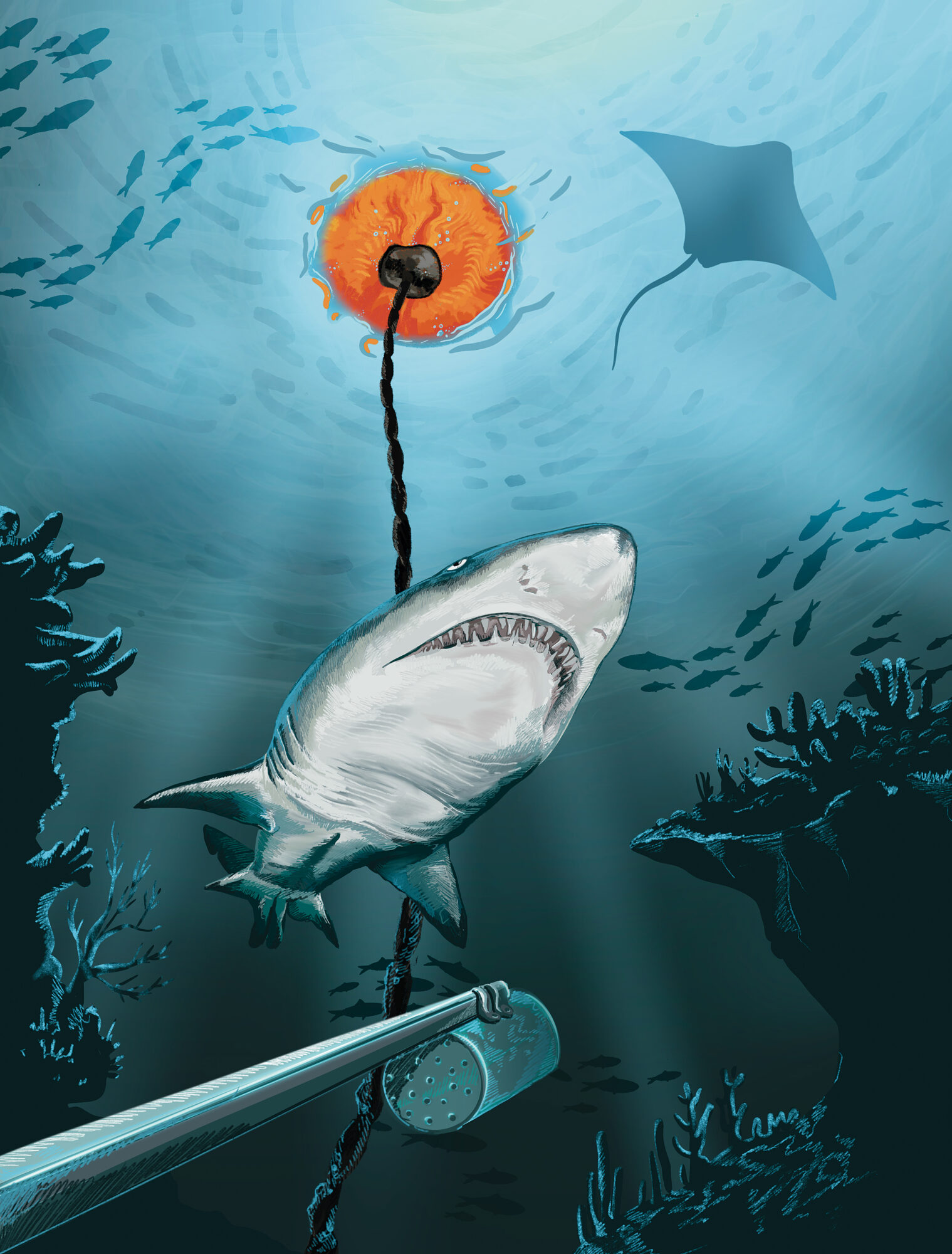
Illustration by Kelsey Manners Dickson | © Save Our Seas Foundation
The harbour was the birthplace of Living Seawalls, which are ecologically designed concrete panels that try to emulate natural structures. Each panel has different designs on the surface, sporting pockets, holes, slates or structures resembling a honeycomb. Shaped like unruly hexagons, they fit together like a mosaic and offer habitat and refuge to a variety of creatures. The panels that now cover some of the seawalls in the harbour provide homes for about three times more species than would be found on a flat seawall.
‘I don’t think we’re going to eliminate coastal infrastructure,’ says Katherine Dafforn, who is a co-lead in the project. ‘So I think we need to think about how we build them smarter, so that we can have beneficial outcomes for diversity and beneficial outcomes for humans as well.’
Illustration by Kelsey Manners Dickson | © Save Our Seas Foundation
I am standing on the little sandy beach nestled at the back of the harbour, looking out at the expanse of grey water. The wind is chopping up the normally smooth surface of the sea, rolling waves towards the shore. It is too windy to go out on the boat, so instead I’m helping the angling team to catch sharks and rays. Helping is perhaps a bit too generous a term, as I have never held a fishing rod in my life before. Now I’m holding one that is towering five metres (16 feet) into the air, engineered specifically to be able to withstand the force of large sharks or fish. While I wonder if I was engineered to withstand the force of large sharks, I suddenly feel a sharp tug on the line and the reel starts whirring. From the many pieces of advice I received from the anglers, all I remember is ‘Do not let go, this stuff is expensive.’ So I hold on for dear life as the creature at the other end of the line is pulling in the opposite direction.
The pulling stops for a bit and I reel in the line until finally I see the grey shape of a little shark emerging from the water. The anglers help pull it out onto the wet sand and we quickly measure it. At just 86 centimetres (2 feet 10 inches) long, it is probably a newborn. She is a female dusky or grey shark, an Endangered species that has established a nursery here and is now the most commonly caught shark, with an estimated 550 individuals in the port at any one time.
One of the taggers carefully removes the hook from the shark’s mouth so as not to cause any damage, while another disinfects the tagging needle and attaches a small yellow dart tag next to the dorsal fin. The whole choreography of fine-tuned movements takes about 30 seconds, minimising stress to the shark as much as possible.
The taggers release her into the water and I look at her as she swims away with a firm slap of the tail. I think about her future. Perhaps she will become the dinner for a bigger shark or end up in the nets of fishermen waiting outside the harbour. Perhaps she will grow big and strong and will be caught again, granting us important scientific data. As a migratory shark, she may travel thousands of kilometres northwards along South Africa’s coast. Perhaps she will support her species by coming back to the port one day to pup.
Illustration by Kelsey Manners Dickson | © Save Our Seas Foundation
In any case, right now she is the poster child for paving the way to an uncertain future where humans and nature can co-exist in relative harmony – the literal grey area between pristine nature and destroyed ecosystems.