
Sharks at your service: trevally fish risk it all to scratch their itch
Scratching an itch, scraping off parasites and sloughing off dead skin cells are hard to do without hands. But when project leader Nico Fassbender watched 500 hours of BRUVS footage filmed in Seychelles, he found that trevallies have found a bold solution to their fishy problems.
When the biggest predators on the reef come cruising by, you’d expect smaller fish to flee – not willingly bump into them. But by the time scientist Nico Fassbender, a researcher and (at the time) PhD candidate at the University of Western Australia, had spent more than 500 hours watching video footage he had recorded of fish swimming near the seabed, he had found so many instances of intrepid trevallies purposefully brushing past the sleek bodies of large reef sharks that he knew it was no accident.
His findings – that bluefin, golden and yellowspotted trevallies choose larger reef-associated sharks like the grey reef, bull and tiger sharks to scrape against to bring relief for itches and parasites, even where cleaning stations and rough coral are available – have been published in the Journal of Fish Biology.
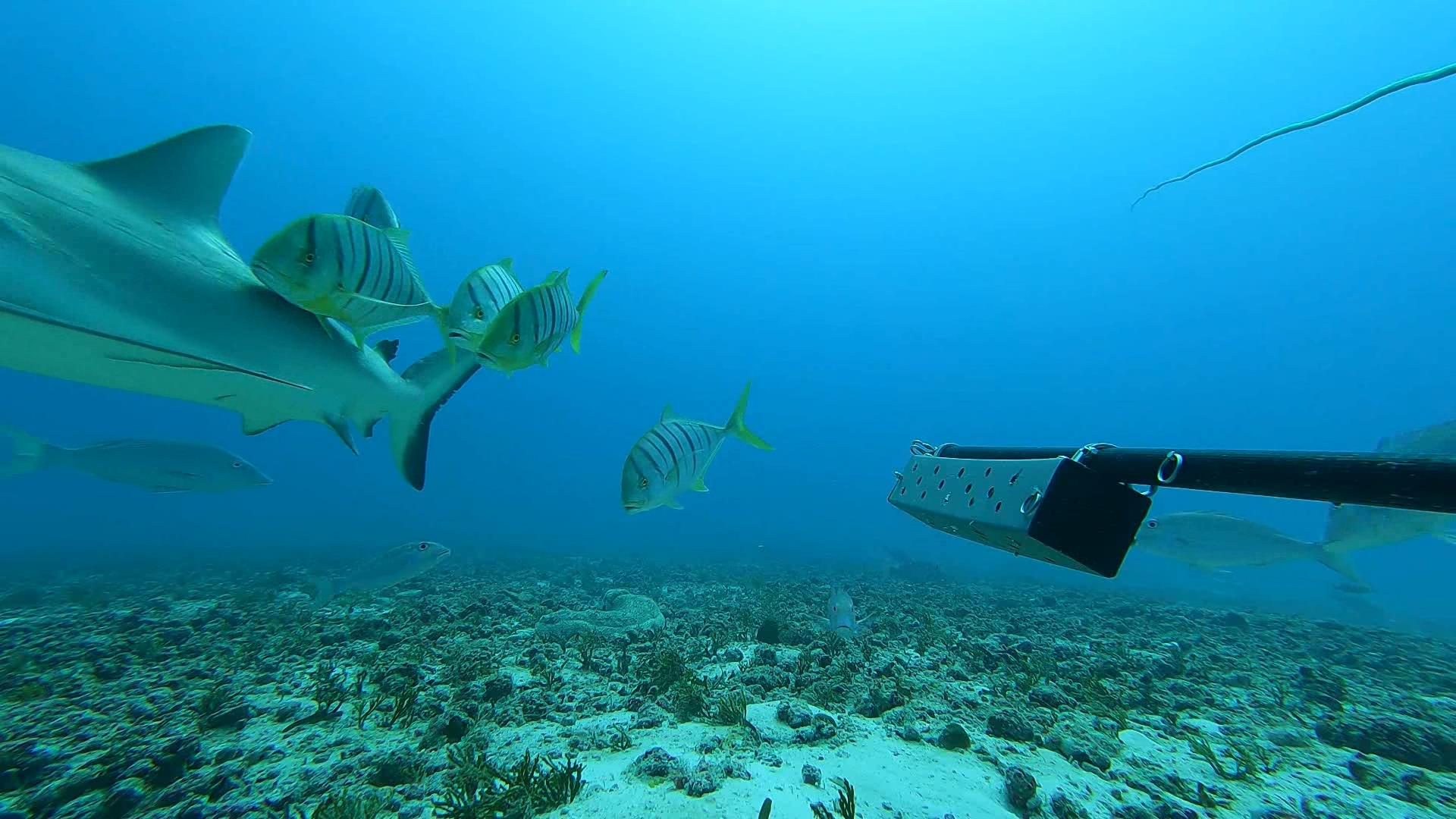
Golden trevally show distinct preferences for where they 'scratch their itch'. On these grey reef sharks, it's typically between the first and second dorsal fins. Photo © Nico Fassbender
Famous fish on film
Trevallies belong to a large family of fish called the Carangidae. There are more than 140 species, and you might already be familiar with one of the largest – the giant trevally, which leapt to global fame when one was filmed grabbing fledgling terns on the wing in David Attenborough’s Blue Planet II. Although the different species vary in size and colour, in general trevallies are known for their speed and predatory behaviour, and are sought after by recreational and trophy fishers.
The bluefin trevally is striking, its electric-blue fins and shimmering yellow scales distinctive in its coral reef habitat across the tropical Indo-Pacific from East Africa and the Red Sea to Mexico and Panama. The aptly named golden trevally found its way into natural history accounts from the 1970s for its tendency to follow divers and has been recorded keeping close to sharks. Blue-green above and silver below, the yellowspotted trevally is also a powerful sight as it roams singly or in shoals in rocky and coral reef ecosystems.
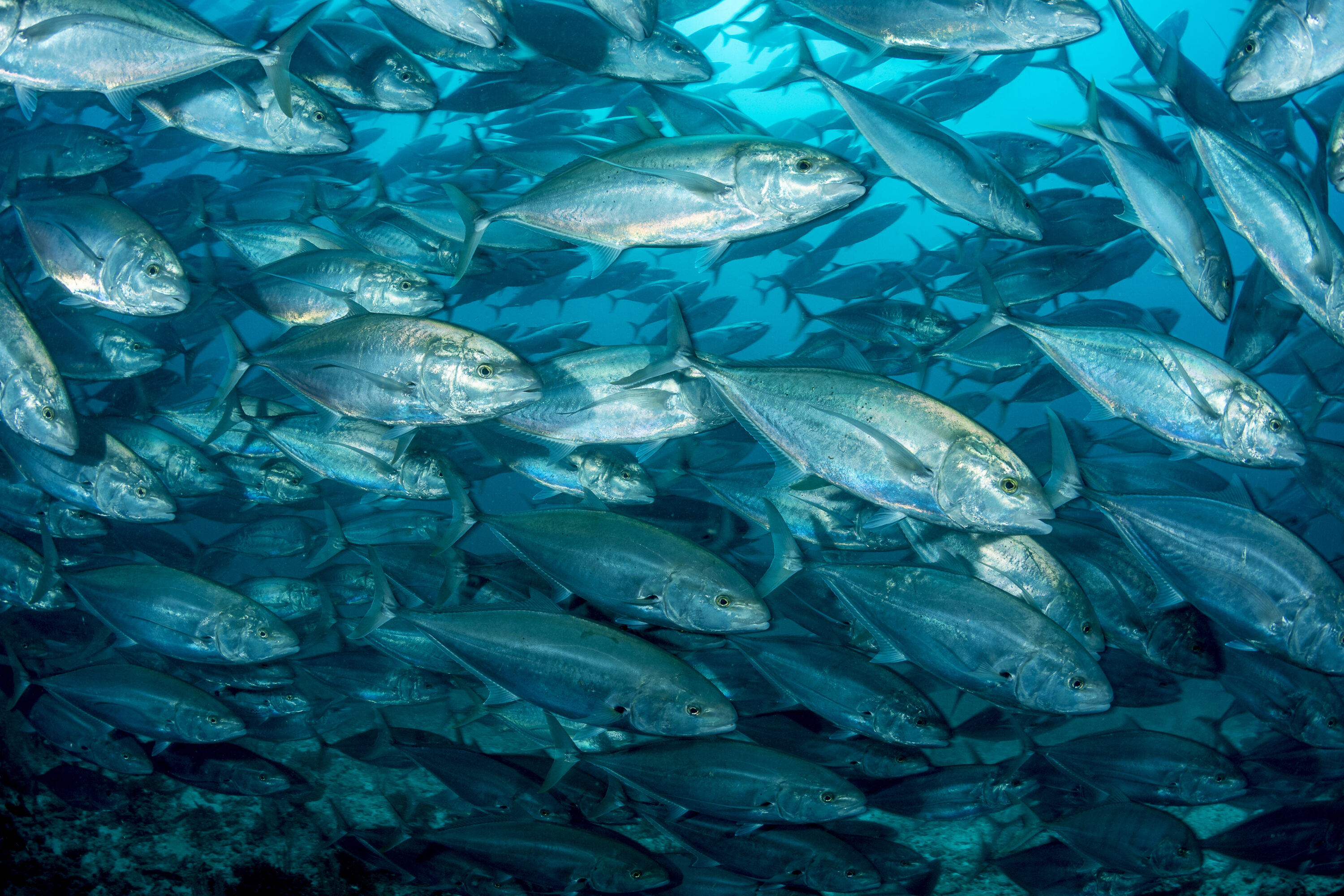
A school of yellowspotted trevally on a reef off St. Joseph Atoll, Seychelles. Photo by Shane Gross | © Save Our Seas Foundation
Scraping against sharks
Nico deployed baited remote underwater video systems (BRUVS) at different sites around Seychelles: around north-western and eastern Mahé; on the west coast of Praslin (sampling Cousin and Cousine islands); and at St Joseph Atoll and D’Arros Island in the Amirantes region. The BRUVS record the marine life in the study region and are particularly useful for gathering information about the abundance, diversity and size of sharks, rays and fish. While it might not be the primary objective, their film is also a helpful medium for capturing interesting animal behaviour, especially in instances where divers need not be in the water.
‘Technology really has made our life as animal ecologists easier, specifically when it comes to documenting and exploring known and novel behaviours,’ explains Nico. ‘The key factor for me is that these observations are often overlooked. A lot of people now take cameras, such as GoPros and Olympus compact cameras, to document what they see underwater. And it’s not just scientists; these are ocean aficionados in general. I believe there’s so much information we could get out of “community science” observations, as well as targeted surveys using video technology, but much of it just goes unrecorded and undocumented.’
The result for Nico and his colleagues, some of whom were based at the Save Our Seas Foundation D’Arros Research Centre (SOSF-DRC) at D’Arros Island at the time, was the first records of this kind of behaviour with bull sharks and tiger sharks in the wild. In each case, the trevally would follow the shark – either alone or as part of a group – and then zoom alongside to scrape itself against the shark from its flanks towards its nose, but never quite reaching the shark’s head. ‘There seems to be some sort of learned caution to avoid the toothy end,’ Nico quips. He believes that this behaviour is calculated, and it reflects a relationship that has become familiar in the ecosystem – the trevallies aren’t just opportunistic risk-takers. That’s because, even though bull and tiger sharks eat trevallies, these sharks showed no obvious reaction to the itchy individuals.
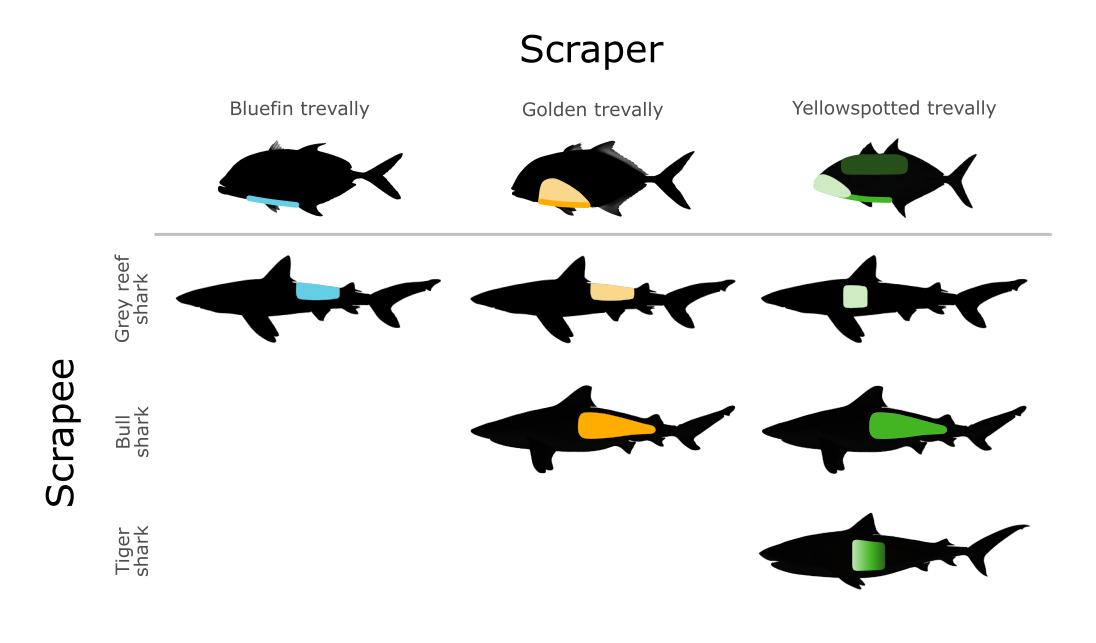
Trevallies showed repeated and predictable patterns in how they approached and scraped against sharks. In all cases, the predators' 'business end' was well-avoided - most likely intentionally, to avoid scratch-time becoming snack-time. Figure © Nico Fassbender
Keeping clean is a common problem for fish
In tropical ecosystems, it’s common to find fish ‘cleaning stations’, where a fish client visits species like wrasses, gobies and cleaner shrimp to have parasites and other skin hassles removed. It’s a low-risk, high-reward scenario – an option that would appear to be more relaxing than chasing alongside a shark. Coral also has a rough surface that can scratch the itch of an irritated ocean animal, but for species like various tuna, rainbow runners and trevallies, the uniquely rough skin of sharks seems to give relief like nothing else. Shark skin is made up of tooth-like dermal denticles instead of scales, and this might well be just the ticket for large, itchy fish.
At first glance, this is an interesting natural history observation that adds to what we know about these extraordinary fish. But there’s a note of caution underneath the novelty: it’s a reminder that sharks play roles in keeping our oceans functioning that we haven’t yet fully deciphered.
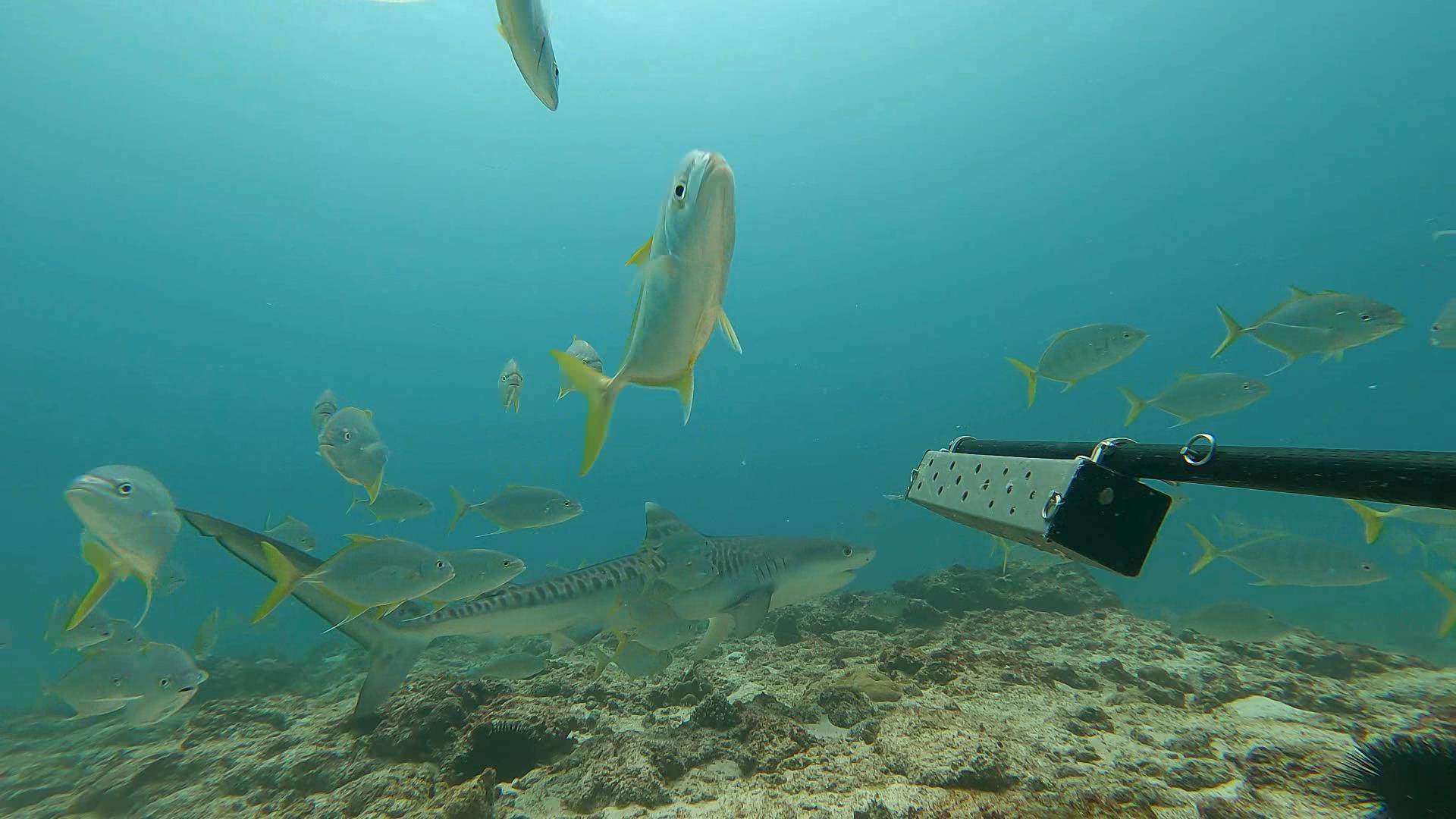
Yellowspotted trevallies scraped against tiger sharks, but also bull sharks and grey reef sharks. Photo © Nico Fassbender
Conserving coral reef ecosystems
‘The key word here really is “functional”, as it is functions that disappear first when species are declining due to (typically) human pressures,’ says Nico. ‘Sharks are already functionally extinct from one in five coral reefs globally, so the better we can protect them, and any species for that matter, the better we can safeguard ecosystem functioning and keep these ecological interactions intact. When we protect seascapes, or safeguard species from extraction, we directly help to keep biodiversity complete and allow nature to remain in balance. In turn, we will be able to better observe, document and ultimately understand these ecological interactions when we see them.’
Nico hopes that as behaviours like this are more consistently documented and studied, we will keep adding to what we are beginning to understand about our oceans – and the complex part sharks play in keeping them healthy.
Read the paper here.
Reference: Fassbender N, Sewell IB, Bullock RW and Meeuwig JJ. 2026. Mobile cleaning stations: trevally scrape on sharks in a tropical reefscape. Journal of Fish Biology.