
Tagging and Tracking: How We Study Sharks Without Harming Them
Have you ever wondered what a white shark is doing a thousand miles away? Where does she give birth? How do these ocean giants navigate the blue abyss? As a scientist, these are the questions that keep me up at night, because the answers aren’t just fascinating, they are essential to saving these incredible animals.
The truth is, we can’t save what we don’t understand. That’s where shark tagging comes in. This work goes beyond science; it helps us understand and protect the ocean’s apex predators.
The significance of a tiny tag
Armed with thermal, depth and an array of other highly specialised sensors, tags merely act as “journals”, helping researchers to better understand the secret lives of sharks by:
Mapping their entire life history: their mysterious migratory routes, where their crucial nurseries and mating grounds are, and how many of them are actually out there.
Providing information on climate change: This data is critical. It helps us pinpoint the exact ocean areas that need protection. We also gain vital insights into how quickly they grow and, more urgently, how climate change is already shifting their movements and distribution.
We can identify areas where sharks are most likely to interact with people, enabling the implementation of public safety measures. Likewise, regions where sharks are likely to overlap with fishing activities can be identified, allowing fisheries to implement smarter, safer management strategies that benefit both people and sharks.
These “journals” not only tell us where sharks go, but also help build effective strategies to help protect these vulnerable species.
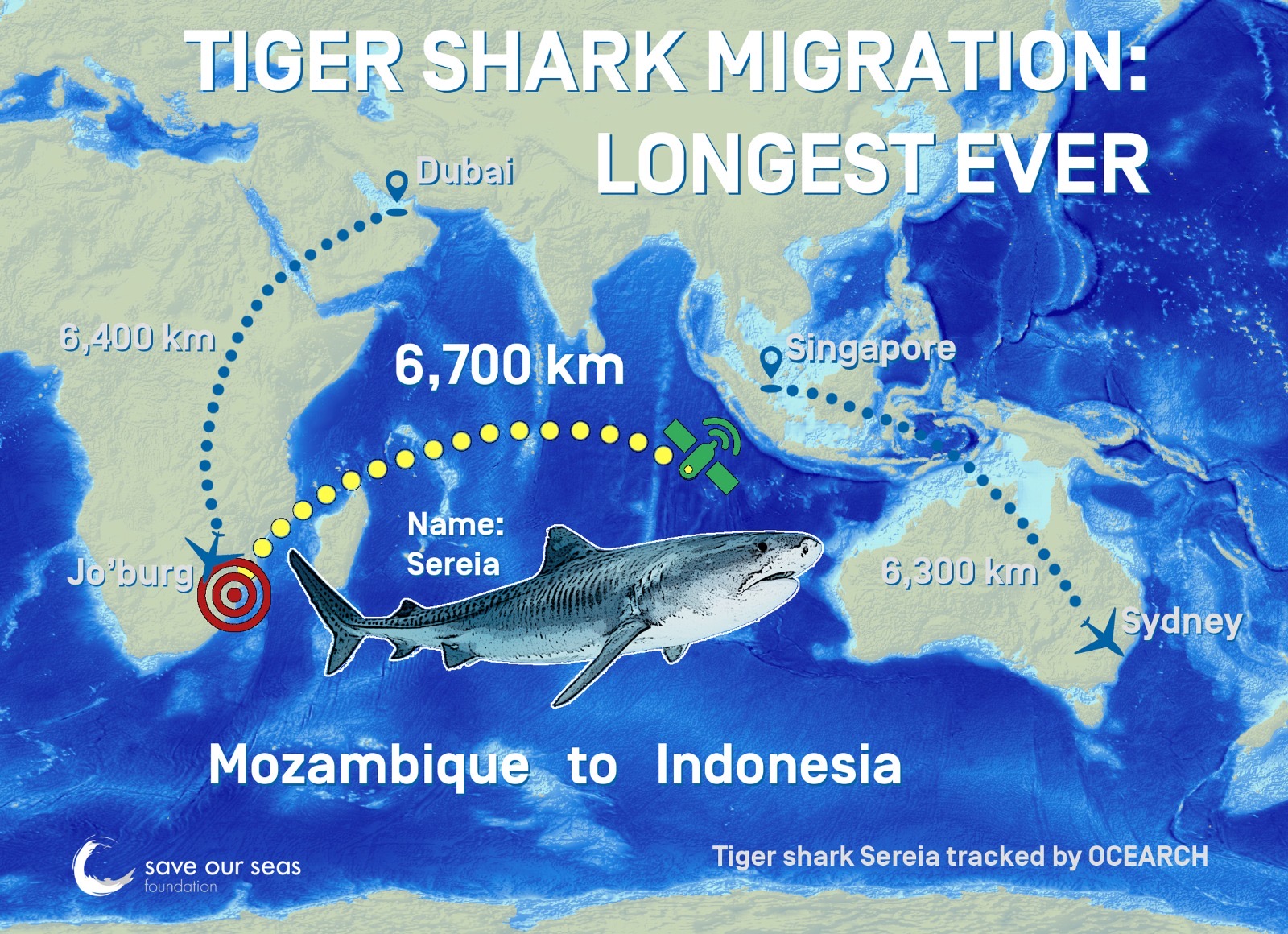
Tagged tiger shark travels more than 6 700 kilometres, confirming transoceanic abilities of the species. The additional distances shown on the map are included for comparison only, to help illustrate the scale of the tiger shark’s migration relative to other long-distance routes. Photo from Save Our Seas Foundation.
Meet the different types of tags
The technology available is incredible, and scientists choose their ‘tools’ based on the specific shark species and the questions they’re asking. Here are some of the different types of tags:
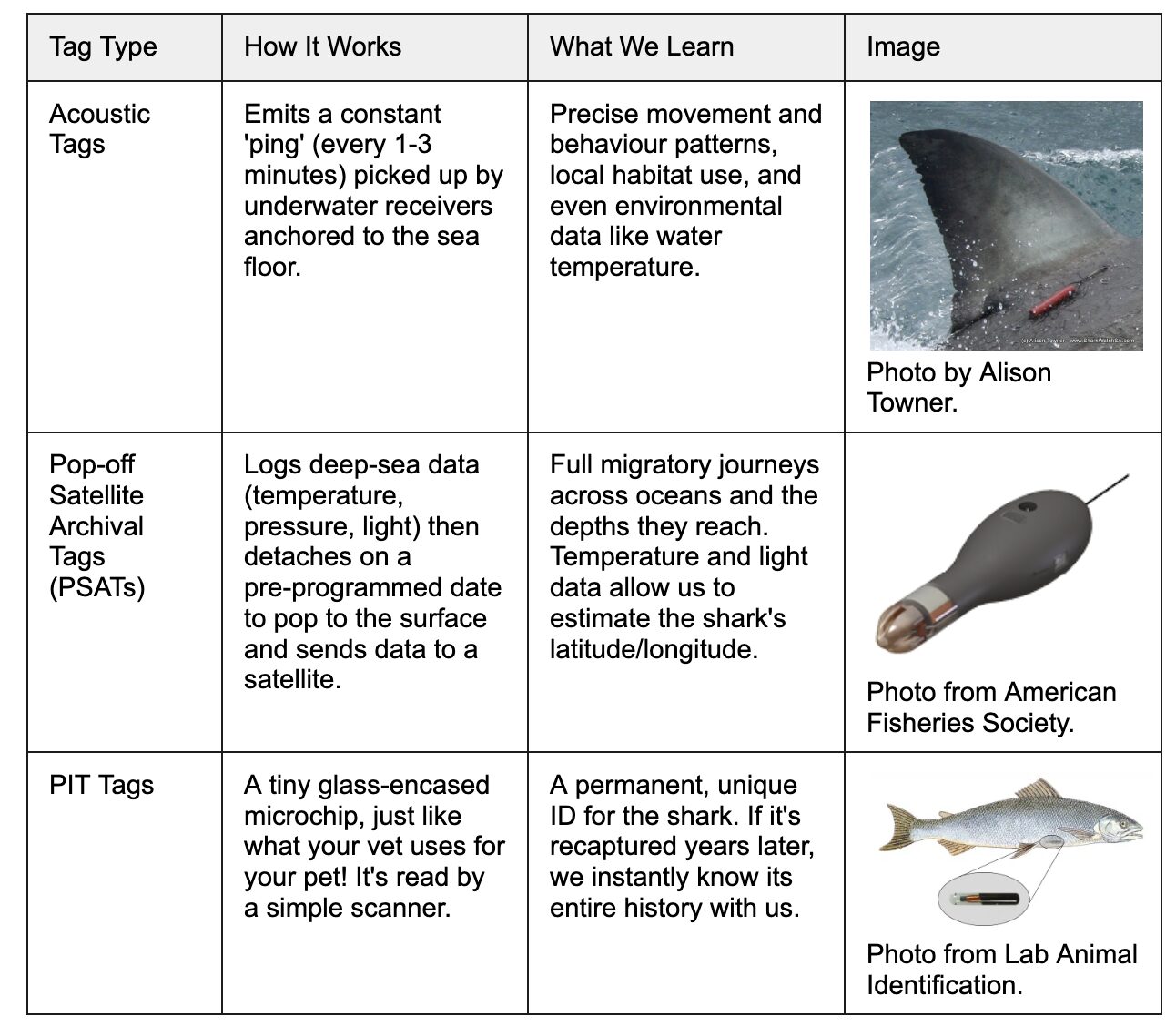
Table showing some of the different types of tags available.
Does tagging stress sharks?
This is the question we are all thinking: Does this hurt the shark?
I’ve been fortunate enough to participate in a handful of tagging expeditions (not associated with the SOSF Shark Education Centre). When you’re up close, handling one of these magnificent creatures, the responsibility is immense. Our primary goal is always the shark’s well-being.
Minimising stress: Yes, there is brief stress during the handling and restraint phase. But this is mitigated by prioritising lightning-fast handling times and keeping the shark in the water as much as possible.No pain: Fortunately, sharks do not experience pain in the same way we do. They lack the complex nerve structures that would allow them to feel pain from a simple tag insertion. We typically apply tags to the thick, non-innervated part of the fin.
Incredible healing: Sharks are famous for their remarkable healing abilities. A minor insertion cut on a fin will regenerate significantly, ensuring no long-term damage or impairment.
Advanced technology: Concerns have been raised about whether tagging may affect a shark’s natural behaviour, its risk of being hunted, or its ability to capture prey. However, tags are designed to be as minimally invasive as possible. For example, PSAT tags are strictly designed to weigh no more than 3-5% of the shark’s body weight, to minimise any impact on the shark’s movement and behaviour.
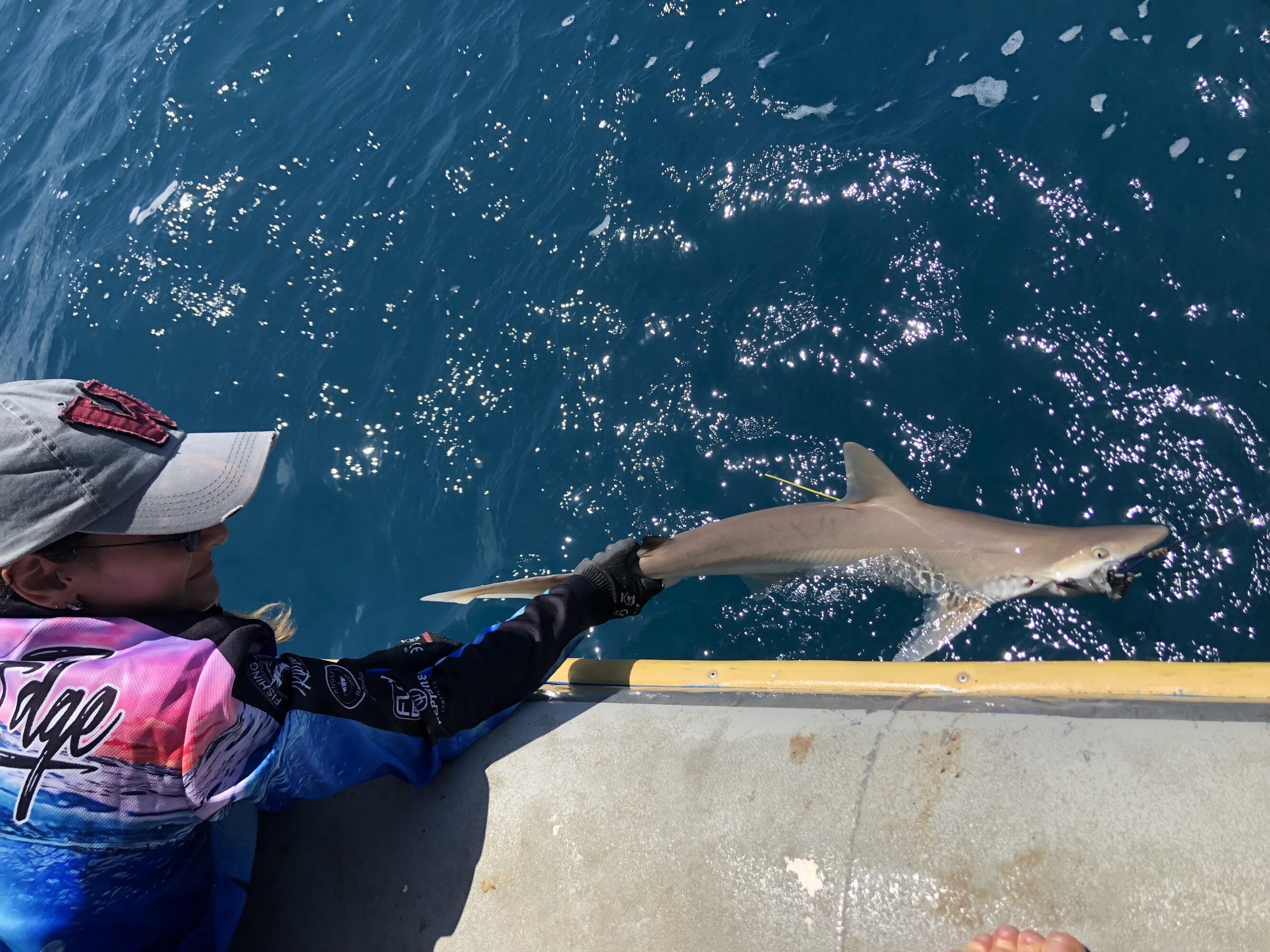
Liat Dayan (author of this blog) assisting with tagging sharks as part of Sasha Faul’s research (James Cook University x Biopixel Oceans Foundation master’s student).
As a scientist, there is nothing quite like holding a shark’s fin, looking into that ancient eye, and knowing that the tiny device we’re implanting will provide the vital information needed to help save these incredible species.
Although the SOSFSEC is not involved in shark tagging for research, as an environmental education organisation, it is our role to highlight the importance of this research. Join us on one of our public open days to learn more about shark migrations; keep an eye on our social media for dates. You’ll be able to explore global shark migration tracks using the PufferfishTM, our state-of-the-art spherical projection exhibit.

Photo of our public tour visitors interacting with the PufferfishTM. Photo by Liat Dayan | © Save Our Seas Foundation Shark Education Centre.
The future of shark tagging lies in uncovering new, critical information that helps us better understand and protect these vulnerable animals. Tagging allows researchers to build evidence to answer essential questions such as “Where have all the white sharks gone?” and “Where do sharks go to mate?” These insights are vital for developing effective conservation and protection strategies.