
Body boundaries? It’s a no for reef manta rays and remoras
On a routine reef manta ray monitoring dive, scientists at the D’Arros Research Centre in Seychelles recorded the first documented instance of a remora hiding in a reef manta ray’s cloaca (the all-in-one exit for the manta’s digestive and reproductive functions).
By its nature, the art of natural history centres on being observant. For the scientists who live and work on D’Arros Island in the remote Amirantes Island group in Seychelles, the undercurrent that flows seamlessly through routine surveys, long-term monitoring projects and scientific studies is the opportunity to observe and understand the ocean in a way that is only possible through immersion.
So when Ellie Moulinie, research officer at the Save Our Seas Foundation D’Arros Research Centre (SOSF-DRC), slipped into the water one morning to start routine monitoring, a never-before-seen behaviour was a possibility – but not the plan. Was it the misplaced threat of predation that spooked the white suckerfish attached to a two-metre-wide (6.5-foot) juvenile male reef manta ray that was feeding at the ocean’s surface? Whatever it was, the result was weird (to us). While the reef manta ray continued unperturbed, the white suckerfish Remora albescens disappeared into the cloaca of its host.
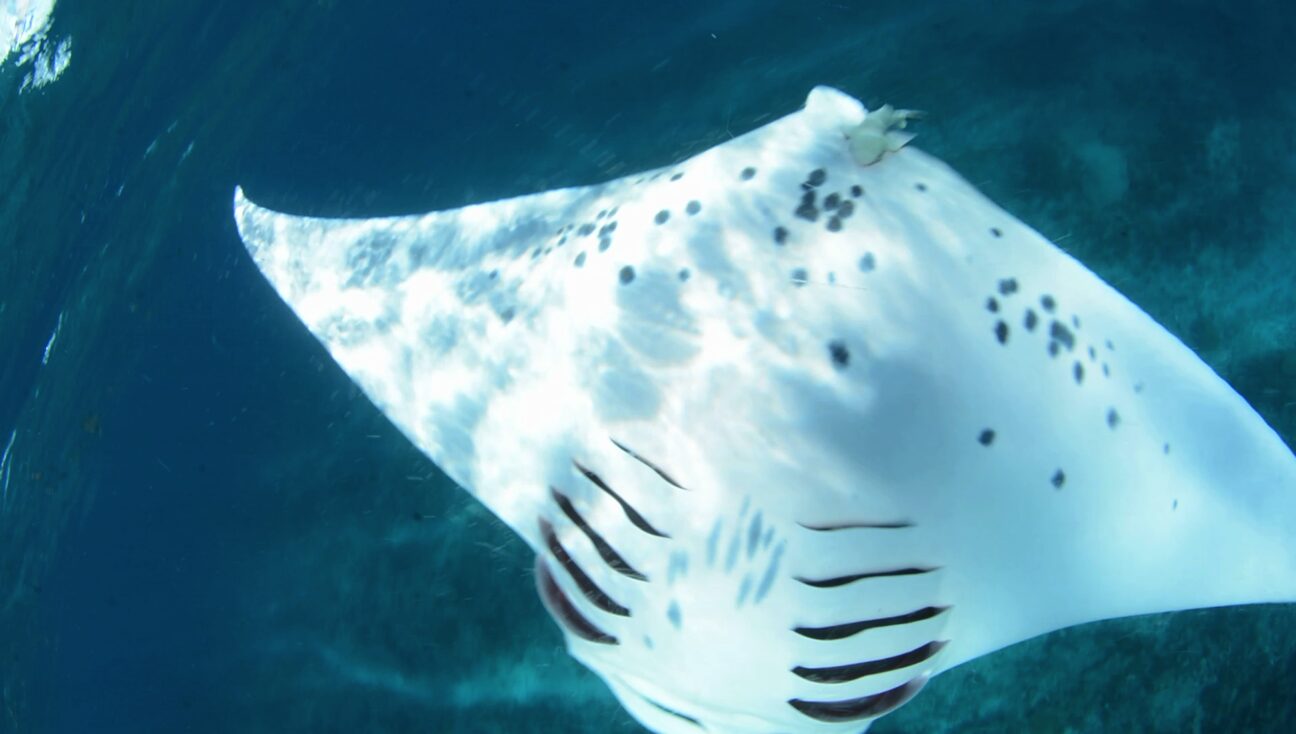
An adult white suckerfish resting on the pelvic fins of a juvenile reef manta ray in the shallow waters of D’Arros Island, Seychelles. Photo by Elllie Moulinie | © Save Our Seas Foundation
It reads as an undeniably odd finding, but there’s importance in this record because it helps us understand the diversity of fish life around D’Arros Island. How fish behave and interact can guide research and management for an important reef manta ray aggregation site – the largest known in the Seychelles Archipelago.
Reef manta ray monitoring at a key aggregation site
The team at the SOSF-DRC monitor a large population of reef manta rays Mobula alfredi that calls the near-shore waters of D’Arros Island home. Each ray has unique markings on its belly that the team members use to identify different individuals. They free-dive around the reef mantas to take photographs of the spot patterns on the underside of the rays’ bodies and these images become part of a long-term database that allows the team to identify and track individuals.
This long-term monitoring enables the researchers to decipher how many mantas are using the site, where they spend their time and for how long. Working with the Manta Trust, they incorporate their data into the bigger picture that builds understanding of the population and ecology of reef manta rays in Seychelles.
On this particular morning, the reef manta ray in question was feeding only 500 metres (0.3 miles) from the shore in water about 15 metres (50 feet) deep. Ellie was taking photos of him when she noticed a single remora hitching a ride near his right pelvic fin. The relaxed reef manta ray swam closer to Ellie, but his passenger was less than thrilled about this move and skedaddled between the pelvic fins and into the cloaca. Reef manta rays, like many animals, have a single opening that allows them to breed and to rid their body of waste. And it’s here that the remora stayed, hiding from the researchers in the water (as the scientists surmise), while the reef manta ray carried on seemingly unconcerned and unhindered.
Remoras are important hitchhikers in the coral reef ecosystem
Specially adapted to attach to different ocean hosts, remoras have a dorsal (top) fin that is modified to act like a suction cup that creates a vacuum, enabling them to hitch a ride on animals like sharks, turtles, whales, manatees and dolphins.
The arrangement provides the remora fish with transport, protection and food (they eat their hosts’ scraps, as well as plankton and their hosts’ parasites) and increases their chances of meeting a mate in the vast open ocean. For the manta ray, it means on-the-go exfoliation, as the remora slough dead cells and parasites from its skin.
What seems bizarre behaviour to us might well be rooted in important biology. Remoras have been recorded staked out in their hosts’ gill cavities, spiracles and mouths. Although we know quite a lot about the more commonly found species Remora remora, relatively less is known about other species in the same family. It may be that species that enter the cloaca are coprophagous, feeding on faecal material or parasites there. What is it that the white suckerfish might be eating – and therefore, what is its role in the coral reef ecosystem?
Is natural history still necessary on a planet that’s in crisis?
Our oceans face a litany of threats, and science is often needed to inform the solutions. But under the pressure of so many crises, is there space for this kind of natural history observation?
‘Natural history will always remain a crucial part of science as it provides baseline information that enables us to understand organisms and their interactions within their natural environment,’ says Ellie, who is the lead author of the resultant publication from the SOSF-DRC, ‘Into the abyss: novel behavioural observation in the white suckerfish’, published in the journal Marine Biodiversity.
‘I believe that the two should be integrated cooperatively, because foundational knowledge is required for effective solution-driven science,’ she adds.
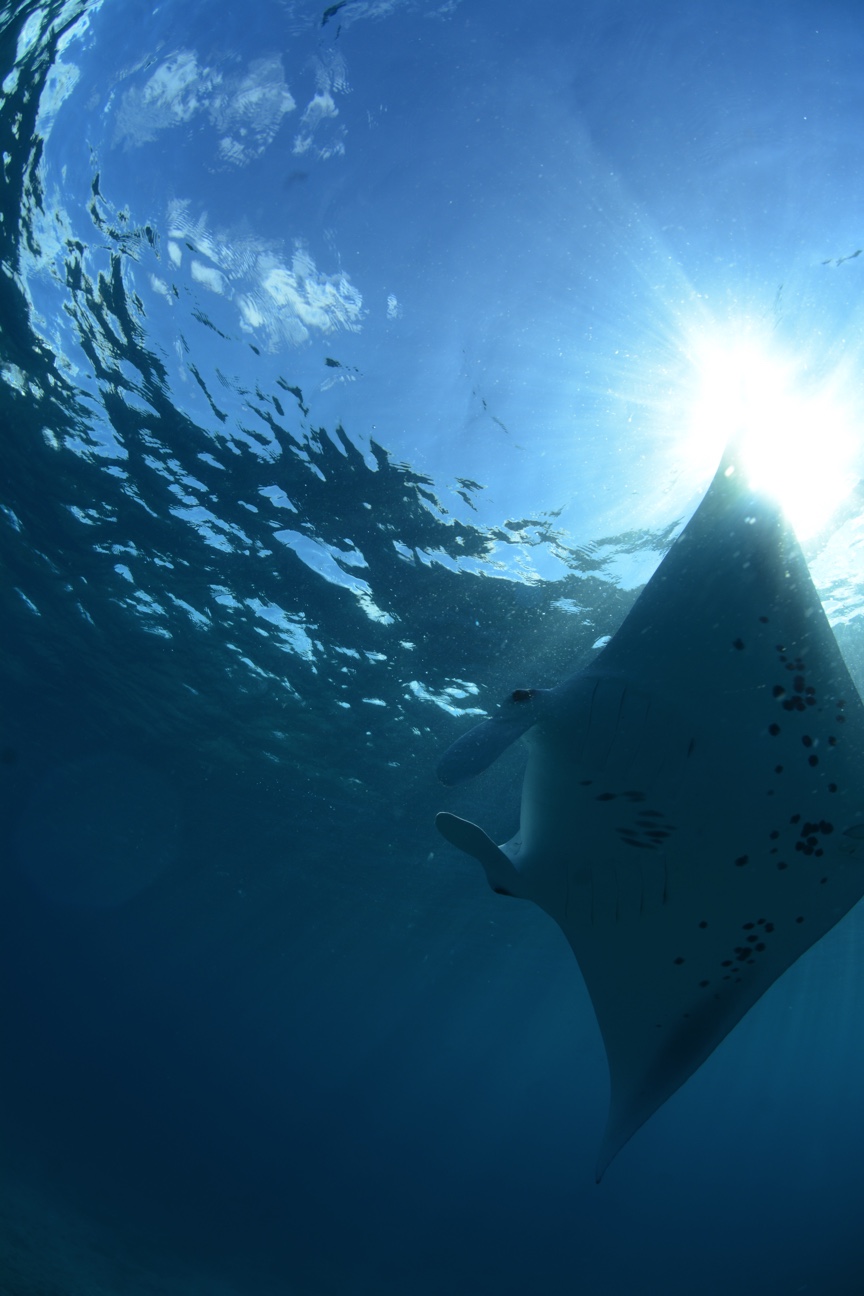
Juvenile reef manta ray feeding in the shallow, plankton-rich waters of D’Arros Island, Seychelles. Photo by Ellie Moulinie © Save Our Seas Foundation
At first glance, it’s a weird observation; but for the researchers at the SOSF-DRC it is also indicative of what we need to know about ecological processes and behaviour in more intact ecosystems before we make management decisions.
As Ellie explains, ‘This novel behavioural observation in the white suckerfish adds to the existing knowledge about the life history of this remora species and helps to further define its symbiotic relationship with its mobulid hosts [manta rays belong to the mobulid family]. D’Arros Island is an important aggregation site for reef manta rays in Seychelles and this increases the chances of recording unique interactions and behaviours that were previously unknown. These encounters and written outputs enable the SOSF-DRC to persevere in its mission and to contribute significantly to the ongoing research into sharks and rays in the Western Indian Ocean.’