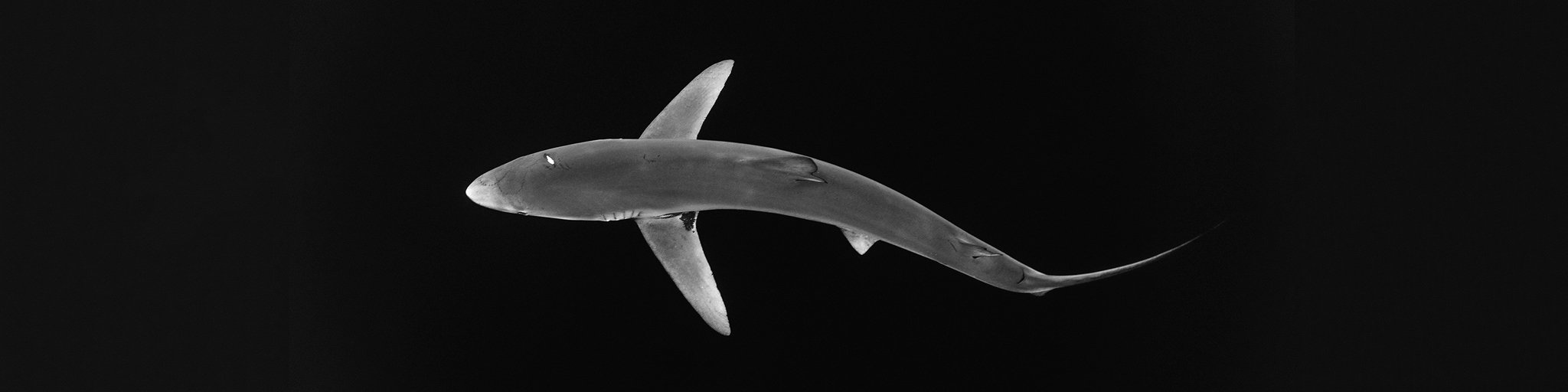
Sawfishes: Ancient, Unique and on the Brink of Extinction
SHOW NOTES
What has a body like a shark, the senses of a superhero and what looks like an enormous hedge trimmer attached to its face? A sawfish, of course! These wonderfully weird animals are among the most extraordinary creatures in the ocean – but also among the most threatened. To celebrate International Sawfish Day on 17 October, host Isla Hodgson is joined by Dr Barbara Wueringer, founder, director and principal scientist of Sharks and Rays Australia (SARA). Barbara has dedicated much of her career to understanding how sawfishes experience the world, how they use their remarkable snouts to hunt and, increasingly, how scientists and communities can work together to protect them. From curious behaviours to fieldwork in crocodile-filled rivers, this episode takes us into the mysterious world of an animal that still has plenty of secrets to reveal.
Before we meet the sawfishes themselves, Barbara takes us back to the experience that first sparked her fascination with the ocean [07.10]. Growing up in landlocked Austria, she spent childhood holidays camping with her family on the Turkish coast. After dinner, they would take their empty food cans down to the water’s edge and, by the following morning, an octopus would have moved inside. These early experiences would prove to be formative for Barbara. “I think as a little kid, seeing an octopus up close…and then, you know, putting it back in the ocean is pretty, pretty exciting,” she remembers. But one year, the family returned to find their campground replaced by a resort. The beach – and presumably the habitat of those octopuses – had changed. It was an early introduction to both the wonder of marine life and its vulnerability.
Barbara’s journey towards shark science continued through snorkelling trips to Jordan and learning to scuba dive in Australia at just 14 years old [09.15]. Like many people, she had grown up believing sharks were something to be frightened of. But diving revealed them to be curious, intelligent creatures who, for the large part, ignored her existence. Later, a volunteer position at the iconic Bimini Biological Field Station cemented her passion and curiosity for sharks. “I was hooked on it,” she laughs, remembering handling juvenile lemon sharks for the first time (“they were such cranky little cuties!”). She has since worked with a wide variety of sharks and rays, but it was an interest in one particular aspect of their anatomy that eventually led her to sawfishes.
Electroreception – the ability of sharks and rays to detect the tiny electrical fields produced by other living things – formed the basis of Barbara’s early career as a scientist [12.49]. She first encountered the subject while reading scientific papers in the University of Vienna library, coming across seminal works by the likes of Professor Steve Kaijura, and became fascinated – especially as it was such an understudied area. Then, Barbara joined Ian Tibbet’s lab at the University of Queensland as an exchange student and embarked on a project investigating the sensory structures of shovelnose rays. “It’s such an interesting sensory system to work with because we can’t understand it,” she says. “Like you can’t see it, we’ve got no comparison to it. You just gotta try and imagine how they could perceive the world and in that regard. And that still blows my mind.”
And few animals take electroreception to such extraordinary extremes as sawfishes [17.40]. There are five recognised species worldwide, four of which occur in Australian waters. Although their streamlined bodies make them look remarkably shark-like, sawfishes are actually rays. Their defining feature is the long, flattened snout (or ‘rostrum’), which is lined with teeth on each side. For Barbara, even after years of studying them, the question remains: why would an animal evolve something so spectacularly strange? “You look at them, and you look at the saw, and you’re like, why? Why do you have that?!”
They are also surprisingly large animals. Newborn sawfishes are already around 50–80 centimetres long, while adults can reach several metres and may take eight to ten years to become sexually mature. The sheer size of sawfishes is difficult to comprehend until you see one beside a person. Barbara describes an old photograph from the Townsville region showing a group of children standing beneath an enormous captured sawfish [19.14]. The image captures both the awe these animals inspire and how much attitudes towards them have changed. Where such an encounter might once have ended with the animal being killed and displayed, today scientists and conservationists are working desperately to keep sawfishes alive.
Historically, sawfishes occurred throughout tropical and subtropical waters, including places where they have since disappeared [22.39]. They are often associated with shallow coastal habitats, estuaries and rivers, and have been described as largely bottom-dwelling creatures with a reputation for sluggish and even “lazy” lifestyles. But more current research has revealed them as active, agile predators, who might travel long distances as adults. Barbara herself has questions about whether the populations she works with in northern Australia are connected to those across the Torres Strait in Papua New Guinea.
So how does that extraordinary saw actually work [27.03]? Its surface contains numerous sensory pores connected to specialised structures called the Ampullae of Lorenzini, which detect the tiniest of electrical fields. It’s like having an antenna attached to your face. This enormously sensitive appendage is particularly helpful for an animal that spends a lot of its life in turbid, murky environments. “If you think about sitting on the bottom of a river with a visibility that is about 10 centimetres – so, nothing – but you have this stick in front of you that can tell you something big’s just swum past, that’s probably going to be very beneficial for you,” Barbara explains. “And then if you get more detail out of that electric field where you can say, ‘whoops, this might be a prey item’ or ‘hold on a second, this might be a predator’, then you can base your behaviours around that.”
Once prey has been detected, the saw then takes on a different purpose [29.23]. Barbara’s postgraduate research involved presenting sawfishes and shovelnose rays with artificial electrical fields designed to mimic prey, placing them either on the bottom (to mimic something buried in the sand) or suspended in the water column. But when the electrical signal was positioned in the water column, their behaviours were different. The shovelnose rays would swim towards it, but couldn’t position themselves to capture anything – with their mouths on the underside of their bodies, they’d have to flip themselves upside down to take a bite. The sawfishes, on the other hand, had a secret weapon: “The sawfish just swam up to it, pulled their eyes in, and gave it a big whack, multiple whacks with the saw,” Barbara recalls. So, this strange-looking snout serves as a prey-detection system and hunting tool all-in-one.
Unfortunately, the feature that makes sawfishes so extraordinary is also a major reason for their decline [34.11]. Their long, tooth-lined rostra become easily tangled in fishing gear, while the saws themselves have historically been collected as trophies. Add to that that sawfishes are very slow to mature and reproduce, meaning that they struggle to recover from overexploitation. All five species are classified as Endangered or Critically Endangered by the IUCN Red List.
Much of Barbara’s conservation work takes place in the remote landscapes of Cape York Peninsula, northern Queensland [35.21]. The region is about two-thirds the size of Germany, but where Germany has 80 million people, Cape York has 45 000. Equally, it is many hours away from medical assistance. “It’s really remote. And I mean, I think in Australia the definition of remote is anywhere where it takes more than half an hour for an ambulance to arrive…for us in some of our sample sites it would take hours until the Royal Flying Doctor Service arrives and that then has to take you to a hospital,” says Barbara. “So yeah, we’re talking remote.”
It is also an area of extraordinary cultural diversity, with many different cultures and Indigenous groups. This also means that what sawfishes mean in different places can vary hugely – in some places, sawfishes may be totem species or feature in creation stories; elsewhere, they have traditionally been an important food source. Losing these animals, therefore, can mean losing much more than a species. It can also mean losing part of a community’s cultural heritage.
This is why working with people has become central to Barbara’s approach [39.48]. When she founded Sharks and Rays Australia in 2015, she knew that she wanted community collaboration to be part of its work. She remembers one of her first field trips with Indigenous Land and Sea Rangers on the Mitchell River. Although Barbara had spent years navigating northern Australian waterways, she still struggled to recognise where a river became shallow and where the boat needed to cross. A ranger explained that she should look at the vegetation. Suddenly, something clicked. The experience moved her so deeply that she remembers “crying behind my sunnies of happiness”. It was a perfect example of what collaboration could achieve: Barbara brought scientific knowledge and animal-handling experience, while the rangers brought generations of understanding of the river and its landscape.
Since then, SARA has developed partnerships with different communities, adapting each project to local priorities and circumstances [42.04]. Some collaborations involve formal data agreements; others are voluntary or verbal agreements. Barbara believes this is one of the most important lessons conservationists can learn. Scientific training often prepares people to understand animals, but real conservation involves navigating the much more complicated world of human relationships. That requires honesty, integrity, respect for local knowledge and a willingness to acknowledge mistakes rather than hide in an “ivory tower”.
One important part of this collaborative research involves satellite-tagging live sawfishes to understand their movements [45.26]. Even the tagging methods have to be adapted to the animals and the environment. Sawfishes can lower their dorsal fins, which makes conventional fin-mounted satellite tags less effective when the antenna slips beneath the water. Researchers instead use alternative attachments developed through previous studies. Then there is the challenge of safely handling a very large animal with a dangerous rostrum in waters that are also home to other large, toothed predators: saltwater crocodiles. Unlike researchers in some other parts of the world, Barbara’s team cannot simply jump into the water beside a captured sawfish. Instead, they work with fishers and local collaborators to secure animals alongside boats or within carefully protected shallow areas, keeping them in the water wherever possible.
The tracking results have important conservation implications [49.39]. Although some tags detached earlier than expected, others remained attached for several months, with one providing data for close to a year. During those periods, many of the tracked sawfishes stayed within relatively small areas, travelling up and down the same river systems or moving short distances along the coast. This means that if sawfishes in one river are depleted, they may not quickly be replaced by animals arriving from somewhere else. As Barbara says, “every river matters.”
Sharing those findings with communities is an integral part of SARA’s work [51.42]. SARA discusses research results with Land and Sea Rangers and at community events, helping people understand why protecting sawfishes in their own waterways matters. Barbara describes how elders in some communities have independently decided to stop taking sawfishes as a traditional food source until populations recover. These decisions were not demanded by scientists or government officials; they emerged from within the communities themselves. Barbara therefore stresses the importance of recognising that people have legitimate needs and different legal rights, including Indigenous traditional hunting rights. Effective conservation is not about blaming people for the pressures wildlife faces. It is about sharing knowledge, understanding circumstances and finding workable alternatives. As she explains, “there is not many people out there who want to do the wrong thing.”
International Sawfish Day offers an opportunity to raise awareness of these incredible animals, and the threats they face, to the general public [55.43]. But sawfishes aren’t exactly mainstream – so how can we encourage people to care about animals they might never have heard of, let alone seen? For Barbara, it lies in their unique other-worldliness: “it is weird and wonderful, and it gives you awe”. They are an animal that is almost impossible to comprehend, which invites curiosity about their evolution, biology and the many different ways animals experience life.
“Every animal is different and lives because of its sensory systems; it lives in such a different world from what we experience,” she reflects. “It’s that concept of how many realities exist parallel, and they’re all valid, and they’re all true.”
You can find out more about Dr Wueringer and the work of SARA here, or by following @SharksAndRaysAU.
Found a saw? You can report it to www.cytags.com (for sighting submissions in Australia) or https://www.sawfishconservationsociety.org/ (for international sightings).
ABOUT OUR GUESTS
Dr Barbara Wueringer
Director and Principal Scientist, Sharks and Rays Australia
Barbara is the founder, director and lead scientist of Sharks And Rays Australia (SARA). Originally from Austria, she first fell in love with sharks when she volunteered at the Bimini Biological Field Station, Bahamas. For her Master’s degree, she worked on the sensory biology of two species of shovelnose ray. She continued to work with shark-like rays and was awarded a PhD from the University of Queensland for a project on the sensory ecology and feeding behaviour of freshwater elasmobranchs of northern Queensland, Australia, including sawfish, speartooth sharks and freshwater whiprays.
Barbara has worked with people from all walks of life, including industry, fisheries, and politicians. Her work in the remote riverine and coastal ecosystems of Far North Queensland and the Cape York Peninsula led her to found Sharks And Rays Australia, an organisation that combines research with outreach to achieve conservation outcomes for sawfishes. Under Barbara’s lead, SARA collaborates widely with Aboriginal Traditional Land Owners and their ranger groups. These collaborations have enabled the establishment of long-term research and monitoring programs for sawfishes and other sharks and rays, many of which are culturally significant to many Aboriginal groups. She holds an Honorary Position at Macquarie University.