Creating impact through imagery
Show notes
We are kicking off season 4 of the World of Sharks podcast (formerly the Whole Tooth podcast!) with a bang! This episode, we are talking to legendary conservation photographer, National Geographic explorer and our very own Director of Storytelling, Thomas Peschak. Thomas has photographed marine life all over the world, including a huge diversity of sharks and rays, and has dedicated his life to creating images that have real world impact for conservation. We asked Thomas about going on assignment for Nat Geo, his process – from finding the perfect story to crafting an affecting photograph – and what makes an image stand out from the crowd. And, of course, we spent quite a bit of time discussing our favourite group of animals, and what it’s like to work with them in the field.
Thomas has been lucky enough have lots of incredible wildlife experiences, and we start by asking him to describe a previous assignment that he would revisit if given the chance [7.10]. For Tom, it would have to be photographing marine iguanas in the Galapagos, an animal that would look “weird and outrageous” on land, let alone underwater. He describes them as “miniature godzillas”, and the experience of photographing them as “otherworldly and surreal”. Although that being said, he has had too many memorable encounters to count, many of which are recalled in his latest book Wild Seas. In the book, Thomas recounts his journey from marine biologist to conservation photographer and storyteller, and we talk about this decision in the episode [10.16]. Having wanted to be a marine biologist since the tender age of ten, Thomas found himself studying for a PhD on abalone – a “dinner plate sized shellfish” found off the coasts of South Africa that, in a pristine environment, can dominate the ecosystem. His research largely focussed on the ecology of the species, but also on the impacts of the intense poaching that was happening regularly in his study sites. Sometimes, he would set up experiments, leave for the night and return to find all of his subjects had gone – only to find their shells littering the seafloor around the corner. Although his data told a conclusive story – that illegal poaching was wiping out abalone from the area – Tom found that no-one was taking an interest. He became increasingly frustrated.
Enter photography [14.10]. Tom had been taking photographs recreationally from the age of 14, and carried his camera everywhere, just for the purpose of communicating with family and friends about what he was doing and seeing underwater. He wondered if he could use this as a tool to show local people what was happening to the abalone. He started by publishing his photographs in local newspapers, with accompanying captions describing his research findings, and then slowly the story began to get picked up by larger and larger outlets. Within the year, a real buzz had been created about the plight of the abalone, and Tom’s images spurred anti-poaching initiatives and the establishment of a marine reserve.
At this point, conservation photography was not an established field [17.16]. But Tom, along with others around the world, were starting to realise the potential power of imagery for conservation, especially when paired with the right science and grass-roots organisations. Although he stayed in science for some time after, Tom made the transition into full-time conservation photographer and is now world-renowned for his work. Fast forward twenty years and science communication and storytelling is much more widely integrated. In fact, scientists are now expected to have some skills in outreach to obtain grants. Tom muses as to whether he would have stayed in science had this been the case when he was younger, as his passion for marine science and desire to have real-world impact very much drives his work [19.30].
So, how can you generate positive conservation impact with imagery [21.50]? Tom discusses the role of his photography in the establishment of the Hanifaru marine reserve in the Maldives, which was created to protect the largest feeding aggregation of reef manta rays in the world. This was his first shoot for National Geographic, and until that point, no-one had photographed this incredible natural phenomenon. Tom himself was captivated. Surrounded by gentle giants, feeding on aggregations of plankton, he took photograph after photograph, trying to capture the magic of the moment so that a reader anywhere in the world could look at the photograph and feel the same emotions. This, he says, is key. People are so besieged with imagery in their day-to-day lives, with social media and the internet. So, you have to try and grab their attention with something they have never seen before, or with a character that they can fall in love with. Once you have this, then you can get them to read the caption. And from the caption, they might take action to help protect the animal they’ve just learnt to love. But, he is quick to say there is no exact formula to create such an image; rather, it’s a case of trial and error, and sometimes the simple matter of right place, right time. This is what happened with Hanifaru. Tom was the first photographer to capture the aggregation of such a charismatic species in the area, which then led to public outcry at the fact that mantas were being targeted for their gill plates. He was able to work with the right organisations to inspire change, and get Hanifaru protected. As Tom says, conservation is a team effort, in which photography and storytelling plays a part [33.00].
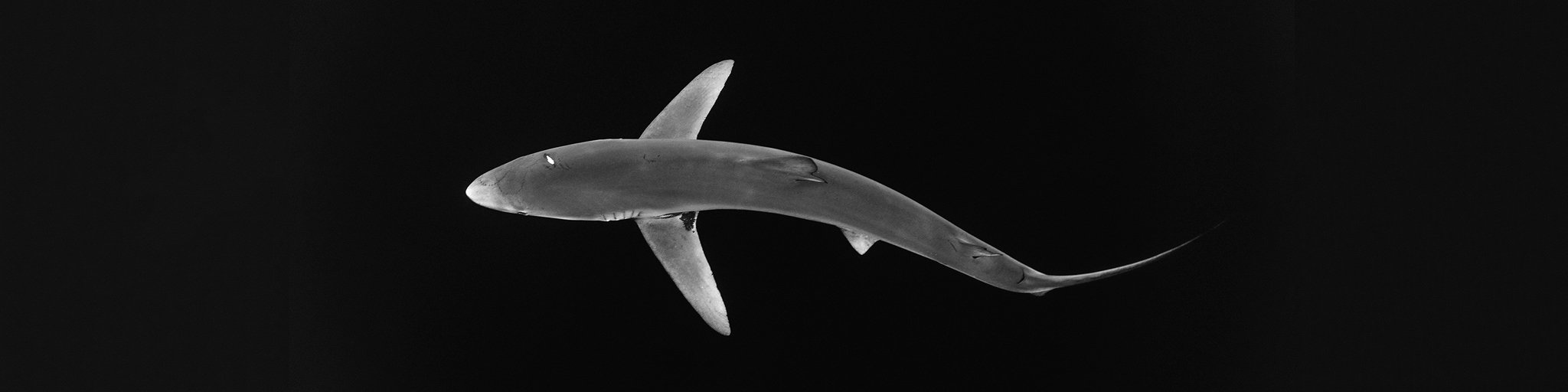
Sharks and rays have been a lifelong passion of Tom’s, for many reasons [32.00]. Firstly, he loves their curious nature, and enjoys the process of getting a shark to be comfortable enough in his presence to act naturally. Secondly, he believes they are the “gateway” to marine conservation – sharks elucidate an emotional response that many other species don’t [35.00]. Sharks can effectively ‘hook’ people in (pun not intended!), and encourage them to learn more about the underwater world they call home.
Getting people interested is one thing, but communicating the numerous threats that face the oceans and encouraging action without scaring people away is a difficult task. Tom calls this “the carrot and the stick” [38.50]. He believes it’s important to create balance, and shedding light on positive stories is just as important as talking about the issues. For example, he works to showcase scientists and conservationists working to protect the oceans and the life that lives within it. This is where his work for the Save Our Seas Foundation shines through – storytelling has always been a key pillar of the foundation, alongside research and education. These central pillars are reflected in the Ocean Storytelling Grants. Their purpose is to find and support up-and-coming conservation photographers and storytellers, who then work with SOSF-funded scientists to tell impactful and hopeful stories about the ocean. Tom is proud to support the next generation of conservation storytellers, who will continue to shed light on complex issues and help garner support for sharks and our seas.
About our guest
Thomas P. Peschak
Thomas P. Peschak is an assignment photographer for National Geographic Magazine. He is a Founding and Associate Director of the Manta Trust, and a senior fellow of the International League of Conservation Photographers. He has been named as one of the 40 most influential nature photographers in the world.
Originally trained as a marine biologist specializing in human-wildlife conflict, he retired from science fieldwork in 2004. He became a wildlife photojournalist after realizing that he could have a greater conservation impact through photographs than statistics. His work focuses on some of the most critical marine conservation issues of our time.
Thomas has written and photographed eight books, including Sharks and People and his latest book Wild Seas, which was released in 2021.
He is a multiple winner in the BBC Wildlife Photographer of the Year Awards and received World Press Photo Awards for his work in 2011 and 2013. In 2015, he gave a TED talk, Dive into an ocean photographer’s world, aboard Mission Blue II, hosted by TED Prize winner Sylvia Earle.
Thomas is a speaker for the National Geographic Live! Series and presented his talk, Wild Seas, Secret Shores in Australia and Singapore.
You can find out more here: https://www.thomaspeschak.com/ or follow Tom on social media via @thomaspeschak.